Middle East Politics PhD Candidate, ATU Tehran
Middle East Politics PostGrad Student, Uni of Tehran
Poli Sci BA Grad, ATU Teh
Iran analyst. Strait of Hormuz guy
"Iran is now confident that it can absorb U.S. bombings, which seriously weakens any military threats the U.S. may issue in the future,” I told @ishaantharoor.
"The U.S. now looks broadly deterred from attempting more aggressive action against Iran, cowed by the risk of sweeping Iranian retaliation.” https://t.co/HfZptqm6vS
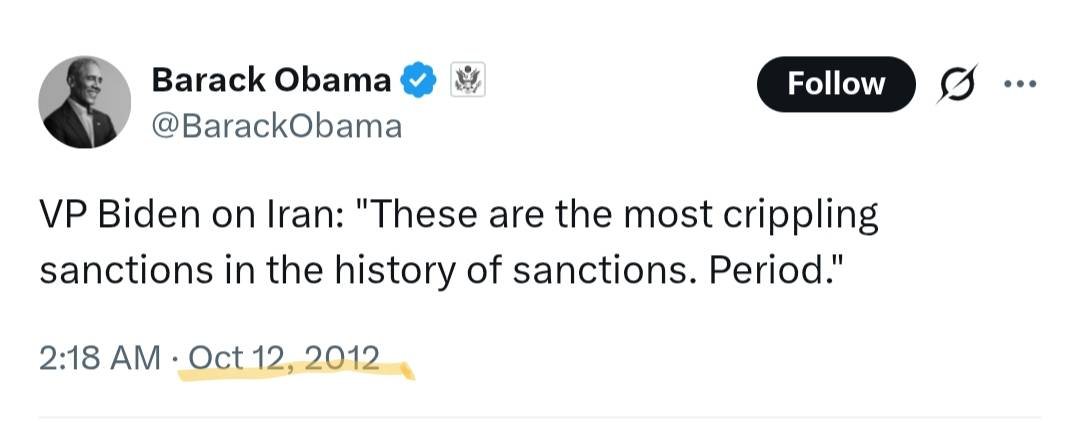
14 years ago: “Most crippling sanctions in history.” Failed.
8 years ago: “Maximum pressure.” Failed.
5 months ago: “Unconditional surrender.” Failed.
Today: “Most crushing economic operation ever.” Bound to fail.
We have seen this movie before. Same bull. Different bullies.
Choose yoyr option.
There’s much commentary, reasonably enough, that max sanctions + blockade is untethered from a clear objective/offer.
That’s publicly true. But is it accurate?
Is the approach aimed at 1/ regime collapse (Bessent)? 2/ economic pain that will force Iran -1-
The recent war made this clear: outsourcing security to an external power does not guarantee protection when real danger arrives.
Calling any single power 'master' of the region overstates unilateral control in an order that has proven far less dependable than assumed!
Trump’s threats of an “economic D-Day” carries a clear signal to Iran that he does not want to go back to war. But as the famous saying goes, "you may not be interested in war, but war may be interested in you." In any conflict the other side gets a vote too. Iran is unlikely to let Trump have it easy. Tehran's play is that if Trump does not want war, then he has to agree to go back to the MoU. Tehran will not settle for economic warfare as a low key out for Trump. https://t.co/Bekamq8XNu
These comments should resonate.
Either Ghalibaf is no longer significant, like Pezeshkian.
Or there is pushback on escalation strategy as economic impact bites.
Time has become a squishy concept, but recall that only a month ago, the US was poised to launch massive new strikes on Iran to reopen the strait. Then, it was poised to make a deal.
Now, it is poised to...wait.
The US has, it seems, run out of good options. So it is falling back on a strategy it has tried many times before.
Iran, meanwhile, can either wait to see if Trump feels the pressure first. Or it can act and attempt to change the status quo in its favor.
Iran has been fairly clear in public regarding its demands: a return to the MOU, with an acknowledgement of Iran's formal control of the strait with Oman. Evidently the administration cannot accept that, and is opting for a return to prewar tactics for want of a better option.
It doesn't seem like a status quo that can (or will) last indefinitely. Somethings gotta give.
Very interesting points. Also raises questions about how Iran may approach a nuclear umbrella for its allies once its nuclear program is weaponized. If the US approaches Hezbollah as Iranian, could Iran end up doing the same?
The Iran narrative in DC has long been that "the sanctions worked".
Almost no one acknowledges that the JPOA and JCPOA happened because Obama did a total U-turn and dropped "zero enrichment".
Trump's Iran policy is partly shaped by this intellectual dishonesty.
The announcement is not a measure against Iran. It is a claim of jurisdiction over the world, and every sovereign state on earth is its real addressee. Iran is merely the occasion. The demand that no country allow its own banks, businesses, airports or ship registries to engage in lawful trade with another country is aimed at everyone else. Sovereignty itself is the target.
A state may govern its own nationals and its own territory. It cannot order a foreign company, operating abroad under the law of its own government, to sever lawful commerce with a third country. Still less can it dictate what may pass through another nation's airports.
Extraterritorial secondary sanctions of this kind have no basis in international law. They violate the sovereign equality of states under Article 2(1) of the UN Charter and the customary prohibition on intervention affirmed by the International Court of Justice in Nicaragua. Economic coercion designed to bend another state's sovereign choices is an unlawful act. This is not a marginal legal dispute. The European Union, Canada and Mexico have enacted blocking statutes precisely to nullify such commands. The illegality has been legislated against.
What is being demanded also tears down the free-trade order Washington itself built. To order third states to halt lawful trade, on top of a naval blockade of a nation's ports, an act expressly identified as aggression in the General Assembly's Definition of Aggression, amounts to collective punishment by financial means and may amount to crimes against humanity.
This is the tariff war continued by other means, the same instrument already turned against friends and foes alike, from Canada and the European Union to Greenland and Panama, and now even against the fantasy that the Strait of Hormuz is "a territory of the United States." One conviction runs through all of it: that every other nation's sovereignty is provisional, held on sufferance and revocable the moment it refuses an instruction. Today the lever is Iran. The principle has no natural stopping point.
Appeasement, therefore, is the one fatal response. Consider what compliance has already bought. A sovereign state was attacked in the middle of negotiations. A signed ceasefire was broken within weeks. Its cities were struck in actions that a growing number of lawyers regard as war crimes, and those attacks were then turned into leverage at the negotiating table. Its civilisation was threatened with destruction, including its cultural sites. Now the coercion is being extended to everyone else.
In 1938, the powers of Europe were promised "peace for our time" in exchange for one more concession. The concession only fed the appetite it was meant to appease. Every government that enforces this decree is not buying an exemption. It is affirming that its own banks and airports are Washington's to license, while moving itself closer to the front of the queue.
What's next in the US-Iran crisis now that the MoU has expired? Check out my latest @The_NewArab piece, featuring insights from @NeilQuilliam1, @naderalihashemi, @AmbGordonGray, Shireen Hunter & Wolfgang Pusztai.
Thanks to @CharlieCHoyle for publishing!
https://t.co/3CK88AiFem
اگر واقعا آمریکا تونسته کنترل ایران بر تنگه هرمز رو تضعیف کنه و با ادامه محاصره و حالا تشدید تحریمهای ثانویه، اقتصاد ایران رو هم زبر فشار موجودیتی بذاره، طبعا ایران دست روی دست نخواهد گذاشت. همه میدونیم که تسلیمی در کار نیست. پس میمونه واکنشهای قهری مبتنی بر اعمال کنترل بر تنگه (حمله به کشتی ها و زدن مسیرهای جایگزین) و شکستن محاصره. طبعا آمریکا هم بیکار نمیشینه. در نتیجه محتمل تربن سناریو از دل این مصاف اقتصادی، یک دور دیگر درگیری نظامی برای تغییر معادله خواهد بود.