@DGIPofficial Service and response is as pathetic as it could be. I emailed regarding an issue and then sent follow up emails. No one responded. باتیں کروڑوں کی دکان پکوڑوں کی
@MOIofficialGoP@MohsinnaqviC42
All the talks and no groundwork. The online passport system is a mess. I emailed regarding the passport renewal issue, but got no response. Don't know what to do next.
@SidraAslamOff All the talks and no groundwork. The online passport system is a mess. I emailed regarding the passport renewal issue, but got no response. Don't know what to do next.
@DGIPofficial All the talks and no groundwork. The online passport system is a mess. I emailed regarding the passport renewal issue, but got no response. Don't know what to do next.
@SidraAslamOff All the talks and no groundwork. The online passport system is a mess. I emailed regarding the passport renewal issue, but got no response. Don't know what to do next.
@MOIofficialGoP 3/3
I have also sent an email regarding the issue, but have received no response.
I would be grateful if you could respond. I can provide my information to verify the status of my record and advise me on how to proceed with the renewal process.
@MOIofficialGoP 2/3
When I start a new application and enter my 13-digit CNIC number, I receive an error message stating that a passport application is already in progress and that I cannot submit a new application. However, I have never previously applied for a passport renewal.
@DGIPofficial Directorate General of Immigration & Passports,
I am currently residing in the United States as a student and would like to renew my passport, which is scheduled to expire on November 21, 2026.
1/2
@DGIPofficial 2/2
However, I am encountering an issue with the online renewal process. When I start a new application and enter my 13-digit CNIC number, I receive an error message stating that a passport application is already in progress and that I cannot submit a new application.
Mitochondria are known as the "powerhouses" of a cell. But that is a ridiculously incomplete description.
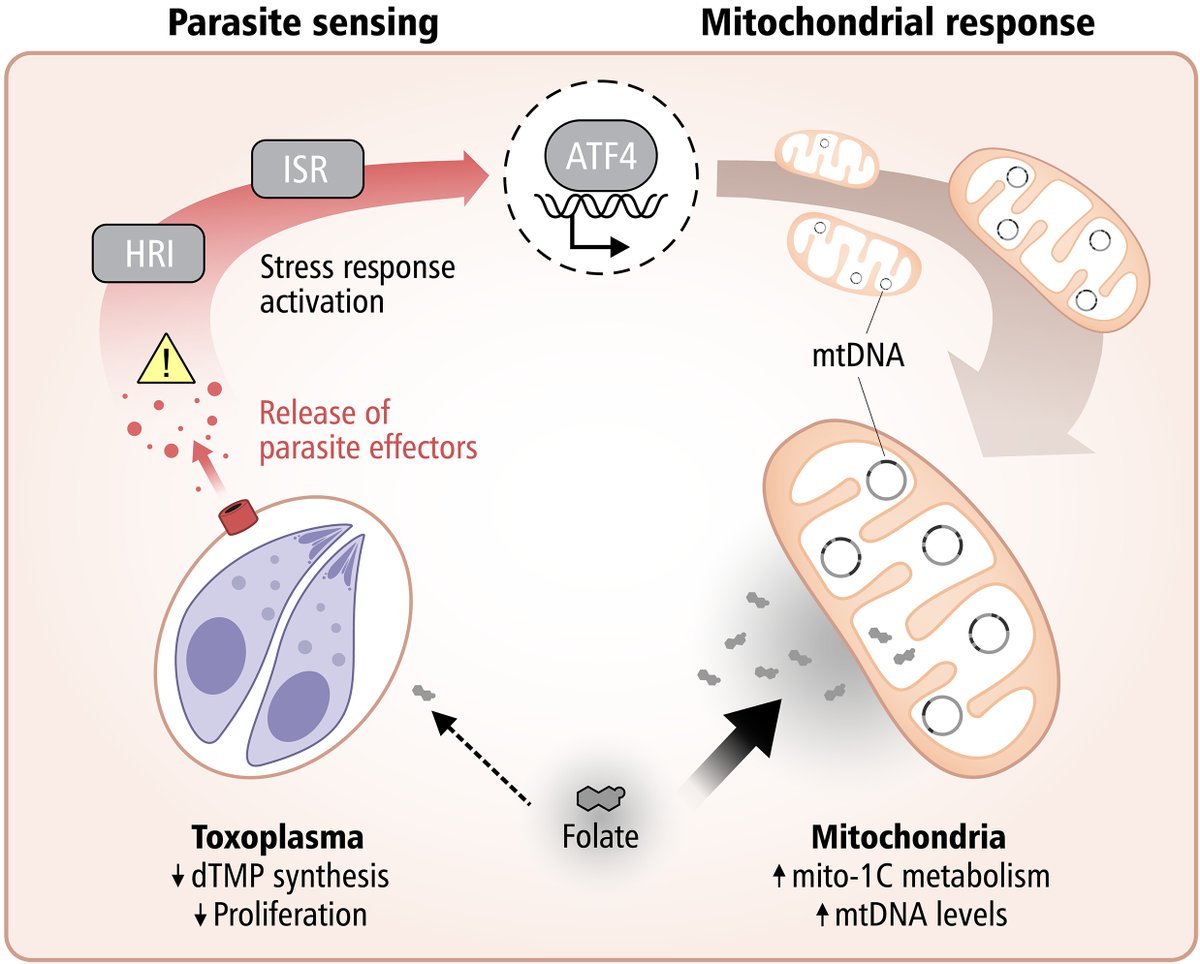
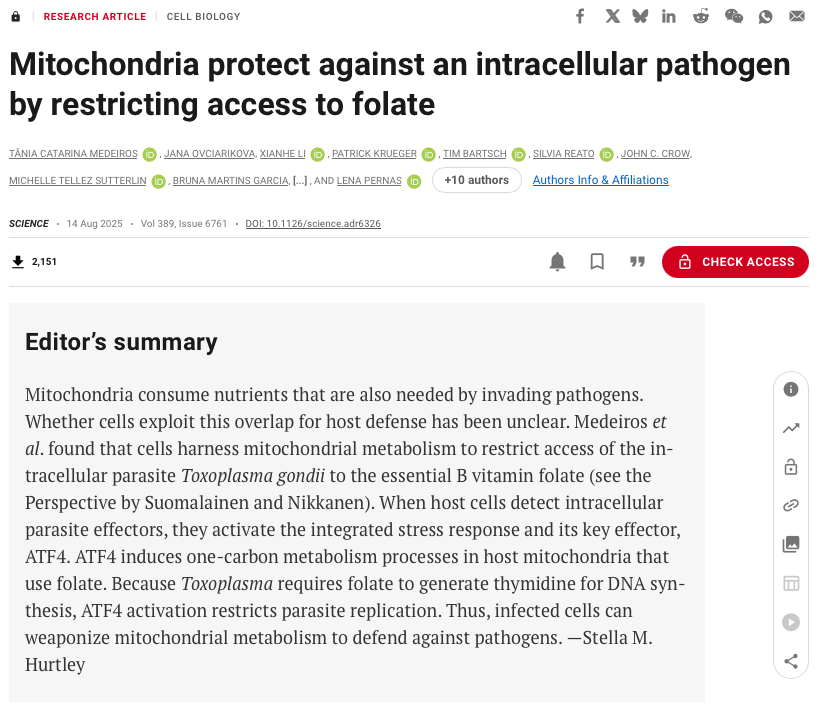
A new study shows that human cells "weaponize" mitochondria during infection. Mitochondria ramp up their metabolism to deprive pathogens of folate, a molecule required for DNA replication.
In other words, this study gives a mechanism by which mitochondria defend host cells from infections. It comes at time when mitochondria are (increasingly) being seen as not only "energy creators," but also living organisms in their own right. (Our most popular essay at @AsimovPress is called "Mitochondria are Alive" and it argues this viewpoint.)
Before I explain this new paper, some context:
1. Each human cell has ~100-1,000 mitochondria.
2. Each mitochondrion carries 2-10 copies of its own genome, distinct from the cell.
3. The cell makes folate, which moves into the mitochondria (through a transporter protein).
4. Folate is needed to make the nucleotides that are used to build DNA! It is super important.
For this paper, researchers infected 3 types of human cells (a cancer cell line, HeLA cells, and fibroblasts) with Toxoplasma gondii, a single-celled parasite. In each case, this caused the amount of mitochondrial DNA to shoot way up. Cells did NOT have more mitochondria, but those mitochondria had much MORE DNA.
This happened, they found, because after infection the cells activate a transcription factor, called ATF4, that then coaxes mitochondria to ramp up their one-carbon metabolism (like building thymidine for DNA). ATF4 levels go up by ~16x after infection and, if you knock this protein out, the mitochondrial DNA increase goes away, and parasites replicate in the cell faster.
(ATF4 activation is not a "general" response to infection. ATF4 only goes up if the human cell senses very specific "effector proteins" secreted by the pathogen!)
But why does the host cell want to ramp up mitochondrial DNA? To hoard folate and keep it away from the pathogen!
The researchers traced the flow of atoms from labeled serine, which feeds into folate metabolism. In normal cells, infection shifted folate use toward the mitochondria. In cells missing ATF4, it shifted folate toward the parasite. Parasites growing in cells without ATF4 had more DNA building blocks (dTMP and dTTP), and they multiplied faster. In short, human cells fight off infections by ordering mitochondria to compete for folate.
Aside from this paper, there is tons of evidence showing that mitochondria are more important than most textbooks give them credit for. Mitochondria also:
1. Grow and reproduce in a distinct way from the host cell.
2. Monitor hormones and metabolites in the cell to watch out for infections. (They sense viral intrusions, for example, and signal host cells to kill themselves to halt the virus' spread.)
3. Have their own genomes, of course, and use biomolecules distinct from the cell's nucleus.
TL;DR Mitochondria are alive, man.
I built an interactive visualization of the Central Dogma.
You can speed it up or slow it down. You can set the length of genes, the initiation rates of ribosomes, protein decay rates, and more.
Why does cancer incidence increase with age?
Is it the accumulation of mutations?
Is it a declining immune system?
Are there other factors?
Both mutation accumulation and immune system decline correlate with age and support predictive models of cancer rates.
🧵
My lab is hiring multiple PhD students and postdoctoral fellows. If you are in Canada and interested in neuroscience, regenerative medicine and stem cells, contact me. We are a productive group working on pathogenesis and treatment of multiple sclerosis. https://t.co/g0qEuQDDi8
Consider joining us at Stanford as a postdoctoral fellow!
If you have a published paper or a preprint, will graduate in the next period, and are excited to work in California, email me your CV and a brief statement of your research interests and trajectory by the end of August.
No prior experience in stem cells, organoids, or assembloids needed (we generally recruit outside of the field).
There are no preset projects—just come ready to tackle important questions in human brain development and disease.
The goal of a PhD is not to learn some facts or read a few papers or learn a bunch of techniques. The goal of a PhD is to learn independence, problem solving, how to finish things you start, resilience, & gain the ability to adapt & think creatively. Learning these things is hard
I'm looking for a graduate student (either PhD or master's) to join my lab starting Jan 2026. If you know any students in social behavior and evolution (and termites!), please let them know!