⚡🏃♂️👨💻🛫 building @AgentDotAi, founded @onescreenai. ML @ Columbia SEAS, MBA @ MIT Sloan | X-HubSpot, Wayfair, Fortune 100 Exec, Start-up builder. Doer.
I agree with this fully. There is a totally new role emerging here. It's a net new role, and requires a somewhat unique set of skills.
This is a nascent idea / stream of conciousness, but the reason I know it exists is because this is essentially what I am doing right now for a handful of companies.
Skills that are useful for this role:
- Systems thinking
- Being good at interviewing people to understand what they do and asking good questions.
- Building diagrams / mental models of how work flows within an organization
- Being on the leading edge of agentic coding platforms (e.g. Claude Code)
- Experimentation mindset
- Asking questions until you fully understand the job to be done
- Realizing that sometimes the job to be done is to completely change the job to be done
- Communicating across different functions, but in a way that forces changes versus build alignment
- Courage to try new things
Lots of other stuff I missed, but if you blur your eyes, these traits all kind of distill down to:
- curiosity
- agency
- willingness to learn new thing
- courage to fundamentally change a lot of things that people just assume are the right way to do things, but no longer hold.
You need to be willing to burn a lot of things down, in a way that gets folks on the ship and makes them better.
It's an amazing time to be building things, and if this vaguely sounds like you --- go for it. Nothing is figured out yet, and you are the one that can help figure it all out.
@saviomartin7 Great work, any chance you'll open source this/some of this or provide APIs for deployment and management? What vendor do you use behind the scenes? Thinking about vibecoding something similar this weekend as well.
Andrej Karpathy literally built the neural networks running inside coding assistants.
He taught the world deep learning at Stanford. He ran AI at Tesla.
If he feels “dramatically behind” as a programmer… that tells you everything about where we are.
The confession here is that raw intelligence and deep technical knowledge no longer guarantee mastery. The new stack isn’t about understanding transformers or writing elegant algorithms. It’s about orchestrating a zoo of stochastic systems that nobody fully controls.
Karpathy’s list is revealing: agents, subagents, prompts, contexts, memory, modes, permissions, tools, plugins, skills, hooks, MCP, LSP, slash commands, workflows, IDE integrations. That’s 15+ new primitives that didn’t exist 18 months ago. Each one evolving weekly.
The mental model problem is real. Traditional engineering gives you deterministic systems. You write code, it does exactly what you wrote. Now you’re managing entities that are “fundamentally stochastic, fallible, unintelligible and changing.”
His “alien tool with no manual” framing is exactly right. We’re all reverse-engineering capabilities in real-time. The documentation is always out of date. The best practices from 3 months ago are already wrong.
The magnitude 9 earthquake isn’t coming. It already hit. The aftershocks are the new normal.
This is the most fun moment to be a developer in years.
The AI tools are imperfect, the patterns are still emerging, and there's genuine room for experimentation. Roll up your sleeves and build something. The earthquake is further opening up what's possible.
The best news about this new layer: traditional engineering skills are more valuable than ever, not less. It helps us minimize shipping slop.
Developers who already invested in CI/CD, testing, documentation, and code review are having the most success with AI tools. These "boring" foundations are accelerators. They turn agents from chaos generators into productivity multipliers.
The real opportunity is learning to work at a different altitude. Instead of typing syntax, we're reviewing implementations, catching edge cases, and shipping features in hours that used to take days. That's genuinely exciting.
Yes, there's a learning curve. Understanding how to provide context, iterate on plans, and review AI-generated code quickly takes practice. But this is learnable through doing - build small tools, review everything, develop intuition through repetition.
The multiplier potential is real when you combine AI speed with engineering judgment. We're not replacing coding skills but we're finally able to focus them on the interesting problems while delegating the tedious parts.
I've never felt this much behind as a programmer. The profession is being dramatically refactored as the bits contributed by the programmer are increasingly sparse and between. I have a sense that I could be 10X more powerful if I just properly string together what has become available over the last ~year and a failure to claim the boost feels decidedly like skill issue. There's a new programmable layer of abstraction to master (in addition to the usual layers below) involving agents, subagents, their prompts, contexts, memory, modes, permissions, tools, plugins, skills, hooks, MCP, LSP, slash commands, workflows, IDE integrations, and a need to build an all-encompassing mental model for strengths and pitfalls of fundamentally stochastic, fallible, unintelligible and changing entities suddenly intermingled with what used to be good old fashioned engineering. Clearly some powerful alien tool was handed around except it comes with no manual and everyone has to figure out how to hold it and operate it, while the resulting magnitude 9 earthquake is rocking the profession. Roll up your sleeves to not fall behind.
What first attracted me to Bitcoin and cryptocurrencies was that the Internet lacked a digital money protocol.
HTTP is the universal information protocol. When HTTP/1.1 was introduced in 1999, 𝟰𝟬𝟮 𝗣𝗮𝘆𝗺𝗲𝗻𝘁 𝗥𝗲𝗾𝘂𝗶𝗿𝗲𝗱 was specified as a standard response. Ahead of its time. Money is information.
Fast forward to 2025 and it’s clear that the term “user agent” was also foretelling. AI agents will perform tasks on our behalf and in doing so will have to exchange information and transact.
x402 is pioneered by @coinbase as an open payment protocol. This is an idea whose time has come. Excited to make it available to our developers using @aisdk and shipping MCP servers… in like 3 lines of code.
startup "truth" i disagree with: don't pay high cash comp
we now pay 250k-350k base for designers and 300k-1m base for software engineers
thread on why everyone is wrong (except me and zuck):
The people have spoken:
Linear-style table filters using @shadcn and @tan_stack table. Open source. Coming soon.
You'll be able to use this as an "add-on" to the Data Table component in shadcn/ui, which already leverages TanStack Table as the headless UI.
I'll get to work on this very soon, once the waitlist for https://t.co/DseacpQvim goes live :)
If you have any comments or suggestions, drop them below 👇
The LLM game changed fast in 2024, and 2025 is about to get even wilder. Curious about on-device GPT-4 models, real-time camera feeds, and “reasoning tokens” that could revolutionize performance (and pricing)? Dive into my latest review on the biggest leaps, the persistent challenges, and what we can realistically expect from AI this year!
https://t.co/ykG5Oj71Np
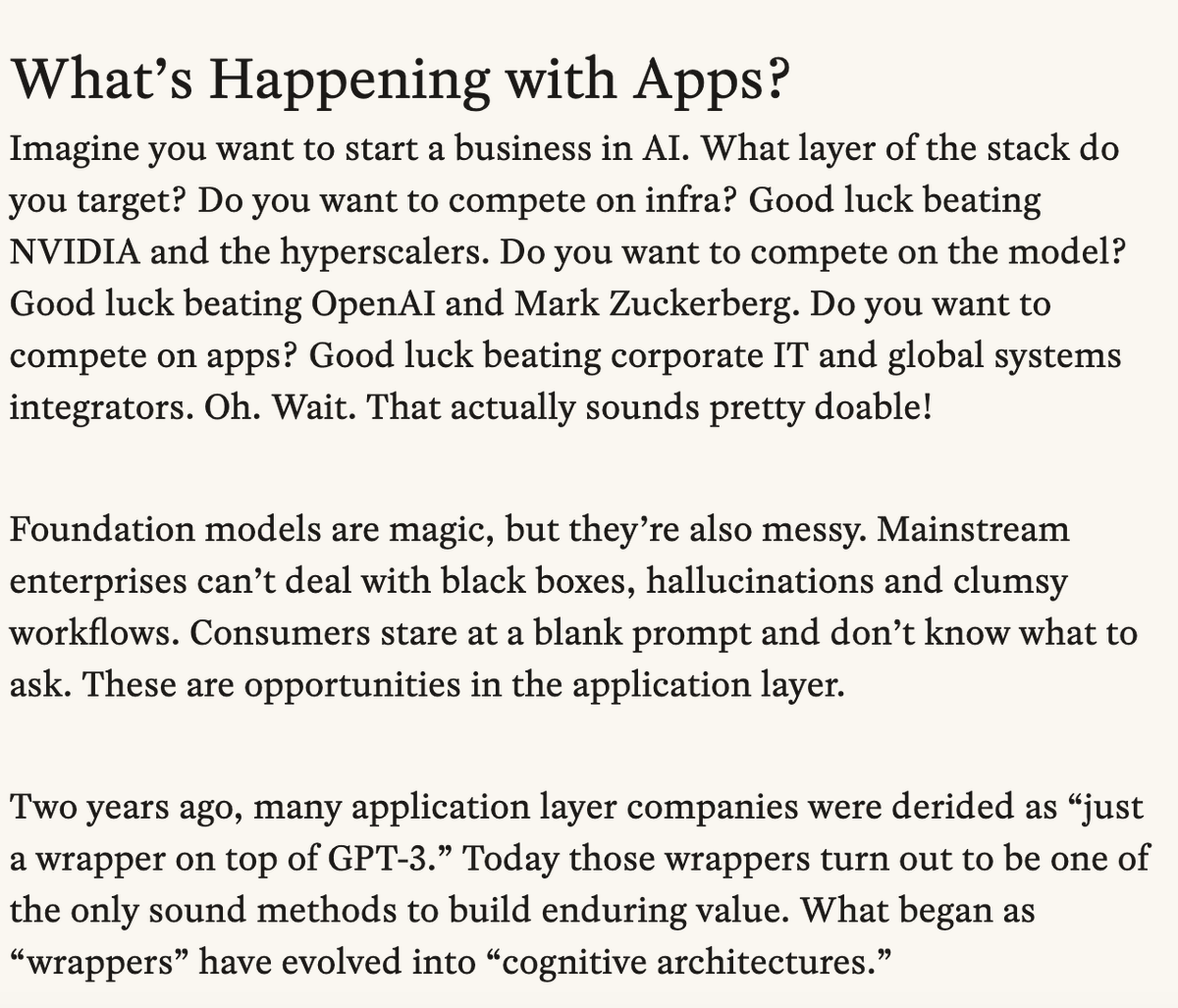
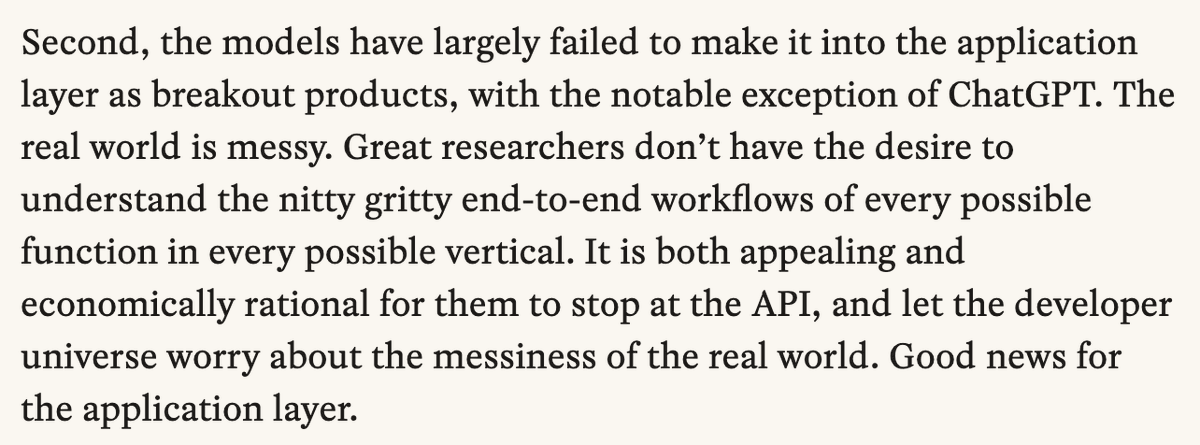
the new ai post from @sequoia is excellent. sharing best screenshots below
here's the tweet:
the opportunity lies at the application layer.
https://t.co/kQ1picTTNU
I wrote down literally everything I've learned about the journey from startup founder ($0) to scaleup CEO ($25billion). This thread is the on the lessons in LEADING. Several more threads coming on different topics.
@ramonsuarez@AgentDotAi Thank you for reporting @ramonsuarez ! We fixed the bug and everything should be working. Please let me know if you see any issues!
Llama3 70B on 4GB GPU, Llama3.1 405B on 8GB GPU with AirLLM lib.
Without quantization, distillation and pruning. 🔥
💡 Key Features:
- Supports Llama, ChatGLM, QWen, Baichuan, Mistral, InternLM
- 4-bit/8-bit compression: 3x inference speedup
- MacOS support on Apple Silicon
- 3x speedup with compression
⚙️ Technique:
- Layer-wise model decomposition
- Block-wise quantization for compression
- Focuses on reducing disk loading bottleneck
-----
layer-wise inference is essentially the "divide and conquer" approach
📌 LLMs contains many “layers.” A 70B model has as many as 80 layers. But during inference, each layer is independent, relying only on the output of the previous layer.
Therefore, after running a layer, its memory can be released, keeping only the layer’s output. Based on this concept, AirLLM has implemented layered inference.
How ❓
During inference in a Transformer-based LLM, layers are executed sequentially. The output of the previous layer is the input to the next. Only one layer executes at a time.
Therefore, it is unnecessary to keep all layers in GPU memory. We can load whichever layer is needed from disk when executing that layer, do all the calculations, and then completely free the memory after.
This way, the GPU memory required per layer is only about the parameter size of one transformer layer, 1/80 of the full model, around 1.6GB.
📌 Then using flash attention to deeply optimizes cuda memory access to achieve multi-fold speedups
📌 shard model-files by layers.
-----
On the con side, latency should increase hugely - accessing data from slower storage (Disk I/O is generally slower, vs having all layers in GPU memory )
📌 You're always going to be bottlenecked by SSD read speeds, paging doesn't help. If the SSD reads at 3GB/s and the model has 70Gb, then you'll wait 23.3 seconds for the generation of just one token. For each token you need a full pass. Only MoE helps here, as you reduce the amount of weights that are needed to be loaded for the computation of one token.
The full talk of my keynote at #inbound24 yesterday.
"The Future of A.I. Agents".
I share some behind-the-scenes looks at the new Agent Builder (waitlist is open and new users are being approved everyday).
https://t.co/DTLrBGZ3eE
BONUS: Dad joke goal achieved. Let me know which ones you liked (I'm building a Dad Joke Agent).
🚨 OpenAI CEO Sam Altman confirms that Level-3 Agents are coming soon
" The shift to level 2 took time, but it accelerates the development of level 3.
This will enable impactful agent-based experiences that will greatly impact technology advancements in technology "
"We believe AI agents will be part of your team on a daily basis.
As with people today on LinkedIn, you want to understand what these agents are capable of, which ones are best – with reviews, endorsements
I want to understand agents as specialists"
@AndreiOprisan on @AgentDotAi, which he's building with @dharmesh, as "The Professional Network for AI Agents"