A pilot study explored collagen supplementation via gelatin on muscle recovery after intense exercise. Participants consumed gelatin or placebo and performed knee extensions to assess muscle soreness and function.
https://t.co/LJREbgUpZM
This work has led to some exciting ongoing preclinical work examining where we are exploring the mechanisms through which gelatin may impact muscle repair- stay tuned!
Happy to share our first study on the effects of vitamin C enriched gelatin supplementation on indices of skeletal muscle recovery following damaging exercise.
https://t.co/uvcXUgv4rQ
Scientists and educators age fastest. Athletes age slowest.
A facial aging clock trained on occupation-linked photos found that the gap between your biological face-age and your real age predicts all-cause mortality. The wider that gap, the higher your risk.
Women aged slower than men in every single occupation measured. No exceptions.
The ranking, from youngest-looking to oldest-looking relative to chronological age:
Athletes > service workers > sales > clerical > managers > professionals > scientists and educators.
The people who study aging for a living look the oldest. I wish I could say I'm surprised.
Your face is a record of cumulative stress, UV, sleep loss, and metabolic wear. Your job title determines how much of each you get.
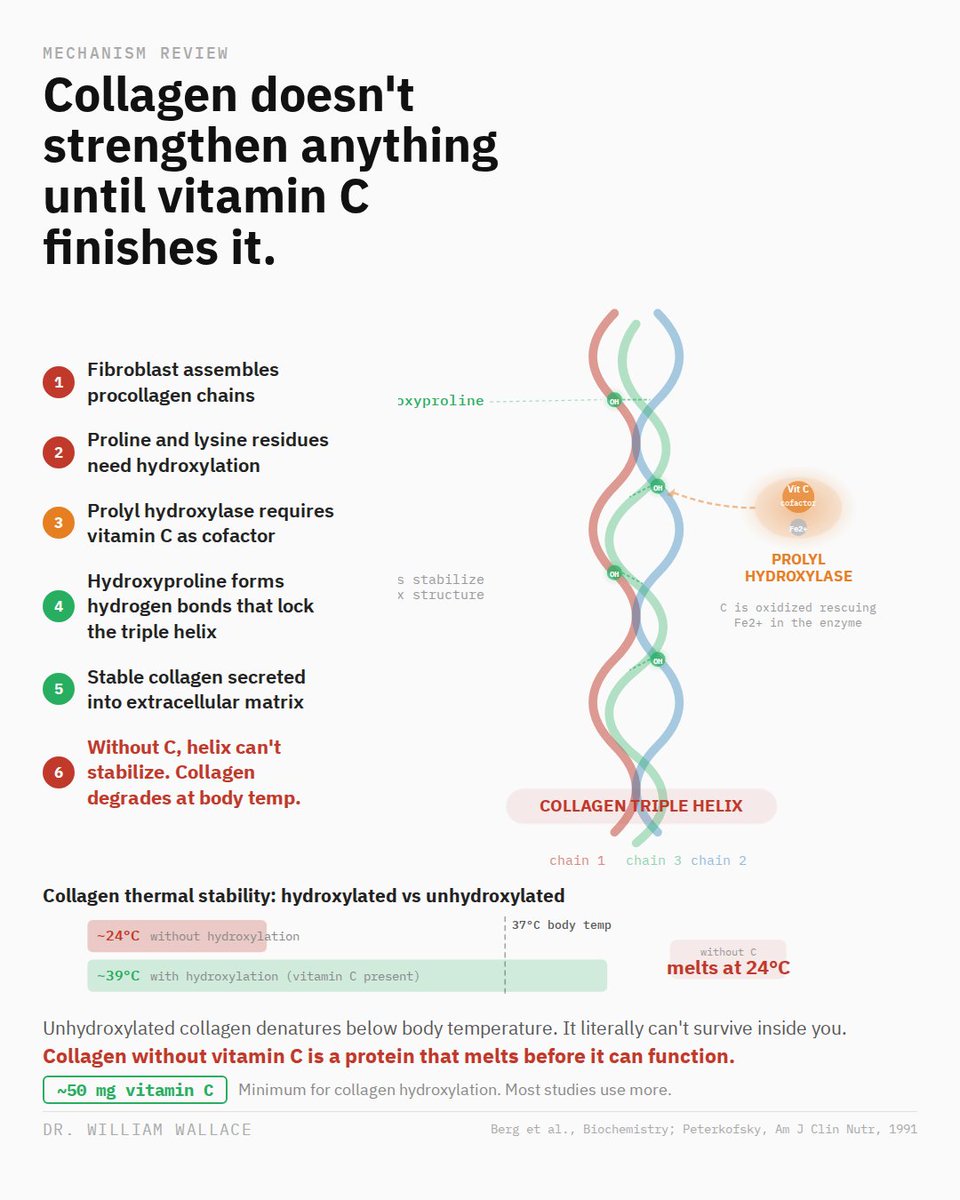
Your body makes collagen constantly. But the version it assembles first isn't finished. Before collagen can hold its shape, an enzyme has to modify specific amino acids in the chain. That enzyme needs vitamin C to work.
Here's what vitamin C actually does: it enables the chemical modification (hydroxylation) that allows three collagen chains to lock together into a stable triple helix. Without that modification, the collagen structure is so weak it falls apart below body temperature. Literally. Unhydroxylated collagen melts at about 24°C. Your body runs at 37°C. The only thing keeping your collagen intact at body temperature is the modification that vitamin C makes possible.
This is why scurvy causes bleeding gums, loose teeth, poor wound healing, and joint pain. Your body is still making collagen. It just can't hold together.
Vitamin C isn't recycled in this process. It's consumed each time. Your supply has to be continuously replenished.
Most collagen supplement studies co-administer vitamin C. The ones that don't rarely account for baseline vitamin C status. If you're taking collagen without adequate C, you're supplying the raw material without the tool that finishes it.
Sources: Peterkofsky, Am J Clin Nutr, 1991. Shoulders & Raines, Annu Rev Biochem, 2009
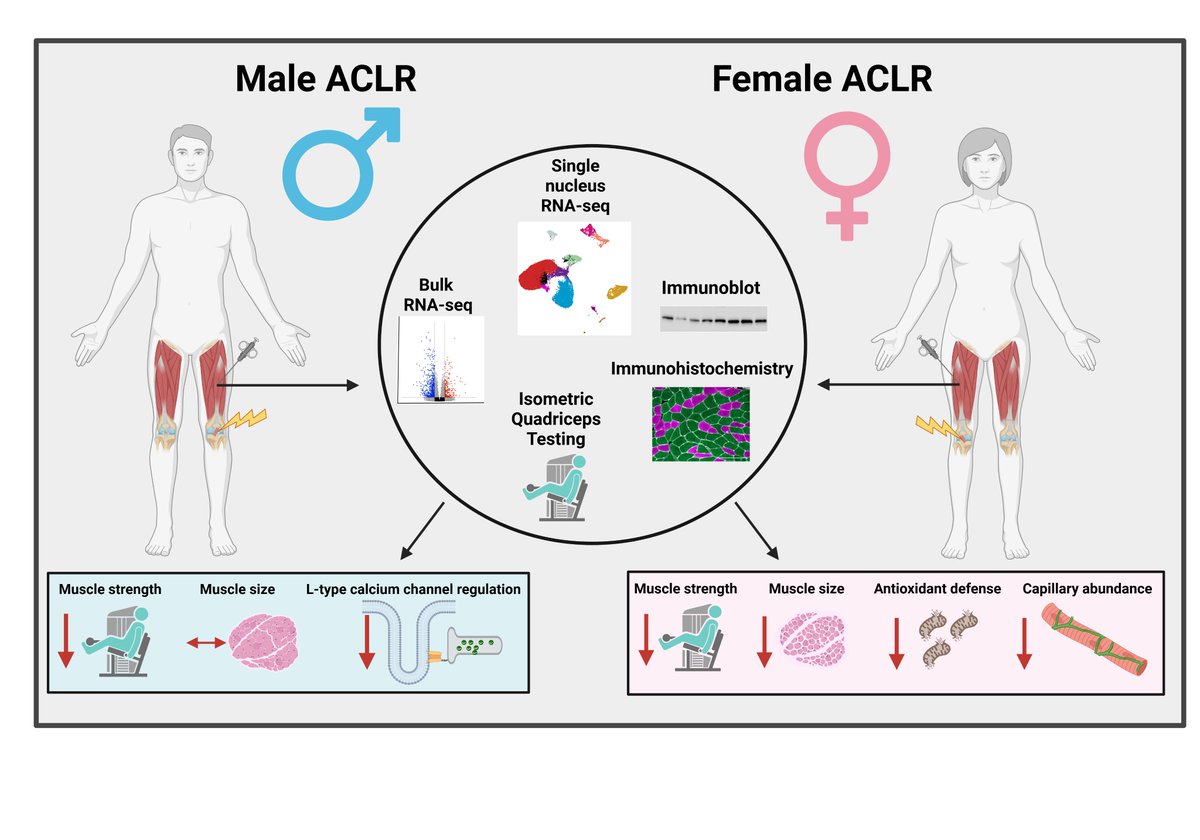
Excited to share our findings on sex differences in muscle signaling after ACL reconstruction—females exhibit a markedly divergent transcriptomic response, with greater susceptibility to atrophy, oxidative stress, and impaired angiogenic signaling:
https://t.co/THIZVOy8en
Research has found that sitting close to a high performer improved performance by 15%.
Sitting close to a low performer decreased performance by 30%.
Surround yourself with people who lift you up. https://t.co/YNjQSsILyY
No real doctor actually thinks VO2 max is any kind of predictor of health. Just a bunch of gym bro 'science-like' wishful thinking. Doctors talk about a1c, BP, metabolic syndrome, genetics (apoE, BRCA, thalassemia), creatinine, etc., like, a hundred times a day. NOT VO2 max.
I initially missed the key point about a recent exercise-after-cancer study that ran for 17 years: it may be the first time a randomized trial has shown that exercise extends life. (I might be wrong: if so, tell me!)
https://t.co/qe96akXHgK
📢New paper alert! Caffeine dampens protein synthesis but the effect is minimal when combined with exercise. Still, its's concerning when trying to maximizing a training response or recover from injury.
https://t.co/XqGe0M9QNc
Results:
- First study to show local subcutaneous fat was positively associated with the devices error in estimating core temp.
- First study to investigate the sensor's skin temperature measure- more work needed.
- No difference in the device's validity between males & females
"We learn efficient ways of doing things, and we stay in those efficient ways of doing things, and so we stop using the parts of our brain that allow us to assimilate new things....So, yeah, I think it's a good idea to be lost occasionally" -@sweatscience (from this week's post)