Physicist/Engineer turned Policy Analyst separating fact from fiction in fields like Cyber, AI, Drones, Nanotech, etc. Opinions are mine; RT's ≠ endorsements.
Hey all, big-compute and big-AI get a lot of airtime but it's also worth spending a minute to think about when AI is forced to be small and what that implies for reliability and so forth. @KyauMill21@CSETGeorgetown
https://t.co/4BVVAzZVsc
New AI & international security paper just dropped. 🔥
Let's take a look at how confidence-building measures can mitigate some of the international security risks associated with foundation models.
https://t.co/QDndLU21zi
New paper just out that I got to watch take shape. One encouraging point that stuck out to me was that there is still room to improve safety across many dimensions; looks like we don't usually have to trade off one type of safe for another yet.
https://t.co/e0WNzCDKvz
Today, the White House announced voluntary commitments about safety and security from seven major AI companies. John Bansemer and I recently wrote a short blog post about what that might look like. Might be worth a gander.
https://t.co/hwckdQlDuP
✨New Policy Brief✨
CSET's @AndrewJLohn & Krystal Jackson, in partnership with the @turinginst, investigate the future of cybersecurity: Autonomous Cyber Defense Agents. Learn more in their new report ⬇️ https://t.co/XgggGUiR37
📊📉New Data Brief📈📊
How important is computing hardware to AI progress, compared to other factors like talent and data? New survey research from CSET's @mrmusser, Rebecca Gelles, Ronnie Kinoshita, Catherine Aiken, and @AndrewJLohn provides answers 👇 https://t.co/ohOKTveQkU
✨New Report✨
AI systems are being rapidly deployed, but many have vulnerabilities that are hard to study + mitigate. In our report produced w/ @StanfordCyber, 17 coauthors from policy research, law, industry + government propose steps to reduce risks: https://t.co/vLukBxjgLe
Who likes tons of data compiled into an easy-to-use and free interface? Want to do bibliometrics or understand the semiconductor supply chain or know which country is doing what in AI? Visit https://t.co/oeJWUcRMOc
In a world where some hackers are making millions of dollars at a time, there’s also the question of who would turn them in at all. That said, it’s not unheard of for hackers to turn on each other, CSET's @AndrewJLohn told @washingtonpost's @timstarks. https://t.co/2IAwNrW5A6
✨New issue brief✨
As the United States faces a growing number of threats in the cyber domain, high school cybersecurity competitions can help to train the next generation of domestic cyber talent, write Kayla Goode, @ali_craw, and Christopher Back ⬇️: https://t.co/LG0UEqdGau
We’re thrilled to announce that Jason Matheny has been selected as our new president and CEO. He is an economist, technologist, highly regarded national security expert, and longtime civil servant. Welcome, Jason! https://t.co/8iCfcgj0GI
Some best practices to consider for deploying large language models from @OpenAI, @CohereAI, and @AI21Labs. Worth a look if you're sending them out into the world.
https://t.co/ReYWhple23
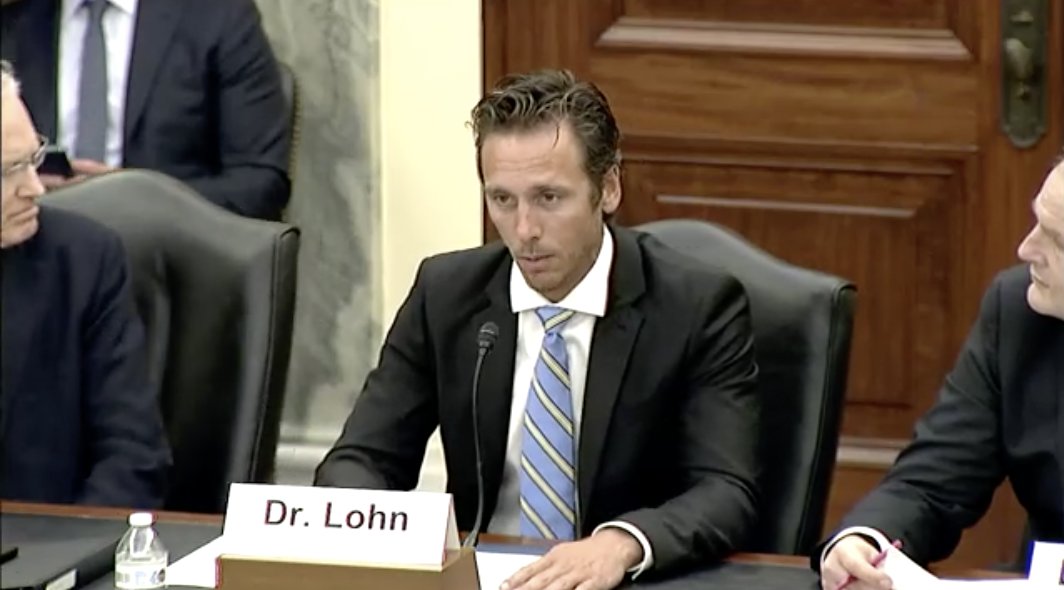
CSET's @AndrewJLohn is testifying LIVE before the @SASCDems and @SASCGOP Cybersecurity Subcommittee where he will outline #AI’s capabilities and vulnerabilities within cyberspace defenses and offenses.
🎉New Policy Brief🎉
Managing vulnerabilities in machine learning is going to require a few changes. A new brief by @andrewjlohn and Wyatt Hoffman discusses a few of those along with what to expect for the future of cybersecurity. https://t.co/FxxkDIPEyS
I think our new one is a fun and short read.
On its face it's obvious that such a steep exponential can't go forever but it's not so obvious when it might stop or why.
🚨New Issue Brief🚨
Computing power is a core driver of modern #AI progress, but how much longer can computing resources keep growing?
In this issue brief, @AndrewJLohn and @mrmusser argue that this growth might slow down sooner than you think. https://t.co/Q5WmtCybjf
@Jason_Healey Point them to us at CSET too, especially the CyberAI Project. We'd love to have more practical skills/experience in our ranks.
https://t.co/sBzKbRRSWU
📣 News Release! 📣
CSET is happy to announce an increase in grant funding, bringing our total funds to more than $100 million, to continue our work at the intersection of emerging tech and security.
https://t.co/rhjogLv1Bw
We usually envision AI conflict, crisis, and escalation as being fast but what counts as fast?
Apples and Oranges but:
State Dept figures Iran nuclear breakout time is 3 months.
Wall clock to train a 1T-parameter language model is also 3 months.
@Miles_Brundage Picture you have years of data on some daily/weekly/whatever thing that happens but then it gets wiped or you find out it's poisoned.
Now you need X data points to train your model and after 24 hours or 1 week or whatever you have 1 data point. Tomorrow 2...
@Miles_Brundage I think computing is a bad measure because it's not usually the limiting factor. But it's more predictable than most so it's somewhat better for setting bounds.
My favorite is when data is necessarily generated slowly so that it is both the limiting factor and predictable.