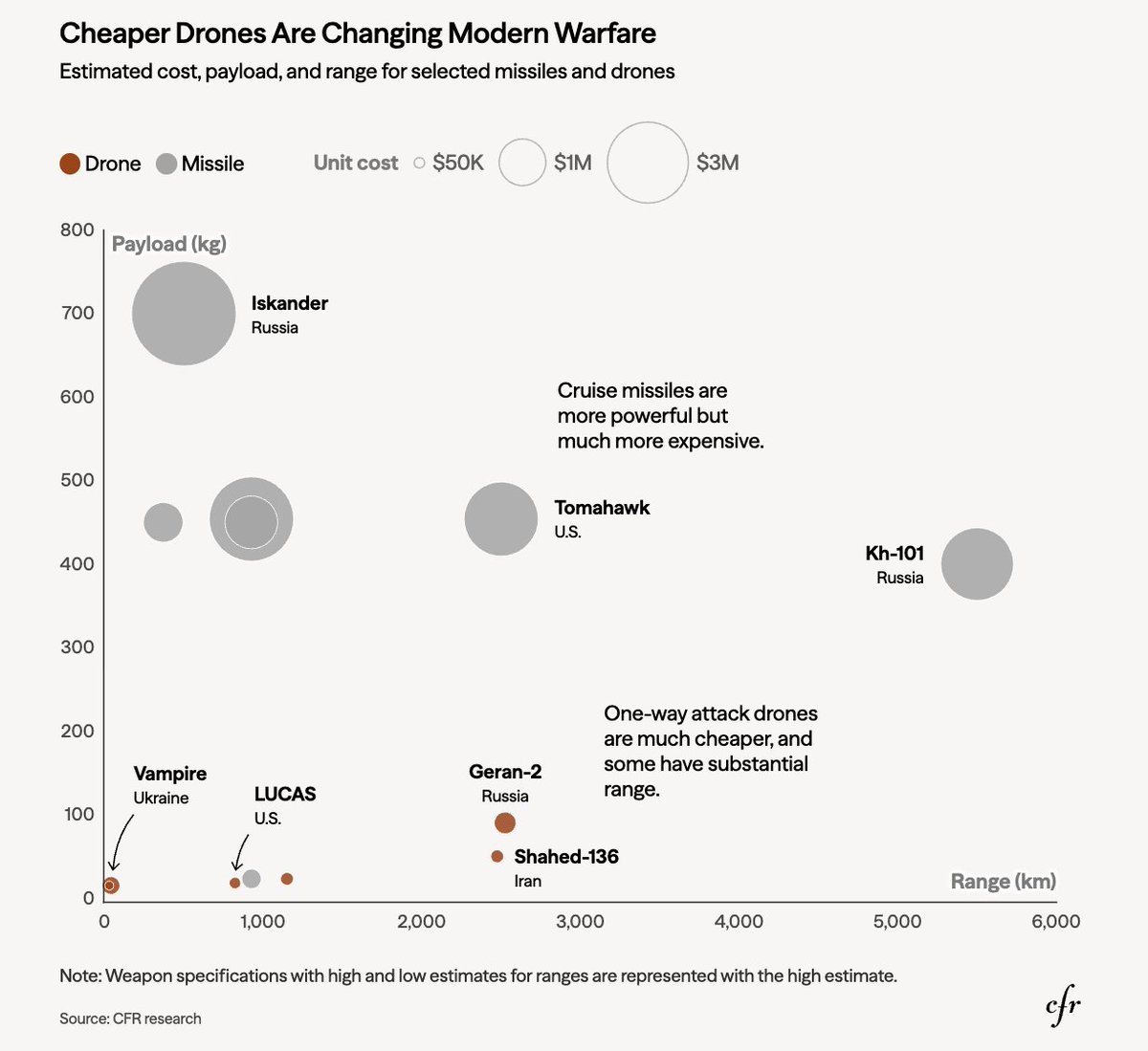
The math of modern warfare is changing.
In the war with Iran, $20k–$50k Shahed-136 drones are forcing defenders to fire interceptors that can cost 5–100× more. Cheap systems are shifting the cost curve of air defense.
Operation Epic Fury and Iran’s response to ongoing U.S. and Israeli attacks represent clear evidence that we are now in the era of precise mass in war, with the high-volume use of low-cost, increasingly autonomous (and sometimes AI-enabled) systems with high-accuracy guidance.
In other words: there a lot more drones on battlefields today—but not the ones people remember from the global war on terrorism.
More with @mchorowitz in @CFR_org, complete with amazing data interactives and visualizations put together by @PhilMcCausland and Austin Steinhart!
https://t.co/MESMTs1uW0
✨ New blog ✨
How can prize competitions turn the Genesis Mission’s AIxBiotech ambitions into real progress?
@steph_batalis and @ali_craw look at how federal prize competitions can incentivize private-sector participation and advance national biotech priorities.👇
https://t.co/4RyVzl2jfn
America’s #AI plan set bold goals for teaching AI in schools & training 1M new #apprentices. Deadlines are up—so where do those promises stand now? @ali_craw explains in a new CSET blog: https://t.co/2COLIj1mqp
The U.S. AI Action Plan promised more than tech leadership—it promised an AI-ready workforce. Two executive orders set deadlines for action on AI education and apprenticeships. Those deadlines have passed. In a new CSET blog, @ali_craw outlines what progress has been made and what gaps remain.
🔗 https://t.co/fN2L2ZgIle
@OJDaniels, Jessica Ji, @jacob_feldgoise, and @ali_craw weigh in on:
• Open questions raised by the Plan
• Security-related recommendations
• Export controls
• Workforce priorities
This CSET data snapshot is descriptive, not predictive. @Lauren_A_Kahn and I designed it to make visible what’s often left opaque:
• Where debris lives
• How long it persists
• Who contributed to its creation
Explore the full interactive here: https://t.co/gj4fmDluGo
#SpaceSecurity #SpaceDebris #CSET #SpacePolicy #ASAT
New from @CSETGeorgetown: Seven decades of launches, collisions, and anti-satellite tests have left more than 34,000 tracked pieces of debris orbiting Earth.
A handful of events by just a few countries created most of it. 🧵
⭐️New Report⭐️
Our new analysis investigates how researchers use open-weight AI models in ways not possible with closed models, based on an empirical review and annotation of hundreds of scientific publications.
Explore it in full here ⬇️
https://t.co/6ONU4UqKz3
In my latest piece for @TheNatlInterest, I explore how science fiction teaches us that the most dangerous futures are the quiet trade-offs we make with technology, convenience, and corporate control.
Read here: https://t.co/9fGznhQkNX
In other words, I found a professional way to evangelize about @CyberpunkGame & @CDPROJEKTRED.
🧵Most agree that open-weight AI models benefit research, but there is a lack of empirical work investigating how these benefits manifest in practice. To address this gap, we reviewed ~250 scientific publications that use open models in ways that require access to the weights
So excited to share that today @CSETGeorgetown and @emergingtechobs are launching an ✨updated✨ version of our chip supply chain explorer! We've got:
👉 New data
👉 New features
👉 New analysis
Links in thread
I'm so pleased to finally share the outcomes of an insightful roundtable discussion on the potential and possibilities of work-based learning for cybersecurity jobs. Researchers, practitioners, educators, and government officials came together to explore what makes work-based learning unique, effective, and valuable for the #cyber #workforce.
Read here: https://t.co/AddIo5HnIG
✨New Report✨
U.S. tech companies have deep ties to Taiwan—via data centers, R&D, and supply chains. In a crisis, these links could shape corporate decisions.
Explore more in our new report by CSET's @SamBresnick ⬇️ https://t.co/xoMLcKLqEV
.@mchorowitz, @Lauren_A_Kahn, and @JoshuaASchwartz call on the United States to invest more in cheap, accurate drones—and “integrate this new generation of capabilities with its existing legacy systems.”
https://t.co/z6TthDrecd
The U.S. conducts 50% more launches today than it did at the peak of the space race-- but SpaceX is responsible for 5 of every 6 launches. What are the implications of this for American national security? Discover here ⬇️🚀https://t.co/w62TxaCBgy
✨New Report✨
AI's impact on the 🇺🇸 workforce could be profound and differs from previous tech shifts: while earlier changes primarily benefited white-collar workers, AI could transform all categories.
More from @oschinski, @ali_craw, and Maggie Wu: https://t.co/3YuhakHtmD
This week @SenMarkKelly and @SenatorRounds introduced a bipartisan bill to enhance consumer literacy and confidence in #AI.
Read what CSET Research Analyst @ali_craw had to say about their new Consumers LEARN AI Act ⬇️ https://t.co/o717q7uwK7
I’m at #NICECyberCon24 this week in Dallas, TX 🤠
Looking forward to discussions on developing cyber workforce talent, building cyber ecosystems, and the future of cyber education.
Let’s connect!
The CHIPS and Science Act of 2022 directed the @NSF to conduct a feasibility study for a potential Artificial Intelligence Scholarship-for-Service program.
In her policy brief, @ali_craw outlines what the AI SFS can learn from the CyberCorps program: https://t.co/9hWGqITZvJ
AI education is becoming a popular subject within K-12 curricula, but it’s easy to get lost in the sea of guidance documents, strategies, and frameworks.
CSET’s @ali_craw & Cherry Wu share some practical observations: https://t.co/qGSb4Ja6Ex