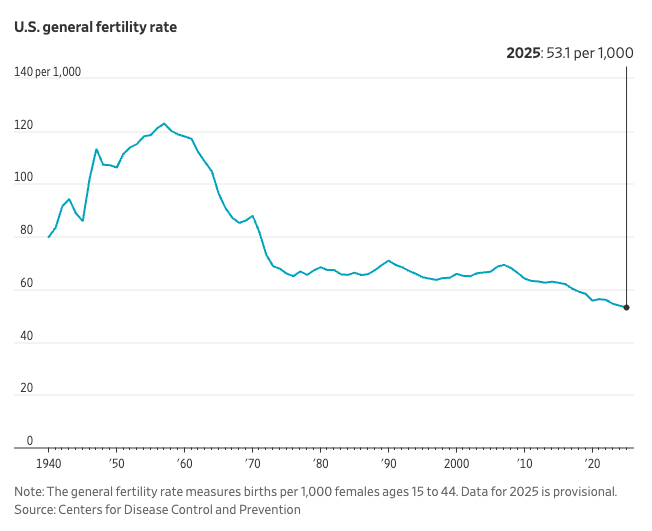
US fertility reached 1.57 last year, the lowest ever recorded, and the WSJ explanation is "uncertainty about finances, relationship stability, and the political climate"
my great grandma had eleven children during the second world war, in a country being bombed, in a house with no running water, on rations.
poor people have always had kids. the poorest people on earth right now still have kids and the financial excuse is a story we tell ourselves because it makes us feel good and the real one is unbearable
the real mechanism is that we got rich enough to redefine children as an expense instead of the point. somewhere in the last fifty years the cultural goal inverted and a child stopped being what life is for and became a line item competing with the lifestyle. once you frame it that way the math never works, because the math isnt supposed to work. that's the point
we are living in the richest moment in human history and we decided to use the surplus to buy ourselves out of the future. the most prosperous civilization that has ever existed is committing demographic suicide at the altar of personal optimization and comfort, and the official line is that we cant afford it
the birthrate is a lagging indicator of a civilization that forgot why it was alive
Elon Musk just told you the job is dying.
Most people heard a prediction.
A few heard a prison door opening.
Musk: “In less than 20 years, working at all will be optional.”
That is not a policy suggestion. That is a countdown.
For three hundred years, the human blueprint has been identical.
You are born. You move to the city. You rent a box near the office. You trade your body and your hours for the right to exist.
You do this until you are old.
Then you stop.
Then you die.
The entire model runs on one assumption. That human labor is the only engine.
AI and robotics delete that assumption.
When the machine handles production at a scale no human crew can match, the forced migration to the city evaporates. The commute evaporates. The cubicle evaporates.
The alarm clock that owns your nervous system for forty years evaporates.
Musk: “I think it won’t be the case that you have to be in a city for a job.”
The city was never a choice. It was a requirement disguised as ambition.
You moved to the noise and the concrete and the $4,000 rent because the paycheck lived there.
Remove the paycheck from the equation and the geography changes overnight.
You can live in the mountains. On the coast. In the silence of a town most people have never heard of.
You can wake up to nothing but trees and cold air and the complete absence of anyone else’s schedule.
That is not a fantasy. That is the math resolving.
But here is where most people break.
They hear “work is optional” and they see emptiness. A species with nothing to do.
Billions of people staring at screens until their minds dissolve.
That fear tells you everything about what the system has already done to us.
We confused labor with purpose.
The grind with meaning.
The paycheck with proof that we matter.
Musk: “In the same way that you could grow your own vegetables in your garden.”
The analogy is precise.
You do not grow tomatoes because the economy demands it. You grow them because something in you wants to build a thing with your hands and watch it come alive.
That instinct does not disappear when the job does.
It gets unleashed.
The artist who spent twenty years doing accounting finally paints.
The engineer who always wanted to build something of her own finally builds it.
The kid in a small town who could never afford to take the risk finally takes it.
Work does not vanish. Forced work vanishes.
What replaces it is creation without a gun to your head.
This is the part that keeps me up at night.
We are standing at the edge of the largest liberation in human history. And the loudest voices in the room are begging to stay in the cell.
They want the commute. They want the boss. They want the structure that tells them when to eat and when to sleep and when they are allowed to think about their own life.
Because freedom without a template is terrifying.
The next twenty years will not test our technology. The technology is already ahead of schedule.
They will test whether the species can handle what it has been asking for since the beginning of civilization.
Time. Space. Silence.
And the unbearable weight of choosing what your life actually means when no one is forcing the answer.
That is not a prediction.
That is the final exam.
And nobody is ready.
🚨 BREAKING: Chuck Schumer just turned America’s airports into pure CHAOS — 300 TSA agents walked off, call-outs have exploded, and paychecks aren’t even showing up.
Lines are now blowing past 4 HOURS.
Insane. Democrats are stabbing this country in the back and skating away with it.
Go AROUND them now. Nuke the filibuster and save DHS!
Ray Dalio just released 500 years of data showing exactly how empires collapse.
His conclusion? America is in Stage 6 of 9.
The dangerous stage.
Here's what his math actually says about where we're headed:
Dalio studied every major empire collapse since 1500.
Dutch. British. American.
The pattern repeats with machine-like precision every 50-100 years.
Not because of politics or ideology.
Because of math.
The "Big Debt Cycle" has nine stages.
We're currently in Stage 6.
The dangerous one.
Here's how it works:
Stages 1-4: The Rise
Countries borrow to build infrastructure.
Debt is productive. GDP grows faster than debt service costs.
Everything feels sustainable.
This was the U.S. from 1945-2000.
Low debt-to-GDP. Strong productivity growth.
Borrowing made sense.
Stage 5: The Top
Debt service hits 15-20% of GDP.
Interest costs start crowding out productive spending.
But everyone's too comfortable to notice.
Markets boom. Wealth gaps explode.
The U.S. crossed this threshold around 2008.
Stage 6: The Crisis
This is where we are now.
Federal debt exceeds 120% of GDP.
Two choices: Let interest rates rise and crash the economy.
Or print money and create inflation.
Both destroy wealth.
Just differently.
In the 1930s, we chose deflation.
In 2008, we chose money printing.
In 2026, we're doing both at the same time.
Stages 7-9: The Reset
Either massive restructuring through negotiation.
Or war.
History shows wars resolve 90% of these cycles.
Not because humans are violent.
Because debts become mathematically impossible to service.
Dalio's data is clear:
When internal inequality peaks AND external rivals emerge, conflicts become inevitable.
The U.S. has both right now.
Wealth inequality hasn't been this high since 1929.
China's GDP grew 6-8% annually while we borrowed to maintain consumption.
Dalio's advice for Stage 6 is simple:
Sell debt. Buy gold.
Not because gold produces anything.
Because governments print money to escape debt traps.
Gold has risen 3x since 2020.
Exactly as the model predicted.
But here's what actually matters for regular investors:
You can't stop the Big Cycle.
But you can position for it.
Dalio's framework identifies five big forces that drive every transition:
1. Productivity growth
2. Debt cycles
3. Money supply
4. Wealth gaps
5. Geopolitical power shifts
When all five align in the same direction, the cycle turns.
Right now, all five are pointing toward Stage 7.
Productivity growth is slowing.
Debt service costs are rising faster than GDP.
Money supply expanded 40% since 2020.
Wealth concentration is at century highs.
China is building parallel financial infrastructure.
The math doesn't lie.
So what does positioning actually look like?
Dalio's research across 500 years shows three consistent patterns:
Pattern 1: Fiat currencies lose value during Stage 6-7 transitions
Every time. No exceptions.
Governments print to escape debt traps.
The dollar, pound, and euro all follow the same path.
This is why gold and hard assets outperform during these periods.
Pattern 2: Geographic diversification matters more than asset class diversification
When one empire declines, another rises.
Dutch to British. British to American.
The cycle doesn't end. It relocates.
Portfolios concentrated in declining empires get crushed.
Pattern 3: Volatility spikes 3-5x during Stage 6
The 1930s saw 50%+ market swings.
The 1970s stagflation created wild inflation volatility.
2008-2009 saw daily 5% moves.
Stage 6 isn't calm. It's chaos punctuated by brief stability.
Here's the data that should terrify you:
U.S. debt-to-GDP: 120% (highest since WWII)
Annual interest costs: approaching $1 trillion
China's GDP growth: 6-8% while U.S. averages 2-3%
Time between 1929 inequality peak and crash: 8 months
Time since current inequality peak: We're in it now