Students sometimes ask me if it still makes sense, in this accelerating age, to pursue a PhD in AI.
Perhaps counterintuitively, I think it's a great time to do so.
I wrote up some thoughts on this here: https://t.co/RRqGR0qi1R
You've probably seen this recommended 2-3 times on your TL by now but... i agree. Watch it.
I think diffusion will take a little longer, but he pretty much nailed it imo.
This is really impressive work!!
A synthetic data pipeline produces a dataset/benchmark that's indistinguishable from real data.
The benchmark includes various different clinically relevant tasks.
None of the test models approach ceiling performance.
I’m as excited about the possibilities AI brings as anyone. I should be because I’ve worked on it since 1985. But I want to balance this excitement with a dose of humanity and what still makes people both special and necessary.
Despite its nearly infinite knowledge, I still write better than Claude. Why? Precisely because I’m human. I understand my audience in a way Claude can’t and maybe never will. I understand what it means to be bored, confused, and distracted because I’ve been board, confused, and distracted. I’ve been moved to tears by words on a page. I have empathy for my reader because I too am a reader with a limited human brain.
So, when I write, I write for you, dear reader. Your time is precious. I need to earn your attention. Writing is a very imperfect process of communication from one human to another.
In contrast to my writing, Claude is brutalist. It assaults with declaratives. It fires off staccato jargon with no sympathy for a reader who is lost. Sure, you can coax it to behave but it doesn’t do this out of empathy for the reader because it lacks this. Claude’s default style reveals the true heart of the machine.
I hope my writing also has a bit of style, a little be of me, in it. A trail of words guiding you into a little part of my mind. The words are a fingerprint left behind. Claude leaves a big greasy fingerprint that is unmistakable. In that sense it has style. But that style reveals its lack of empathy for the reader. The best word for it is “condescending”.
What drives me to write this missive is some small creative spark and a human drive to share it. I woke up this morning with “a bee in my bonnet” about our societal enthusiasm and fear about AI. I need to write to articulate my thoughts to myself and hopefully to you.
AI is getting very very good. But I’m still better at this and other things. I’m sure that you too are better than AI at what you do. Real humans are still more creative and more interesting than AI. I want facts from AI, but I want to know what humans think and feel. I hope we blunder onwards into the future writing, creating, and sharing in our wonderfully imperfect human way.
If you read something written by me, know that it was written by me. It is my brain reaching out to yours without the filter of AI. My words. Imperfect. Like me and like you.
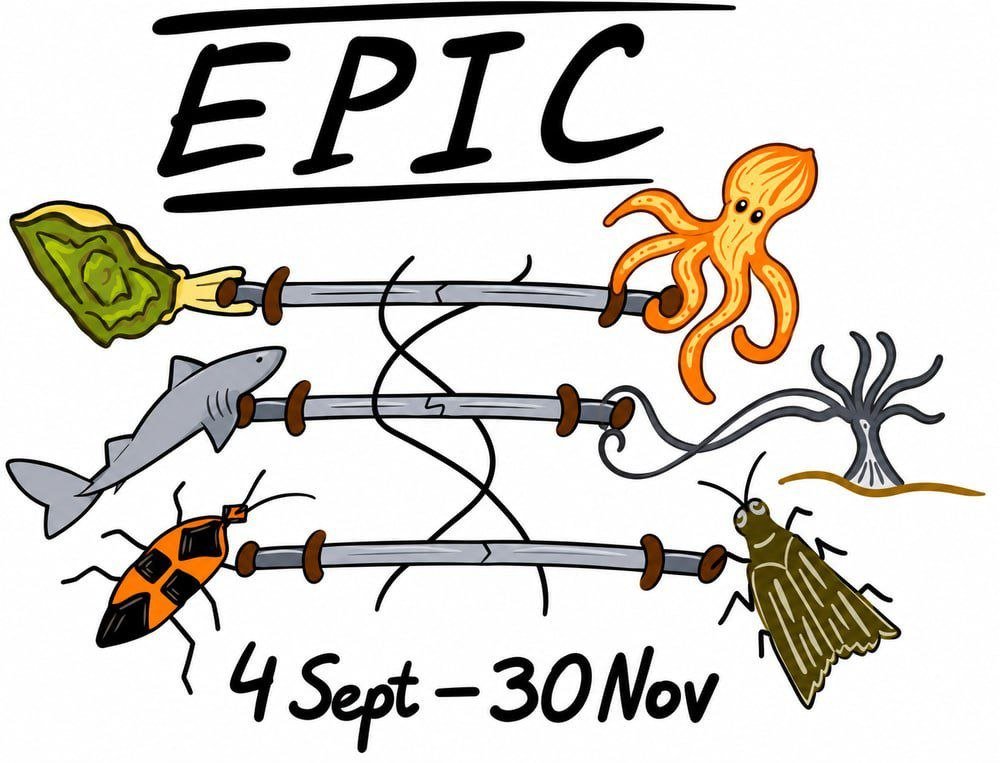
🧬 EPIC is open: the Eukaryotic Promoter and transcription Initiation prediction Challenge.
The goal: predict where, and how strongly, RNA Pol II starts transcribing, from nothing but DNA sequence. At single-nucleotide, strand-specific resolution.
https://t.co/wS43RvhuY2
🧵 1/7
I said "auto-regressive LLMs, in and of themselves, will not lead human-level AI"
That statement is still totally true.
First, the reasoning abilities of current AI systems are based non-auto-regressive search (which is what I have always advocated for). But AFAICT, they do it in token space, which is limited and inefficient. I have claimed that human-like reasoning must be a search in continuous representation space. It looks like the industry is moving towards that.
Second, the self-improvement methods, as currently practiced, only work for domains where the quality of outputs can be scored without human intervention, such as mathematics, code, and scenarios that can be simulated accurately. Not anything else. Humans and animals learn new skills way more efficiently than current RL methods.
Third, the multimodal capabilities of current AI assistants generally use separately-trained encoders (that are not LLMs). This is also what I've been advocating. Except that I think the best way to do this is with JEPA trained with self-supervised learning. The research community is clearly moving towards that (3000 papers on JEPA in just 4 years).
Fourth, if LLMs were a path to human-level AI, we would have domestic robots and Level-4 or Level-5 self-driving cars for consumers by now. And we don't. We certainly don't have cars that can learn to drive in 20 hours or practice like any teenager. We're still missing something pretty huge to claim human-level intelligence (let alone superhuman).
Sure, we now have computer systems that are impressive, very useful, and whose performance is superhuman in an increasing number of domains (coding being one of them).
But that's true of the entire history of progress in computer technology.
Lastly, there is a basic confusion about what intelligence actually is.
It is not the mere accumulation and regurgitation of existing declarative knowledge (which is essentially what LLMs do).
As Jean Piaget famously said, "intelligence is not what you know, it is what you do when you don't know."
It is your ability to solve new problem without any prior training, to act in previously-unknown scenarios, and to adapt very quickly to new situations with minimal training.
We're still far from that.
Found a genuinely useful repo for anyone writing ML papers.@ChenLiu_1996
A Yale CS PhD shared the Python scripts behind figures from Nature Machine Intelligence, ICML, NeurIPS, and ECCV.
Maybe I can finally stop spending half my research life moving matplotlib legends by 3 pixels.
https://t.co/2Cx2f9mJYz
Simple beats complicated:
For single-cell batch correction, we show that 👉linear transformation👈 with conditional distribution matching beats deep learning embedding methods like ScanVI.
😮🤪😱😯😲🤠😋🤯🤓
(Preprint link below. Thank you for your attention to this matter.)
Apply to the EMBL Sabbatical Programme now! 📢
This is a great opportunity for senior scientists looking to expand their scientific horizons!
You could receive up to €15,000 and be based at any of EMBL’s six sites for 3 to 6 months.
🔗Apply here: https://t.co/VjoigOAaCX
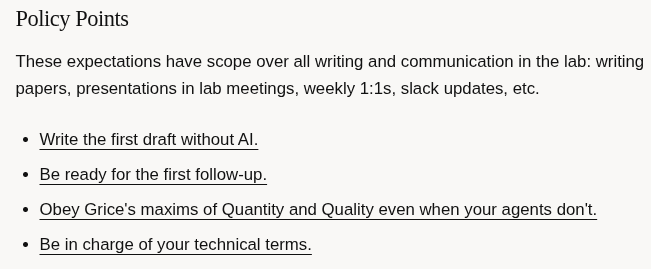
As agents perform increasingly complex tasks for researchers, it's important to develop norms for communicating with other humans. Here's my lab's policy on AI in writing and communication, focusing on helping us think deeply and communicate precisely.
https://t.co/vdvM7Ky3Os
My husband asked me yesterday why is AI moving at lightspeed while robotics feels slower?
I think its a really interesting question and speaks to what unlocked mainstream AI over the last decade—and why physical robots can't easily tap into those same accelerants.
Science is a team sport, so we're bringing together experts across coding agents, biological reasoning, specialist models, bench science, and hardware acceleration for three days of building.
Four tracks:
🛠️ OSS build
🔗 Orchestration
📊 Benchmarking
💡 Open Track
Apply here: https://t.co/ThKoERNVcH
Getting ready to publish my complete guide to RL for LLMs tomorrow morning. Although the post contains many of my own thoughts / learnings, it is also a synthesis of so many great resources that have been published over the years:
- The RLHF Book (https://t.co/n3aUxqWtgS) by @natolambert
- Reinforcement Learning by Richard S. Sutton and Andrew G. Barto
- Spinning Up in Deep RL (https://t.co/EYcOOllvIy) from OpenAI
- Build an LLM (https://t.co/6HfXuofVwq) and Reasoning Model (https://t.co/l5uS247A04) from Scratch by @rasbt
- Various notes (https://t.co/hpsyAKOnRv) and papers (TRPO, PPO, etc.) from John Schulman
- Policy Gradient Algorithms (https://t.co/caNLakSjo5) by Lilian Weng
- A Vision Researcher’s Guide to RL (https://t.co/25awrjj5Bd) by @YugeTen
- From REINFORCE to Dr. GRPO (https://t.co/M23e3Fl3VZ) by @qingfeng_lan
- Async GRPO in the Wild (https://t.co/A5qeYMwcy4) by @yumo_xu
- Open RL infrastructure like TRL (https://t.co/TGrrnJ574t) and OpenInstruct (https://t.co/L9pObiUb1c)
I highly recommend reading all of them. They’ve truly helped me to learn so much.
Pretraining Recurrent Networks without Recurrence by @akarshkumar0101 & @phillip_isola is a great paper!
It makes an end-run around the problems of RNNs via a transformer teacher to learn good predictive state representations & supervised learning of a memory transition function
A.I. hallucinations can be remarkably useful. They are dreaming up riots of unrealities that help scientists track cancer, design drugs, invent medical devices, uncover weather phenomena and even win the Nobel Prize.
Gift article: https://t.co/qvlS57kUWb
very comprehensive Review on single-cell foundation models from @JiayuanDing, @Xiaojie_Qiu, @TheodorisLab, and colleagues. After going over it, I would encourage the authors to make it more critical rather than primarily an inventory of models.
First, I think Fig 1 needs some rethinking. The definition of scFM has become too loose. For example, the actual model unit of GET is celltype pseudobulk aggregated from scATAC-seq, hence not single cell model. Also thanks for highlighting our TissueNarrator, but we certainly do not consider it a bona fide scFM - it is a specialized spatial transcriptomics model built by leverging an existing foundation LLM (Qwen). TissueNarrator is very interesting and we re having lots of fun w/ it but it's not a scFM. Anyway - Fig 1 seems to mix FMs, specialized models built on FMs, and task-specific models into one big family tree.
More broadly, I think the more interesting question for a scFM review in 2026 is not how many scFMs now exist or how their architectures differ, but what has the scFM paradigm actually bought us? Since the first wave around scBERT/Geneformer/scGPT, the number of models, parameters, and pretraining cells has exploded, but as a field we are not convinced that capabilities have advanced proportionally.
- Where has large scale pretraining enabled something that a strong specialized model could not do ?
- Where do scFMs consistently beat strong task specific or even simple baselines?
- Where is the broad evidence for true cross-context generalization on biologically interesting tasks?
The Review mentions many of these challenges indeed, but I think they should be much closer to the central theme of the article rather than appearing mainly in a later Challenges section :-)
I might almost suggest to flip the review around and instead ask:
- what have we actually learned after several years and many scFMs?
- What claims have survived independent benchmarking?
- What has scaled and what has saturated?
- What capabilities are genuinely attributable to pretraining and where do we still need much more evidnece?
- What important biological problems remain essentially unsolved by scFMs ?
Given the current rate of model proliferation, there may be another 50 scFMs by this time next year and this inventory / figure will become outdated very quickly. To me, a more useful and timely "state of the field" critique would be much more valuable and long-lasting than another "model zoo" review .