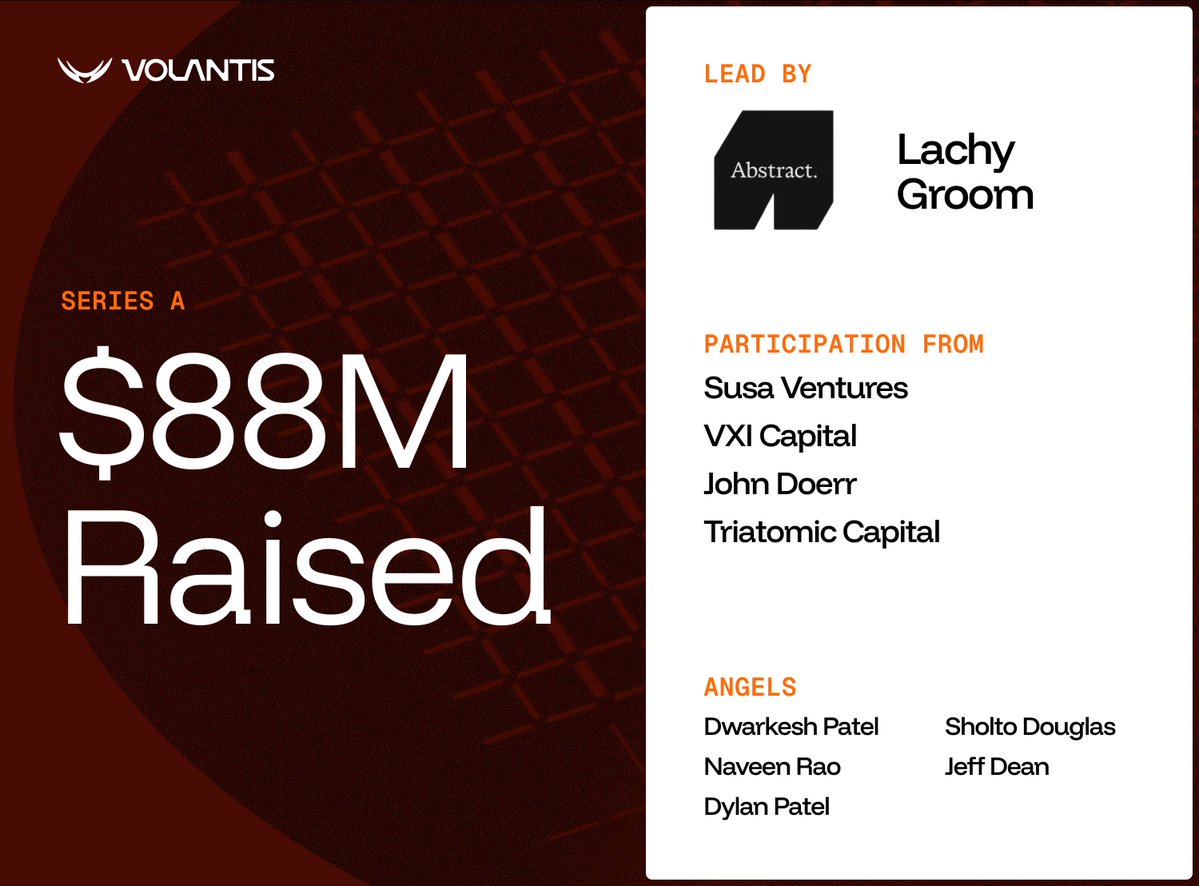
Excited to announce Volantis's $88M Series A.
We are solving Al's memory bottleneck by using optics, enabling chips with huge amounts of fast & cheap memory.
By boosting both the memory bandwidth and capacity per chip by orders of magnitude, we enable ultra-fast inference (up to 10,000 tps/user) for large models (>10T) - with low $/tok to boot.
Initially, this will enable insanely fast agents - think coding agents that finish in minutes or even seconds instead of hours.
More excitingly, optics is a fundamentally scalable way to increase memory systems. Not 2X/year, but by orders of magnitude across new generations. This will enable a structurally new Al industry, including restarting scaling laws, holding entire repos in context windows & more.
Our team has pioneered many core semiconductor technologies: the 1st CoWoS product, early HBM, the 1st silicon photonics CPO systems, the 1st high volume tunable VCSELs, the 1st processors to directly communicate using light & more.
We’ve already sent data >10× farther than equally tiny electrical wires inside a chip package. Our next iteration is already taped out and targets world-record bandwidth density over relevant distances, read more: https://t.co/ljYTimdcbJ
>be Jensen Huang
>born 1963 in Tainan, Taiwan
>dad is a chemical engineer
>family moves to Thailand, then to America
>age 9, parents send you to boarding school in Kentucky
>plot twist: it's actually a reform school
>roommate has a knife, covered in cigarette burns
>other kids are violent, troubled, dangerous
>you're a tiny Taiwanese kid who speaks broken English
>survive by doing homework for the older kids
>clean toilets every morning before class
1970s:
>family reunites in Oregon
>finally normal life
>get a job as a busboy at Denny's
>wash dishes, mop floors, seat customers
>fall in love with the work
>no joke, you genuinely love it
>learn that no job is beneath you
high school:
>table tennis prodigy
>ranked top in the nation for your age
>also good at academics
>quiet, focused, grinding
1984:
>graduate Oregon State, electrical engineering
>go to Stanford for masters
>smart but not the smartest in the room
>don't care, you outwork everyone
1984-1993:
>join AMD as a microprocessor architect
>then LSI Logic as a chip designer
>learn the guts of how chips work
>see that graphics are the future
>nobody agrees with you
January 1993:
>meet Chris Malachowsky and Curtis Priem
>both engineers, both believers
>meeting spot: a Denny's booth
>yes, the same Denny's where you bussed tables
>you're 30 years old
>idea: build chips specifically for 3D graphics
>PCs are beige boxes that display spreadsheets
>you want them to render worlds
>everyone says the market doesn't exist
>you: "it will"
>initial investment was $600 ($200 each from founders)
>found NVIDIA with $40,000
1993-1995:
>work out of a tiny office
>build the NV1
>technically ambitious
>uses quadratic texture mapping (not triangles like everyone else)
>Sega partners with you
>then Sega changes direction
>NV1 flops
>company nearly dies
>first near-death experience
1996:
>pivot hard
>admit the NV1 approach was wrong
>adopt industry-standard triangle rendering
>release RIVA 128
>it's fast, it's cheap, it works
>sells a million units
>NVIDIA lives
1997-1999:
>graphics card wars
>you vs. 3dfx vs. ATI vs. everyone
>3dfx has Voodoo, the market leader
>you're the underdog
>outship them, outpace them
>release new chips every 6 months
>insane cadence
>competitors can't keep up
1999:
>release GeForce 256
>invent the term "GPU" graphics processing unit
>it's marketing genius and technical innovation at once
>the GPU does calculations the CPU used to do
>games look better, run faster
>gaming explodes
>you ride the wave
2000:
>3dfx collapses
>you buy their assets
>the king is dead
2000s:
>dominate gaming
>every serious gamer knows your name
>green logo everywhere
>ATI (later AMD) is your only real competitor
>you trade blows for years
>but you're always slightly ahead
2006:
>make the bet that changes everything
>launch CUDA
>a programming platform that lets developers use GPUs for general computing
>not just graphics, any parallel computation
>Wall Street: "why would anyone need this?"
>academics: "interesting but niche"
>you: "just wait"
>invest hundreds of millions over the next decade
>no immediate payoff
>investors complain
>you don't budge
2012:
>deep learning starts working
>researchers discover neural networks need massive parallel computation
>CPUs are too slow
>your GPUs? perfect
>AlexNet wins ImageNet using NVIDIA GPUs
>the AI winter ends
>spring begins
2016:
>hand-deliver the first DGX-1 to OpenAI personally
>$129,000 AI supercomputer in a box
>Sam Altman thanks you
>this machine trains the models that become GPT
>you're not just supplying the AI revolution
>you're arming it
2017-2019:
>crypto boom
>miners need GPUs to mine Bitcoin and Ethereum
>demand explodes
>gamers can't buy cards, miners buy everything
>revenue skyrockets
>then crypto crashes
>inventory glut
>stock drops 50%
>second near-death scare
>you survive
2020:
>buy ARM for $40 billion
>biggest semiconductor deal ever
>regulators block it
>deal collapses in 2022
>$1.25 billion breakup fee
2022-2023:
>ChatGPT launches
>the world discovers AI
>everyone realizes: all of this runs on NVIDIA
>every AI lab, every cloud provider, every tech giant needs your chips
>H100 GPUs sell for $40,000 each
>can't make them fast enough
>data centers beg for allocation
2024:
>NVIDIA market cap: $1 trillion
>then $2 trillion
>then briefly passes Apple and Microsoft
>most valuable company on earth
>you're worth $100 billion+
the lifestyle:
>still wear black leather jackets
>every single day
>same style since the 90s
>have an actual NVIDIA tattoo on your arm
>employees get matching tattoos
management style:
>no 1:1 meetings
>40+ direct reports
>everyone's in the room together
>if you disagree, say it publicly or shut up
>"I'd rather hear bad news early than good news late"
>run the company like you're always 30 days from bankruptcy
>because you remember when you almost were
>multiple times
2025 & 2026:
>AI demand still exploding
>Blackwell chips shipping
>competitors trying to catch up
>AMD, Intel, Google, Amazon all building AI chips
>you're still ahead
>still paranoid
>still shipping
from Denny's busboy to $100+ billion.
the entire future runs on your chips.
every ChatGPT query, every AI image, every autonomous car.
all NVIDIA.
you saw it 20 years before anyone else.
you bet the company on it.
you were right.
If intelligence is the log of compute… it starts with a lot of compute! And that’s why we’re scaling our GPU fleet faster than anyone else.
Just last year, we added over 2 gigawatts of new capacity – roughly the output of 2 nuclear power plants.
And today we’re going further, announcing the world's most powerful AI datacenter, located in southeastern Wisconsin.
Fairwater is a seamless cluster of hundreds of thousands of NVIDIA GB200s, connected by enough fiber to circle the Earth 4.5 times.
It will deliver 10x the performance of the world’s fastest supercomputer today, enabling AI training and inference workloads at a level never before seen.
For AI training workloads, you need compute at exponential scale. That’s why we designed the datacenter, GPU fleet, and network together as one integrated system. This ensures a single job can run from day 1 at exponential scale across thousands of GPUs.
Fairwater uses a liquid-cooled closed-loop system for cooling GPUs that requires zero water for operations after construction.
And we’re matching all of the energy that is consumed with renewable sources.
And of course, it is just one of several similar sites we’re lighting up across our 70+ regions. We have multiple identical Fairwater datacenters under construction in other locations across the US, in addition to our AI infrastructure already deployed in over 100 datacenters around the world, powering model training, test-time compute, RL tuning, and real-time inference at global scale.
Too often during times like this, people go with the current and only later wonder, how did we get here?
With Fairwater, we're charting a new path: doing the hard engineering work, bringing compute, network, and storage into one highly scaled cluster, and designing closed-loop energy systems to meet real-world computing needs.
And partnering with local communities to ensure it's thoughtfully done in a way that is sustainable, creates new jobs, and expands opportunity.
We are thrilled to see this take hold in Wisconsin, and we are just getting started.
A cheat code I wish I knew at 18...
The 4 Types of Luck:
In 1978, a neurologist named Dr. James Austin published a book entitled Chase, Chance, & Creativity: The Lucky Art of Novelty.
In it, he proposed that there are 4 types of luck:
(1) Blind Luck
(2) Luck from Motion
(3) Luck from Awareness
(4) Luck from Uniqueness
Here's what they are:
Type 1: Blind Luck
Completely out of your control:
• Where you are born
• Who you are born to
• Base circumstances of your life
• "Acts of God"
These are the truly random occurrences of the universe.
Type 2: Luck from Motion
You’re creating motion and collisions through hustle and energy that you are inserting into an ecosystem.
You increase your luck surface area through simple movement.
The increase in collisions opens you up to more lucky events.
Type 3: Luck from Awareness
Depth of understanding within a given arena allows you to become very good at positioning yourself for lucky breaks.
Naval says: "You become very good at spotting luck."
You can “spot luck” from a mile away because of your knowledge and experience.
Type 4: Luck from Uniqueness
Your unique set of attributes attracts specific luck to you.
“[This type] favors those with distinctive, if not eccentric hobbies, personal lifestyles, and motor behaviors.” - Dr. James Austin
Type 4 Luck actually seeks you out.
The Stages of Luck
I personally think of Types 1-3 as coming in stages as you grow up:
• Type 1 dictates your early years
• Type 2 as you hustle in your 20
• Type 3 as you gain experience in your 30s+
Type 4 is unique—it’s dislocated from age.
Always remember the Luck Razor:
When choosing between two paths, choose the path that has a larger LUCK SURFACE AREA.
Your actions put you in a position where luck is more likely to strike.
It’s hard to get lucky watching TV at home—it’s easy to get lucky when you’re engaging and learning.
There are lots of simple ways to increase your luck surface area:
• Talk to more new people
• Send more cold emails
• Write/share in public
• Participate in digital communities
• Spend time in rooms where you feel like the dumb one
To recap the 4 types of luck:
• Type 1: Blind Luck
• Type 2: Luck from Motion
• Type 3: Luck from Awareness
• Type 4: Luck from Uniqueness
If you enjoyed this and learned something new, follow me @SahilBloom for more in the future!
Google's new Quantum Computer can complete 47 years of computing tasks in just 6 seconds.
Here's everything you need to know about this groundbreaking new tech and how it could change the world:
In 2000, Blockbuster was the movie rental king with 60,000 stores and 9,000 employees. Reed Hastings and I, on the other hand, were just two Silicon Valley geeks with a DVD-rental-by-mail idea.
We’d been struggling since 1998 to find a way to make it work, and by the summer of 2000, we were finally seeing light at the end of the tunnel. Our no-due-dates, no-late-fees subscription model was a hit. Customers were pouring in and the company was growing like crazy.
Running a subscription business takes a lot of cash, since you pay acquisition costs up front while the revenue comes in over time. But it was the height of the internet boom. Cash was plentiful.
Until suddenly it wasn’t. Over a few short months, the internet bubble finally popped. The .com at the end of our name had been a badge of honor; now it was three scarlet letters. And with customers flooding in, cash was flying out. We’d spent more than $50 million getting to this point, and now it looked like our success was going to bankrupt us.
Luckily, there is a Silicon Valley play book for this. It’s called “pursue strategic alternatives”—code for “sell, and sell fast.”
The obvious strategic alternative for us was Blockbuster. Which is why, just a few weeks later, you’d have found me, Reed, and our CFO Barry McCarthy sitting at a giant conference table on the 37th floor of the Blockbuster headquarters in Dallas, getting ready to pitch Blockbuster.
The pitch was simple. We would join forces with Blockbuster. We would run the online business. They would run the stores. We would jointly develop a blended model. And everyone would live happily ever after.
And it was going great. They were leaning in. They asked good questions. Until they asked the most important question of all: “How much?”
Now, we had rehearsed this. We figured we were $50 million in the hole... so let’s go with that! Reed leaned forward confidently and told them: “Fifty Million Dollars.”
There was perfect silence. Their words were “we’ll consider it,” but we could tell they were fighting to suppress laughter. After that, the meeting went downhill fast.
Well, what doesn’t kill you makes you stronger. Or, as my father used to tell me, “sometimes, the only way out is through.” We knew there was no easy way out. We struggled for years. But we eventually did make it through. We had our IPO. We passed Blockbuster in revenue.
And today, the company that Blockbuster could have purchased in 2000 for $50 million, has a market cap exceeding $150 billion. And that company with 9000 stores? Now it’s got just one.
But what’s the lesson to take from this?
There’s certainly an inspiring one: It’s possible for a handful of people, with no prior experience in the video business, to take down a 6 billion dollar category-leading company.
But I think the more important lesson—one that Blockbuster learned too late—is simply this:
If you are unwilling to disrupt your business, there will always be someone willing to do it for you.
Saul is my 2021 Investor of the year.
I have studied many successful fund managers this year but nobody beats the success of him.
He has averaged over 32%+ CAGR for over 28 years and 6x'd his portfolio returns.
This is Thread Pt. 2 of where I dig deeper into his framework:
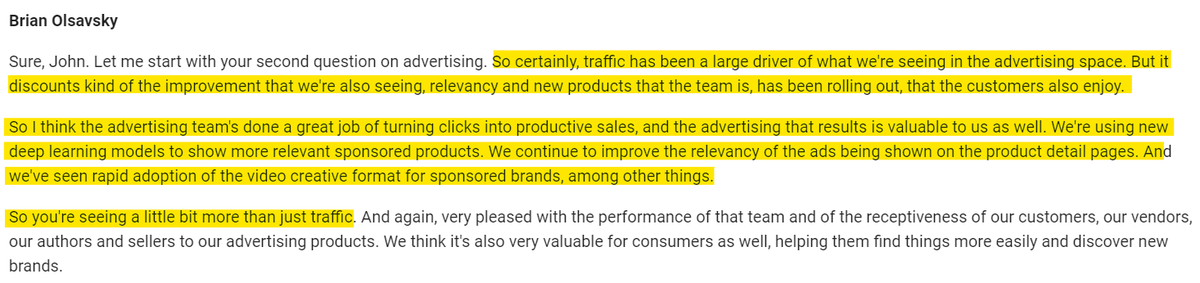
Hypothesis: we are early in "metaverse" hype cycle/bubble. Watch $50-100M market cap companies declaring they are building "metaverse" with their stocks going parabolic
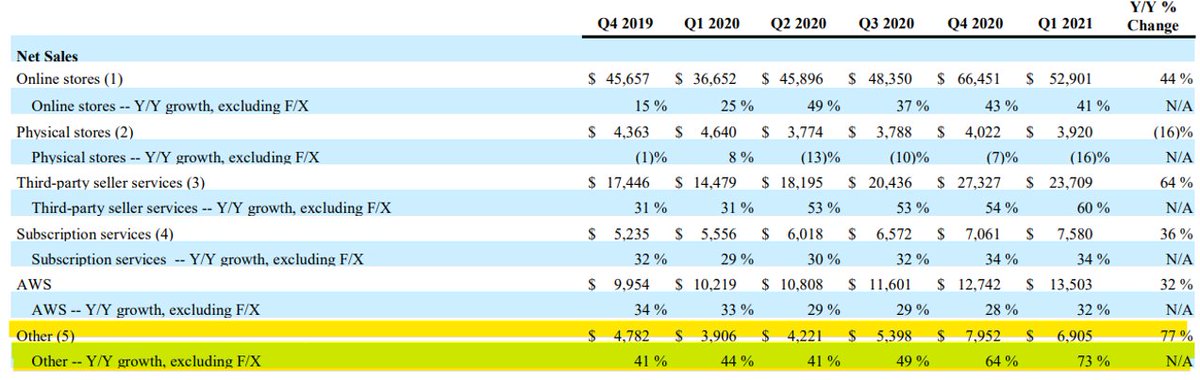
Incredibly Amazon's advertising business now contributes more than half the revenue of an AWS and growing 2x faster.
Over TTM, it's a $25B business w/ high margins and growing 73% YOY as of last quarter.
$AMZN
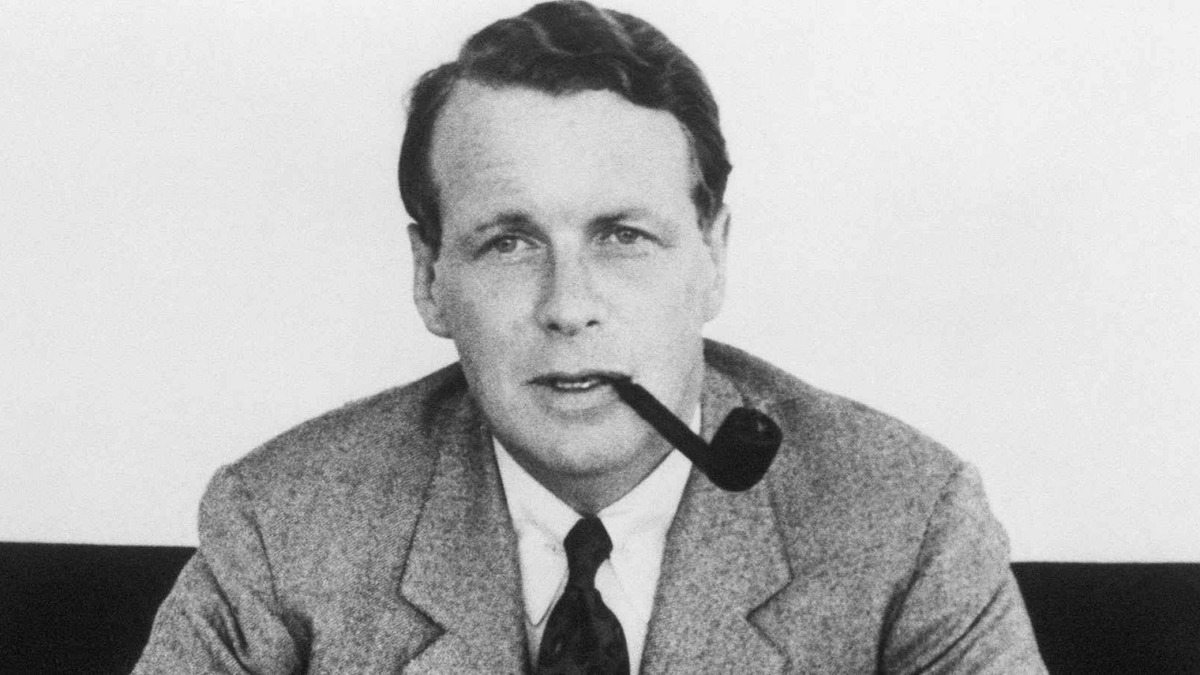
One of the most legendary marketers of all time: David Ogilvy
In 1982, David wrote an internal memo to the employees of his advertising agency titled "How to write."
And in just 10 bullets he put together a masterclass in effective writing.
Here's a breakdown of each one:
In 1995, only two years after the birth of the worldwide web, @BillGates tried to explain ‘The Internet’ to Letterman.
Today, tech pioneers face the same redicule as they describe AI, blockchain and cryptocurrency










![SahilBloom's tweet photo. A cheat code I wish I knew at 18...
The 4 Types of Luck:
In 1978, a neurologist named Dr. James Austin published a book entitled Chase, Chance, & Creativity: The Lucky Art of Novelty.
In it, he proposed that there are 4 types of luck:
(1) Blind Luck
(2) Luck from Motion
(3) Luck from Awareness
(4) Luck from Uniqueness
Here's what they are:
Type 1: Blind Luck
Completely out of your control:
• Where you are born
• Who you are born to
• Base circumstances of your life
• "Acts of God"
These are the truly random occurrences of the universe.
Type 2: Luck from Motion
You’re creating motion and collisions through hustle and energy that you are inserting into an ecosystem.
You increase your luck surface area through simple movement.
The increase in collisions opens you up to more lucky events.
Type 3: Luck from Awareness
Depth of understanding within a given arena allows you to become very good at positioning yourself for lucky breaks.
Naval says: "You become very good at spotting luck."
You can “spot luck” from a mile away because of your knowledge and experience.
Type 4: Luck from Uniqueness
Your unique set of attributes attracts specific luck to you.
“[This type] favors those with distinctive, if not eccentric hobbies, personal lifestyles, and motor behaviors.” - Dr. James Austin
Type 4 Luck actually seeks you out.
The Stages of Luck
I personally think of Types 1-3 as coming in stages as you grow up:
• Type 1 dictates your early years
• Type 2 as you hustle in your 20
• Type 3 as you gain experience in your 30s+
Type 4 is unique—it’s dislocated from age.
Always remember the Luck Razor:
When choosing between two paths, choose the path that has a larger LUCK SURFACE AREA.
Your actions put you in a position where luck is more likely to strike.
It’s hard to get lucky watching TV at home—it’s easy to get lucky when you’re engaging and learning.
There are lots of simple ways to increase your luck surface area:
• Talk to more new people
• Send more cold emails
• Write/share in public
• Participate in digital communities
• Spend time in rooms where you feel like the dumb one
To recap the 4 types of luck:
• Type 1: Blind Luck
• Type 2: Luck from Motion
• Type 3: Luck from Awareness
• Type 4: Luck from Uniqueness
If you enjoyed this and learned something new, follow me @SahilBloom for more in the future!](https://pbs.twimg.com/media/F1uFZy6XsAAkAwV.jpg)