I built the LLM interface I wished existed.
interface0 is for power users: cross-provider memory & chat, multi-model synthesis, sharing & team features, granular context engineering, template prompts, forking, prompt enhancing, & more
Here's a demo—see 🧵 for the rest
I just had my house tested by @lightworkhome and low and behold, like @lennysan... I too was being blasted by EMFs🔌
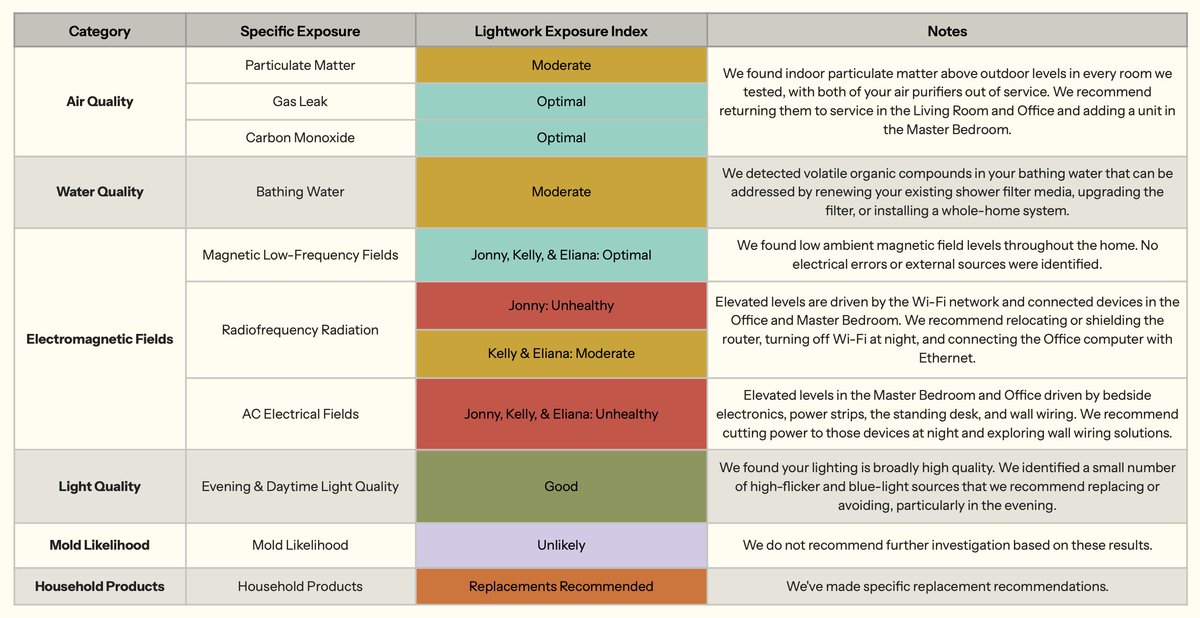
They did a 4hr+ at home assessment covering air + water quality, mold, EMFs, lighting & household products (you can see my results overview below)
Even though we're renting, making a few changes to create a 'default healthy' home environment feels like such low-hanging fruit because they're mostly one-and-done fixes.
Their estimate was that it'll cost <$250 total to make the main suggested improvements (full-spectrum flicker-free LED, wifi-router cover, plug timer to turn off connected devices at night, shielded extension cords etc.)
I'm so bullish on what @andy_bromberg, @DomFrancks and the team are building with Lightwork. If you're interested in learning more they're generously offering a free home health consult here: https://t.co/k33mHarC6F
Hey Isaac, if you're interested, that we have information about EMFs in these two articles and others on our site:
https://t.co/eH51QqsIKL (very in-depth review of the scientific literature relating to RF-EMF carcinogenicity)
https://t.co/6h4BfwaK3h (overview of EMFs)
There are a LOT of non-scientific perspectives and fearmongering on EMFs out there. But at Lightwork we aspire to counter that with data & science :)
It turns out, my house has been making me dumb(er). Sorry about that. Fixing it now.
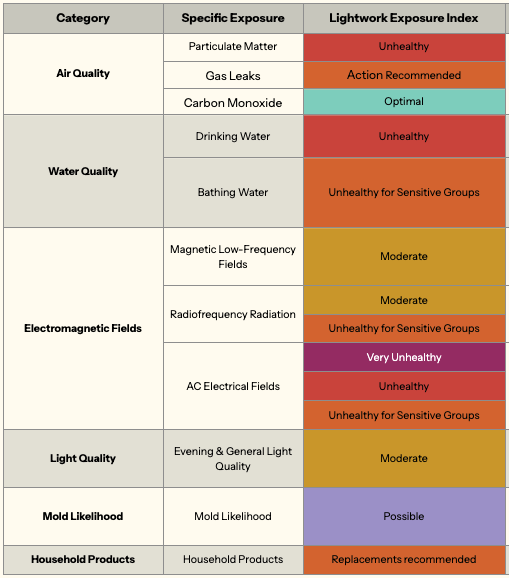
After I saw Lenny's tweet a month or so ago, I did a home health assessment and here’s what I found:
- High CO2 levels (~1,000 ppm) due to lack of ventilation. Studies correlate CO2 at this level with impaired cognitive function. Fix is simply opening windows.
- High levels of small particulate matter (PM0.3 - PM1.0) in the home compared to outside. Air purifiers are the move here.
- LEDs impacting sleep. We swapped out bedroom LEDs for incandescents.
- We had WiFi Access repeaters throughout the house. RF levels were high. Still learning about EMF effects but out of precaution took out the repeaters next to where we spend a lot of time (e.g. the kitchen).
- Luckily, very low levels of mold!
Lightwork was selected to perform home health assessments for clients of Immortals Concierge, Immortals’ premium concierge health program, ensuring member homes are evaluated alongside the rest of their health.
As announced by @bryan_johnson in February, Immortals Concierge includes a dedicated concierge team, BryanAI 24/7, extensive testing, millions of biological data points, continuous tracking, evidence based skin and hair protocols, and access to the best longevity therapies on the market — as well as a Lightwork Home Health assessment.
"Immortals Concierge is an exceptional program, and we're excited to provide assessments to their clients and help them create healthy, optimized home environments," said @andy_bromberg, Co-Founder of Lightwork, “home health is a critical component of overall well-being and longevity. Immortals Concierge follows a philosophy of ‘measurement, scientific research, intervention, repeat,’ and Lightwork aspires to the same approach.”
Lightwork’s home health assessments are comprehensive, white-glove evaluations that can include air quality, water quality, EMF exposure, lighting, mold, noise, chemical exposures, and more, along with remediation support.
Lightwork leverages its custom technology and procedures to quantify these exposures and potential remediations, which are measured against the Lightwork Exposure Index, a proprietary set of science-backed standards.
Lightwork was selected to perform home health assessments for clients of Immortals Concierge, Immortals’ premium concierge health program, ensuring member homes are evaluated alongside the rest of their health.
As announced by @bryan_johnson in February, Immortals Concierge includes a dedicated concierge team, BryanAI 24/7, extensive testing, millions of biological data points, continuous tracking, evidence based skin and hair protocols, and access to the best longevity therapies on the market — as well as a Lightwork Home Health assessment.
"Immortals Concierge is an exceptional program, and we're excited to provide assessments to their clients and help them create healthy, optimized home environments," said @andy_bromberg, Co-Founder of Lightwork, “home health is a critical component of overall well-being and longevity. Immortals Concierge follows a philosophy of ‘measurement, scientific research, intervention, repeat,’ and Lightwork aspires to the same approach.”
Lightwork’s home health assessments are comprehensive, white-glove evaluations that can include air quality, water quality, EMF exposure, lighting, mold, noise, chemical exposures, and more, along with remediation support.
Lightwork leverages its custom technology and procedures to quantify these exposures and potential remediations, which are measured against the Lightwork Exposure Index, a proprietary set of science-backed standards.
For those founders with strong ops DNA exploring India1 opportunities, I predict a @lightworkhome for India could be an interesting startup idea. This could also be an interesting revenue angle for Urban Co to explore.
Essentially
1/ scan for toxins across the house
2/ recommend mitigation tactics incl curated products (with a commerce opportunity)
D2C founders could look at specific toxin-free variants of products such as mattresses (foam emits phthalates etc). More on this below.
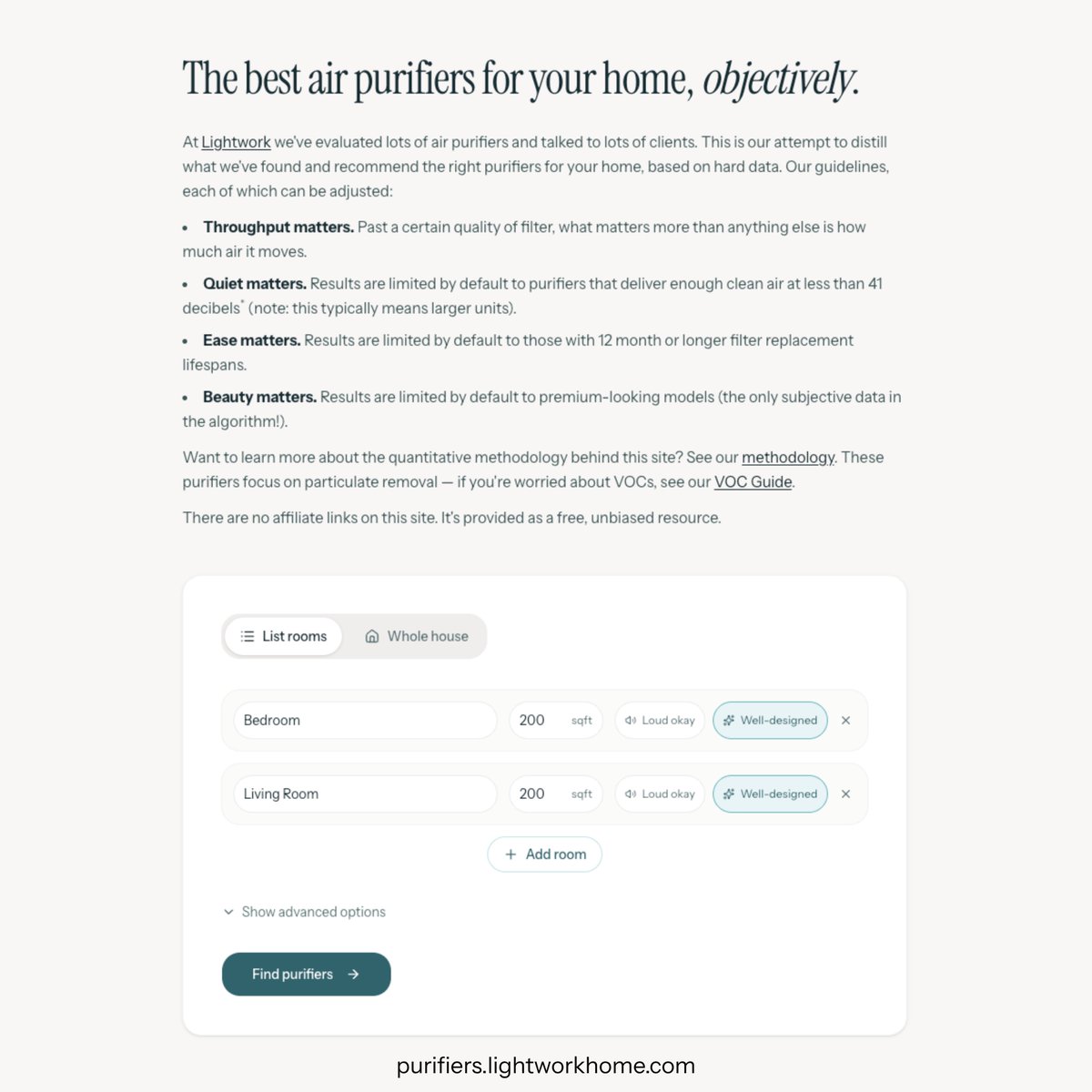
We built a free, data-driven tool to objectively help you choose the right air purifier for your home.
There is so much marketing noise in the air purifier space. Companies use and come up with all sorts of buzzwords to suggest that their purifier does something special. It's shockingly difficult to get straight answers and objectively evaluate performance.
So we created a free tool to help you pick the right air purifiers for your home. 100% free, no signup required, no affiliate links, no partnerships or bias. Just data.
Here’s something that might surprise you: most modern air purifiers filter about the same percentage of particles. Any HEPA filter removes at least 99.97% of particles at around the size it performs worst at (which is pretty dang good!). So what matters more is throughput (measured as CADR, or Clean Air Delivery Rate), how much air the unit can push through that filter. A purifier that's too small for your room will never get the air clean, no matter how good the filter is.
But after consulting on air filtration with a lot of clients, we've realized that there are some other real-world, practical considerations that most recommendations ignore:
> Quiet matters. If an air purifier is too loud, people simply won't use it. And an unused air purifier is no good at all.
> Ease matters. If you have to replace the filters too often, most people will simply not do it. And dirty filters tank the efficacy of a unit.
> Beauty matters. For many customers, having an ugly air purifier is a non-starter. So finding aesthetically-appealing ones, at least for certain rooms, is a factor.
> Price matters. On top of all that, people want value. If it's too expensive, it won't get purchased in the first place.
So we've created a tool that factors in all of the above to recommend the right air purifiers for your home. You put in your room sizes and preferences around noise and design, and it recommends a best-value pick and an upgrade pick for each room. The site walks through the methodology behind it all, including a metric we developed called "Quiet CADR," the clean air delivery rate at a volume you can actually live with.
One of our main goals at Lightwork is to bring science-backed, data-driven rigor to the home health industry, which has historically been plagued with imprecision, poorly-supported claims, and (at worst) scams.
(link below)
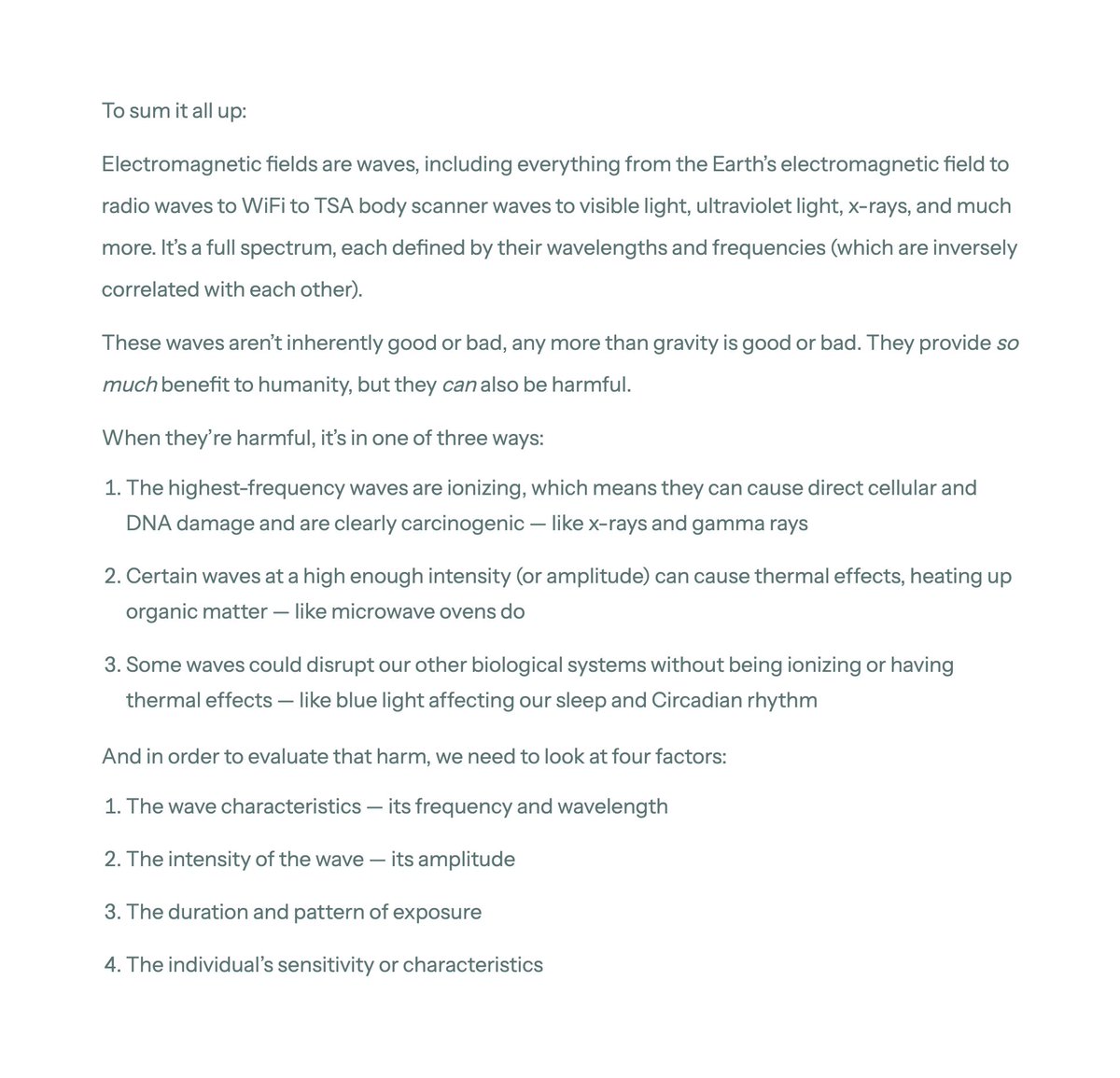
Thanks, Sarah. We're in agreement that biological interaction is not at all the same across the spectrum. Attached is a screenshot of our ultimate summary in the original article — we specifically say you need to look at the frequency, the intensity, the duration and pattern of exposure, and the individual in question before drawing any hard conclusions.
I appreciate the feedback, but I'm frankly not sure how I would explain some of these topics to people without using examples (which I think we are clear are only examples and don't represent the entire spectrum — that's sorta the point of the article).
Regarding major health authorities — certainly true in some cases, although also worth noting that regulatory limits vary by country. We go into the regulatory dynamics in the US in yet another article here, which suggests some questions about the approach (including the fact that the FCC, the US' primary RF-EMF regulator, has been under a standing DC Appeals court remand for the last 5 years to better explain their rationale for the current limits and yet has not done so): https://t.co/Ldfif9o8dk
Hi Sarah — author of the article here. Happy to discuss the article and the science.
Since you're interested in the body of scientific papers, you may enjyo another piece we published with a pretty exhaustive review of the literature on potential carcinogenicity of RF-EMF, which looks at many papers, some of which claim common exposures are harmful and some which claim they aren't. The literature is certainly divided! https://t.co/cbUg32BDUi
To your points:
>- You’re making a false bio equivalence. Blue light affects specific retinal photoreceptors evolved to regulate circadian rhythm. Wifi + AC EMF don't interact with those receptors.
Where in the article do you see us claiming wifi & AC EMF interact with those receptors? We do not. Blue light is simply used as an example to demonstrate that non-ionizing, non-thermal electromagnetic fields _can_ have disruptive biological effects (something commonly disputed in public, but which we think is effectively incontrovertible). We don't believe that RF-EMF works through the same mechanisms as blue light, in general.
>- Re: “EMFs can disrupt systems in your body.” Which systems? Through what mechanism? At what dose?
The article you were reading was an overview of EMFs broadly and explicitly did not set out to answer those questions. The one I just linked above has much more information regarding your questions on RF-EMF bioeffects specifically. We plan to write another similar one on ELF Magnetic fields and likely one on AC E fields.
>- Re: “If the amplitude is high enough, tissue gets heated.” For microwave oven levels at 1000W. Wifi router emits 0.1/1W dispersed. Nothing to compare here.
Correct, and our article agrees with you here. We do not claim that wifi routers cause thermal effects. In the section you cited, we are simply explaining what thermal effects are, not suggesting wifi routers cause them. (It's the "Non-ionizing but thermal" section of the article, which we don't claim applies to things like wifi routers)
>- Non-ionizing radiation (wifi, radio, AC) doesn't have enough photon energy to break chemical bonds. Only ionizing radiation does
Also correct, and also completely in line with our article. See section "Ionizing EMFs" which describes what you're saying in detail. I'm not sure what you're suggesting we got wrong here.
>You present correct physics concepts, then jump to unsupported biological implications
Can you please point out the "unsupported biological implications" in the article? If there are any, we would want to address them and update the article.
>+ you're not explaining why the dozen of papers who claimed that there're no significant risks at realistic exposure are wrong.
Regarding the papers — that was not the mandate of the overview article. But if you have any thoughts or disagreements with our analysis in the literature review article (on a clearly divided scientific body of evidence), we would deeply appreciate it. We take the science seriously and are always open to corrections and updates.
See below for some research & writing we (Lightwork) have done on EMF science. Would be thrilled to discuss the actual science with anyone who wants to.
I'm not sure the EV concerns are substantiated, especially given (for most people) limited time spent in them vs. sleeping or working setups. And we have measured EV EMF exposure and they do not necessarily have highly elevated fields — very dependent on the electrical configuration and where you are in the car, and the type of EMF you are looking at. I don't see it as a huge concern.
https://t.co/i0bghC1Cu7
(Andy from Lightwork here) I'd add, JD, if you're interested, that we have more information about EMFs in these two articles and others on our site:
https://t.co/cbUg32BDUi (very in-depth review of the scientific literature relating to RF-EMF carcinogenicity)
https://t.co/WBEO8fw9IQ (overview of EMFs)
We agree — there is a TON of non-scientific perspectives and fearmongering on EMFs out there. But at Lightwork we aspire to counter that with data & science :)
(Andy from Lightwork here) I'd add, JD, if you're interested, that we have more information about EMFs in these two articles and others on our site:
https://t.co/cbUg32BDUi (very in-depth review of the scientific literature relating to RF-EMF carcinogenicity)
https://t.co/WBEO8fw9IQ (overview of EMFs)
We agree — there is a TON of non-scientific perspectives and fearmongering on EMFs out there. But at Lightwork we aspire to counter that with data & science :)
I did a whole-house toxin health assessment, where a guy spent half a day testing our house's air quality, water, EMFs, lighting, mold, and household products.
So many surprises:
- Our Waterdrop reverse-osmosis water filter seems to be introducing a chemical (Dichloromethane) into our drinking water that wasn't in the (whole-house filtered) tap water. Will recheck this to make sure it's not a fluke.
- Even though we have air purifiers in many parts of the home, they weren't on the proper setting so our air quality was not great. Turned them all up higher.
- Most of our light bulbs have blue light and super high flicker rates which disrupt circadian rhythms. Replacing a bunch of them.
- The wifi router in my office is EMF'ing the sh*t out of me. Going to move it to a different part of the room.
- The powerstrip under our bed is EMF'ing the sh*t out of us. Getting a grounded power strip that avoids this.
- Some of our shampoos and soaps had harmful ingredients.
On the plus side, no gas leaks or carbon monoxide 👌
I'm predicting this is going to become the next microplastics-type trend, to test your home for toxins and harmful products.
@kepano@obsdmd I don't mind the "attachments get synced into an attachments/ subdir in the shared root folder" solution honestly — feels weird to not let anyone on the doc add attachments
I love Obsidian, but I hate pasting my notes into Google Docs to share & collaborate with others.
So I built a plugin called Collaborative Folders that enables real-time, e2e encrypted, multiplayer editing inside your local Obsidian app.
Path conflicts - everyone can rename the folder independently, doesn't propagate. If you receive a "Company docs" folder share and you already have one, it shows up as "Company docs (1)" in your vault
Attachments - this is tricky. What I do now is that attachments in shared notes get copied to a attachments/ subfolder in the shared folder, and the references in the note get changed to that one. I don't like how it requires duplicating the attachment, but didn't have a better idea. Open to others!
Short links - assuming you mean [[links]]? There is some weirdness here, I don't change these. So if you have a [[link]] to another file that isn't shared... it will just link to that location in the recipient's vault, which might be nowhere or a different place. If the [[link]] is to something in the shared folder, it will continue to work as long as you don't rename the folder. I can see having some logic there, but thought it might be surprising and so left it "basic"
Lmk any other edges you can think of, I want to make the ergonomics of this as smooth as possible. Feels like some inherent conflict between "local-first" and "sharing," and my principle so far for resolving is "avoid surprise." Really I think the best answer would be entirely separate "shared vaults" like Google Shared Drives, but that's less pleasant and integrated...
Note: beta product, use with caution and always back up your vault!
p.s. if anyone knows someone at Obsidian and can get my community directory submission nudged... I'd appreciate it :)
https://t.co/hsshDmpeQW