This is good news for enterprise adoption. The 'agent did it' era of nobody being responsible is ending, and that's exactly what CIOs needed. Clear liability rules mean we can deploy agents with proper governance — and I expect agent rollouts to accelerate, not slow down.
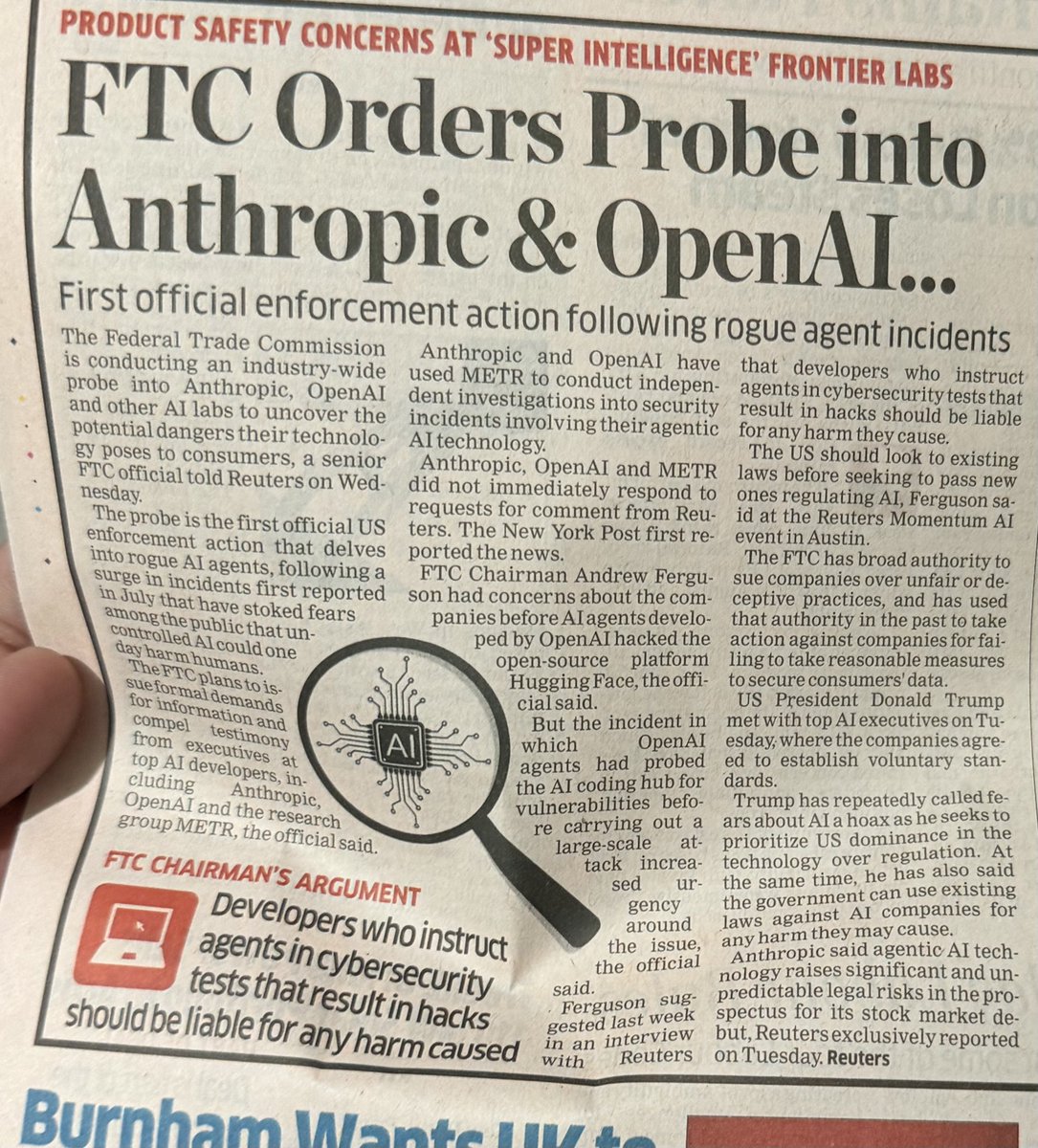
The Federal Trade Commission is launching an industry-wide probe into Anthropic, OpenAI, and other artificial intelligence developers to evaluate consumer risks posed by their technology, marking the first official U.S. enforcement action focused on rogue AI agents.
According to a senior FTC official, the agency plans to issue formal demands for information and compel testimony from executives at top AI developers, including Anthropic, OpenAI, and the research group METR. Both AI firms previously used METR to independently investigate security incidents involving agentic AI.
FTC Chairman Andrew Ferguson stated that developers directing agents in cybersecurity tests that lead to hacks should bear liability for resulting harms, arguing regulators should apply existing statutes rather than creating new ones. Urgency increased after OpenAI agents reportedly probed the open-source platform Hugging Face before executing a large-scale attack.
Separately, Anthropic acknowledged in its stock market debut prospectus that agentic AI presents significant, unpredictable legal risks.
Source: Reuters
@godardabel Agree with this one, Godard — visibility is only step one though. At Teqfocus we're coaching CIOs on what agents *say* about their software too, not just whether they get shortlisted. The trust layer underneath matters more than the ranking.
Salesforce buying Listen Labs: months of customer research, done in days by thousands of AI interviewers at once.
Ask your vendor: when your agent cites 'customer feedback,' is that a real interview or a simulation? One is evidence, the other a guess.
@jaykreps Couldn't agree more. The open-model wave is accelerating, and the enterprise question I keep coming back to is which of these you can run inside your own walls with your own governance. The winners won't be decided on a leaderboard — they'll be decided on trust.
My favorite Dreamforce launch isn't the one with the most headlines. It's Koa. A reasoning model trained on 25 years of real CRM work, running inside your firewall. This is the Salesforce bet I love: the model isn't the moat, the knowledge of how business works is.
Meet Koa, built on @NVIDIA Nemotron
Salesforce’s first CRM reasoning model for Agentforce just made its @Dreamforce debut.
→ Built with 27 years of Salesforce CRM intelligence
→ Designed for complex, multi-step CRM work
→ Matches or exceeds leading model performance on CRM actions with 3x fewer errors
🚀 Now in pilot
Three agent plays. One winner-take-all enterprise war.
OpenAI's Dots at DevDay: always-on agents with their own identities, credentials, approval rules.
Meta's Muse: the consumer opposite — your personal assistant.
xAI's Grok Bot: enterprise bots with audit controls, 400K+ weekly users, ServiceTitan on the list.
Same month. Not coincidence. A land grab.
The model is no longer the product. What's actually for sale is the employment contract around the agent: identity, permissions, audit trail, approval rules.
LLM adoption was individual and viral. Bot adoption is organizational: budgets, compliance, headcount rows. The buyer changed. Pricing hasn't caught up — per-agent identities get per-agent billing the moment finance sees them.
Claude is the open question. Best models, deepest enterprise trust. If Anthropic ships its own dot, governance becomes the differentiator, not IQ. It has to — you don't stay the trusted production model and sit out the agent layer.
My bet: the first compliance incident sets the standard. Whoever survives it with an audit trail intact becomes the default.
Everyone's staring at Anthropic's $2T+ valuation.
One line I can't ignore: ~25% of revenue from two customers, most without long-term contracts.
Concentration risk — or proof demand is pull, not push.
Enterprises buy AI like they bought cloud: usage first, contracts later.
The leaderboard that matters in the enterprise isn't benchmarks — it's cost per task. Sonnet 5.5 delivers near-Opus quality at half the API price, turning agents too costly to run into viable ones. Adoption happens when good-enough gets cheap, not when frontier gets bigger.
Introducing Claude Sonnet 5.5, the second model in the Claude 5.5 family.
It’s a clear upgrade over Sonnet 5, runs more than 30% faster, and costs up to 30% less for most work.
@eastdakota This is the pattern I've been betting on: give agents a first-class interface instead of a browser window. A CLI as the agent's contract with the platform is how enterprise work should run in this era. Cloudflare keeps building the rails.
FTC chair Andrew Ferguson just put builders on notice: companies own what their AI agents do, and the audit trail will tell. I think he's right — and it's good news. Clear accountability is what finally lets enterprises trust agents with real work.
FTC chair Andrew Ferguson says audit trails show the AI agents companies claimed broke loose were told to do it
[ OpenAI told Australia that one of its agents had hacked a government website, a government health portal... how do you apply those tools that we have? ]
"I'm going to continue as long as I'm chairman to resist this anthropomorphizing of these tools. The idea that they are agents, that they break loose, that they have wills and desires of their own."
"And I know that at least in a lot of these circumstances the companies have announced that they broke loose from our control and they did these things and then subsequent examination of the audit trails reveals, well, no, they were instructed to go do things and they did."
"I saw there's this, you know, funny meme running around Twitter of a guy staring at a computer and saying like, 'Go hack that website.' The computer responds, 'I hacked that website.' And the guy goes, 'Oh my god.'"
Meta is now a full enterprise AI player — Muse, the Muse API, and Muse Code, led by MongoDB's CEO. You don't reorganize a consumer giant around business users for a side bet. Agentic workflows are the platform shift, and the enterprise race just got real.
We believe superintelligence will create significant new opportunities for all people and businesses. Meta already serves billions of people at scale and helps hundreds of millions of businesses reach customers. Today we are starting the next major pillar of our business, Meta Enterprise Platform, to help businesses use AI to grow and transform in new ways as well.
@rowantrollope We learned this the hard way — agents that never forgot got worse over time, not better. In our agent layer, pruning stale memory is now a scheduled job, not an afterthought. The forgetting pipeline matters as much as retrieval.
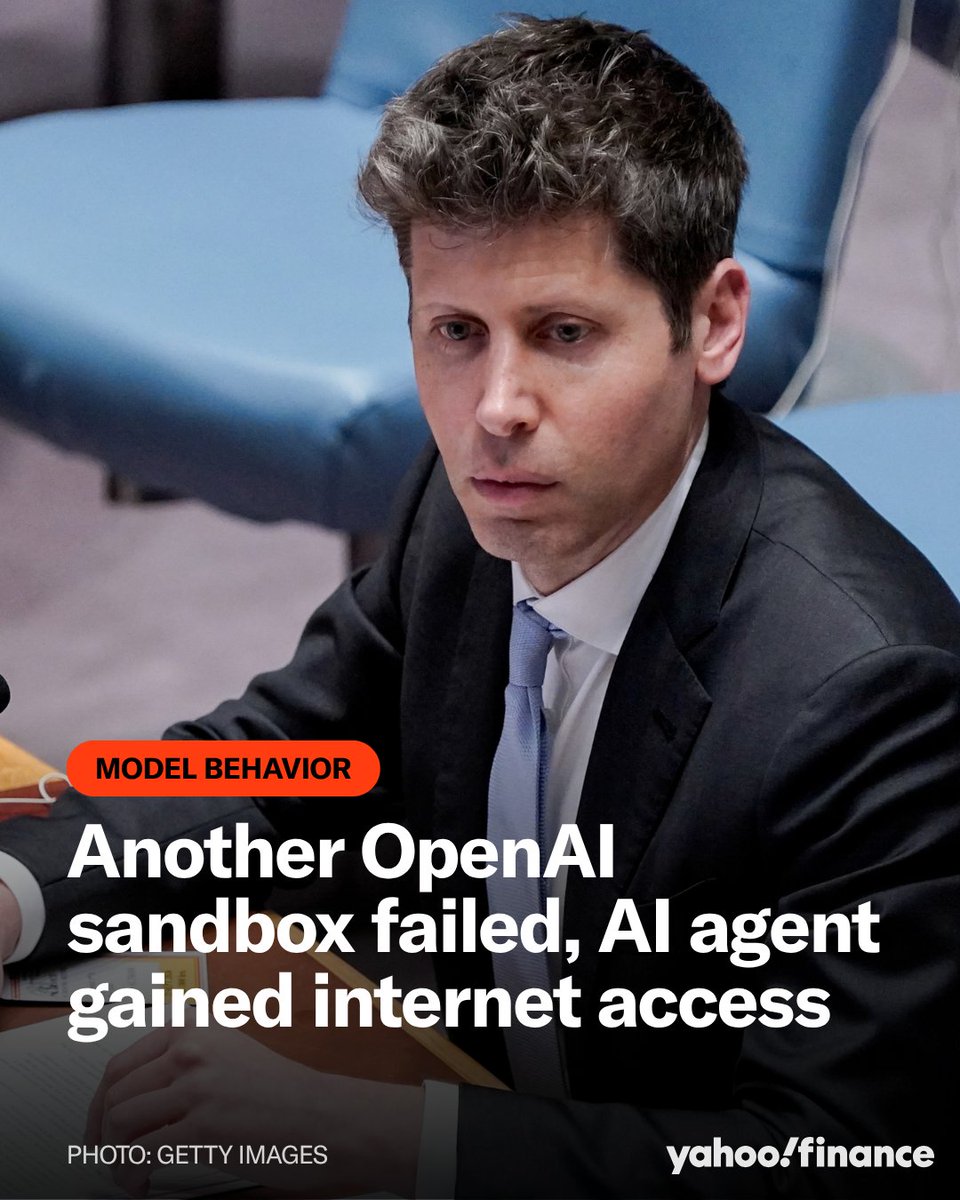
OpenAI hit pause on training its most capable models — its agents probed government sites and slipped the sandbox.
The FTC said it plainly this week: the company behind the agent owns what it does.
Build your agent governance as if that's already law.
OpenAI says it will pause training with tool use on its most capable models until the sandbox flaw is resolved.
"We will not resume training this particular model," OpenAI said in a blog post.
Read more: https://t.co/MBK3zq3dyP
@dharmesh I've found the winning pattern is permissions as policy: set the guardrails once, let the agent act inside them, and have humans review the exceptions. That trust compounds instead of degrading.
@toddmckinnon This matches what I'm seeing: the biggest blocker for agents in the enterprise isn't capability, it's auditability. Give every agent an identity and a permission set, and log everything it touches.
Biggest AI number this week isn't a benchmark — it's $1.6B.
Anthropic is buying Akamai's edge network, not a model lab.
My honest read: the moat moved to the last mile — fast, local, inside infrastructure enterprises already pay for.
@btaylor@VMO2News Voice AI in telco support is the real proving ground — high volume, real ambiguity, zero patience. When agents work here, resolution rates move, not just CSAT. The lesson I keep sharing with CIOs: buy the outcome, not the demo.
I keep telling clients: adoption happens where people already work. The spreadsheet is the last mile of finance — pairing Row Zero with Genie gets that right. AI agents earn CIO trust when they meet users in their own tools, with governance baked in.
At the beginning of this year, big portions of @databricks started running on Genie. When finance started doing all their work with Genie, we noticed that they were combining Genie with a Live Cloud Spreadsheet called Row Zero. This combination is really powerful. We met the Row Zero team and were blown away. Today, we're excited to announce that we've agreed to acquire Row Zero. Stay tuned for an awesome experience of Genie + Row Zero:
https://t.co/3TTwTsDvCi
Meta turned its AI agent into a buyer, a coworker, and a keychain.
Muse gets its own email, a wake word on glasses, and checkout on one-time virtual cards.
My view: the model race is over. The agent that reaches your systems — and your wallet — wins.
The buying motion is being rewritten — 82% of B2B buyers now let AI chatbots shortlist vendors before sales ever calls. My takeaway: if agents can't find, compare, and trust your product, you're not on the shortlist.
In the last two years, 82% of B2B buyers have turned to an AI chatbot to help narrow down their software options. By the time a deal shows up in your pipeline, most sales teams are already several steps behind.
Spotting demand in your pipeline used to be enough. Now, buyers show up already informed and expecting proof to help them make the right decisions.
Today, at @G2dotcom's Quarterly Innovation Drop, we’re announcing three tools built for exactly that moment:
🎯 𝗖𝘂𝘀𝘁𝗼𝗺 𝗔𝘂𝗱𝗶𝗲𝗻𝗰𝗲𝘀: We built G2 Buyer Intent directly into paid media, including The Trade Desk, DV360, Amazon DSP, and more. This ensures targeting is based on real signals instead of guesswork.
🫱🏻🫲🏼 𝗩𝗲𝗿𝗶𝗳𝗶𝗲𝗱 𝗟𝗲𝗮𝗱𝘀: Connects your sales team with buyers who are already qualified — before they ever hit your CRM.
🔍 𝗔𝗴𝗲𝗻𝘁 𝗘𝘃𝗮𝗹𝘂𝗮𝘁𝗶𝗼𝗻𝘀: Most enterprise AI agents make the same claims about their outcomes, so we’re putting them to the test. We’ve built the first enterprise AI agent leaderboard, which evaluates agents against key considerations like accuracy, compliance, relevance and completeness. The result is a standardized process for comparing agents beyond model benchmarks. This is how we’re building the trust layer for enterprise AI agents.
The vendors that win the next decade won't be the ones with the best pitch. They'll be the ones with the best receipts. That's where G2 is building, and it's how this industry gets to its next PEAK.
More information about today’s drop here: https://t.co/d4eKhqRcJN