NASA-Daten zeigen beispiellose Begrünung der Erde
Während Regierungen weltweit Billionen ausgeben, um den CO₂-Ausstoß zu reduzieren, verweisen einige Wissenschaftler auf eine Entwicklung, die in der öffentlichen Klimadebatte nur selten im Mittelpunkt steht: Die Erde wird grüner.
Satellitendaten…
https://t.co/mMwJYDk3GE
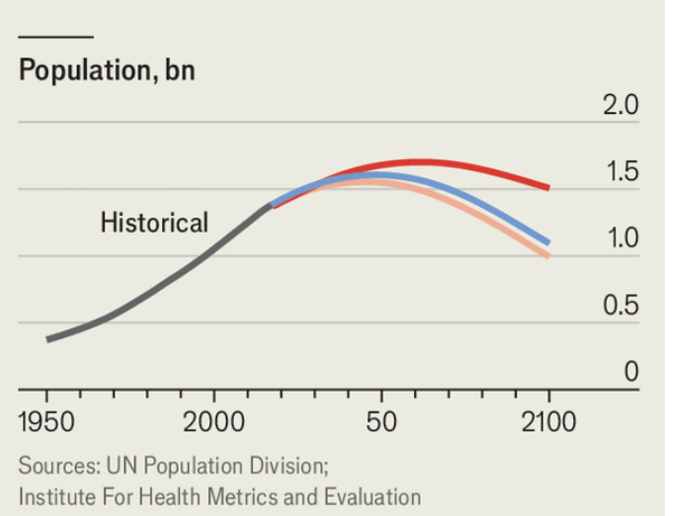
Our cover story in Asia this week is India's baby bust. Fertility rates are falling remarkably fast across the country-- in several states women are now having the same number of children as those in Scandinavia. That means we should think differently about India's future:
Look at the surrounding. Temple is encroached to such an extent that I am afraid in few years Dharmic people will start encroaching on top of temple. This is VRINDAVAN by the way! Even Jihadis may look like a failure infront of them.
Biggest tragedy of Gangetic plains is that it has become too much addicted to Jholachhaps socialism.
The hostility and opposition towards BRT has always been about power politics.
BRT reallocates scarce road space from a minority travelling in private cars to a majority travelling by public transport. For some, the idea that a bus full of workers should move faster than a luxury SUV is simply unacceptable.
Many of these BTech+MBA/policy/econ chaps
Are blackpilled about their own life
They did two degrees aimlessly without proper focus or interest
And now completely lost and disillusioned
India's Total Fertility Rate has fallen from 2.3 (2012-14) to 1.9 (2022-24), with most major states now below replacement level.
Southern states, facing ageing populations and future labour shortages, have already begun discussing incentives to encourage higher birth rates.
Demography changes slowly, but its consequences last for generations.
Over two-thirds of all countries are now below the replacement rate of fertility needed for a stable long-term population. India exemplifies why this global slump is happening https://t.co/7LrxRzC6wk
As recently as 2019, Narendra Modi warned India was facing a “population explosion.” Today, India's total fertility rate of 1.9 is below replacement, and the TFR in major cities like Delhi (1.2) is lower than that of advanced economies.
The Economist writes
India's total fertility has collapsed to much below 2.1 now (the replacement rate), and is dropping sharply. By 2100, India may shrink to well below 100 crores. And surprisingly, all this is happening even as India's women labour-force participation remains very low. Women no longer want more than 1, or at the most 2, kids.
#fertility #India #TFR #RFR #WLFPR
Lucknow: The proposed Regional Rapid Transit System (RRTS) corridor between Lucknow and Kanpur has gained momentum, with the Uttar Pradesh government approving funding for key planning reports.
The gangetic plains.
Endless flat lands. Easy to develop.
You could have never ending housing supply.
How did the NCR real estate industry make it so that we see prices doubling/tripling and homes going out of reach for the avg person?
To claim GCCs as crucibles of R&D is, for an unknown person, an ignorant take, and for a known person, a dishonest take. A GCC is the bottom half(sometimes 2/3rd charitably) of a tech stack in the capability vertical for a mechanical engineering company. It may have entire breadth of functional work but the core research in the “R”&”D” part happens at HQ. A simple test is say a bunch of engineers come out of Cummins India in Pune, can they create their own IV engine. The answer is no. Therein lies the answer. The core know why, the generation, testing and validation maps, the wealth of data of precious designs and tribal knowledge on niche physics phenomena observed during tests, recorded and analyzed, the testing processes stay in the HQ R&D center. And whatever useful output comes from the GCC the patents are filed in the name of the company and owned by the MNC. To claim this as Indian R&D is essentially blurring the line to make India look good.
Helps in twitter debates for gotcha points but doesn’t do much for national capabilities.
Only 14.6% of total PLI outlay has been disbursed to manufacturers. PLIs by design have a delayed reward mechanism. Allocated outlays also seem to be outlandish in some cases, especially if only 20% has been disbursed 3-4 years after the onset of the scheme.
We need to rethink PLIs or develop more hybrid schemes where capex, opex, employment incentives and production incentives are combined into a single scheme.
Some notes and caveats for the chart to keep in mind: - Solar and Battery PLI disbursements should kick in soon -late 2026/early 2027. Will update the chart then.
- Will make a separate chart for investments attracted by PLIs for each sector.
- Pharma, bulk drugs, food, telecom, white goods and medical devices are included in the 'Other 7 sectors' because data for individual sectors is not available.