I went through all 248 files in the new USAID Files that were just released. Here is a list of all the "disinformation" and "information integrity" programs your tax money was really being spent on:
- $358M US 2021 foreign media "disinformation" spending (USAID 72%)
- $158M USAID global media programs
- $93.9M Iraq Chemonics "Community Resilience Initiative"
- $79.8M Ukraine Russian-language TV and digital content
- $75M Ukraine Internews Media Program
- $60M Ukraine media programs to counter "disinformation"
- $30.5M Latin America "Citizens Empowered" program
- $24.7M Ukraine gov't comms, incl masterclasses with Hollywood experts
- $20M Europe/Eurasia OCCRP investigative reporting
- $19.9M Colombia "Partners for Transparency" media (La Silla Vacía)
- $19.9M Venezuela IRI independent news
- $19M Tunisia Political Transitions Project
- $15M Belarus Freedom House, Internews media
- $15M Armenia Internews media program
- $15M Central Asia Internews MediaCAMP
- $14M Serbia IREX MediaInnovation
- $14M Ukraine Chemonics "Confidence Building Initiative"
- $13.4M Mexico journalist/human rights defender protection
- $12.8M Venezuela Freedom House news program
- $12M Ukraine emergency media activities
- $10.65M Kyrgyzstan Internews Media-K
- $10.35M Nicaragua "Voices for All" media
- $10M Bosnia Internews media engagement
- $10M Georgia IREX media program
- $10M Western Balkans Internews media
- $9.7M Tanzania FHI360/Internews media
- $9.4M Nicaragua media strengthening
- $8.5M Chad FHI 360 civil society
- $8.3M Moldova Internews media accountability
- $8M Serbia Media Investment Fund
- $8M Sri Lanka IREX media (MEND)
- $7.5M Georgia "information integrity"
- $7.5M Eurasia Russian-language news
- $7M Philippines media freedom initiative
- $6M Mexico ICFJ Reporting Hub
- $5.3M German Marshall Fund anti-disinformation
- $5M Belarus NDI/IRI political program
- $5M Guatemala/Peru/DR youth media "Voces de la Juventud"
- $4.5M Mali media literacy
- $4.4M North Macedonia youth media literacy
- $3.9M Central Asia countering disinformation
- $3.5M Azerbaijan IREX journalism
- $3M Serbia social media influencer training
- $2.6M Moldova "resilience initiative"
- $2.5M Bosnia investigative journalism
- $2.35M Peru civic education for schools
- $2.1M Belarus "alternative narratives"
- $2M Mexico Article 19 free expression
- $2M India UNICEF COVID messaging
- $1.79M Indonesia media literacy via memes, games and influencers
- $1.6M Ukraine "critical media consumption"
- $1.5M Belarus civil society media/disinfo
- $1.5M Jordan anti-disinformation
- $1.47M Asia/Eurasia IREX Vibrant Information Barometer
- $1M Mali radio campaign
- $779K Ukraine National Association of Media
- $631K Libya anti-disinformation
- $500K Internews/YouTube media pilot
- $488K Malaysia anti-disinformation
- $464K Afghanistan "Peace Support" messaging
- $200K Cambodia digital monitoring
- $61K Kyrgyzstan digital security support
- $38K Latin America digital support
- $32K OECD "Mis/Dis Hub" (plan incl DEIA/LGBTQ+ grants)
Here are some additional USAID proposed spending mentioned:
- $300M Countering Chinese Influence Fund
- $20M "information manipulation" funding mechanism
- $8–10M per year for disinformation fund via Summit for Democracy
- $2M "information manipulation" monitoring hub
- $1.5M staff "information integrity" training
Again, this is so our tax money being spent to manipulate the media and disinformation programs all over the world
This is what USAID was really used for. It wasn’t for helping feed the hungry. It was used for regime change and manipulation
🇮🇳 Honour the heroes. Remember their sacrifice.
Join us on 26th November 2026, 7:30 PM onwards at the Gateway of India, Mumbai, for the 18th anniversary remembrance of 26/11.
A Candlelight Vigil, Special Video Screening, Pledge Ceremony, felicitation of martyrs’ families & Message to the Nation.
🇮🇳 Take the online pledge: [https://t.co/LqQvg7UAnj]
Let us unite.
One Nation. One Resolve
#NeverEver2611 #26November #NSG
Saw Batman riding a buffalo to ‘Saajan Saajan Teri Dulhan’?
No, you’re not imagining things!
The Dark Knight has gone full desi, complete with village adventures, roadside chai breaks and his very own Bhains Mobile.
But who is the creator behind this viral AI series, and how is he making it happen for just ₹5,000?
Scroll down to meet the mind behind Desi Batman!
#DesiBatman #SujalJaiswar #AIContentCreator #AIVideoCreation #ViralIndianCreators
[Sujal Jaiswar Desi Batman viral AI video, Desi Batman buffalo video creator India, NewDen Productions Sujal Jaiswar]
Reporters Collective (Thread)
From last few days, Reporters Collective has been doing exposés on Election Commission, and their exposés are so childish that they get debunked within a hours
Let’s teach them how to expose
Let’s expose money behind the Reporters Collective
1/19
I asked Swami Harshanand, “Why do so many successful men, like Jensen Huang, have other women in their life? Is it that success makes them more susceptible to temptation?”
He smiled and replied, “All men are similar. It’s just that women rarely seduce unsuccessful men.”😃
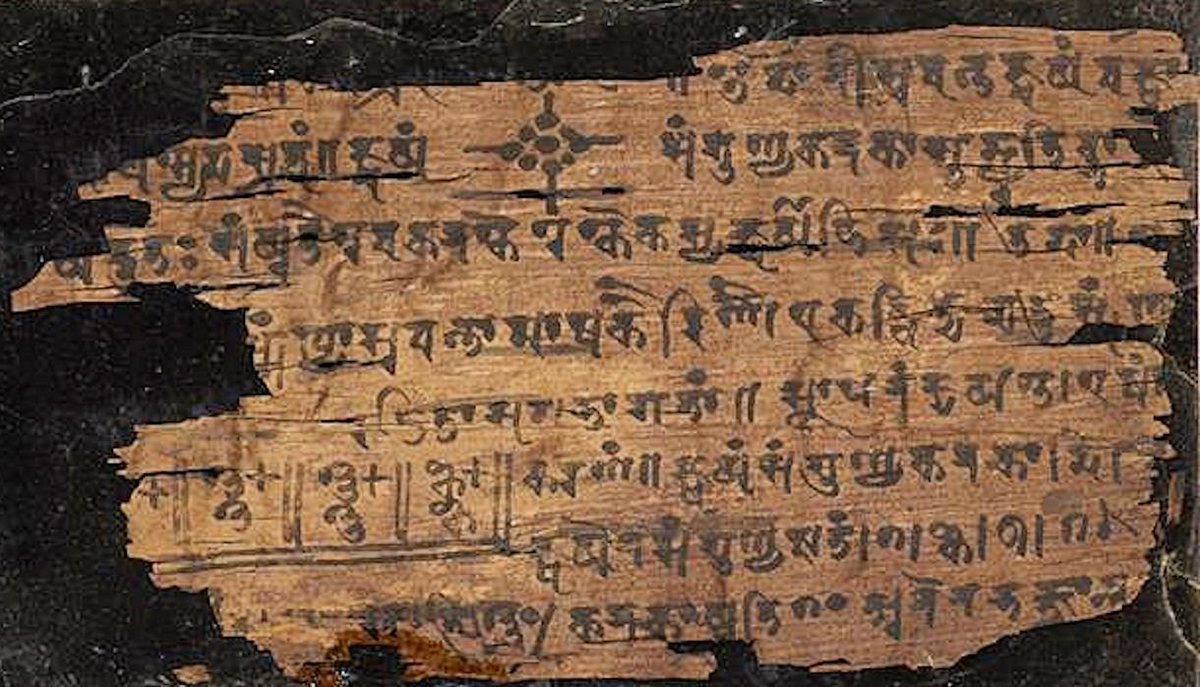
A farmer digging in a ruined place near Peshawar in 1881 found 70 fragile leaves of birch bark. They carried mathematics that still surprises us.
One leaf holds a rule for the square root of a non square number. Subtract the nearest square. Divide the remainder by twice that root. Apply one correction. That is all.
How good is it?
The manuscript itself computes the square root of 339009. Its answer is correct to 11 decimal places.
In another problem it checks its own answer using a fraction whose numerator has 23 digits. No decimals. No calculator. Just digits in a row, and dots for zeroes.
The bark reached Oxford's Bodleian Library in 1902, and the rule sat there, admired but shelved. Then in 1976, M.N. Channabasappa, a mathematics prof. at Karnataka Regional Engineering College, Surathkal, re-deciphered the sutra and turned the rule into an iteration.
In 1979 he reported that, iterated, the Bakhshali rule reaches the square root of 41 to ten decimal places 38% faster than Newton's method.
A rule from a birch bark, beating Newton at his own game.
In 2012, David Bailey and Jonathan Borwein proved why. One Bakhshali step is secretly 2 Newton steps rolled into one, so every step multiplies the correct digits by about 4.
They wrote that the Western tradition knew no square root method this powerful until well after the Enlightenment.
How old is the bark?
Oxford's 2017 carbon dating says its leaves come from at least 3 different periods, the oldest from the 3rd or 4th century. The rule itself cannot be dated. It may be older than the bark it sits on.
We do not know the scribe's name. We do know the professor's. Why is it not in our maths textbooks?
Sources: Indian Journal of History of Science, Ganita Bharati, American Mathematical Monthly, MacTutor, Bodleian Libraries
Photo: A folio of the Bakhshali manuscript on birch bark. The dots are its zeroes. Credit: National Geographic / Bodleian Libraries
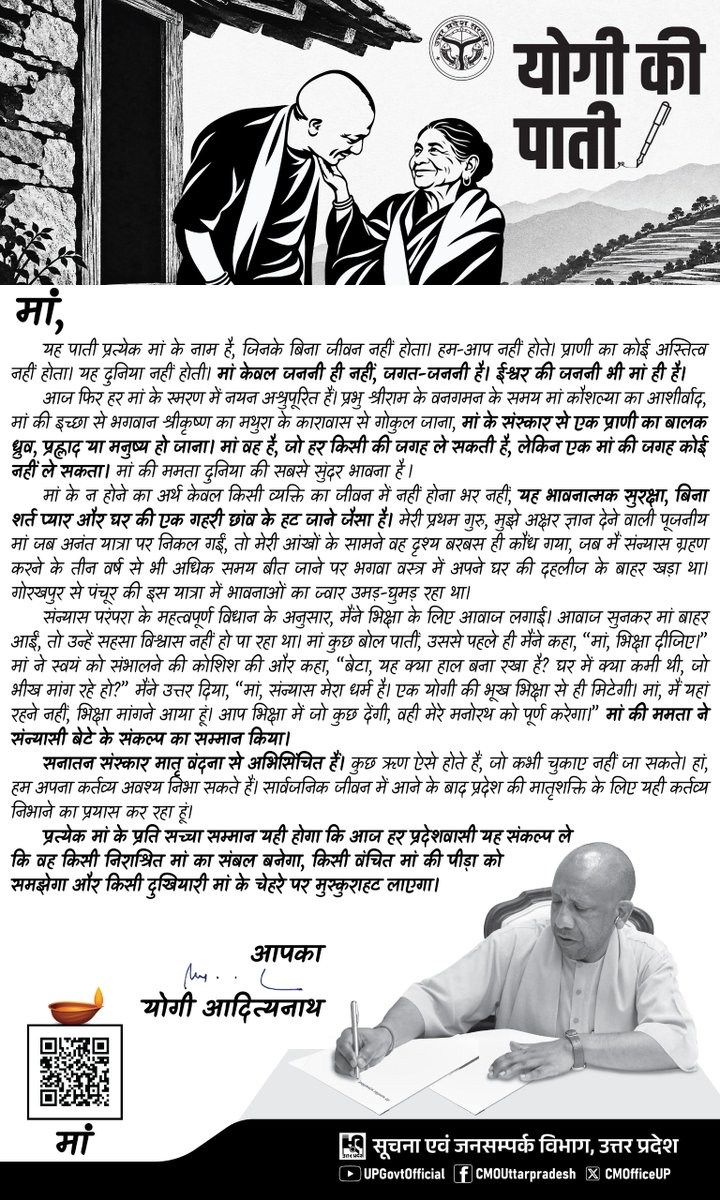
सनातन संस्कार मातृ वंदना से अभिसिंचित हैं। कुछ ऋण ऐसे होते हैं, जो कभी चुकाए नहीं जा सकते। हां, हम अपना कर्तव्य अवश्य निभा सकते हैं। सार्वजनिक जीवन में आने के बाद प्रदेश की मातृशक्ति के लिए यही कर्तव्य निभाने का प्रयास कर रहा हूं।
प्रत्येक माँ के प्रति सच्चा सम्मान यही होगा कि आज हर प्रदेशवासी यह संकल्प ले कि वह किसी निराश्रित माँ का संबल बनेगा, किसी वंचित माँ की पीड़ा को समझेगा और किसी दुखियारी माँ के चेहरे पर मुस्कुराहट लाएगा।
The Sarasvati was so important to the Indian world that the memory of it was exported, with Indian religious ideas, as far away as Japan.
My son came back from his recent trip with photographs of the Benzaitendō at Chūson-ji in Hiraizumi, a thatched Edo-period hall in northern Honshu dedicated to Benzaiten, the name Japan gave to Sarasvati after she arrived with Buddhism.
Her eight arms and the bow and arrows she carries come from the Golden Light Sutra, which has a whole chapter on her. The statue in this hall was given by the wife of Date Tsunamura, lord of Sendai, but the cult is far older: she was worshipped in Japan by the Nara period, and the eight-armed figure at Tōdai-ji is the oldest in the country.
In Chinese her name meant something close to "deity of eloquence". At some point in Japan the second character was swapped for one meaning wealth, and she's mostly prayed to for prosperity now, which I suspect would have puzzled the poets of the Rig Veda.
The English panel at the hall calls her an Indian goddess of water and harvests. The Japanese text alongside it is more specific and names the Sarasvati river.
I think it’s time I got a new visiting card. Chairman of the jury for India’s Best CEOs for Business Today, India’s Happiest Companies and Times 50 Finest Restaurants. Jury member for Condé Nast Traveller’s Best Restaurants, Economic Times 40 Under 40, and part of the global jury choosing the world’s Best Restaurants.
Available for hire! 😄
For over 160 years, one question has haunted mathematics: is there a hidden order in the prime numbers?
In 1859, Bernhard Riemann linked the primes to a function called the zeta function and guessed that all its important "zeros" lie on a single straight line. If he was right, the primes are spread along the number line about as evenly as they possibly could be.
No one has been able to prove it, and the Riemann hypothesis became the most famous unsolved problem in math, with a $1 million prize on offer. On 20 November 2026, that may have changed: Anthropic mathematician Levent Alpöge announced that, working with the AI model Claude, he believes he has found a proof, and that the method also resolves a broader version known as the Generalised Riemann Hypothesis. The proof was written in Lean, a language computers can check step by step, and independent researchers, including MIT's Andrew Sutherland, have compiled it without issues. The proof has not yet been formally accepted, but if it holds up, it could be the biggest moment in modern mathematics, and the first time an AI helped crack one of math's greatest mysteries
Something incredible is happening inside a lab in Pune, and I am not sure how many of us are aware of it.
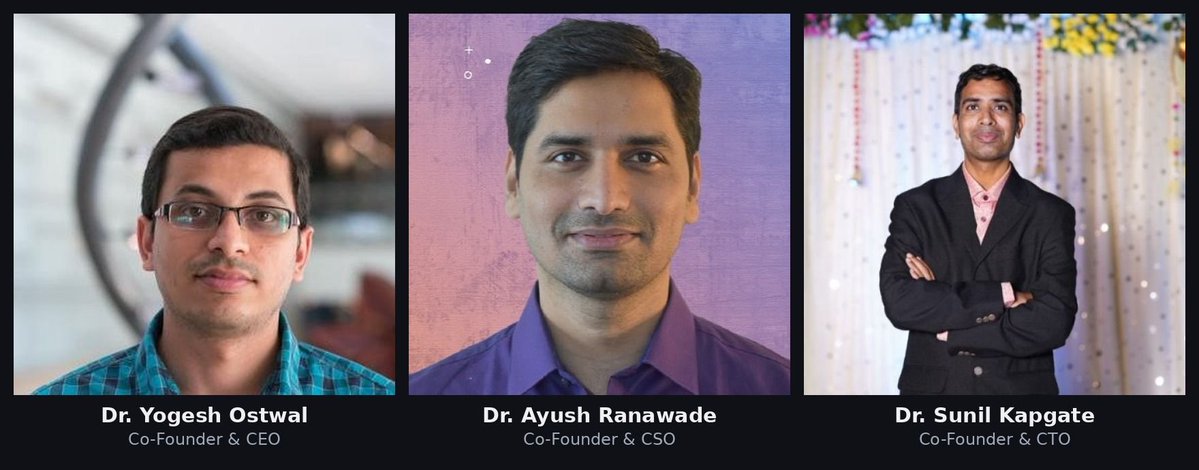
3 young PhD scientists, Dr. Yogesh Ostwal, Dr. Ayush Ranawade and Dr. Sunil Kapgate, are doing something that sounds like science fiction. They are designing viruses that hunt cancer.
Their startup is called Nucleovir Therapeutics, founded in 2024 at the incubation centre of IISER Pune.
The idea is simple to say and very hard to do. Cancer cells survive because our immune system fails to spot them. Certain viruses, called oncolytic viruses, can expose these hidden cells and also kill them directly.
Nucleovir uses its own AI model to design such viruses. Work that earlier took years can now be done in months.
Their 1st targets are glioblastoma, the most aggressive brain cancer, and pancreatic cancer. 2 of the toughest cancers we know.
And this is not just an idea on a slide. Nucleovir is the 1st licensed oncolytic virus manufacturer in India.
BIRAC picked them as 1 of the top 5 winners of its Bio AI Hub program in 2025 and funded them. Speciale Invest backed them in a seed round in June 2026, and BIRAC supports their AI platform under the government's Bio-AI program. NITI Aayog has featured them on its Frontier Tech portal.
Right now they are in the preclinical stage, preparing their 1st animal trials for the anti-glioblastoma virus. Human trials come after that.
It is a long road. But the question that started this company is worth reading twice: what if curing cancer could one day be as simple as taking a flu vaccine?
In a country where at least 15 lakh people battle cancer, 3 PhDs in a Pune lab have decided to fight cancer with a virus.
Names to remember: Yogesh, Ayush and Sunil. 🙏🙏
Sources: NITI Aayog Frontier Tech portal, Nucleovir Therapeutics, BIRAC
Photo: Dr. Yogesh Ostwal (CEO), Dr. Ayush Ranawade (CSO) and Dr. Sunil Kapgate (CTO), founders of Nucleovir Therapeutics, Pune. Credit: @SpecialeInvest