@fedex774@YetAnotherValue They've sold gas turbines for decades to LNG plants, refineries, pipelines. hyperscalers now want 500MW/campus, grid queue is 5+ years, can't wait.
$BKR — Baker Hughes, $63.88. The latest SEC filings tell a story the price hasn't fully repriced yet.
Q1 2026 8-K: IET RPO at a record $33.1B. May 21 8-K: $13.6B Chart Industries deal cleared shareholder vote, now sitting with EU regulators.
This is a pivot in motion.
@fedex774 The company is transitioning from oilfield-services cyclical into LNG / data-center power infra. It was mentioned in the latest podcast by @YetAnotherValue.
OFSE Oilfield Services & Equipment. Legacy drilling/completions. Cyclical with rig count.
IET Industrial & Energy Tech. LNG turbines, data-center power, H₂/CO₂ kit. The pivot.
RPO Remaining Performance Obligations. Signed-but-unbilled backlog.
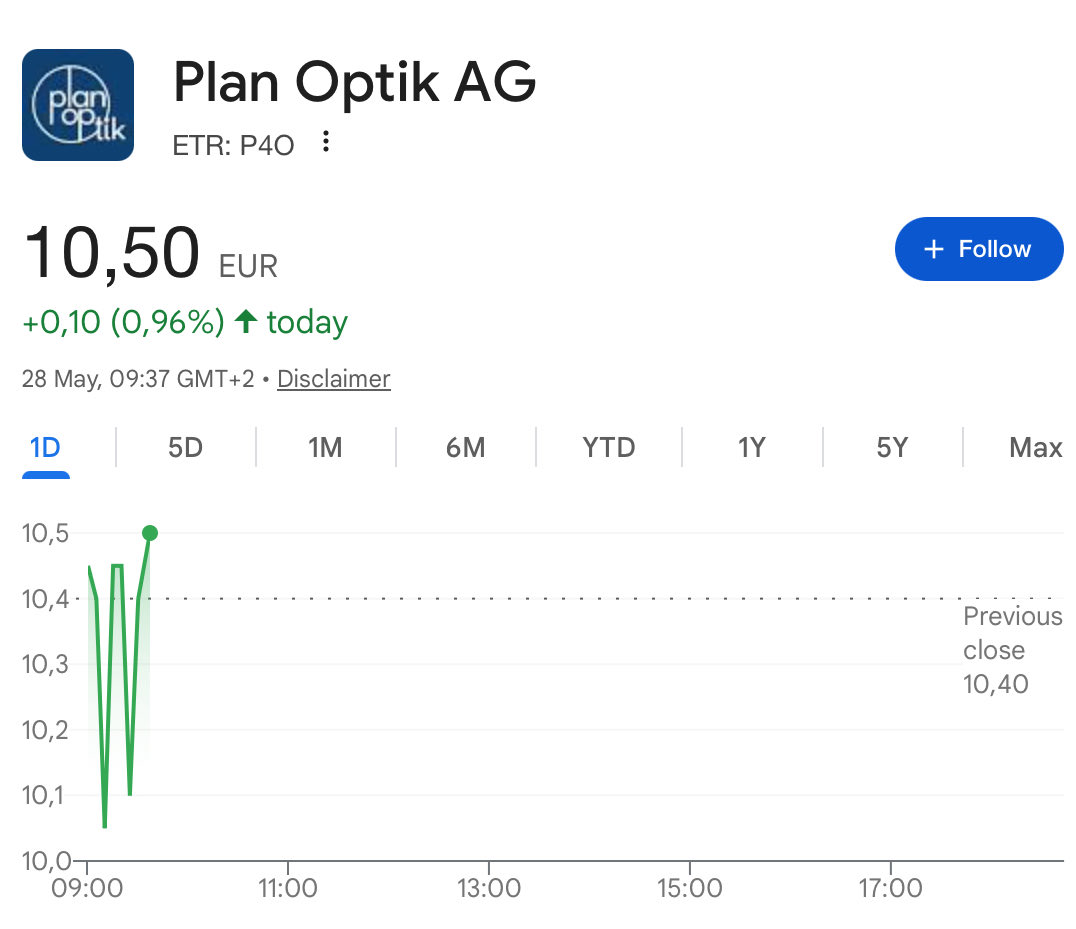
One of the most overlooked chokepoints in the entire AI hardware supply chain sits inside a €50M market cap German micro-cap operating out of a small town in the Westerwald that almost nobody outside specialist German investor forums has heard of.
$PLANOPTIK (ETR: P4O)
The AI infrastructure buildout is running into a physical wall. Organic substrates warp catastrophically under the thermal loads of modern AI accelerators drawing 1,200 watts each. The industry’s answer is glass core substrates, which match silicon’s thermal expansion coefficient almost perfectly, reduce package warping by more than 50%, improve signal integrity by 40%, and cut chip power consumption by up to 50%. The glass core substrate market is forecast by SEMI to grow at a 67.2% CAGR between 2028 and 2040.
But here is the bottleneck within the bottleneck:
To make glass substrates functional, manufacturers must drill tens of thousands of microscopic vertical pathways called Through-Glass Vias through substrates as thin as 100 micrometers. Traditional methods are too slow, economically unviable, and generate microcracks that cause catastrophic fracturing under thermal cycling. This TGV fabrication problem is the ultimate chokepoint in the glass substrate supply chain.
PLANOPTIK solved it.
In exclusive collaboration with the 4JET Group, they developed Volume Laser Induced Structuring, a proprietary multi-phase laser-and-chemical process that modifies glass molecular structure locally at tens of thousands of vias per minute without removing material, then selectively etches only the modified channels. Perfectly smooth-walled micro-holes, positional accuracy better than 2 micrometers, zero microcracks, and yields traditional methods cannot approach. PLANOPTIK processes panels up to 1,500 x 800mm. Traditional methods are constrained below 200mm.
The second chokepoint: Optical Circuit Switching packaging.
Google’s TPU v4 and v5 architectures deploy OCS using MEMS mirror arrays that physically reflect infrared laser beams between tens of thousands of GPUs. These arrays require hermetic micro-structured glass packaging with optical-grade caps allowing laser beams to pass through with zero distortion. PLANOPTIK is the sole supplier of these glass packaging wafers to Silex Microsystems, the world’s largest pure-play MEMS foundry, and Teledyne DALSA. Their headquarters sits directly adjacent to specialist optical coating manufacturer BTE Born, creating an integrated supply loop competitors cannot easily replicate.
Why do the financials look so poor?
Two simultaneous non-recurring events crushed 2025. Major customers went through prolonged inventory destocking while management simultaneously converted from German GAAP to IFRS and upgraded from the Frankfurt Open Market to the Regulated Market General Standard. Compliance costs were massive and concentrated entirely in 2025. Normalized against 2023 peak: €13.25M revenue, €3.07M EBITDA, €1.67M net profit, and an 88% gross margin reflecting absolute pricing power. Restructuring is entirely behind the company. Destocking has concluded. Management guided revenue growth exceeding €1M in 2026 and expects massive acceleration in 2027 as multiple customers enter full series production ramp.
Balance sheet: €3.73M cash, €19M total assets against €6M liabilities, 68% equity ratio, zero debt, Altman Z-Score of 7.72 indicating near-zero insolvency risk.
€50M market cap. 0.44% institutional float. Now eligible for European mutual funds and ETFs for the first time following the Regulated Market upgrade. An 88% gross margin, zero debt, a proprietary TGV process with no credible competitor, and sole-supplier status in OCS glass packaging for the world’s leading MEMS foundries.
The glass core substrate market grows at 67.2% CAGR from 2028. Advanced packaging doubles from $44B to $87B by 2035. PLANOPTIK holds the manufacturing key to both.
The market has not found it yet.
$P4O
A $145M Japanese company may be one of the reasons humanoid robots will ever be able to safely touch a human being.
While capital floods into robot software, actuators, and AI compute, everyone is ignoring the one company that gives physical AI its sense of touch. Without it, humanoid joints cannot detect resistance, cannot yield to contact, and cannot safely operate around people. And that oversight is the opportunity.
The name is $6853.T — Kyowa Electronic Instruments Co., Ltd.
For a humanoid robot to function in unstructured human environments, it needs active impedance and compliance control: the ability to continuously detect external forces and dynamically modify joint torque in real time. That requires foil strain gages: ultra-thin conductive grids bonded directly onto joint structures that convert microscopic physical deformation into electrical resistance changes readable by the robot's control system.
Kyowa has spent decades refining the alloy compositions, polyimide backing materials, and adhesive bonds required for micro-strain measurements at this precision. Their KFGS series neutralizes thermal drift in aluminum, steel, and carbon fiber composites. Their LFM-A multi-axis haptic transducers measure six simultaneous force and moment components, with a hollow-center structure allowing internal cable routing through joint centers, directly resolving one of the hardest mechanical packaging challenges in humanoid arm design.
And this is not just a hardware sale. Every strain gage fleet accumulates micro-structural drift over millions of cycles. Safety-certified humanoids operating near humans require periodic recalibration. Kyowa maintains an entire division dedicated to calibration engineering and measurement consulting, a sticky, recurring service annuity that scales with every robot deployed globally.
The financials:
Q1 2026 revenue: ¥4.65B, up 3.1% YoY. Net profit: ¥551M, up 15.5% YoY. EPS: ¥21.75 for the quarter, up from ¥17.53 in Q1 2025. Trailing twelve-month EPS of ¥42.9 puts the stock at a P/E of 19.2x to 20.1x. Price-to-Book sits at just 1.04x to 1.2x — the market is pricing this sensory technology leader near liquidation value.
The balance sheet is immaculate. Total debt as of Q3 2025: ¥400M against ¥17.4B in equity:
a debt-to-equity ratio of just 2.3%, down from 12.3% in 2020. Five consecutive years of deliberate deleveraging. A 4.7% share buyback announced in December 2025 for up to ¥800M. Annual dividend yielding 2.40% to 2.55%, fully covered by operating cash flows.
The peer comparison:
Kuroda Precision trades at 45.99% debt-to-equity and reported a net loss in the trailing twelve months. Allient has surpassed the $1B market cap and carries $202M in debt. Chieftek's share price has run far ahead of earnings. Kyowa is profitable, nearly debt-free, buying back stock, and paying a dividend, yet still trades near book value.
The risks, because a real thesis requires them:
Yen appreciation could compress export margins for international robotic OEMs. A portion of revenue remains tied to traditional industrial machinery CapEx cycles. Daily liquidity is thin with Hikari Tsushin at 8.08% and Asia Electronics at 7.48% of the float.
Mitigations: Kyowa's customers are high-end research labs and aerospace testing centers where technical performance is price-inelastic. Humanoid robotics is a secular growth curve independent of industrial CapEx cycles. And the low liquidity is precisely why this stock remains undiscovered and mispriced.
The market is pricing Kyowa as a steady-state Japanese precision toolmaker.
What it actually is: a partial chokepoint in the entire physical AI execution layer, with a near-zero leverage balance sheet, rising earnings, active buybacks, and a calibration annuity that scales with every humanoid robot ever deployed.
A $145M company that may play a part in giving the entire humanoid robotics industry its sense of touch.
Not financial advice. Do your own research.