For those who love cell-free, liposomes, or phages,
The final version of "A synthetic cell phage cycle" is out!
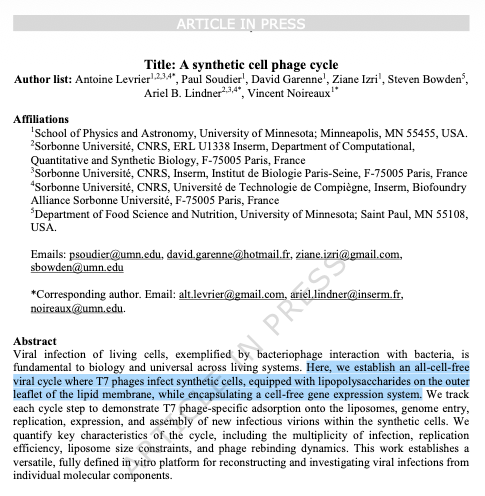
We’ve been playing at the interface between synthetic cells and phage biology, trying to see how far a minimal system can go: https://t.co/EprilE5zVp
"A synthetic cell phage cycle."
This paper shows the first viral lifecycle (from infection to replication to release) achieved using synthetic cells.
A bacteriophage is a virus that infects bacteria. This study focused on T7, which infects strains of E. coli. The typical phage lifecycle goes like this:
1. The phage lands on a cell membrane, latching onto lipopolysaccharides which branch out from the surface.
2. T7 injects its genome into the cell. The cell "reads" this DNA, copying it and using it to build more phages.
4. Phages get assembled. T7 has a head, a double-stranded DNA genome, and tail tibers which grab onto cells.
5. The phages are released; often they literally "blow up" the cell and rush through the opening.
These steps seem relatively straightforward, but no studies before this one have done all of them in synthetic and enclosed cells. Many other papers, though, have managed to make phages in test tubes; it's just that they didn't include the infection or release steps.
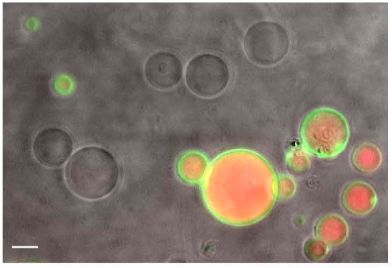
For this paper, the authors first made little "bubbles" by mixing fats and lipids and then embedded modified lipopolysaccharide molecules on their surfaces. They filled these bubbles with cell-free extracts, made from squished/killed E. coli cells. (So this is cheating a bit; it's not truly a chemically-derived, synthetic system.)
Next, they modified T7 phages so that their genomes encoded a red fluorescent protein. This way, they could track infections over time, as infected bubbles became a darker red color.
The phages were added to the bubbles and infected them over ~4 hours. To get the new phages *out* of the bubbles, the authors cheated a little (again) by quickly adding salt to trigger an osmotic shock that blew up the bubbles.
One interesting thing here is that Arthur Kornberg (Medicine Nobel, 1959 for discovering DNA polymerase) once imagined exactly such a "synthetic" virus lifecycle, writing in 1974: "Despite the extraordinary complexity of the viral life cycle, its dissection and eventual reconstruction with chemically defined components in a cell‐free system from start to finish remains an attractive prospect."
The next step here, of course, will be to get the phages to release from cells on their own and to extend this to other phages or viruses. The point of this work, I'd say, is mostly basic; it's an ode to the old Feynman adage: "What I cannot create, I do not understand." This, at least, proves that we understand all the components of a T7 phage lifecycle. In building synthetic systems for other viruses, we can figure out what we know -- and don't know -- for them as well.
In terms of applications, this approach also makes it easier to study viral infections in a more controlled and repeatable way; researchers can make tons of variables and screen for their impacts much more quickly, all without without having to grow / rely on the intricacies of living cells.
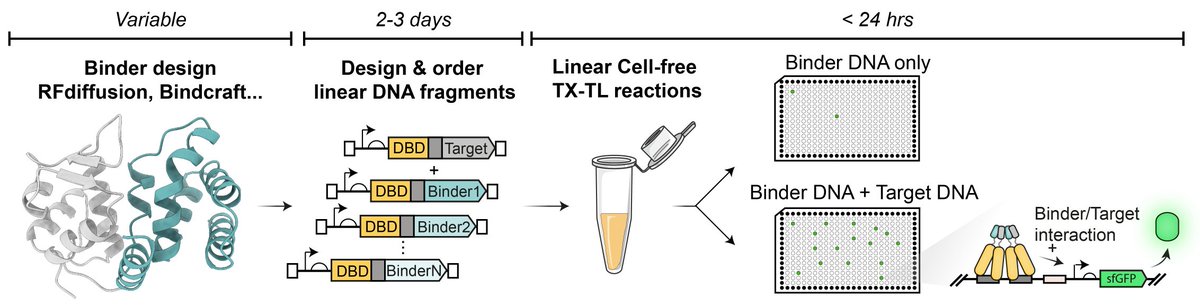
You designed binders for your favourite protein and wish there was a way to experimentally screen them within 24h w/ only a set of pipettes and a plate reader?
Check out our Cell-Free 2-Hybrid approach (CF2H)
Full post: https://t.co/KTSNnA4dsS
Preprint: https://t.co/J6X9htyAzl
"...we establish an all-cell-free viral cycle where T7 phages infect synthetic cells, equipped with lipopolysaccharides on the outer leaflet of the lipid membrane while encapsulating a cell-free gene expression system."
Looks useful; an in vitro system to study viral infections.
New on @biorxiv!
We’re excited to share our latest paper on combining cell-free systems and machine learning to express full genome in vitro.
Check it out ! 👉 https://t.co/nvsOkkGPYw
Catch us at SEED in Houston this June to discuss this work with @LeaWagnerSynBio#CellFree
Split minireporters facilitate monitoring of gene expression and peptide production in linear cell-free transcription-translation systems
By @AntoineLev in @thenoireauxlab and Bonnet labs https://t.co/MStE07XHp2
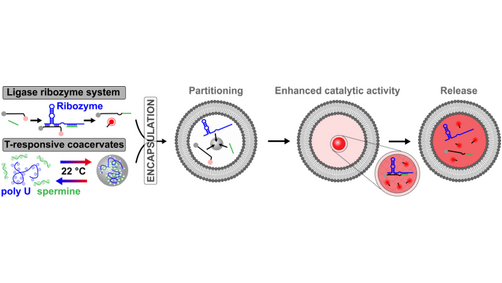
Spatiotemporal Propagation of a Minimal Catalytic RNA Network in GUV Protocells by Temperature Cycling and Phase Separation (Schwille) @MPI_Biochem@AntoineLev#openaccess thanks to #projektDEAL https://t.co/zvTw6UNA1y
Cell-free prototyping of biological parts and devices using linear DNA template can greatly improve your pipeline for diverse application ( enzyme screening, RNA sensor prototyping...) Discover our system making it easier than ever.
Want to use linear DNA🧬 in lysate-based cell-free systems and wish it were easier? Wish no more! Here we show that ΔrecBCD BL21 extracts can be optimized to reach near-plasmid levels of expression (with no additives or T7RNAP).
“A synthetic receptor platform enables rapid and portable monitoring of liver dysfunction via engineered bacteria.”
A new preprint is out from our lab of which I was lucky enough to be a part!
https://t.co/mqOIdvEeDy
1/10
After six years of exciting research, the Max Planck Research Network for Synthetic Biology (MaxSynBio) is coming to an end. Join us for our closing symposium, taking place in a virtual format from 30 Nov - 02 Dec 2020. Register now for free at:
https://t.co/Q6u173AjMX