Why did Scotland punch so far above its weight in the age of industrialisation and enlightenment?
The usual answer is education.
But I argue that this puts the cart before the horse, and that it was almost entirely down to capital:
https://t.co/3essZXC7HC
We should try to kick our 'legislate and forget' habit.
For example:
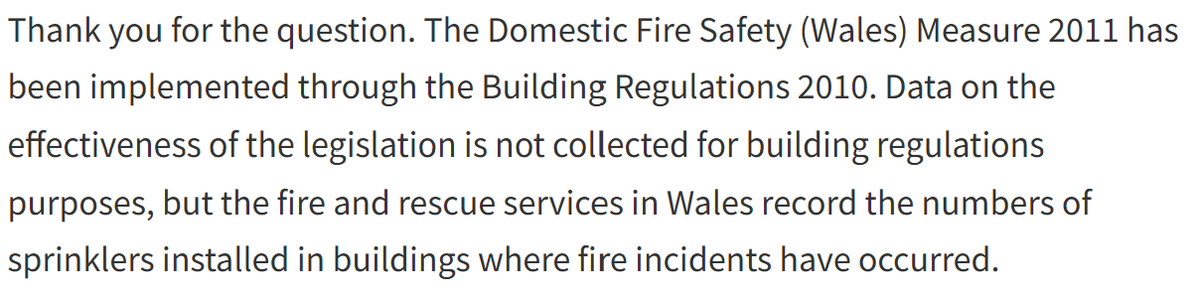
Since 2016 Wales has required sprinklers in *all* new homes. Universal & unusually strict approach. Typically adds £3k to build cost.
But we then just chose not to monitor effectiveness of the new regs.
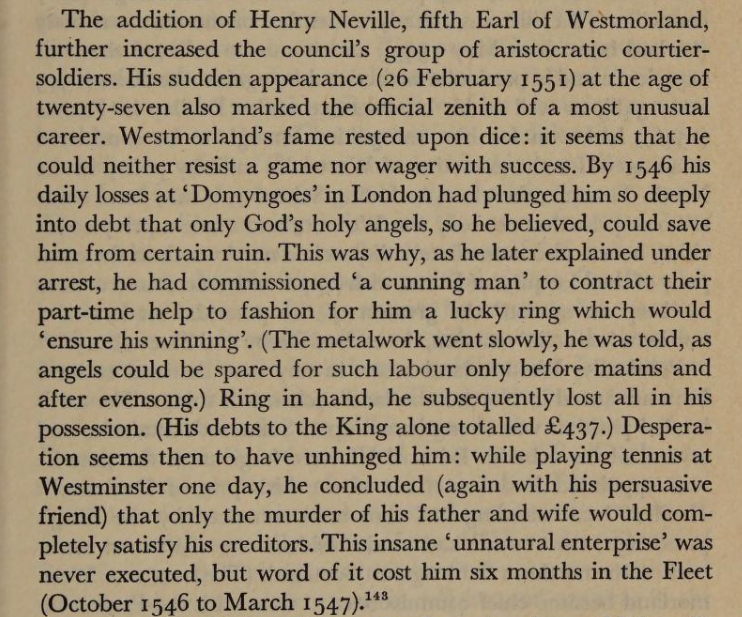
Absolutely COLOSSAL wars, which nobody has heard about because they were such a dismal failure. He undertook a major amphibious invasion of Scotland in 1544, then taking 32k troops across to France that same year to take Boulogne - almost 3x as many men as Henry V invaded France with in 1415. Then he had to see off a massive French Armada in 1545 - having already spent a great deal on coastal fortifications during a Franco-Habsburg invasion scare in 1539-40. Then in 1547, the regent for his son Edward VI invaded Scotland bent on actual conquest - meaning expensive forts and garrisons - suffering major rebellions in 1549 that the French took advantage of by invading the toehold at Calais/Boulogne and splitting it in two. It was hugely, hugely expensive, and even despite major sell-offs of land and loans, they had to massively debase the currency to afford it too!
In 1551 the English government halved the value of the entire country's money supply over the space of just a few months. Yet no historian has ever explored the consequences, other than in passing!
We're literally building tunnels across fields in open countryside because officials in Whitehall spent too much time listening to "the people whose areas it will effect".
@DavidWootton69@_paullay Unfortunately we have no idea. As the statute was repealed, I imagine that any slaves were freed, but it sounds - reading between the lines of the repeal law - like employers were unwilling to enslave people. And of course May-Sept 1549 was the Commotion Time.
Very important point in here, from a former civil servant who has worked a lot on this issue: “social value” requirements are a hidden tax on procurement, notionally borne by the government’s suppliers, but with the incidence actually on the government itself.
Andy Burnham got a big round of applause on Monday for saying:
“We will make sure that all eligible public contracts are subject to proper social value weighting.”
Here’s what that means, and why it’s a bad idea.
Most public sector contracts award c10% of the ‘marks’ in the bid evaluations for “social value” - the supplier’s commitment to various policies which aren’t to do with the contract. Employee training, creating jobs outside of London, DEI, Net Zero and using SMEs are all common areas they compete on for a good score. The model is rooted in the Public Services (Social Value) Act 2012, which established 30 pages of guidance on it. The Procurement Act 2023 and the latest National Procurement Policy Statement continued this commitment. Only MoD is exempt from using social value in tenders, though it regularly does - for example, a tender for nuclear deterrent research last year awarded marks for a commitment to reversing the impacts of Covid-19 on local communities and Net Zero.
Social value is a bad policy. And you don’t have to believe any of the many goals government are trying to advance through social value are bad goals to agree with me. Because even if you want all those objectives delivered, making companies for them as a ‘buy in’ to working on government contracts is a bad way to do it.
Most people recognise that the way social value is practiced in procurement is performative. It asks suppliers to make commitments, they fill out a form saying what they can do, and then there’s no follow up. Not even to check if they were telling the truth. Many think there should be. But imagine how prohibitively complicated that would be! On Net Zero, for example, most suppliers have to hire a consultancy to fill out their tenders because they don’t track their emissions (particularly small companies). Keeping doing that would be very costly to them. Government struggles to monitor the basics of contract performance - quality of delivery, and actual cost. Until we fix that, there’s no point doing social value monitoring.
But setting aside the implementation problems, the policy is full of holes.
Social value requirements are complex and costly to compete on. Doing it isn’t hard for the big “primes” that get c10% of public sector commercial spending, but it is hard for smaller companies - particularly start ups and scale ups, who have huge challenges accessing government procurement as it is. This only further stifles innovation, which is the whole point of going out to the market in the first place - markets are great at innovating, much better than governments. But the most innovative companies are further discouraged from bidding because of social value.
The policy also fails on its own terms. Take SMEs. A bias towards allocating contract spending to small businesses isn’t a good idea, but it’s been a consistent one across governments and that won’t change. But social value doesn’t improve that. A big supplier can get full marks for saying it has a lot of SMEs in its supply chain. But a SME has to fill out the same bid to compete with that, even if its whole budget is going to an SME (their own company). Bizarre!
And it isn’t free. Anything that suppliers do to meet social value objectives which they wouldn’t otherwise do comes at a cost. I’ve had civil servants glibly tell me “that’s just the cost of doing business with government”, or that it’s a kind of tax they should pay for the privilege. This is moronic. Suppliers pass that cost on to government when they work out what a profitable bid would be, so government is just funding their social value activities.
This is a really inefficient way of government funding those objectives. Hundreds of different companies doing their own small Net Zero initiatives (for example) is much less efficient than the government bolstering its own (considerable) clean energy infrastructure plans.
(Cont)
According to an Italian in England in 1552, wealthy English women were bled several times a year to keep their complexion, instead of using make-up like in Italy.
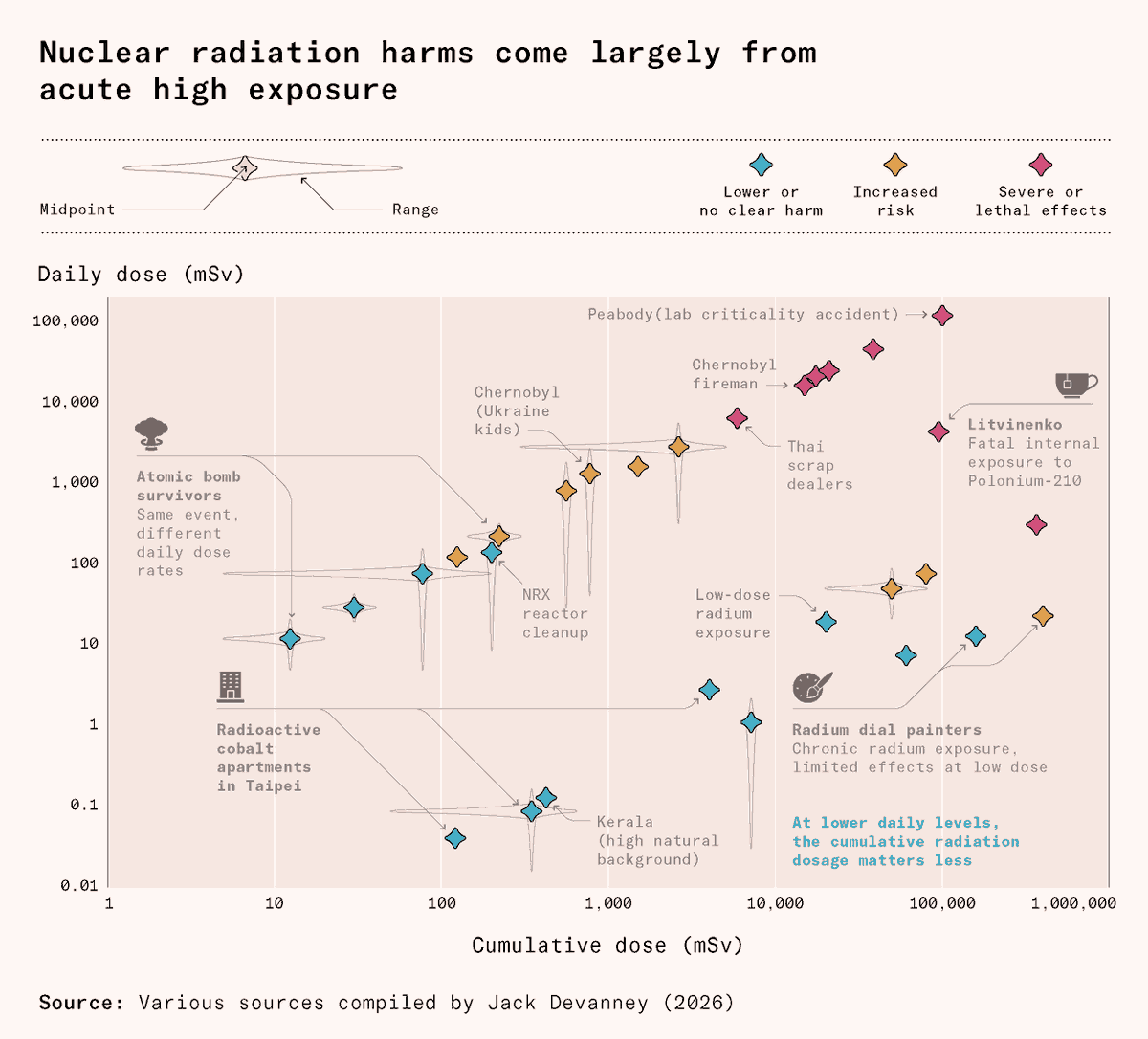
Would you rather be exposed to the radiation of 1,000 CT scans all in one go, or be hit with the same cumulative amount of radiation, but over the course of a lifetime?
https://t.co/krJx47qKAh
Hopefully you will not have to take that decision, but if you do, make sure it's spread out over your lifetime.
There is now overwhelming evidence that low-dose-rate ionizing radiation is not that harmful. Even Chernobyl, by far the world's worst nuclear disaster, exposed millions yet has likely killed 60 or so people. A total of 200 may die early. The other bad civil nuclear disasters – Windscale, Fukushima, and Three Mile Island – likely killed nobody at all.
The evidence is rolling in:
---> Many residents of Kerala are exposed to seven full-body CT scans' worth of ionizing radiation every year. But multiple studies find no effect on their health.
---> Taiwanese apartment dwellers were unwittingly exposed to up 100 CT scans per year because their apartments were made with radioactive cobalt rebar. But dwellers suffered much lower cancer rates than other age-comparable Taiwanese.
---> Between 1915 and 1950, women in factories painted radium onto watch dials to make them glow in the dark. Those licking the brushes sometimes suffered severe cancers. But non-lickers had lifetime doses equivalent to nearly 1,000 CT scans with no effect.
---> At 58 in 1945, Albert Stevens was injected with an enormous amount of plutonium, exposing him to a radiation dose equivalent to 300 CT scans every year. He lived to be 79.
These and many other studies show that ionizing radiation's harms are primarily about concentrated acute doses, not low doses over a long time. Yet nuclear regulatory systems are based around the principle that any radiation exposure is totally intolerable. This leads to rules like 'ALARA' – as low as reasonably achievable – which continually ratchet up regulatory requirements, making nuclear power slow and expensive.
Read my new piece with @chalmermagne for @WorksinProgMag.
@mrianleslie@Scott_Wortley Bang-on. They are utterly, utterly uninterested in policy, and only care about interpersonal drama. Like hollywood producers who make a biopic about a famous scientist that only features their love life.
@DanNeidle The problem is that everyone expects to see an exit tax WITH a wealth tax of some sort, given the general political direction of travel. It’s the mix that matters imo, even if other countries have it.
@BennetEnjoyer The key words are “other than in passing”. Gould does discuss it, as does Challis, but their focus is the debasement itself, not how it was stopped.