Introns have a hidden regulatory role! 🧬🎉
Delighted to share our latest paper showing that inefficiently spliced introns and spliceosomal proteins direct RNA methylation, engaging RNAi to silence retrotransposons and regulate gene expression
https://t.co/tVTWTewauk
Congratulations to all the authors on the excellent publication👏👏@grewalsh@bharatbhatt91 Yi Wei Ashis @DrisyaV1. An important contribution to the field🎊🎊
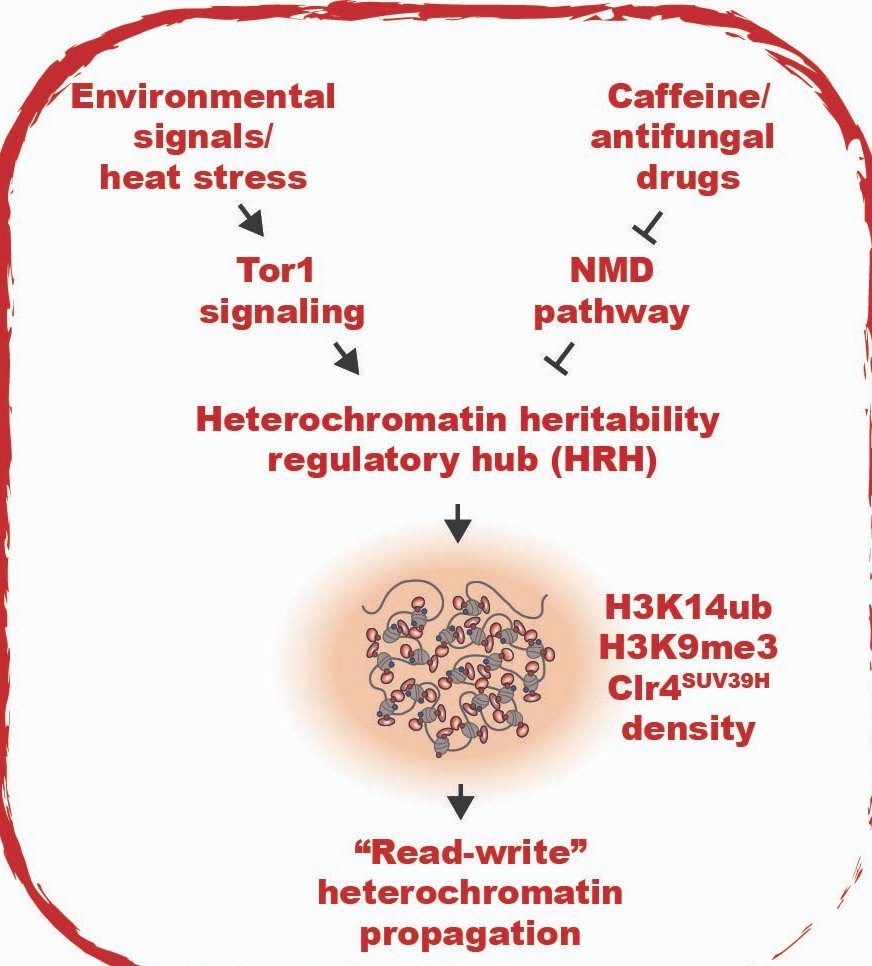
Stress controls epigenetic inheritance!
A histone ubiquitylation-based regulatory hub links stress/environmental signaling to heterochromatin self-propagation and epigenetic inheritance-reshaping how we think about development, drug resistance and cancer👉https://t.co/Wf8y1HjHEX
Excited to share our work in @NatureComms! 🎉
How does the spliceosome choose between competing 5′ splice sites?
Our study dissects the mechanism of HEH1 alternative splicing in yeast, highlighting 5'SS competition and regulation.@ubl_rna@DBS_IISERM https://t.co/M6WabLjSYF
Thrilled to share that I’ve joined @TIFRH_buzz as an Assistant Professor! Deeply grateful to my mentors (esp @grewalsh and KN Balaji), colleagues, friends, family & EVERYONE who made this possible. Excited to explore Epigenetics & the 3D Genome with the brilliant minds in India!
1/2 Elated to share our collaborative work with Monika Sharma @PlakshaUniv in @NAR_Open We used a combination of genetics, biochemical and simulation studies to probe allostery in E. coli DgoR, a GntR/FadR family transcriptional regulator. @DBS_IISERM https://t.co/tjWBkviA9S
🔬 Decoding Silencing: How Heterochromatin Transcribes to Silence Itself!
🧬Our latest research reveals how a pioneer transcription factor-like complex PhpC/NF-Y infiltrates repressive heterochromatin, generating transcripts with hidden introns that kickstart RNAi-mediated heterochromatin formation
https://t.co/LMzKtyhlPu