Ecom is the #1 best business in the world in 2026.
And I'm not saying that because we built one to $260M.
I'm saying it because the math is undeniable:
1. No cap on revenue
— we went from $0 to $103M in annual revenue in under 5 years
2. No one physical location required
— we ran a global business from a laptop
3. No inventory risk if you structure it right
— subscription model means predictable demand
4. No VC required
— we raised $0 and kept virtually all the equity
5. Customers pay you before you fulfill
— unlike almost every other business model
6. Retention compounds
— every subscriber you keep is revenue you don't have to re-earn
7. Data ownership
— you know exactly who your customer is, what they buy, and when they churn
8. Exit multiples are extraordinary
— we sold for $260M on $103M revenue
I've been in mobile technology. Fitness. Cannabis. Children's health.
Nothing compounds like a well-structured ecom brand with a subscription model and strong unit economics.
The ceiling doesn't exist.
The only question is whether you pick the right category, build the right product, and have the patience to let it compound.
Most people quit before the compounding becomes visible.
Comment "X" if you want my full playbook of everything I learned while building my business and how you can too :)
**must be following + retweet to receive.
The most important lesson in investment history got completely lost.
Druckenmiller pitched Soros on shorting the British pound in 1992. $5.5 billion. 100% of the fund. He thought that was bold.
Soros told him it was timid.
"That is the most ridiculous use of money management I've ever heard. We should be 200% of our net worth in this trade, not 100%."
What most people misread: Soros wasn't reckless. He was calculating asymmetry.
The British pound was trapped inside the European Exchange Rate Mechanism at a rate the UK couldn't sustain. Inflation was 10%. Unemployment was surging. Interest rates would have to go to 15% to defend the peg, which would collapse the housing market and politically finish any government that tried it.
The trade had a ceiling and a floor. If it worked, you made a fortune. If it didn't, Britain defending the peg raised rates high enough that you exited at a small loss.
This is what Soros actually teaches and nobody says it plainly: position sizing is a function of conviction, not diversification. When the expected value is radically positive and your downside is bounded, putting in 100% means you didn't actually believe your own analysis.
They put in more. The fund made $1 billion in a single day. September 16, 1992. Black Wednesday.
Druckenmiller has given dozens of interviews since. The lesson he repeats every time: when you're right, most investors still undersize the position. The rarest skill in money isn't finding the trade. It's having the nerve to actually bet it.
Biotech growth is the nature progression of the looksmaxxing trend is a healthmaxxing trend.
In short, there is no reason to be wealthy if you cant live longer and look better. AI data crunching, and eventually quantum, will help accelerate proteonomics, geonomics and cell therapies to make fatal disease chronic illnesses and some types of neoplasia detectible before they ever become metastatic or, potentially, even malignant.
I am spending a lot of time on BioTech these days, more convinced than ever we are looking at a new bubble forming.
It's a bit difficult for your average person right now to navigate.
This entire industry will explode... so it's worth diving into.
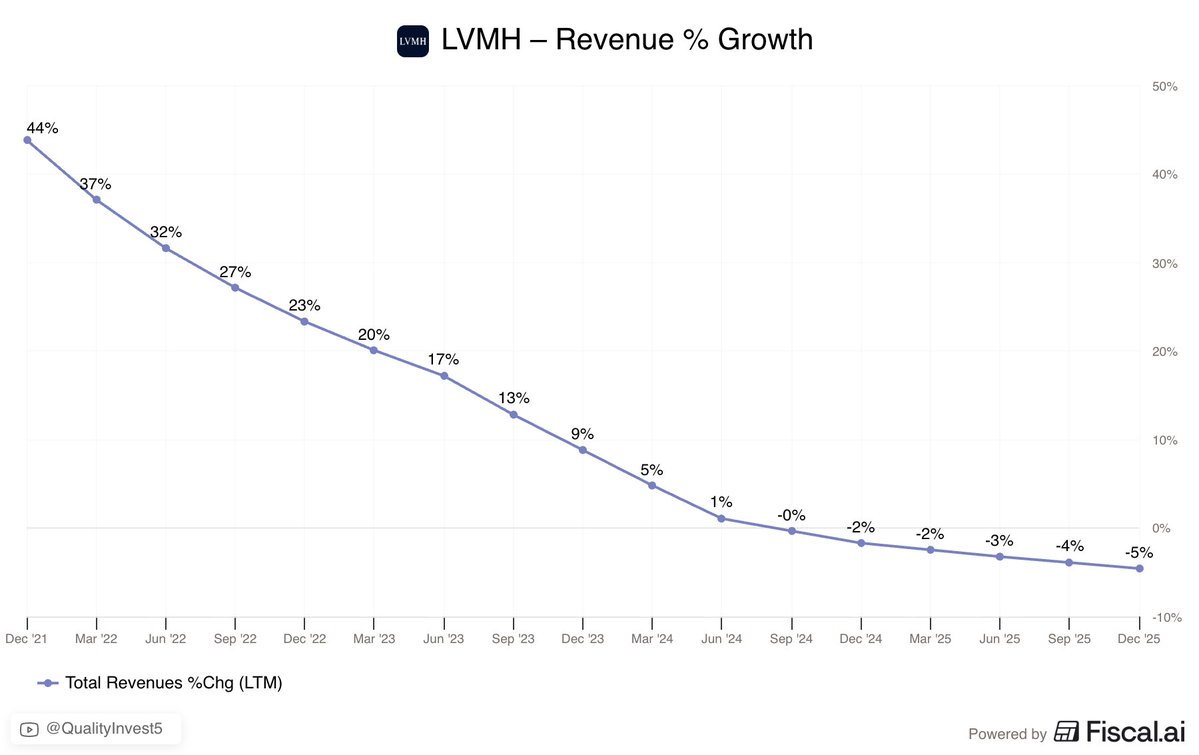
LVMH the parent of Louis Vuitton, Dior, Fendi, Sephora and 70+ other luxury houses
Has now put up SIXTEEN consecutive quarters of de-accelerating growth
$LVMUY $LVMH $MC.PA
Mark Zuckerberg on the best advice Peter Thiel ever gave him
“Peter was the person who told me this really pithy quote that, ‘In a world that’s changing so quickly, the biggest risk you can take is not taking any risk.’ And I really think that that is true.”
Mark continues:
“Whenever you get yourself into a position where you have to make some big shift in direction or do something, there are always people who are going to point to the downside risks of that decision — and locally they may be right. For any given decision you make, there’s upside and downside. But in aggregate, if you are stagnant and you don’t make those changes, then I think you’re guaranteed to fail and not catch up. So to some degree, I think it’s really right that, over time, the biggest risk you can take is to not take any risks.”
Source: @ycombinator (Aug 2016)
The brand outscaling you isn’t smarter. They just hit publish more times this week than you did this month.
“We tested creative and it didn’t work” you tested 3 ads. That’s not a test, that’s a vibe.
Iteration > inspiration. The winning ad is usually version 9 of something that flopped at version 1.
We’re obsessed with creative at all brands, it’s one of the biggest levers
We scaled our supplement brand to $3M/month with MRR
$35M+ run rate this year
30k+ subscribers
77.7% margins
I put our entire strategy into one doc + a 30 min video
I covered:
- the MRR model that pays you even when your ads are off
- outscaling your competitors
- the creative engine behind every winning ad
- how to actually scale past $1M/month
- the payment processors nobody's using yet
& more
Like + RT + Comment "PLAYBOOK" and I'll send it straight to you
There's a legendary investor named Nick Sleep who at one point held basically 3 stocks (Amazon, Berkshire and Costco).
One of his strategies was based on a Jeff Bezos quote:
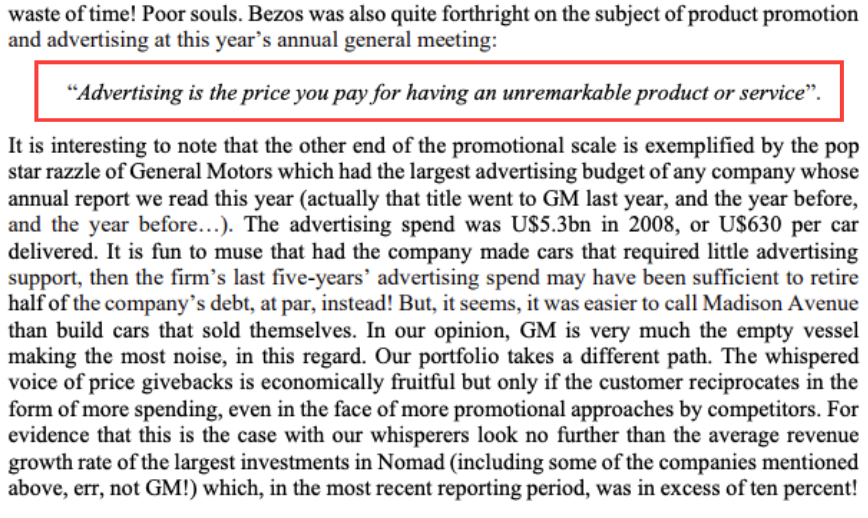
“Advertising is the price you pay for having an unremarkable product or service.”
For example, he noticed GM spent $5.3 BILLION on advertising in 2008. They could've paid off a size-able chunk of the company's debt with that amount of cash. And the ads just covered up poor strategy and products.
Now, I don’t entirely buy this given GEICO advertises like crazy and Buffett owns it. Coca-Cola too. And Amazon. Great companies CAN be great advertisers.
But I do dig the sentiment.
Shaan and I talked about this on MFM recently: https://t.co/JzgWEE68WK
SpaceX is a historic liquidity transfer event from public market investors to private market investors
This will flow down to the next wave of frontier venture capital backed companies, driving more funding and higher private market valuations
If you are in your early twenties:
- Make your burn rate as low as possible
- Avoid attachment to material things (cars, clothes, apartment)
- Make yourself as uncomfortable as possible
- Get a job that either a) teaches you high value skills or b) allows you to learn/work on side projects while on the clock
- Cultivate your focus and creativity above all else
- Individuate. Don't try to fit in. Avoid crabs-in-bucket groups
- Take astronomical risks
You have a small window of opportunity to differentiate yourself. It will be exponentially more difficult the older you get. Do not waste it in a cubicle during the week and a bar during the weekend. Send it.
I get “help me with peptide traffic” messages all day every day but today we got a 4 piece on all socials with 4 different people.
Please search my twitter for the amount of times I have said how fucking retarded you have to be to start a peptide company right now before asking me for help with peptides.
That being said I will pin this post.
I am available to help you but I require $500,000 up front to advise your company.
I also require a $500,000 yearly salary, a 15% rev share and a significant equity share (this will be dependent on how far along you are)
I make zero guarantees, in fact you most likely will fail even having me in your corner (50/50) but if you’re coming to me with these questions and you have no traffic then you will 100% fail and you will lose every dollar you have thinking you can turn it around because “peptides are the future bro”