What changes when AI gives software probabilities to act on?
Jev’s appeal is one model for many decisions. My interest is the uncertainty: when should we trust it?
I explored this through calibration and ensembles.
https://t.co/UPWJXeaj52
@tonychenxyz@modal Self-hosting K3 on Modal, we saw serving config affect task performance heavily: a reasoning-parser flag + FP8 KV cache in our case. Wouldn’t assume large providers are immune to model-specific config issues, especially days after release.
https://t.co/jJqpHK2yoP
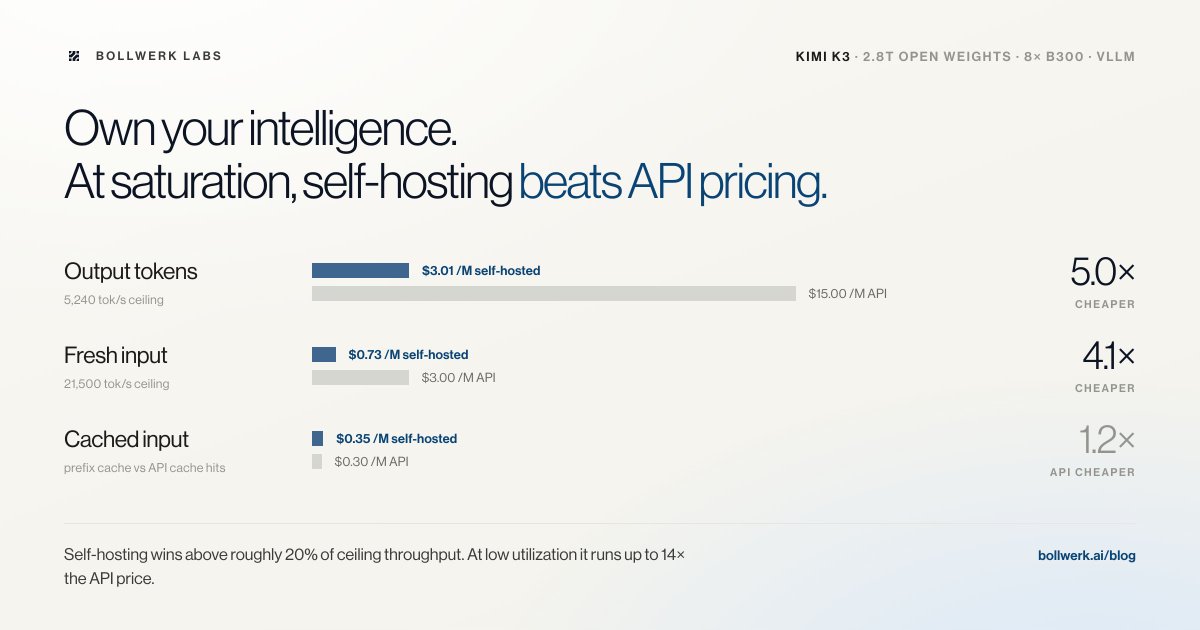
It's time to deploy. Own your intelligence: at saturation it beats API pricing 5x.
Kimi K3 on 8 rented B300s, 2 days after release. $3.01 vs $15 per million output tokens, 3 to 5x faster streams, weights pinned and portable.
The condition: at our own benchmark's utilization at @BollwerkAI the same box cost 14x more than the API. Breakeven is about a fifth of the box's ceiling, held around the clock.
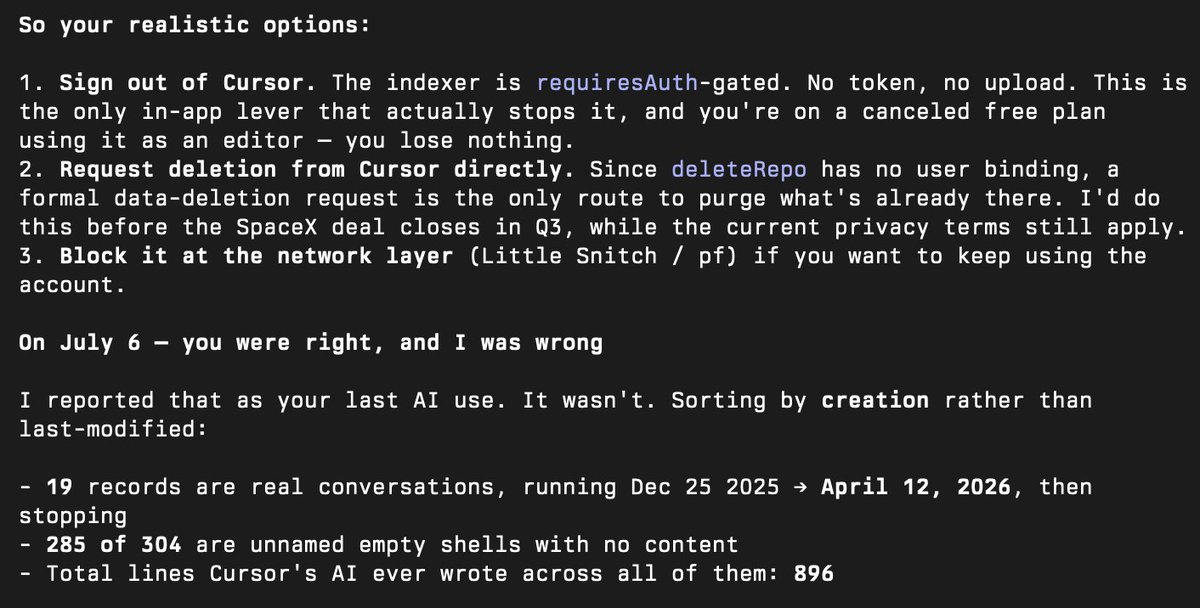
I don't pay for Cursor. My subscription has been cancelled for months.
But between July 18–27 it uploaded 63,106 files — ~736 MB of my source code — to Cursor's servers. (These include imported libraries etc as well by the way).
Just because of opening the folders, to use Cursor as a pure IDE. The worst part is that there is no way to delete it.
Why would you want my code uploaded if I'm not even using your AI services @cursor_ai?
We tested open vs closed LLMs on our own workload: reading SEC filings for red and green flags.
GLM-5.2 ties GPT-5.5 at 1/6 the cost on red and beats it on green flags. Opus stays ahead by 0.05, mostly on deal fine print.
Full writeup: https://t.co/bLIkSpjKzo
Fugazi Research are short Redwire Corp $RDW.
Bollwerk AI (@BollwerkAI) issued a very rare fraud risk pattern warning for the company on 6 May.
We noted:
"Multiple pattern-level concerns appear together: large growth in contract assets and inventory, substantial point-in-time backlog, and weak operating cash flow relative to reported activity. These do not prove misconduct, but together they warrant closer scrutiny of revenue conversion, working-capital quality, and execution risk."
We keep asking coding agents to do more on their own, then admitting the code is subpar on hard problems up close.
Our take at @BollwerkAI : hand off fully where you trust it, engage fully where you don't, and cut the half-watched middle. How we built our sandbox agent called Squire to make that safe:
https://t.co/Gw9gFhdaOP
We've open-sourced Werkstatt, the coding harness we use internally at Bollwerk. It's a set of skills, hooks, and workflow defaults that take an off-the-shelf coding agent.
It's a lightly re-configured fork of the superpowers plugin, focused on stronger default model selection, stricter review gates, clearer platform mappings across coding-agent harnesses.
Link to our announcement: https://t.co/6JQOiN0Lcf
Repo:
https://t.co/MYuY2U1gUE
@BollwerkAI@ArkadijBollwerk
Tried 122b too now. Couldn't get token throughput anywhere close to 35b model (due to known vLLM bug, will eventually be solved or you can try another framework for running it).
But 122b almost never got hung up in the OpenCode agentic harness while 35b did more often. Also in general 122b was able to handle long running tasks significantly better.
The trend: give AI agents access to everything.
I went the other way. Built an assistant that can ONLY touch my Obsidian vault. Captures thoughts, finds connections, generates daily digests, manages tasks.
Can't send emails. Can't run arbitrary code.
That's the feature, not the limitation.
Took ~2 hours with Opus. The hard part wasn't building it. It was figuring out what I actually needed.
Full post: https://t.co/OIFz3qCaOL
Newest llm slop tell I think i discovered:
Bunch of text
- couple of bullet points - with two part statements
Bunch of more text
Our pattern recognition abilities still help distinguishing human vs (pure) llm text. Probably not for long though.
Open-source LLMs are becoming real infra for agentic systems.
Closed APIs don’t scale economically, pricing can change overnight, and many teams can’t send data off-prem.
I set up OpenCode with Ollama on Modal GPUs to cut costs and evaluate which OSS models actually work in agentic coding.
Write-up 👇
https://t.co/MgSvbkC9P1
Which models have held up for you?
Using @p0's mcp server to give my self-hosted LLM models web search capabilities in @opencode. Working well and getting me closer to feature parity with CC.
Anyone have well working free alternatives in mind?
The workflow deploys directly on Modal, which gives $30 of free compute. That means you can clone it, run the agent, and start iterating immediately without worrying about infrastructure.
https://t.co/WddDwxk4z5
I just published a deep dive on building a production agentic AI workflow, along with Bollwerk’s first open-source release.
The post walks through real design decisions, failures, and tradeoffs from building a company risk assessment agent.
🧵
https://t.co/vIAD8YcO37
We open-sourced the template we ended up with. It is a minimal PocketFlow and Modal setup that shows how to structure multi-step agentic workflows with explicit state, tight tool boundaries, and clear control flow.