America used to lead the world in transit delivery. Now we lead in transit costs, and build less as a result.
Over the last year, we worked with 17 experts to write a Transit Abundance Playbook with specific policy solutions that directly address the causes of rising costs. Together, they show that our high transit costs are a policy choice that can be fixed.
Check out our solutions at https://t.co/xuGFEybT60:
1. @ericgoldwyn - Reform federal grants to include early, small, milestone-based grants to reduce project risks.
2. @steph_pollack - Cut procedural requirements, fund early right-of-way spending, require accelerated state and local permitting, and loosen procurement rules.
3. @rohanaras and @aarmlovi - Cap federal cost-sharing and encourage joint procurement to reduce bus overcustomization.
4. @_brianpotter - Cut redundant subway cross-passages to bring our fire safety standards in line with Europe's.
5. Anthony Potts - Allow and encourage agencies to do procurement based on the best value, not just the lowest cost.
6. @alon_levy - Require itemized bidding in procurement to increase transparency and reduce mid-stream change orders.
7. Anonymous - Adopt Italy’s "Conference of Services" model to empower a single decision-maker to ensure permitting disputes are resolved up front.
8. Lizzie Speed and @BennettCapozzi - Create a repository for federal transit reports and project data, along with an AI-based system for querying it.
9. Jamey Tesler - Give transit projects the same delegated permitting authorities that states have over highways and roads.
10. @the_transit_guy - Exempt voter-approved transit projects from costly and redundant permitting to deliver projects the voters asked for.
11. @AidanRMackenzie - Allow transit agencies to buy land and prepare for construction while permitting occurs.
12. @PaulrsLewis - Reduce dependence on expensive consultants by encouraging more capacity within transit agencies.
13. @AndrewMillerYYZ - Enable transit automation by spelling out worker protections explicitly instead of requiring a veto-prone process.
14. @profplotch - Provide confidential ways for agencies to share lessons learned with each other.
15. @jmooreotto - Streamline access to federal loans to create an alternative funding model for transit projects.
And many thanks to @mattyglesias for publishing the intro I wrote with @ArnabDatta321 on Slow Boring: https://t.co/VHY5ZQi1xl.
IFP's Transit Abundance Playbook is finally live! We brought together 17 experts to explain why American transit costs are so high, and how we can bring them down — unlocking more, cheaper, and faster transit.
Check out the intro on Slow Boring: https://t.co/qlBMyir8TX
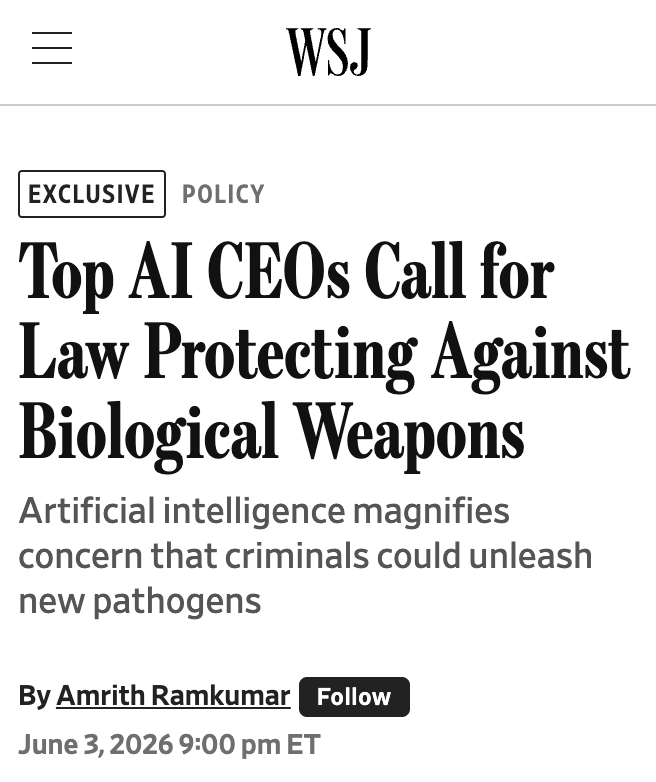
No one should be able to order a bioweapon through the mail.
@IFP & @JoinFAI are proud to co-lead an open letter calling for mandatory DNA synthesis screening & recordkeeping.
Signatories include:
- Sam Altman, CEO & Co-Founder, OpenAI
- Dario Amodei, CEO & Co-Founder, Anthropic
- David Baker, Director, Institute for Protein Design; 2024 Nobel Prize in Chemistry recipient
- Patrick Collison, CEO & Co-Founder, Stripe
- Paul Graham, Founder, Y Combinator
- Demis Hassabis, CEO, Google DeepMind; 2024 Nobel Prize in Chemistry recipient
- Emily Leproust, CEO & Co-Founder, Twist Bioscience
- Lawrence Lessig, Roy L. Furman Professor of Law and Leadership, Harvard Law School
- Gerald W. Parker, former Special Assistant to the President for Biosecurity and Pandemic Response
- Mustafa Suleyman, CEO, Microsoft AI
- Alex Tabarrok, Professor of Economics, George Mason University
- Alexandr Wang, Chief AI Officer, Meta; Founder, Scale AI
- Christine E. Wormuth, President & CEO, Nuclear Threat Initiative; 25th Secretary of the Army
Read the letter and see the full list of signatories: https://t.co/BwZiJXw3JT
Many DNA synthesis companies voluntarily screen orders to mitigate biosecurity risks, but no law requires them to do so.
Leaders in AI, biotech, life sciences, national security, and the nucleic acid synthesis industry agree that Congress should act to strengthen safeguards against biological threats.
@deanwball put it well in the WSJ:
“If you’re synthesizing the stuff that yields biological life and viruses, we’re asking you to screen to see whether it is dangerous in some way. That seems like a reasonable thing for society to insist upon.”
At @IFP, we’ve spent the past 3 years thinking about all the different ways the US government & philanthropy fund R&D.
Until now, R&D funders haven’t had a systematic way to match the innovation problem to the right funding tool.
We built THE ATLAS OF INNOVATION to fill that gap.
https://t.co/XZshJ7pr1f
Alongside @UChi_MSA, we’ve boiled down thousands of hours of research into a handful of questions covering how much the R&D funder knows about:
- the problem they want to solve
- the solution it should have
- the team that should build the solution
Why the Atlas matters:
The US government spends close to $200 billion every year on R&D. And after the Anthropic and OpenAI IPOs, there will be hundreds of billions of dollars in new philanthropic giving.
Choosing the correct funding approach to the social problems they’re trying to solve will mean the difference between success and failure.
For example, NSF research grants have helped seed breakthroughs from MRI machines to search engines, but grants aren’t built to deliver the kind of industrial speed and scale that a project like Operation Warp Speed required.
Picking the wrong funding approach can leave programs behind schedule, over budget, or without anything to show for all the money they spent.
How we built the Atlas:
1. We began by creating a matrix of dozens of considerations that a thoughtful policymaker or funder would ideally weigh before deciding how to fund a project.
2. We looked at every major funding approach, from grants to R&D tax credits to advance market commitments, analyzing when they work well and when they fail to meet the mission.
3. We spent months deep in the weeds of contract theory and incentive design, looking at historical examples and the state-of-the-art research in innovation economics.
4. We then worked to turn that research into a tool that time-strapped policymakers and philanthropic funders could rely on at the start of an innovation funding cycle.
5. Three years later, we are launching just that: a new (and visually stunning) website to help funders decide how to best incentivize innovation. And all they have to know… is what they currently know about their innovation goal! The Atlas takes care of the rest.
How to navigate the Atlas:
Answer questions about your goal to find the funding approach aligned with the information you have.
Each funding mechanism has its purpose for particular technologies and specific moments in development.
There shouldn’t be an ARPA for every field, just like we don’t need a prize or AMC for every innovation. The Atlas helps you navigate those tradeoffs.
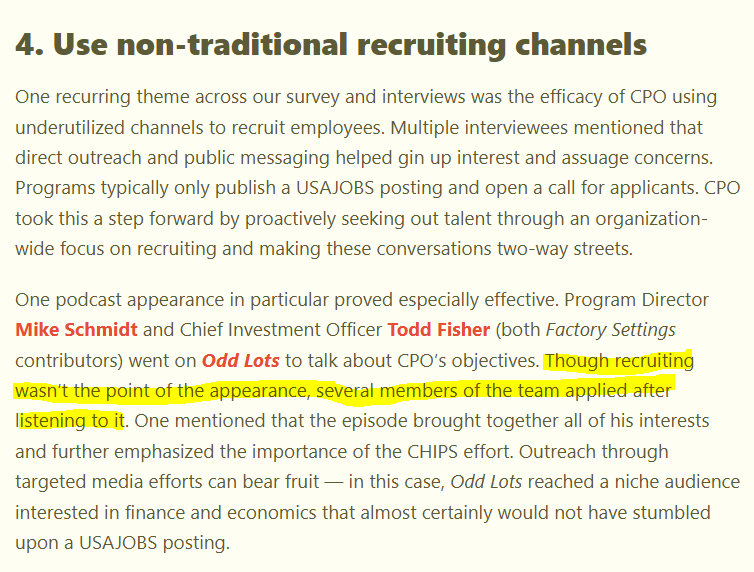
"Program leaders’ decision to go on the Odd Lots podcast was referenced by several colleagues, with non-traditional recruiting pathways serving as critical for getting team members"
CHIPS needed a team that could sit across the table from large, well-capitalized semiconductor firms and negotiate deals that both protected the taxpayer and delivered on national security objectives.
A lot of the program success was built on the backs of government operators and national security professionals. Equally important, however, were the private sector hires that the program brought onboard.
This week in Factory Settings, I took a look at how the program was able to effectively recruit private sector talent.
A few of the most salient points:
- Program leaders’ decision to go on the Odd Lots podcast was referenced by several colleagues, with non-traditional recruiting pathways serving as critical for getting team members
- CHIPS gave significant empowerment to junior colleagues, allowing them deal reps well above their private sector counterparts
- The program had a tangible, positive impact on the career trajectories of the private sector talent that came through the program
Private sector talent isn't everything, and traditional government competencies are equally critical. Nevertheless, future industrial policy efforts would do well to make a concerted effort to get ex-financiers, operations professionals, and technologists working towards program success.
Read here: https://t.co/6h0MiBhv6P
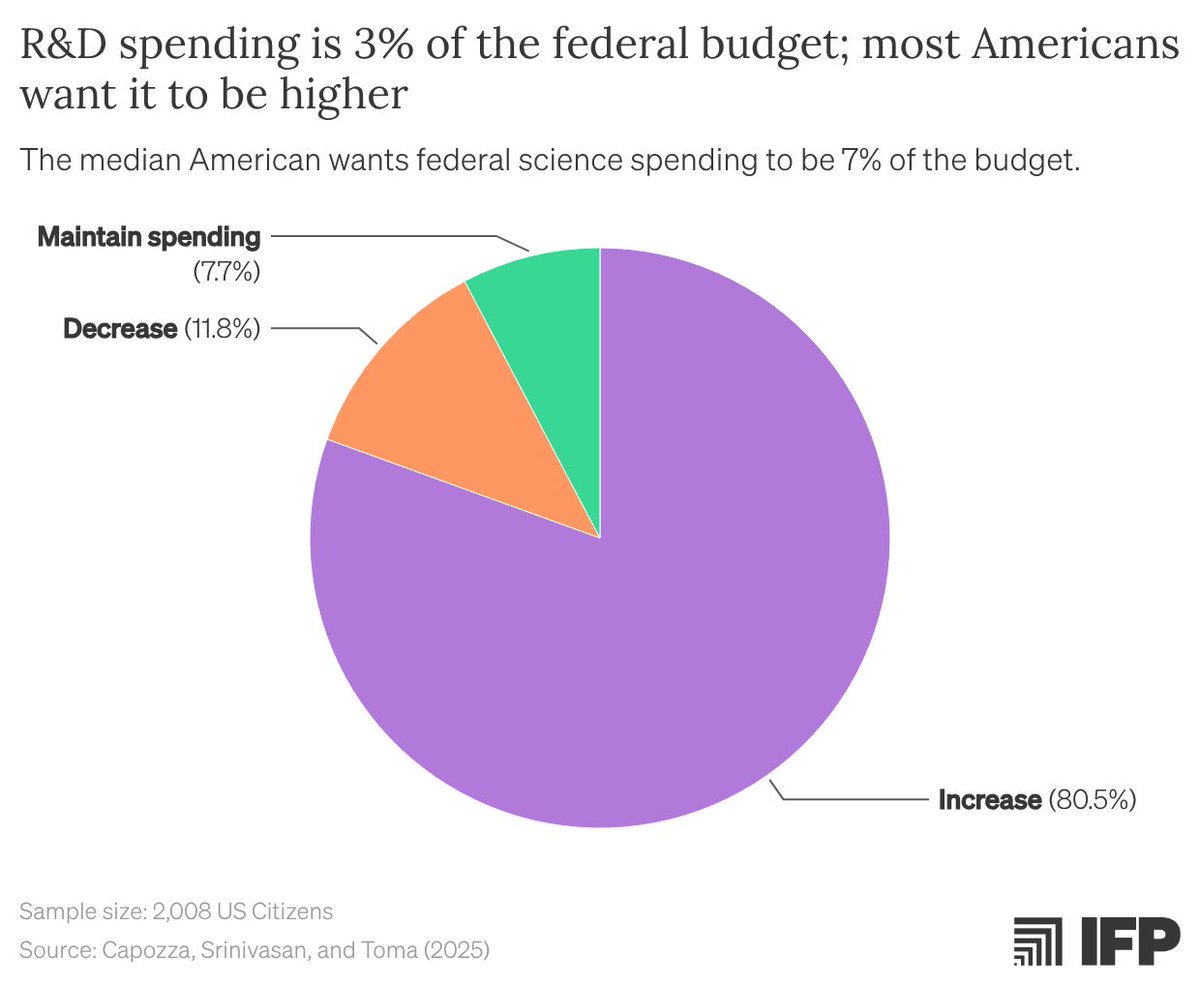
Americans support science spending - this isn’t new. But how much do they want to spend on it?
A new study suggests that when Americans know what the government spends on science, 80% want increased spending, and the median respondent wants to double spending.
So why did the Trump Admin try to cut nondefense science funding by 21%? And why is science spending so slow right now?
Give the people what they want: fund American science.
Macroscience piece with @McKenzieLeier here: https://t.co/dtb85vVksr
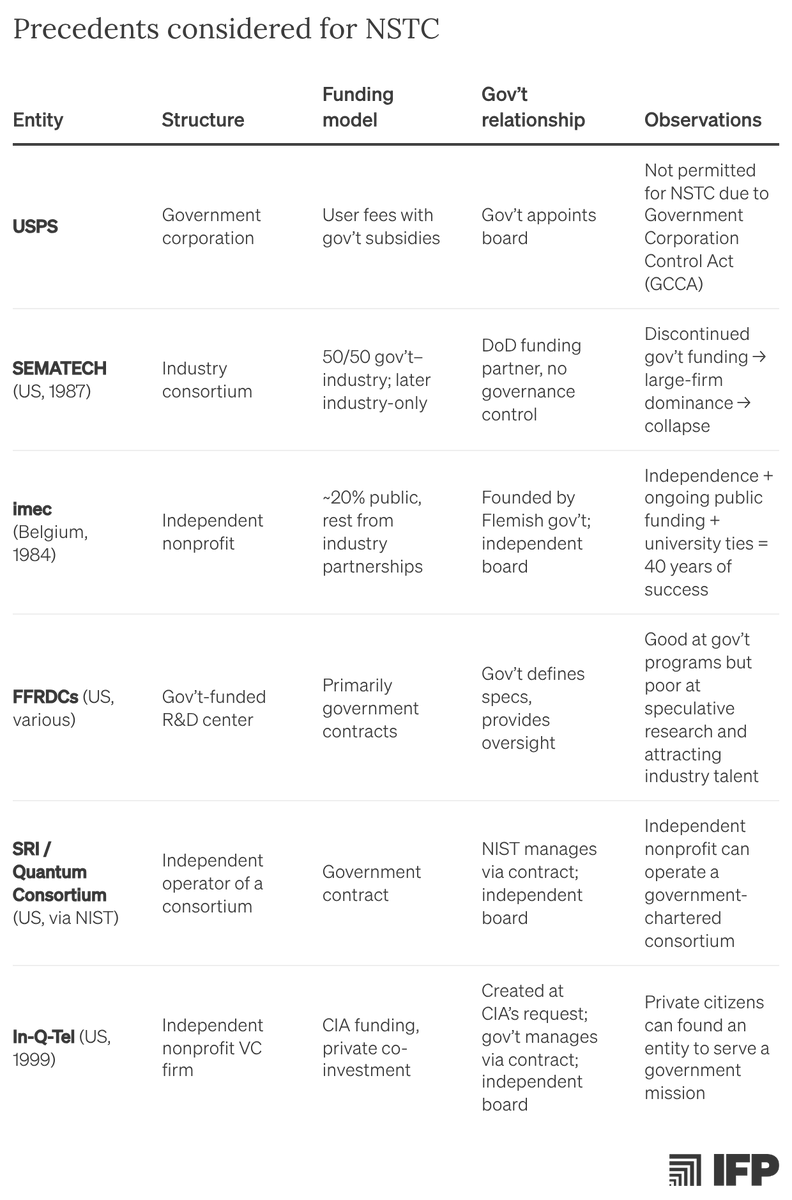
The CHIPS and Science Act instructed the Dept. of Commerce to start a National Semiconductor Technology Center. Its responsibilities: conduct research and prototype advanced semiconductor tech, grow the semiconductor workforce, and establish an investment fund.
In designing NSTC, Commerce had to decide on an institutional structure. They decided on an independent non-profit that would contract with the government - but it turns out there were a lot of potential options!
See Macroscience/Factory Settings cross post (!) on the rise and fall of NSTC here: https://t.co/fyn0a5xNrb
The Davis-Bacon Act requires "prevailing wage" on federally funded construction. It's been on the books since 1931. Applying it to the CHIPS Act created a bunch of problems...
1. One company learned mid-negotiation that it might need to locate 20,000 construction workers who'd already cycled off the job & pay them hundreds of millions in retroactive backpay — for work done years before CHIPS funding was awarded.
2. Another company making chips critical to the auto industry & defense industrial base couldn't reconcile prevailing wage with its profit-sharing pay structure or the requirement to track every employee's hours by trade classification. Their deal died after Davis-Bacon challenges consumed 6 months of negotiations.
3. For leading-edge fabs costing $20-25 billion to build, the Davis-Bacon premium ran into the hundreds of millions. But because CHIPS grants only covered ~10% of project costs, a 1% increase in construction costs meant a 10% increase in program costs, and fewer total projects funded.
4. To be clear, no single compliance requirement broke the CHIPS program. But the accumulation — Davis-Bacon, NEPA, procurement rules, the Paperwork Reduction Act — made execution far harder than it needed to be.
New at Factory Settings, by Mike Schmidt, former director of the CHIPS Program Office: https://t.co/ZzuDuZMWXH
IFP is hiring an Editorial Director (the role I'm leaving).
Teddy Roosevelt said, "The best prize that life has to offer is the chance to work hard at work worth doing."
That's been my experience with this team. I couldn't recommend it more highly.
https://t.co/aYQCJZszGh
Competing with China doesn't mean becoming China.
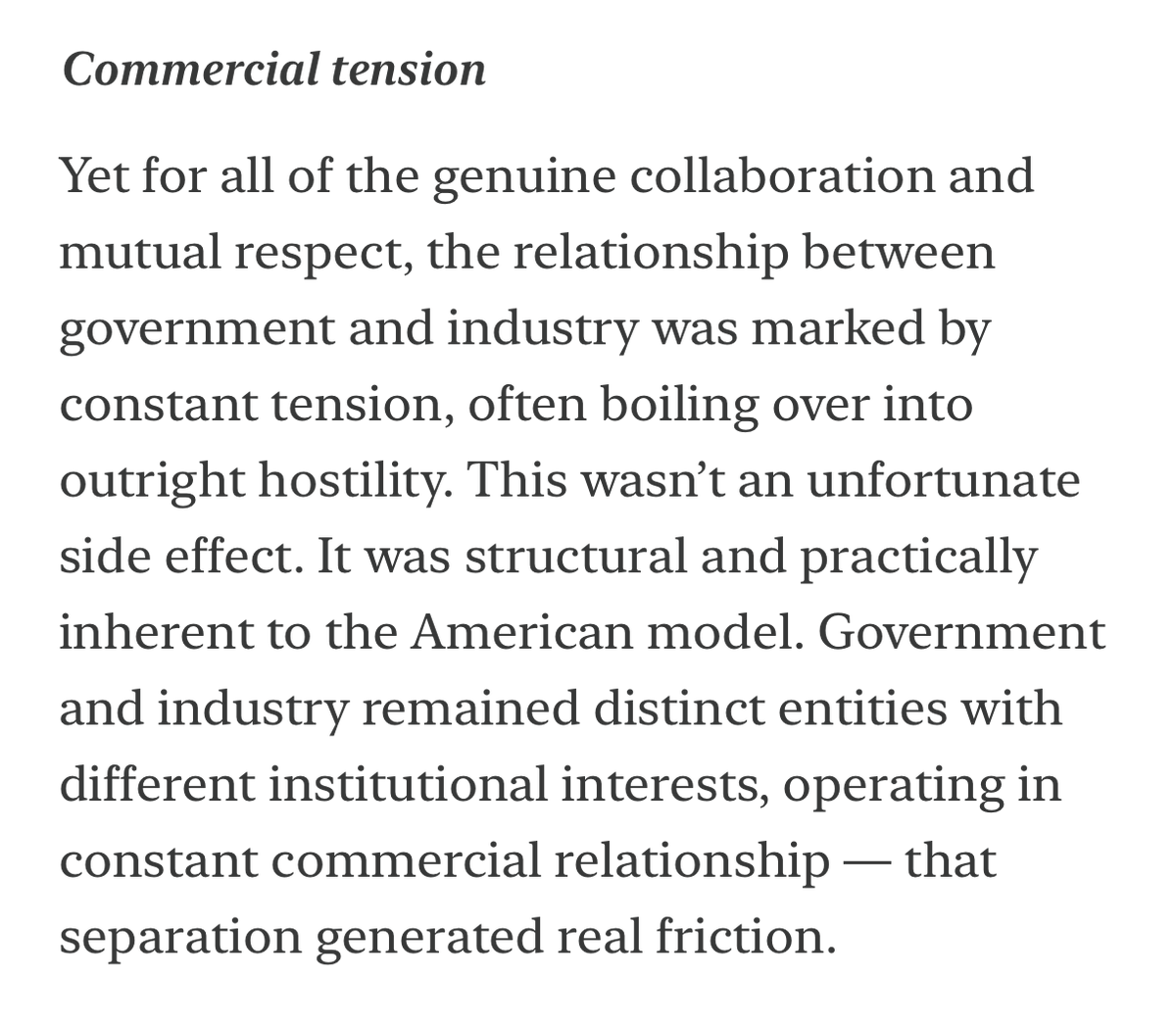
We have our own tradition of industrial policy, it worked because government & industry fought each other constantly. That tension was a feature, not a bug.
See Mike Schmidt's latest for Factory Settings on lessons from WW2.
How similar are Trump and Biden, really, in their approaches to economic statecraft?
Of course, Liberation Day is the kind of move on tariffs the last administration never considered, as is the ongoing attempt to seize Venezuelan oil production, to name two examples.
But when you compare both administrations to the American consensus of the ‘90s, you start to see a different picture. They each approach economic statecraft differently, yes. But both have actively experimented with a set of tools that were basically absent from the toolkit of the post-Cold War era.
I didn’t expect that to be the takeaway from my mega-episode with Daleep Singh, @ArnabDatta321, and @petereharrell. Daleep and Peter were senior officials on Biden’s National Security Council; Arnab is a colleague at @IFP, and an influential thinker on energy/industrial strategy.
When I put this episode on the calendar, my hope was to get three of the smartest, most thoughtful liberals I could find on the topic of economic statecraft, and have them run a full assessment of the last year: tariffs and the trade war, export controls on chips to China, taking equity stakes in domestic companies, the works. I expected them to critique how the Trump admin has executed its tariff strategy and its trade deals, which they did. But I was surprised by the degree to which all of them were open to the admin's use of novel or forgotten tools — equity stakes, offtake agreements, concessional lending capital — even if they critiqued the execution. Daleep argues that future administrations should build more robust state capacity, in something like a "Department of Economic Security," to have the measurement and prediction ability to use these tools more strategically.
Some of the other surprising takeaways for me:
- “China’s had a really good trade war,” says Daleep.
- Compared to 2000, there are ten times more sanctioned individuals and entities in the world. Hyper-targeted sanctions, used this often, are a 21st-century practice.
- China has storage capacity for 2 billion barrels of oil. It has already stored over 1.4 billion barrels and will add millions more in the next couple years.
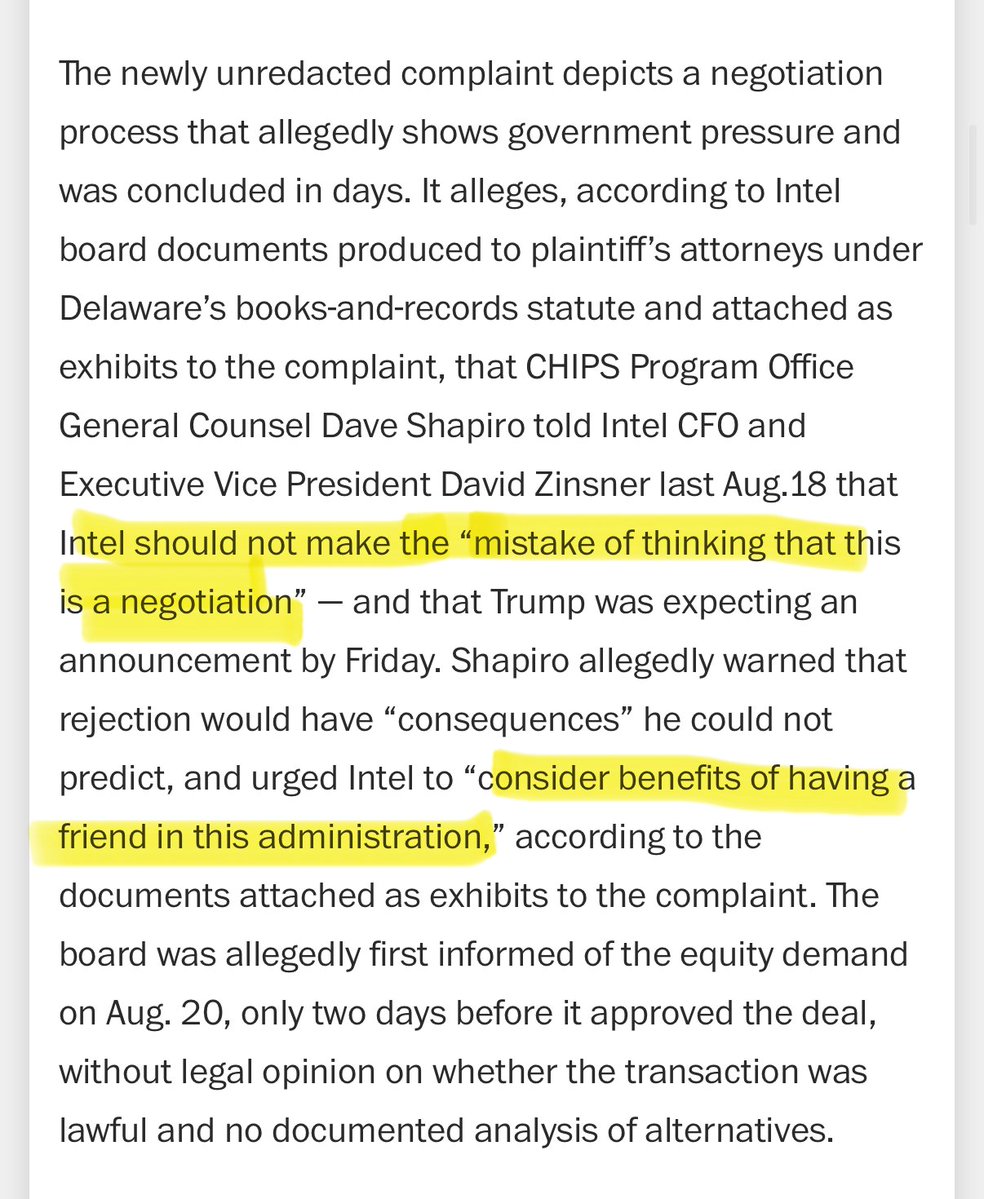
- The federal government has now taken equity or equity-like stakes in more than 15 companies over seven months.
- We now have by far the world's highest steel and aluminum prices.
- $100+ billion in capex would be needed to rehabilitate Venezuelan oil fields, and their pipelines currently leak oil every single day.
Full episode here, give it a listen/read: https://t.co/fu7E1KDDcx
-When should the government hire contractors?
-What functions do they perform well?
-How does FAR make contracting hard?
Check out the latest from Factory Settings piece from Sara Meyers to learn more. https://t.co/XD04XbD4li
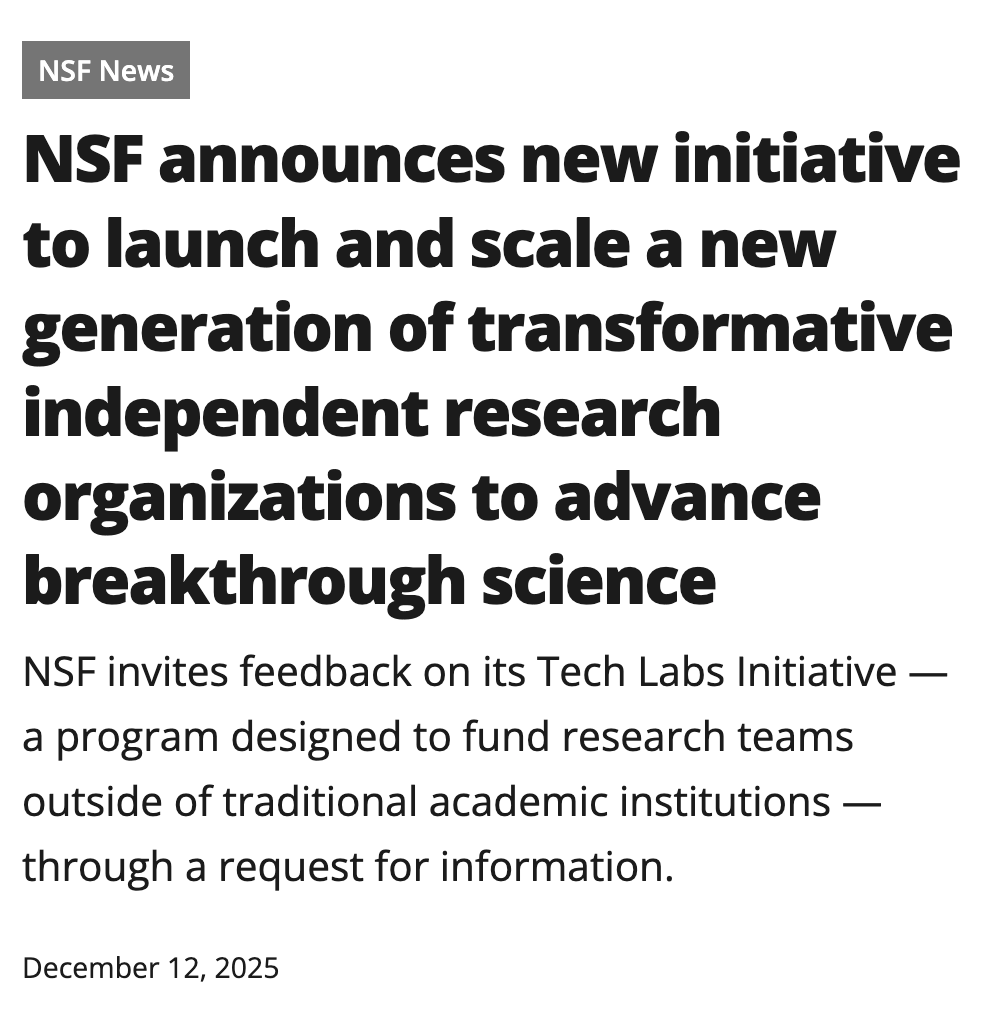
NSF is launching one of the most ambitious experiments in federal science funding in 75 years.
The program is called Tech Labs, and the goal is to invest ~$1 billion to seed new institutions of science and technology for the 21st century.
Instead of funding projects, the NSF will fund teams. I’m in the @WSJ today with a piece on why this matters (gift link): https://t.co/xteQ3NgWVC
Here’s the basic case:
1) Most federal science funding takes the form of small, incremental, project-based grants to individual scientists at universities.
2) The typical NSF grant is ~$250k/year to a professor with a couple of grad students and modest equipment over a few years. This is a perfectly reasonable way to fund some science, but it's not the only way.
3) A healthy portfolio needs more than one instrument. Project-based grants are like bonds: low-risk, steady, safe. But no one trying to maximize long-run returns would put 70% of their portfolio in bonds.
4) Yet that's basically what our civilian science funding portfolio looks like. Around 3/4ths of NSF and NIH grant funding is project-based.
5) Tech Labs is NSF's attempt to diversify that portfolio. The Tech Labs program is aiming for:
- $10-50 million/year awards per team
- 5+ year commitments
- Measuring impact through advancement up the Tech Readiness Level scale rather than papers published
- Up to ~$1 billion for the program
- Supporting research orgs outside traditional university structures
6) Scientific production looks very different than it did when the NSF launched 75 years ago. The lone genius at the chalkboard can only do so much. Frontier science + tech today is increasingly team-based, interdisciplinary, and infrastructure-intensive.
7) The team behind AlphaFold just won the Nobel Prize in Chemistry. It came from DeepMind, an AI lab with sustained institutional funding and full-time research teams. It would be near-impossible to fund this kind of work on a 3-year academic grant.
8) Same pattern at the @arcinstitute (8-year appointments, cross-cutting technical support teams) and @HHMIJanelia (massive infrastructure investments to map the complete fly brain). Ambitious science increasingly needs core institutional support, not a series of project grants stapled together.
9) Similarly, Focused Research Organizations (@Convergent_FROs) have showcased a new model supporting teams with concrete missions and predefined milestones to unlock new funding.
10) There’s a whole ecosystem of philanthropically-supported centers doing amazing research, like the Institute for Protein Design, the Allen Institute, the Flatiron Institute, the Whitehead Institute, the Wyss Institute, the Broad — the list goes on.
11) But philanthropy can’t reshape American science alone. The federal government spends close to $200 billion each year on research and development, an order of magnitude more than even the largest foundations.
12) If we want to change how science gets done at scale, federal funding has to evolve. And the NSF and NIH don’t have dedicated funding mechanisms to support or seed these sorts of organizations.
13) Earlier this year, I started working on a related framework called “X-Labs” that built on all this exciting institutional experimentation that’s been happening within the private and philanthropic sectors. It’s time for the federal government to step into the arena: https://t.co/0iVLobqQeA
14) Traditional university grants are still important for training the next generation of scientists and for certain kinds of curiosity-driven work. But after 75 years of putting nearly everything into one model, we should try something different.
15) And key program details are still being developed! You can reply to the Request for Information with suggestions or feedback on how to design this program here: https://t.co/R6MNo0ZfN1
16) Science is supposed to be about experimentation. Science funding should be too.