🚨New paper! I tackle a confound in mate preference research: Are preferences & standards driven by your own sex or target sex? 2 studies show preferences are (mostly) driven by own sex, but ideal standards are driven by target sex. Full study: https://t.co/tCCb1DL9s2 #Research
Out today in @EvolHumBehav---
after nearly 40 YEARS---
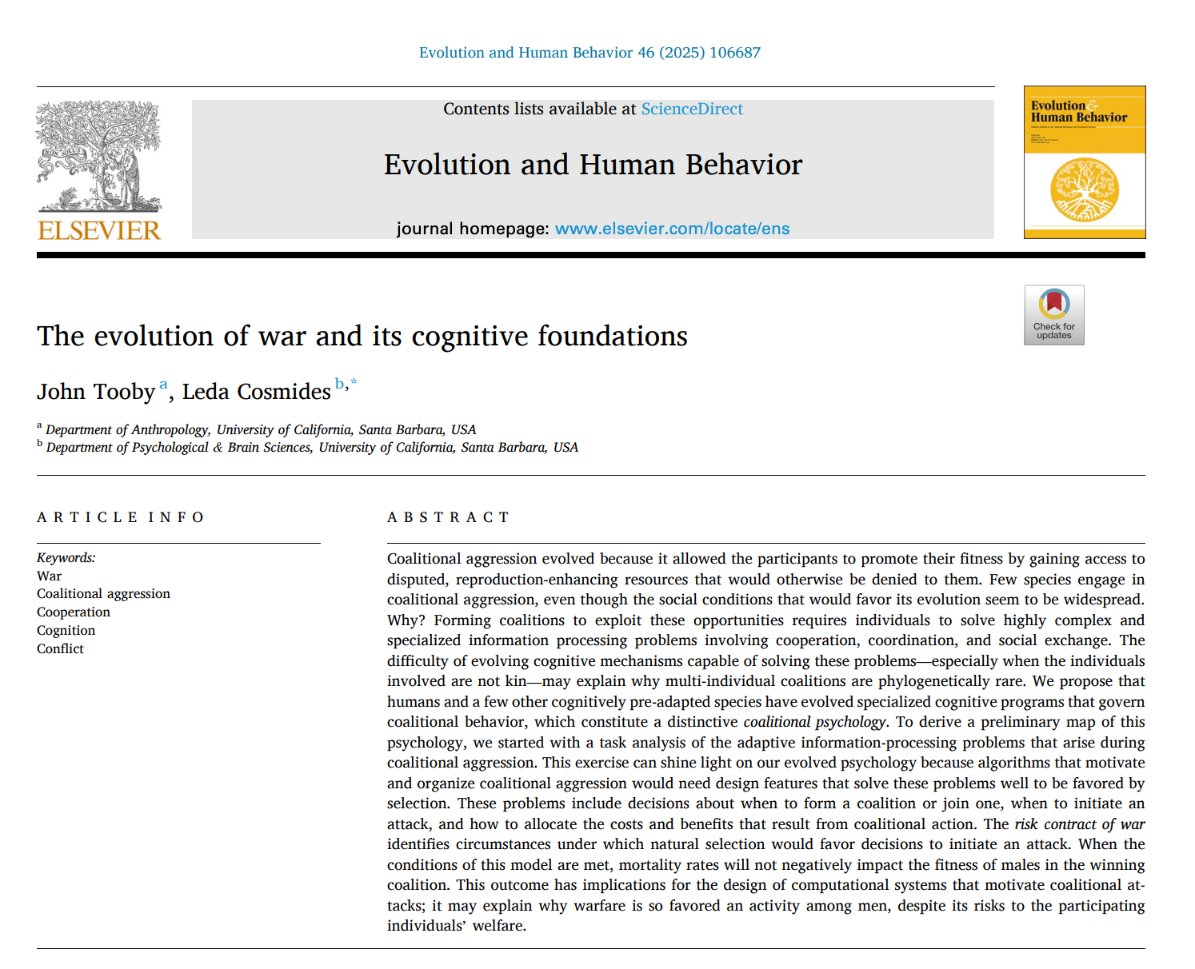
"The evolution of war and its cognitive foundations" from Tooby + Cosmides
Interested in the history + slow progress of science?
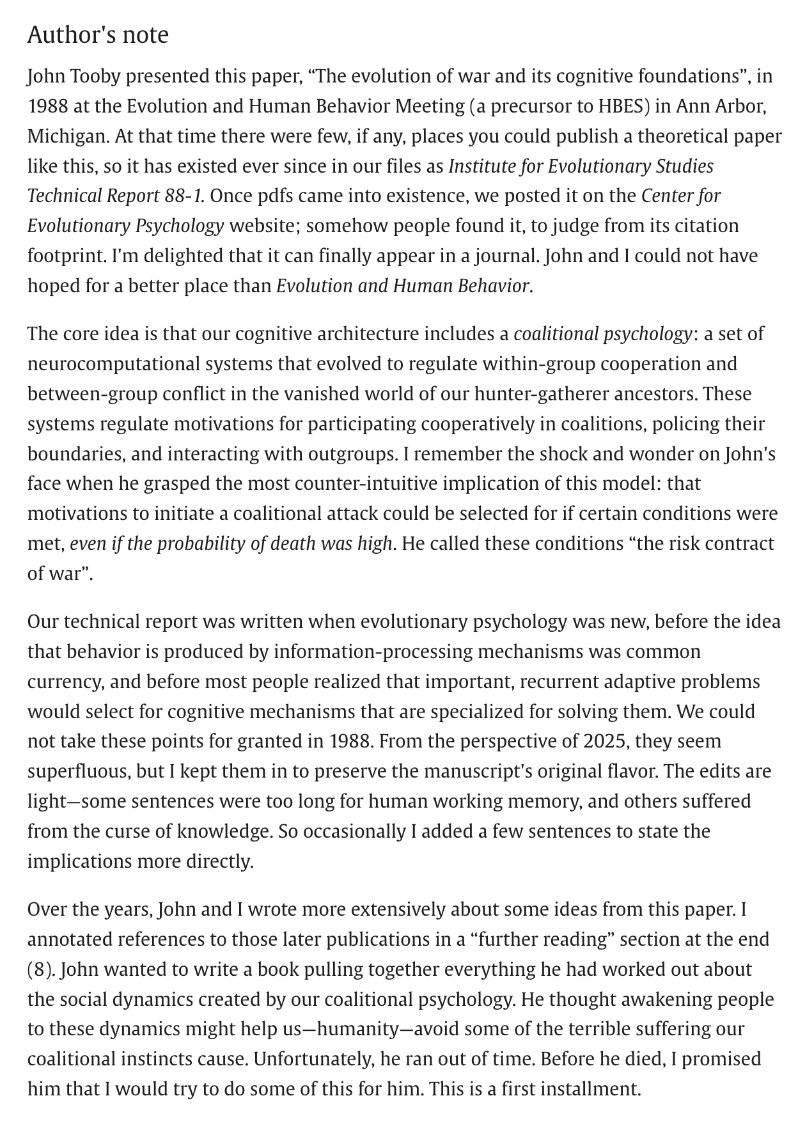
🚨Don't skip the Author's Note🚨
Link 👇
🚨New paper! I tackle a confound in mate preference research: Are preferences & standards driven by your own sex or target sex? 2 studies show preferences are (mostly) driven by own sex, but ideal standards are driven by target sex. Full study: https://t.co/tCCb1DL9s2 #Research
Our new target article, "Cognitive Representations of Social Relationships and their Developmental Origins" by Ashley J. Thomas, is now accepting proposals for commentary!
Deadline: March 13th, 2025
Learn more: https://t.co/z5lW0PDsP2
Read here: https://t.co/qifdMu6VdP
Fresh off the press! (DM me for a pdf)
Existing research demonstrates that people react with disgust to pathogenic stimuli compared to non-pathogenic stimuli, but there has been a lack of research examining whether people are equipped with a more finely graded disgust response.
Across three experiments involving participants from the United States and India (total n=1,333), @kaypeathebee, myself, @LaithAlShawaf, and David M.G. Lewis tested the Threat-Dependent Disgust hypothesis: Do people discriminate between pathogen threats of different magnitudes and react with more disgust toward pathogen threats of a greater magnitude?
In Study 1 (n=428), we tested the prediction that people would be more disgusted by a pathogen threat touching their hand relative to their foot, given that touching a pathogen with the hand is more likely to result in the pathogen entering the body (e.g., through the mouth).
In Study 2 (n=453), we tested the prediction that people would be
more disgusted by a pathogen threat touching another person’s hand relative to another person’s foot; people touch others more with their hands than with their feet, so a person with a contaminated hand poses a greater disease threat than one with a pathogen on their foot.
In Study 3 (n=452), we tested the prediction that people would be more disgusted by skin wounds caused by pathogenic infections than by surgical incisions; although both wounds pose the risk of exposure
to another’s bodily fluids, wounds caused by pathogenic infections pose a greater disease threat.
Results across all three
experiments support the Threat-Dependent Disgust hypothesis, suggesting that disgust is sensitive to the magnitude of pathogen threat in a more finely tuned manner than previously demonstrated. (Link below.)
Are men's friendships the same as women's friendships? Find out in Robin Dunbar's latest HBES blog post: https://t.co/bQ57nQtXsx
Or read the original EHB article: https://t.co/q73usWOaJh
As an undergrad, financial barriers held me back from doing research many times. Today, many talented students from Turkey face the same challenge. With the inflation of the Turkish lira, flights and even visa fees become impossible to afford.
To contribute, see the link below:
Interested in how infants and young children learn about plants and nature? I am currently looking for PhD students to be part of my (new) Lab for Infant Learning and Cognition (LILAC) at @UCSBpsych in beautiful Santa Barbara, CA. The application deadline is December 1st 👶🪴
Interested in pursuing a PhD in psychology at UC Santa Barbara? The Psychological and Brain Sciences department is hosting a virtual open house event this Friday (10/18) from 1-4pm! Come learn more about our research, program, and student experiences. See you there!
Interested in grad school in psychology? Perhaps at UCSB?
The Psychological and Brain Sciences department at UC Santa Barbara will be doing an open house next Friday (10/18)! Come learn about our department and program. Register at the link in this flyer:
Applying for the NSF SPRF (post-doc fellowship) this year? @AboodyRosie put together a tremendous resource: a database of previous application! https://t.co/m1ATtmtS5j Thank you to everyone who contributed to this --- you just made my life easier.
Introducing UCLA's NEW
🧠Center for Friendship Research🧠
Science needs to pay more attention to FRIENDSHIP. So, we're doing that!
The multi-faculty center will help lead the way in forwarding a science of friendship.
Let's be friends!👇
https://t.co/BoREodxatQ
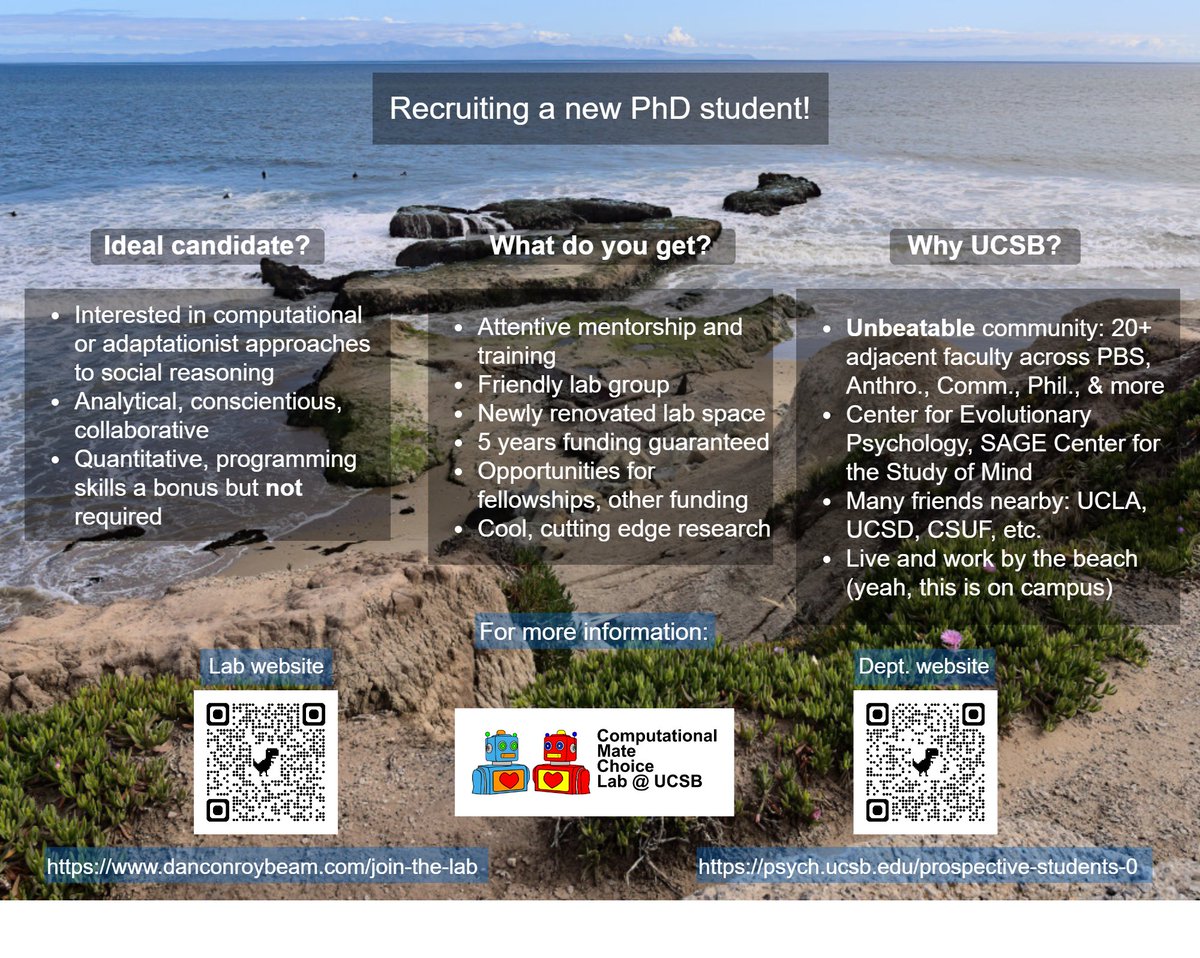
Our lab is recruiting a new PhD student for Fall 2025. Please share!
If you're interested in adaptationist/computational approaches to human social reasoning, esp. mate choice, I'd love to see your application.
More information here: https://t.co/xZE1hzJv1o
WEBS members: Voting for our committee positions is now open until August 2nd at 5:00 pm BST. The voting link and nominee information was sent to your email on file. Please check your spam box if you did not receive the email. Questions or concerns? Contact [email protected]
The misuse of research isn't unique to evolutionary psychology, but this field’s public appeal brings unique challenges and opportunities. Rather than blaming the field or specific researchers, we should aim for better communication practices.
Recognizing our dual audience of scientists and the general public, we can enhance the impact of our work and mitigate its misuse.
https://t.co/A8zhd27C9I