Based on the evidence so far, the Asgard archaea seem to have evolved in multiple ways that primed them to birth eukaryotes. This suggests that the origin of complex life on Earth wasn’t just an incredibly lucky chance.
https://t.co/qSz8UxGQyv
Two comets – one from beyond our Solar System, the other bound to the Sun – have appeared side by side in the night sky, creating a rare celestial sight that left astronomers stunned.
The image, captured from Reunion Island in the Indian Ocean, shows comets C/2025 K1 (ATLAS) and C/2025 R2 (SWAN) glowing with luminous comas and trailing tails, seemingly racing across space together. Though they look paired from Earth’s vantage point, their origins couldn’t be more different.
Comet ATLAS is believed to be an interstellar traveler, entering our solar system on a hyperbolic trajectory from the depths of space. Comet SWAN, by contrast, is a periodic visitor, discovered by NASA’s Solar Wind Anisotropies instrument and locked in orbit around the Sun. The odds of them aligning in Earth’s skies at the same moment are vanishingly small.
[📸 LucPerrot_Photo]
A new observation from @NASAWebb of asteroid 2024 YR4 has improved our knowledge of where the asteroid will be on Dec. 22, 2032 by nearly 20%, thus raising the chance of a lunar impact to 4.3%. 2024 YR4 is now too far to observe until 2028. https://t.co/iVzKgB0gfc
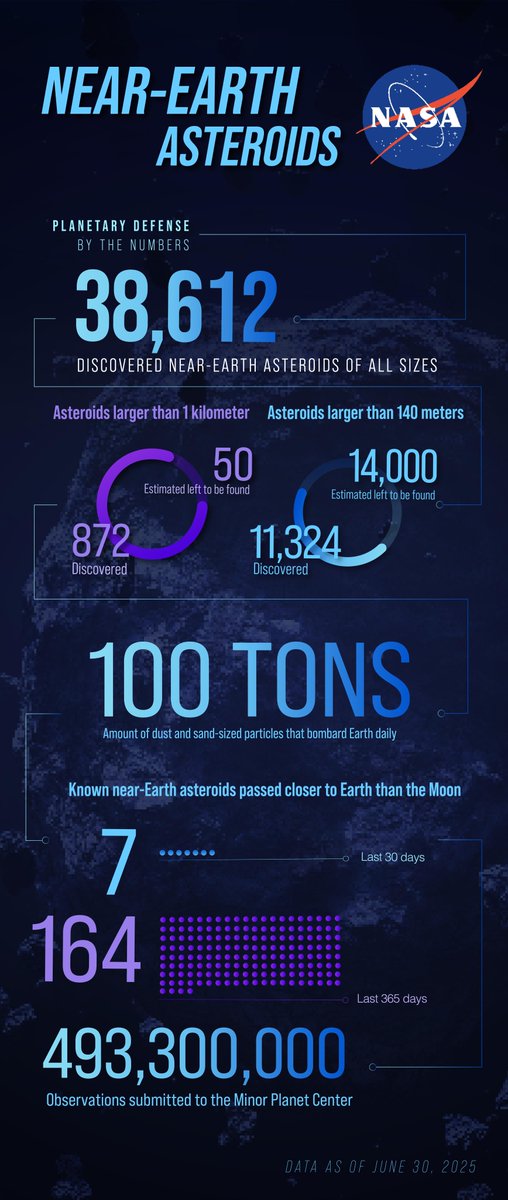
At NASA, we find asteroids before they find us. International #AsteroidDay aims to raise public awareness about impact hazards and the ongoing preparations to protect our planet. This #AsteroidDay, learn more about NASA's planetary defense efforts and check up on how many near-Earth objects we've found so far: https://t.co/ujC6lMJ6lm
3I/ATLAS isn't just fascinating because it is the third interstellar visitor found in the solar system; new research suggests it's also the oldest comet ever seen, at over 7 billion years old. https://t.co/fVqHG311WQ
Missed our webinar about "Planetary Defence - Astronomy and Space Missions at the Service of Humanity"? Don't worry, you can rewatch it here: https://t.co/bjGt1nBqEy
‘Fireball’ has some stunning photography of the ice sheets in Antarctica where scientists hunt for fallen meteorites.
Worth watching!
#Comets#Asteroids#Meteorites
I’ve watched the beautiful documentary called ‘Fireball - Visitors From Darker Worlds’ on AppleTV.
It was written and narrated by Werner Hertzog, presented by Clive Oppenheimer.
The latest edition of the IAU Working Group Bulletin on Small Bodies Nomenclature (Volume 5, #8) has been released.
The PDF can be found here: https://t.co/L2bE4ElLHT
Just finished my first imaging run of 2025.
Everything is still working fine.
Did 125 x 5 sec images for each field.
Analysis with Tycho Tracker to follow.
The next issue of our @ztfsurvey newsletter Cosmic Newsflash is out. Find out when our public data releases are scheduled, read our science highlights, watch the science vlog, and more. The spotlight this time is on our near-Earth asteroid hunters
https://t.co/dfELc3SaC2






![Rainmaker1973's tweet photo. Two comets – one from beyond our Solar System, the other bound to the Sun – have appeared side by side in the night sky, creating a rare celestial sight that left astronomers stunned.
The image, captured from Reunion Island in the Indian Ocean, shows comets C/2025 K1 (ATLAS) and C/2025 R2 (SWAN) glowing with luminous comas and trailing tails, seemingly racing across space together. Though they look paired from Earth’s vantage point, their origins couldn’t be more different.
Comet ATLAS is believed to be an interstellar traveler, entering our solar system on a hyperbolic trajectory from the depths of space. Comet SWAN, by contrast, is a periodic visitor, discovered by NASA’s Solar Wind Anisotropies instrument and locked in orbit around the Sun. The odds of them aligning in Earth’s skies at the same moment are vanishingly small.
[📸 LucPerrot_Photo]](https://pbs.twimg.com/media/G13gbAXW4AAb-zW.jpg)