Introducing Astrolab’s Crewed Lunar Vehicle (CLV-1), chosen by @NASA to transport crew across the lunar surface and support the construction of a permanent lunar base.
Adapted from our FLEX rover architecture reflecting NASA’s revised approach to lunar surface mobility, CLV-1 is designed to support astronaut operations, science activities, and cargo logistics on the Moon.
No tire shops on the moon.
These tires, built with strategic partner @Venturi Space, have been tested on 11 platforms, from NASA's Glenn Research Center to Switzerland. They go on FLIP, CLV-1, and every FLEX rover we build.
The Moon doesn’t forgive untested assumptions. We test here so it works there.
The Salt Lake City School District Moon Mission Symposium, made possible by the Salt Lake Education Foundation, brought together students, educators, and community partners to celebrate student work in STEM, storytelling, and space exploration. Over 2,000 students from the SLC School District will be sending their projects to the Moon later this year.
Through Starborn Academy, students studied science and technology, explored career pathways, developed Moon Mission projects, and shared their ideas with judges, guests, and community leaders. Selected students from participating middle schools will represent their schools at @NASAKennedy , where they will watch their projects launch to the Moon aboard @Astrolab_Space's FLEX Lunar Innovation Platform (FLIP) rover as part of the @voyagertech_ Griffin-1 mission.
We are grateful to the partners who helped make this program and event possible: @slcschools, @Team_SLEF, @Astrolab_Space, astronaut @DrSianProctor, @Boeing, and the @slcecondev.
Thank you to @BrandonFugal, astronaut Laura Stiles, and Brendan Hall for speaking with students and helping them connect their classroom learning to real-world exploration, creativity, and opportunity.
$nrpi
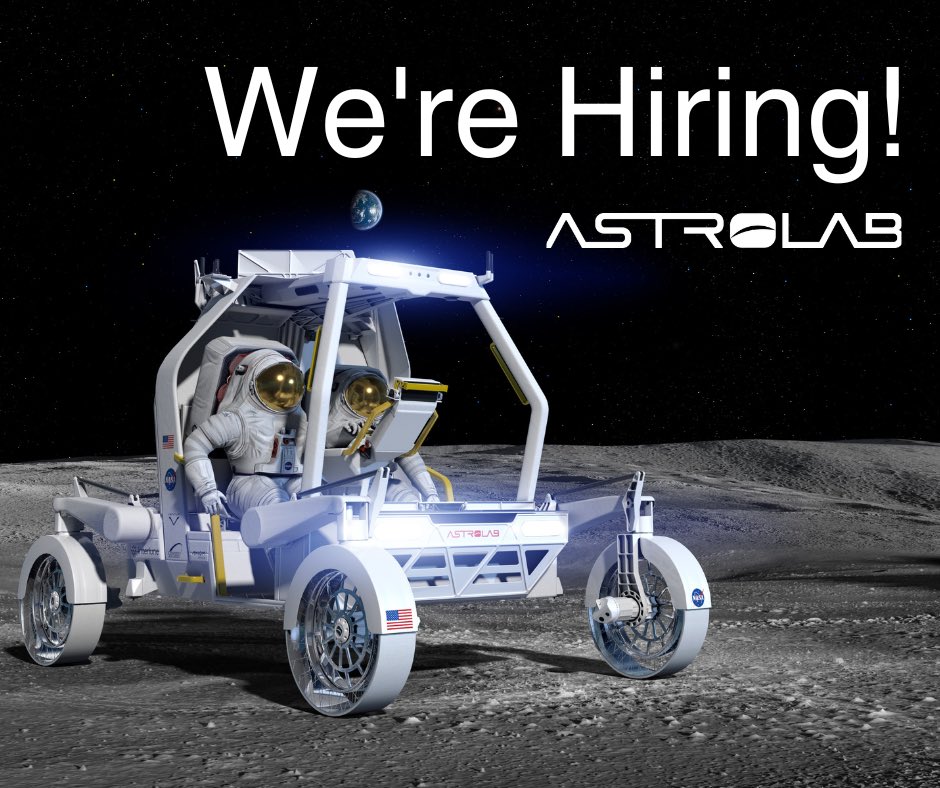
We're hiring Avionics, Software, and Vehicle Engineers at Astrolab!
If you're interested in working on cutting-edge lunar mobility systems, we have openings across rover navigation, FPGA, perception, power systems engineering, and more.
Explore all positions here:
https://t.co/n16b9iJKyV
Testing the next lunar rover.
Fun to go to the hottest place on Earth to help develop @Astrolab_Space's FLEX vehicle. It has multiple cool new tech ideas, to be used when the FLIP version rolls on the Moon soon.
Advances from both are being built into the CLV-1 Crewed Lunar Vehicle that @NASA chose for Moon Base - will go over 6 mph, directly and remotely piloted.
Our FLIP rover is now attached to @astrobotic hardware! FLIP was recently stacked and integrated onto the cone and ramps of the Astrobotic Griffin lander, the rover’s ride to the Moon.
Our FLIP mission launching in the second half of this year (2026) will directly support the development of our Crewed Lunar Vehicle (CLV-1).
The tires, batteries and wheel actuators developed for our FLIP and FLEX rovers by Astrolab’s strategic partner, Venturi Space will also be used by CLV-1. FLIP will test our hardware in the lunar environment, as well as validate our rover software and processes.
Yesterday we introduced CLV-1 (Crewed Lunar Vehicle). Let's explore the use-cases it was designed for and engineered to accomplish:
-Consistent with NASA’s requirements, CLV-1 is designed primarily to transport astronauts and their supplies.
-Conduct surface operations remotely.
-CLV-1 shares hardware with our FLEX rover, using the same tires, batteries and wheel actuators developed by our strategic partner, Venturi Space.
-When stowed on a Commercial Lunar Payload Services lander for delivery to the Moon, CLV-1 measures approximately 2 meters by 2.3 meters by 2.2 meters.
-Once deployed, CLV-1 will measure approximately 4 meters long by 2.3 meters wide by 2.6 meters high to the top of its antenna.
-CLV-1 has a maximum mass of 950 kilograms and can reach speeds of 10 kilometers per hour on level ground.
-CLV-1 is the first in Astrolab’s planned CLV line, with future vehicles expected to be designated CLV-2, CLV-3 and so on.
Copy, Moon Joy(rides)!
Over the next 18 months, our selected providers – Astrolab and Lunar Outpost – will finalize designs for Moon rovers that astronauts will drive to travel, transport supplies, and support remote operations. https://t.co/K9iQzBwrwE
We are proud to be partnering with @Axiom_Space, @OdysseySpaceRes and @InterluneSpace to deliver CLV-1 and related services capable of supporting NASA crewed and robotic surface missions.
Thanks also to strategic partner @Venturi Space who is providing important technology to CLV-1 like tires and batteries.
The #AxEMU's ride on the Moon has been secured. “We’re proud to support @Astrolab_Space on the Lunar Terrain Vehicle Services program, as @NASA advances human exploration at the lunar south pole,” said Russell Ralston, senior vice president, spacecraft development, Axiom Space. “The Axiom Space EVA team brings deep experience in spacesuit integration, crew displays and controls, tool design, operations and human systems engineering to help ensure CLV-1 can support astronauts as they conduct science and exploration on the Moon.”
https://t.co/1izL5OY2gx
We have awarded @AstroLab_Space with a lunar terrain vehicle award. Their Crewed Lunar Vehicle is a rover designed to transport astronauts and supplies across the lunar surface.
This vehicle will be deployed to the Moon by 2028 through our commercial lunar payload services initiative.
NASA has selected Astrolab as one of two providers of a crewed lunar rover for the Artemis program, advancing the agency’s plans to establish sustained surface mobility at the lunar south pole.
Read the full announcement: https://t.co/OQ9RKbZqyz
As our FLIP rover prepares for the final stages of pre-flight testing, we’re seeing our animations turn into space-ready hardware. Next step, doing it all on the Moon.
Now that FLIP has completed its first drive, what’s next for our rover before it heads to the Moon?
Next up is final testing, including shock testing, vibration testing, and FLIP’s last thermal and vacuum chamber (TVAC) test. These tests ensure the fully assembled rover can survive launch and the harsh conditions of the lunar surface.
Then FLIP heads to Cape Canaveral, FL! There it will be integrated onto the top of @astrobotic's Griffin lander and prepped for launch.
Exciting milestones in FLIP’s journey are coming very soon!
Artemis era rovers need to operate both with human assistance, as well as autonomously. LiDAR is one of the key tools that will make that possible.
Hardened by @NASA_Marshall in partnership with Fibertek, Astrolab will use this LiDAR perception system aboard our FLIP rover to test the technology on the Moon. The payload is adapted for the severe conditions on the Moon, and FLIP will use it to capture high-resolution 3D scenes of its surroundings for navigation, obstacle detection, and hazard avoidance.