With Ralph Pudritz, I've been editing the section of the 2nd edition of the Handbook of Exoplanets focused on "Formation and Evolution of Planets and Planetary Systems". This thread collects together the contributions currently available on astro-ph: (1/5)
First day as a postdoc at NoirLab in Tucson today, keen to connect with US researchers and if anyone wants a talk about white dwarf planetary systems let me know! 🔭🪐
New paper out today where we find simultaneous dust and gas emission in the disc surrounding a white dwarf star - this tells us that the dust and gas must be produced together around this white dwarf - more details here: https://t.co/oQVlHGuU2l
Individuals from disadvantaged backgrounds are not responsible for fixing issues related to diversity, equity, and inclusion.
I repeat… 🗣️
Individuals from disadvantaged backgrounds are not responsible for fixing issues related to diversity, equity, and inclusion.
And, one of the teams was formed at the last EuroWD conference 2 years ago, so it seems fitting that we find out we got accepted during this year’s EuroWD conference!
We are kicking off #EuroWD24 with some great statistics on the growth of the conference and the number of white dwarfs discovered per participant, from 1974 it was 30 and now more than 1500!
Is your brain ready for a LOT of interdisciplinary exoplanet knowledge! 🧐🤯 You know it is!
🧵In Jan 2021, Keith Putirka, Siyi Xu, and I joined forces to put together 15 chapters (and a workshop!**) written by experts in their field, where the core of each chapter was:
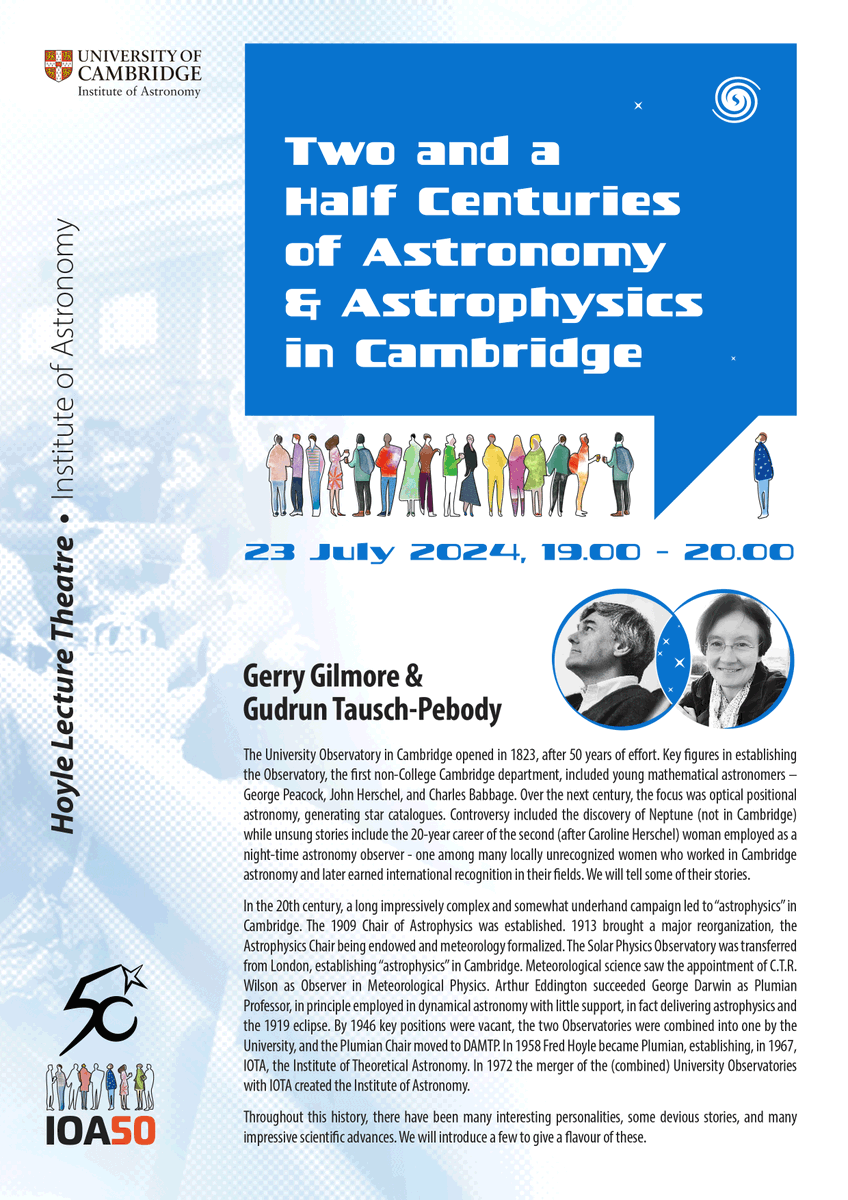
As part of our 50th-year celebration conference, we are holding a series of special public talks.
On Tuesday 23 July, you can hear about "Two and a Half Centuries of Astronomy and Astrophysics in Cambridge". Get a free ticket here: https://t.co/IJm1IH38Wp
Save the Date! We’re hosting a community workshop May 5-7, 2025 at the @JHUBloombergCtr in Washington, DC to discuss the future of infrared astrophysics and synergies across the spectrum going into the next decadal survey.
I'm happy to share that my first PhD paper was published today in @ScienceMagazine, featuring the analysis of the #jwst spectrum of a planet-forming region around a young star revealing an extremely carbon-rich gas composition. The paper: https://t.co/OB2757IaJY #ScienceResearch
Some exciting Fri morning news! Some of you may know I have been working on an introductory level Python textbook for astronomy --- it is now published! https://t.co/y6K0YE55RC Anyone with institutional IOP access should be able to view the PDF for free.
New paper! My student Natsuko Yamaguchi studies a population of wide (~1 au) white dwarf + main sequence binaries discovered via Gaia astrometric binary orbits. 1/n https://t.co/0AleZt9F1d
It’s finally April! Do you know what that means? Some cheeky scientists have created some April Fool’s scientific papers and submitted them to arXiv, a free distribution service for open-access scientific papers, and this year’s submissions did not disappoint!
Andrew Swan kicks off the final day of #DustDevils24 with a review on Extreme Debris Disks (those systems with fractional luminosities > 1%) - including lots of fun information on white dwarf disks, a topic close to my heart
Zach Vanderbosch has the final talk of #DustDevils24 who is presenting a census of white dwarfs hosting transiting planetary debris, there are now 21 systems split into two categories: those near/within the Roche radius and those beyond the Roche radius
Akshay Robert talks about the frequency of transiting planetary systems around polluted white dwarfs by searching for transits in the TESS lightcurves and found a planet fraction of 0.8%. Also finds short-period Kronian planets are unlikely to occur around WDs #DustDevils24