Indian Point opponents promised that hydro power from Quebec would supply as much electricity as one of the units.
That new source of supply needed a transmission line. After many delays, the line is now in service - roughly 5 years after the last electricity from Indian Point NPP was supplied to the grid.
But…. Hydro Quebec is supplying something less than 20% of the promised power. The deal approved by NYSERDA includes many loopholes that allow Hydro Quebec to keep its “abundant” power whenever it needs it.
"One project alone [the Champlain Hudson Power Express] could provide 1,000 megawatts of hydropower – 50 percent of Indian Point's capacity – and that project has all its approvals."
- Paul Gallay, Riverkeeper president, January 2017
Yesterday, CHPE delivered zero.
It wasn't an outage. NYISO listed the line as available at its full 1,250 MW for all 24 hours, and Hydro-Québec scheduled nothing across it. The last time that happened was July 28. The drop came fast: CHPE carried 15–20 GWh a day from Sept 28 to Oct 1, then 7.6 GWh on Oct 2, about 3 GWh on Oct 3 and 4, and nothing on Oct 5.
Is that allowed? Yes. Hydro-Québec's contract with NYSERDA has no daily or hourly delivery requirement. According to the PSC order approving it:
The only floor is seasonal. Hydro-Québec has to deliver 40% of its promised annual amount in each six-month period.
That floor isn't enforced yet. It's measured over three seasons and doesn't start counting until the third, so the first real test is around summer 2027.
Outages shrink it. It's reduced whenever the line is down, and for curtailment and force majeure.
Hydro-Québec is paid only for what arrives. A zero day costs ratepayers nothing, and also delivers nothing.
The promise was much bigger than the floor. Hydro-Québec bid 10.4 TWh a year. When the PSC approved the contract, it said that number showed the "objective to fill the CHPE line to maximum capacity for 95% of the year." Since June 1, CHPE has delivered 0.68 TWh, about 19% of that pace.
Over the entire day: New York used 378 GWh. Gas supplied 36%, nuclear 20%, hydro 18%, solar 9%, wind 9% and imports 8%. Demand peaked at 18.0 GW at noon, and NYC's highest-priced hour hit $97/MWh.
@DarebeTruthfull Did you mean to write balloon? That implies that it is ready to pop at any minute.
Perhaps you were thinking of cocoon - which implies comforting and protective.
The two words sound similar. I have to ask - are you a native English speaker?
Türkiye President Recep Tayyip Erdogan’s son-in-law Selcuk Bayraktar is the chairman of Baykar, a successful drone company. He is also the owner of TMRS Energy.
For the past couple of years, TMRS Energy has been quietly preparing to enter the SMR industry by developing the capability to manufacture small modular reactors.
The transition from drones to SMRs sounds vaguely familiar.
I also wonder if the family relationship to the President has anything to do with Türkiye's efforts to establish a new regulatory regime for Small Modular Reactors.
@MickMechanics Influencing, not writing. The bill is described as being prepared by Ankara, presumably by the legislature.
Presidential influence in Türkiye seems to be stronger than it is in the US. I'm not sure how much stronger these days.
Something new has happened in the growing set of Small Modular Reactor companies that have gone public.
Executive leaders at @newcleoenergy, a European company that was already well-capitalized before going public in the US via a SPAC, believe their shares are selling for a bargain price.
Their reaction was to ask their shareholders for permission to buy some of them back during the next five years. Their shareholders overwhelmingly approved, by a 99.8% majority vote, to approve the company's capital buyback plan.
Sounds like newcleo leaders and shareholders believe shares in their company are "on sale" at a price where buying is more logical than selling.
@ElonToo I see it more as business and political fraud.
Responsible engineers issued numerous predictions that warned of similar outcomes before Indian Point was closed.
Nuclear industry leaders - like NEI - should be reminding everyone that “bailouts” that keep useful plants running have paid huge financial dividends to customers.
Competitors? Not so much.
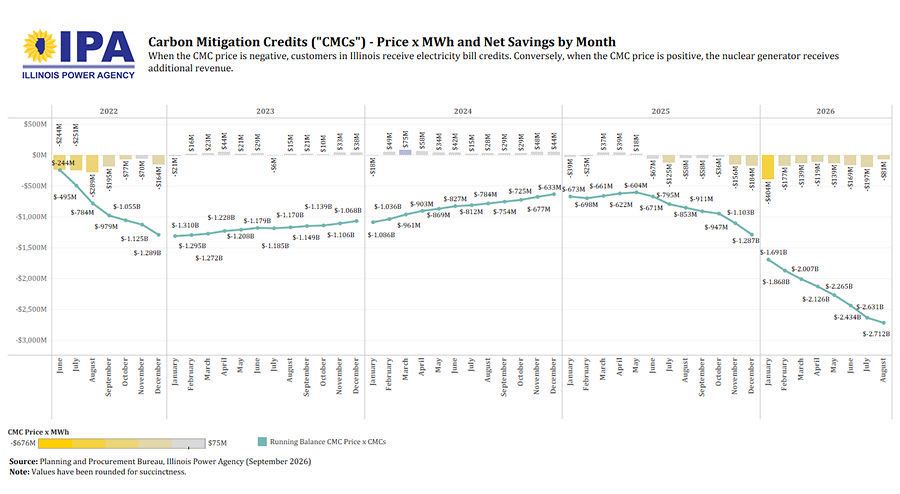
When Illinois saved its nuclear plants it was characterized as a “bailout”.
Since passage, the “bailout” has returned $2.7 billion to ratepayers.
https://t.co/RXDmRErtIu
The Tennessee press is reporting on a planned ceremony today as TVA receives its construction permit to build a BWRX-300 at the Clinch River site near Oak Ridge TN.
Tennessee Governor Bill Lee and U.S. Sen. Marsha Blackburn are expected to attend.
This will be the 2nd advanced reactor construction permit issued by the US NRC.
(The first was TerraPower's Natrium plant in Kemmerer, WY.)
When the NRC first accepted TVA's Construction Permit Application, it expected to issue the CP in December 2026. IOW, it cut 3 months from the initial schedule.
This article provides an example of how politicians and the news media effectively suggest to the public that everything nuclear is uniquely dangerous. The truth being the opposite. Article link in reply.
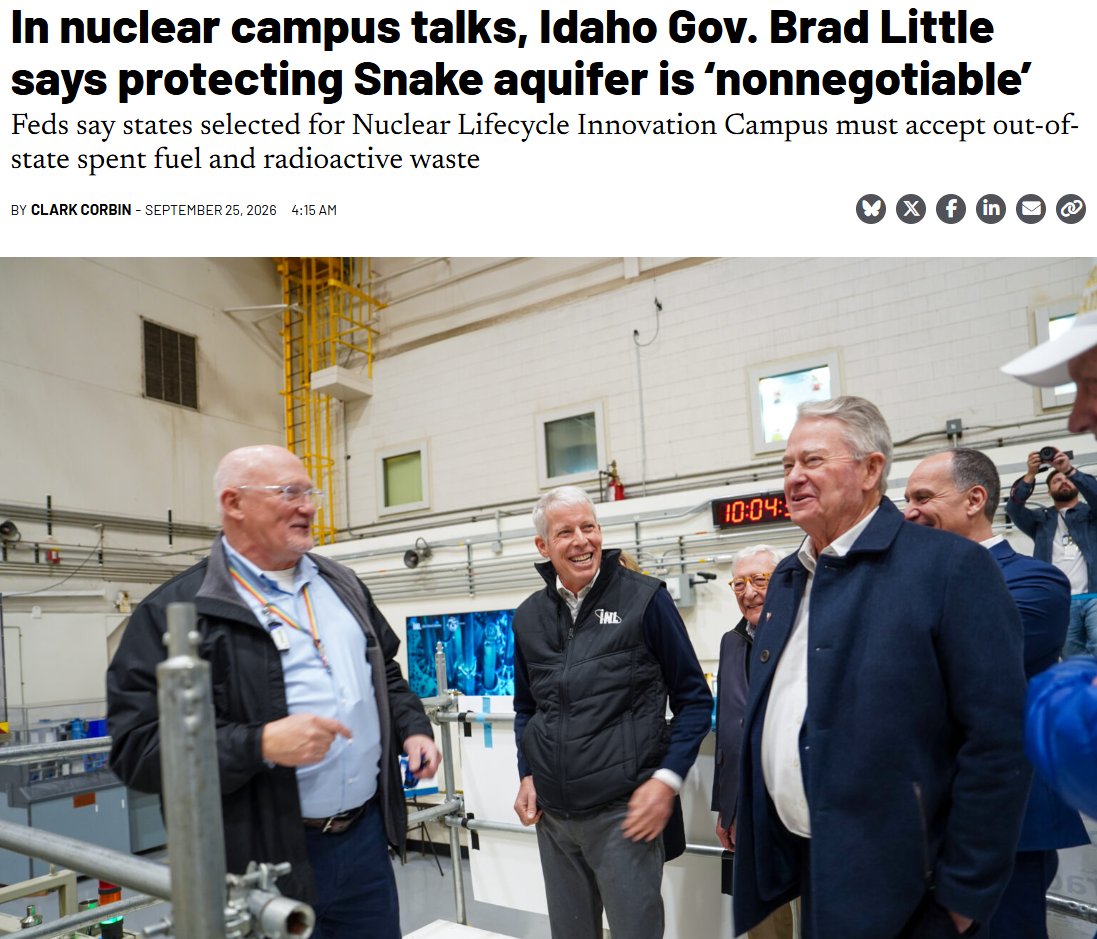
Idaho's governor, who is negotiating with the DoE about hosting a nuclear lifecycle innovation campus to Idaho, says that it will not will not be sited anywhere near Idaho's main aquifer. He said "he will not jeopardize the health of the Eastern Snake Plain Aquifer or the health of Idahoans."
An Idaho legislator characterized storage of used nuclear fuel as a “forever decision”. Suggesting that nuclear has the only waste stream that will never go away.
Again, the opposite of the truth. It's one of the only waste streams that disappears over time (exponential decay). Many other waste streams, from coal and even solar have toxic elements (like mercury, arsenic, and cadmium, that last forever (do not decay over time). Such non-nuclear waste streams are also vastly larger in volume, are much more prone to dispersal, and are disposed with far less care. They pose a much greater public health risk, now and in the future.
This is what leaders should be telling the public. They should also tell the public that nuclear power waste has never harmed the public (over ~60 years of operation). A much better record than other energy sources and industries.
But alas, they feel a need to make such statements to assure the public that they will be safe, because the public is (already) afraid of all things nuclear. But these very assurances are affirming the public's belief that nuclear is uniquely dangerous. It's a viscious cycle.
How do we get out of the circle? Stop digging and start telling the public the truth. That nuclear's risks are uniquely SMALL.
Both the ITC (solar) and the PTC (wind) were well exercised support programs by 2005
I'm very sure that drafters of EPA 2005 understood the difference between the ITC and the PTC.
They selected the one that would provide an opportunity to CLAIM support without PROVIDING any support.
It's now possible to find information about the cumulative value of US federal tax credits for wind and solar energy.
Here are the current estimates:
$35 B - $50 B for wind energy, starting with the Energy Policy Act of 1992 and renewed seven times since then.
$70 B - $90 B for solar starting in 1995, with the vast majority of that ($65 B - $75 B) since 2006.
In contrast, nuclear energy has received about $0.5 B in tax credit funding since 1992.
Though a federal tax credit for nuclear energy - 45J - was created by the Energy Policy Act of 2005, it was completely unused for almost 20 years.
It was first claimed after Vogtle 3 (Jul 2023) & 4 (Apr 2024) were completed.
Yet some RE advocates believe it is unfair for nuclear energy to continue to receive federal assistance after their credit programs were eliminated by the OBBBA.
As Secretary of Energy Chris Wright explained during a live episode of the Shift Key podcast recorded during NY Climate Week, the free market advocate explanation is that nuclear energy was forcibly restrained by the government for more than 30 years. The current support is designed to help revive the industry to accelerate its ability to compete on its own merits.
In yet another article about the "slow" pace of new nuclear power, I saw a bizarre statement from a research company.
“The money is arriving faster than the projects are maturing,” said Max Hermanson, a vice president at the Washington-based research company ClearView Energy Partners. “The nuclear renaissance is currently still showing up more on balance sheets than construction sites.”
(Ref - EnergyNow "Dozens of companies are developing the next wave of nuclear technology, based on new designs" 9/25/26)
News flash - money MUST arrive before construction and manufacturing can progress. Money is the lubricant that enables workers and pays for materials purchases.
Successful fundraising based on visions and solid plans has to take place before anything can be commercialized.
If you believe that today's TRISO fuel costs ensure that reactors using TRISO will be hopelessly uncompetitive, a short history report might be useful.
Before the development of nuclear submarines and the Shippingport Nuclear power station, zirconium was considered to be a cool laboratory material. It was known to have a high melting point and exceptional corrosion resistance in water, even at temperatures in excess of 500 ℉.
During the early stages of reactor development, scientists also determined that it had a very small neutron cross-section for absorption.
In other words, it was the best available material for cladding nuclear fuel.
There were real problems, however. In the mid 1940s zirconium cost more than $600/kg in nominal (non inflation adjusted) dollars. It was really, really expensive.
There was also limited global supply, measured in just a few kilograms. That fact was tightly linked to high unit costs.
Zirconium had additional issues. It was often contaminated with hafnium, it was brittle, pyrophoric in powder form, and subject to nitrogen contamination. It needed careful handling and tight quality assurance standards.
Rickover – a well-read, experienced industrial engineer with a strong materials background – chose to use zirconium for fuel cladding. He judged it to be superior to aluminum and stainless steel, two of the available alternatives.
His choice was loudly criticized by people who claimed that the choice was expensive, logistically risky and reckless. Some labeled the decision as "intellectually arrogant."
By the end of the 1950s, zirconium prices had fallen to less than $15/kg – 40 times less than 1946. There was an adequate supply to support a major commercial power plant expansion and quality control techniques supported the large increase in production without inhibiting use.
Many in the renewable energy lobby have been sharply critical of the Trump Administration's actions to slow or halt offshore wind development.
Wonder if they have any idea of the current state of Germany's offshore wind deployment? There are currently 16,000 MWe (16 GWe) of capacity sitting in limbo. The owners of the leases are faced with sharp cost increases for materials and construction costs as well as rising interest rates. Market prices of electricity have been volatile and discouraged customer from signing PPAs and developers from reaching final investment decisions.
Transmission system operators have had major challenges in developing the required grid connections, giving wind farm developers a good target for finger-pointing when criticized for failing to follow through.
Major leaseholders invested as much as $7 B to obtain the leases and then invested tens of millions more in surveying the sea bottom to prepare for installation. Several have indicated their desire to walk away from the investment altogether, even offering to give the government their survey data. They want to rid themselves of any future liabilities.
IOW, a president who wants to protect the sea views from his golf courses is not the only barrier to offshore wind development.
Your “it has become trivial” is a significant simplification of a technological endeavor that didn’t happen automatically.
The point I’m making is that it was driven and succeeded. Similar advances have happened in other industries when creative, optimistic people made hard decisions and pursued difficult goals.




![NYEnergyAllies's tweet photo. "One project alone [the Champlain Hudson Power Express] could provide 1,000 megawatts of hydropower – 50 percent of Indian Point's capacity – and that project has all its approvals."
- Paul Gallay, Riverkeeper president, January 2017
Yesterday, CHPE delivered zero.
It wasn't an outage. NYISO listed the line as available at its full 1,250 MW for all 24 hours, and Hydro-Québec scheduled nothing across it. The last time that happened was July 28. The drop came fast: CHPE carried 15–20 GWh a day from Sept 28 to Oct 1, then 7.6 GWh on Oct 2, about 3 GWh on Oct 3 and 4, and nothing on Oct 5.
Is that allowed? Yes. Hydro-Québec's contract with NYSERDA has no daily or hourly delivery requirement. According to the PSC order approving it:
The only floor is seasonal. Hydro-Québec has to deliver 40% of its promised annual amount in each six-month period.
That floor isn't enforced yet. It's measured over three seasons and doesn't start counting until the third, so the first real test is around summer 2027.
Outages shrink it. It's reduced whenever the line is down, and for curtailment and force majeure.
Hydro-Québec is paid only for what arrives. A zero day costs ratepayers nothing, and also delivers nothing.
The promise was much bigger than the floor. Hydro-Québec bid 10.4 TWh a year. When the PSC approved the contract, it said that number showed the "objective to fill the CHPE line to maximum capacity for 95% of the year." Since June 1, CHPE has delivered 0.68 TWh, about 19% of that pace.
Over the entire day: New York used 378 GWh. Gas supplied 36%, nuclear 20%, hydro 18%, solar 9%, wind 9% and imports 8%. Demand peaked at 18.0 GW at noon, and NYC's highest-priced hour hit $97/MWh.](https://pbs.twimg.com/media/HT9FwX7W0AAqx_A.jpg)