📢🧵 New paper out on @MethodsEcolEvol !
Can #MachineLearning be used to get accurate, unbiased density estimates in #cameratrap studies? Our findings suggest it can! 📷🦊 Check out how automated classification could improve wildlife monitoring!
https://t.co/PS0CiOWlUl
🧵(HILO) Un equipo de investigación del MNCN-@CSIC ha desarrollado TropiCam-AI, el primer algoritmo de IA que identifica automáticamente, a partir de imágenes de cámaras trampa,las especies animales que habitan en el dosel de bosques húmedos neotropicales. https://t.co/IKofzVPyte
📢Wonderful postdoc opportunity!
Postdoc position in ecological modelling of camera trap data for biodiversity monitoring in the #Biodiversa WildIntel project https://t.co/lKlgggB0cJ
deadline: 1.09.2024
The position is affiliated with the @INCPoland.
https://t.co/rl8NvS82qs
📖Published📖
Our new research article investigates whether foundation models are already performant enough to be used in ecology for animals' behavioural classification, from camera trap images, without any fine-tuning 📸 Find out more here 👇
https://t.co/5ml0e3KpOZ
Excited to share that Martina Fernando, PhD student at our Global Mammal Assessment Lab, just presented her work "Developing a global probability map of illegal hunting on terrestrial mammals"with Michela Pacifici and Marco Davoli 🐘🌍#ConservationScience#IllegalHunting#ECR2025
Finally published in Ecological Solutions and Evidence, paper titled "Ecologically sound strategies for renewable energy transition: Balancing conservation and energy development in coal plant conversions," by Michela Pacifici @global_mammal🌿
#GreenEnergy
https://t.co/XTWDNbVsVk
Artificial intelligence is already used extensively to infer outcomes from tables of data, but this typically involves creating a model for each task. A one-size-fits-all model just made the process substantially easier https://t.co/pAtziaxq66
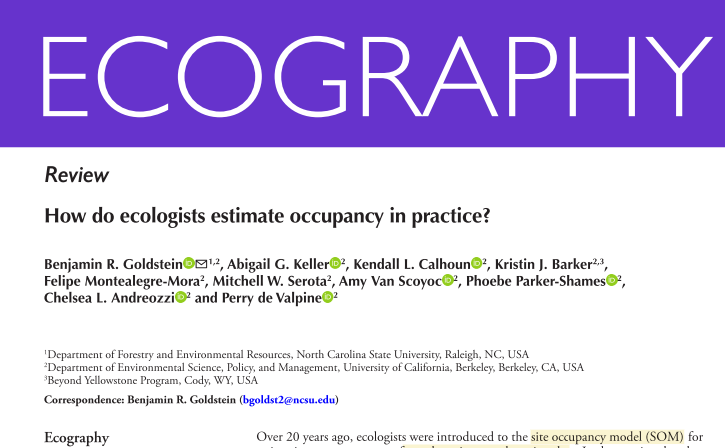
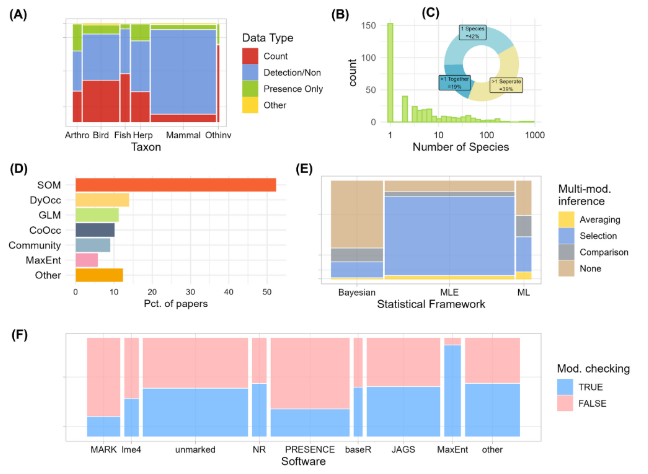
Realy nice review on how do #ecologists estimate #occupancy in practice
It seems that single-species is the most common model family, #mammals the most common group, and unmarked #Rpackage the most common software
#cameratrapping
Wildlife photo of the week is an Anatolian leopard is caught by a camera trap set up in Ankara, Turkey. It’s thought there are fewer than 1,100 adult leopards left in the region.
https://t.co/ZAUw6AAJ2P
Siamo lieti di comunicarvi che stanno per arrivare i podcast "Volevo solo salvare i panda 🐼", una guida galattica per conservazionisti. L'intro al seguente link
https://t.co/zDRCmyZiCC
Stay tuned 😍
@jeremyjcusack@MethodsEcolEvol Thanks! Yes, to better isolate the effect of AI classification we manually extracted position and movement parameters, knowing that AI tools such as the one developed by @timmhaucke are already being tested in pratical applications: https://t.co/wk98UJ0y5E
📢🧵 New paper out on @MethodsEcolEvol !
Can #MachineLearning be used to get accurate, unbiased density estimates in #cameratrap studies? Our findings suggest it can! 📷🦊 Check out how automated classification could improve wildlife monitoring!
https://t.co/PS0CiOWlUl
@engmlubbad@MethodsEcolEvol Hopefully in the immediate future we could see how more ecologist start to envision the potential of more automated approaches, and how this can benefit faster and more efficient research practices. ⤵️
Towards an automated protocol for wildlife density estimation using camera‐traps - Zampetti - Methods in Ecology and Evolution - Wiley Online Library https://t.co/dJ4VrUyh1E
📢🧵First paper out as a preprint on @biorxivpreprint!
📷🦊 We tested if machine learning for automated species classification can be used safely in camera-trap models for density estimation, and found out that this approach can yield unbiased estimates.
https://t.co/dirwaIgZuH
‼️🔴 Our results suggest that popular algorithms for animal detection such as MegaDetector can be safely integrated with CT-DS and REM, and that final density estimates are reliable. Moreover, CT-DS showed to be robust even when taxonomic classifier accuracy was as low as 50%.