@PierrePoilievre All the companies worth investing in Canada already left. Lots of work to do to regain the investment community's trust. I guess this could be a start
Identifying the right stocks is not difficult.
Owning them — holding through the volatility and brutal drawdowns — is the real test.
Aggressive buying when others are panicking is what actually retires you and delivers financial freedom!
Horizon 1: delivered.
IREN has delivered Horizon 1 to Microsoft and achieved NVIDIA Exemplar Cloud status on NVIDIA GB300 NVL72.
Read more: https://t.co/ItVXSXK1V7
$IREN: Generational Buying Opportunity?
Even after today's incredible market recovery, $IREN is still down nearly 50% from its local highs made in June.
There is no doubt that this has been one of the most vicious sell-offs in the company's history.
The question any rational investor should be asking at this point is whether the drawdown is justified. Is the market getting this right, or is it mispricing something and presenting investors with a significant opportunity?
While it's true that $IREN has been underperforming its peers this year, the honest truth is that most AI and data center related stocks have been sold off aggressively over the past few weeks.
Some of it comes down to valuations getting stretched, but a lot of the market-wide panic traces back to a couple of catalysts that spooked investors out of high beta AI stocks.
The first that comes to mind is the recent release of Kimi, a Chinese open weight model that's knocking on the door of the frontier, roughly one generation behind in capability.
To me this is a DeepSeek 2.0 moment, plenty of panic with little substance behind it. It's true that broader adoption of open weight models threatens the market position of the frontier labs, which have enjoyed extraordinary growth curves so far. But it is by no means a bad thing for hardware makers or cloud providers like $IREN.
After all, end users still have to run the model somewhere, meaning on a cloud provider's servers built from AI hardware. If anything, the commoditization of the model layer is a great thing for the companies upstream of it, as cheaper tokens lead to greater adoption of AI (think Jevons paradox).
The second scare, and the most recent one, is more nuanced. On Monday a report claimed that a Shanghai-based, state-backed firm has begun mass-producing homegrown DUV lithography machines, the deep-ultraviolet immersion tools ASML has dominated for years. $ASML fell as much as 8% intraday, and a lot of AI stocks went down with it.
I have since read plenty of reasonable takes from people far more knowledgeable on lithography than me. Some argue $ASML retains a significant lead for many years to come. Others point to China's track record of commoditizing high-end tech, pressuring the pricing power and market share of Western competitors, and argue it's only a question of time until they catch up.
As an $IREN investor, the eventual outcome is pretty much agnostic to me. It's either neutral or potentially even positive.
If China stays behind the frontier of DUV lithography for another decade, it's a non-event. If they catch up quickly, then if anything it should be read as a positive for anybody downstream of the hardware sellers.
Cheaper hardware directly reduces the capex a cloud provider needs, which is already a positive on its own. But push the thought further and ask what happens with the cost savings from cheaper hardware. This is a topic explored at length in our recent deep dive; The Golden Age of Neoclouds.
In a typical competitive market, those savings get passed down to the consumer, making it a neutral event for cloud providers. That only holds, however, if market participants can deploy enough of the cheaper hardware to compete the savings away through undercutting. I've argued in the report that the primary constraint heading into the end of this decade becomes access to power, and with it the ability to bring data centers online at scale.
The end result is that market forces, constrained by data center supply, will lead to most upstream cost savings consolidating at the cloud layer instead of passing through to the end consumer. Users still benefit from token costs falling through technological improvements, but hardware prices coming down is primarily a gift to cloud providers, at least until the power bottleneck lifts, which won't be for a very long time as I've argued in detail in the deep dive.
So to sum up, China getting into DUV lithography is either neutral or positive for $IREN. For some semi-related companies it's either neutral or negative, which makes the sell-off more rational as it relates to them.
So why is the market selling off the entire AI sector without caring about the nuances of how these events hit individual companies differently?
For one, markets rarely behave rationally. After a hot run, any negative-sounding news becomes an excuse to sell, and often to sell everything and ask questions later. Many investors also generalize instead of thinking impacts through the way more sophisticated ones do. And the AI industry being young and not yet well understood, with a limited track record, adds to the pile.
In any case, this has produced what I consider a generational buying opportunity in $IREN (NFA, of course).
Today the stock trades at ridiculous levels relative to the company's fundamentals. By the end of next year $IREN will have over 1.2 GW of data center capacity online, which should support ARR comfortably above $12 billion. Ironically, $IREN trades at a market cap of $12b today. Let that sink in…
I also get the concerns about profitability and dilution, but as someone who has done extensive modelling on this, I consider both fears overblown.
$IREN's most recent deals with $NVDA and AI-native enterprises carry very attractive project-level margins of over 25%. That accounts for guided COGS, depreciation of both the DC infrastructure and the GPUs, financing costs, and a hypothetical 21% tax if these projects were taxed in isolation (which they aren't, of course).
This gives a good picture of where $IREN's net income margins trend as the company scales. Management is investing heavily into branding and talent right now, but those expenses won't rise anywhere near as fast as the megawatts coming online, so operating leverage does the rest.
Today $IREN holds about 5.8 GW of secured power across a rapidly growing powered land portfolio. Once fully built out, that should comfortably carry $50-$60b in annual revenue. At net margins around 20%, which I deem a realistic long-term target at that scale, you're looking at $10-$12b of net income.
I believe $IREN is roughly 5-7 years away from that point. Given the tremendous earnings growth the path implies, multiple consecutive years of more than 100% growth, a PE of 50 would be very fair, if not conservative. That implies a market cap of $500-$600b.
The way I see it, the opportunity couldn't be more clear.
Even accounting for massive continued dilution, say outstanding shares more than tripling from today's levels, we're still looking at a share price around $500 in a relatively short timeframe.
And on dilution specifically, model out the pipeline and you'll notice the need for it diminishes over time as operating cash flows scale, all of which can and will be reinvested into growing the pipeline.
$IREN is currently in what I consider phase 1 of a decade-long growth spurt, with operating cash flows still tiny relative to where they'll be a few quarters from now, so the need for equity raises is at its highest right now and should gradually level off as revenue-producing capacity comes online.
Long story short, dilution isn't something I lose sleep over. It primarily comes down to whether $IREN delivers on the buildout of its powered land portfolio, which I believe they will given their track record.
The other factors I watch closely are competitors' ability to bring compute online and the useful lifespans of GPUs. Luckily both are trending in the right direction, with power scarcer than ever and GPU lifespans extending well beyond what most initially expected.
TLDR:
As someone invested in the stock since $4.8, I believe $IREN today trades at one of the most attractive valuations in the company's history, especially on a risk-adjusted basis.
Thank you for reading, cheers! ✌️
$IREN New Contract Economics
I have seen a lot of discussion on $IREN's new $2.8b of AI Cloud contracts, and I believe most people are underestimating just how attractive these contracts are.
The most common assumption I've come across is that the new contracts have an average duration of roughly 3 years and generate around $3.6/GPU-hour. I believe the available evidence points elsewhere.
Management didn't disclose the exact contract economics. However, they provided enough breadcrumbs throughout the announcement that we can reverse-engineer them with a surprisingly high degree of confidence.
Here is the new information we got:
- Combined value of new contracts: $2.8b
- New year-end ARR guidance: over $4b
- 85% of the new guidance has been contracted
- Weighted average contract duration across $IREN's portfolio: ~4 years
- Prepayments of new contracts amount to 45% of GPU related CAPEX
Previously known information that remains useful:
- New contracts are for a portion of the 50k B300 units that are being installed at Mackenzie & Childress this year
- The recently signed $3.4b contract with $NVDA has a 5 year duration, paying ~$3.77 per GPUh
- $MSFT accounts for $1.93b of year end’s ARR
- PG accounts for $500m of year end’s ARR
The reason many investors arrive at roughly $3.6/GPU-hour is because they assume $IREN's year-end ARR will be exactly $4b, even though management guided to over $4 billion.
Starting with a $4b ARR target, they subtract Microsoft's ~$1.93b ARR and Prince George's $500m ARR, leaving roughly $1.57b of ARR attributable to the 50,000 GPUs being deployed across Childress and Mackenzie.
$1.57b / 50,000 GPUs / 8,760 hours = ~$3.6/GPU-hour.
The same assumption also leads to the commonly cited ~3-year contract duration. If total ARR is $4b, then 85% contracted equals $3.4b of contracted ARR. Subtract Microsoft's ~$1.93bn ARR and Prince George's $500m ARR, and you're left with roughly $970m of ARR for the new $2.8b contract cohort.
$2.8b / $970m = ~2.9 years, which gets rounded to ~3 years.
The issue is that both conclusions depend on treating “over $4b” as though it were exactly $4 billion. Once that assumption is removed, both the implied contract duration and the implied $/GPU-hour would sit higher than that.
All we know for certain is that the new contracts are collectively worth approximately $2.8 billion. This means that the longer their duration, the thinner the attributable ARR becomes.
There is another variable that most investors appear to be ignoring: management stated that the average contract duration across $IREN's entire portfolio is now “approximately 4 years”.
Importantly, management did not limit that statement to capacity commencing this year. It was framed as applying to the entire contracted portfolio, which should therefore include the recently signed $NVDA contract, as well as $MSFT and Prince George and the newly signed $2.8 billion cohort.
That allows us to work backwards and estimate how long the newest contracts would need to run for the overall portfolio average to land at ~4 years.
We know the value and duration of the Microsoft and NVIDIA contracts precisely:
Microsoft is worth $9.7 billion over 5 years, while NVIDIA is worth $3.4 billion over 5 years.
We also know that Prince George represents $500 million of ARR, although IREN has not disclosed the average contract duration of that cohort.
Fortunately, my good friend @_Sgr_A_Star recently analyzed $IREN's latest 10-Q and used the quarter-over-quarter change in remaining performance obligations to estimate that the newly commenced Prince George contracts have a duration of roughly 3 years. I independently verified the analysis and believe that is a reasonable assumption.
Including the older contracts still running at Prince George, I estimate the entire Prince George portfolio carries a weighted-average remaining duration of ~2.7 years. At $500 million of ARR, that equates to ~$1.35 billion of remaining contract value.
Microsoft, NVIDIA and Prince George therefore represent ~$14.45 billion of total contract value against roughly $3.12 billion of annualized revenue. That implies a weighted-average duration of approximately 4.6 years before including the newest $2.8 billion cohort.
For the entire portfolio to then land at management’s stated average of approximately 4 years, the newest $2.8 billion cohort would need to average ~2.35 years in duration.
That would imply ~$1.19 billion of attributable ARR ($2.8 billion / 2.35 years).
Adding that to Microsoft’s & PG’s ARR results in approximately $3.62 billion of contracted ARR that counts toward this year’s year-end ARR guidance.
Management stated that roughly 85% of its expected year-end ARR was already contracted. If $3.62 billion represents that contracted 85%, it would imply a total year-end ARR of ~$4.26 billion.
We can then subtract the $1.93 billion attributable to Microsoft and the $500 million attributable to Prince George, leaving $1.83 billion of implied ARR for the broader 50,000-GPU fleet.
Spread across 50,000 GPUs and 8,760 hours per year, that translates into ~$4.18 per GPU-hour.
This is notably above the $3.60 per GPU-hour figure most people are anchoring towards.
The honest caveat is that management described the 4 year weighted-average contract duration as an approximation. How much leeway they allowed themselves is impossible to know.
Under the lower-yielding, roughly 3 year assumption for the latest cohort, the weighted-average duration across the portfolio comes out to ~4.22 years. Technically, that still rounds to four years, so it could reasonably be viewed as fitting management’s description.
Here is why I believe the $4.18/GPU-hour and 2.35-year outcome is closer to reality than the alternative.
First, as I have repeatedly noted, the $3.60/GPU-hour / 3 year estimate is derived by treating management’s “over $4 billion” year-end ARR guidance as exactly $4 billion. We already know that is not what management said. If anything, $3.60/GPU-hour should therefore be viewed as the hard floor.
Another factor pointing toward a materially higher GPU-hour rate is a recent note from Needham analyst John Todaro, published after a call with $IREN's IR team shortly after the latest contract announcements. In that note, he stated that the newest cohort of contracts was priced above the NVIDIA agreement, which came in at ~$3.77/GPU-hour.
We cannot know whether that was his own inference or whether management gave him an additional piece of information. But it is difficult to see how he could state that with confidence without some degree of management confirmation.
Purely from a commercial perspective, it would also make little sense for the NVIDIA contract to yield more than the newer deals. The NVIDIA agreement is at least 2 years longer in duration and is backed by one of the most creditworthy counterparties in the world. Lower counterparty risk and longer duration should result in lower pricing, all else being equal.
The NVIDIA contract is also significantly larger than any individual agreement within the $2.8 billion cohort, and economies of scale should place additional downward pressure on pricing.
It is true that the NVIDIA contract includes managed services, while we do not know how much of the newest cohort consists of bare-metal capacity versus Mirantis-managed services. But that incremental service component should not outweigh the combined impact of materially longer duration, lower counterparty risk and greater scale.
TLDR 👇
I believe management deliberately chose to sign a mix of higher-yielding, shorter-duration contracts. That would make strategic sense given that GPU-hour pricing is rising across the market and $IREN's previous contract mix was heavily skewed toward lower-yielding, long-duration agreements.
Management has also made it clear that it wants a diversified customer base and a broad mix of contract structures. This latest cohort appears to fit that strategy.
A roughly $4/GPU-hour rate on the newest contracts would allow the underlying GPUs to be fully paid off and even generate a modest hardware profit by the time the contracts expire approximately 2.5 years later, even after assuming gross operating expenses equal to 15% of revenue, or roughly 85% project-level EBITDA margins (previously guided).
This also raises the question of why management chose to guide to “over $4 billion” rather than disclose the precise year-end ARR figure it is currently targeting.
My view is that management intentionally left room to come in comfortably above the $4 billion level investors will naturally anchor to. The remaining contracts still need to be finalized, so maintaining a buffer instead of publishing the exact figure they are trending toward is prudent risk management. It reduces the chance of missing a closely watched year-end target due to timing or execution slippage.
My current estimate is that year-end ARR will land between $4.1 billion and $4.3 billion. That would imply the recent cohort of contracts is yielding roughly $3.80 to $4.30 per GPU-hour.
Thanks for reading, cheers! ✌️
Pretty good piece explaining $NUAI.
Like $WYFI and $IREN, lots of tailwinds.
438 owned acres in Ector County, Texas.
Over 1 GW of planned long-term capacity.
Phase 1 targeting roughly 200MW with first power as early as end of 2027.
And an option on 3,500 acres in Lea County, New Mexico for a potential multi-gigawatt second campus.
I've reiterated my bullish thoughts on behind the meter gas generation numerous times this year...
They've setup in the Permian Basin, where Waha gas prices have literally gone negative at times?
Cheap stranded power, no grid interconnection queue, and a direct path from stranded gas to AI compute...
I bought some today after reading this over the weekend... NFA as always. 🫡
Upon signing new contracts $IREN raises its year-end ARR target from $3.7b to over $4b 💪
For anyone paying attention, this ARR raise was inevitable...
Over the coming days Horizon 1 will be delivered, adding ~$120m to $IREN's quarterly AI revenues.
By Q1 2027 revenues will exceed $1b per QUARTER.
Think about it, $IREN is guiding for >$4b ARR on 480 MW of delivered capcity this year. For 2027, management is guiding for 1.2 GW, with much of that being higher yielding Rubin capacity.
Year-end ARR for next year will easily be >$12b. That's $3b per quarter!
Investors continue to miss the forrest for the trees on $IREN. It's pretty obvious where this ship is sailing...
Kimi K3 has received far more love than we expected, and our GPUs are feeling it.
Over the past 48 hours, demand has pushed close to the limits of our current capacity. To protect the experience of existing subscribers, we're temporarily pausing new subscriptions and prioritizing compute for current members. Existing subscribed users are not affected.
We're adding capacity as fast as we can and will reopen new subscription spots in batches.
Going forward, we'll also split membership into two more focused plans: Kimi Membership for Kimi Web, App, and Work; and Kimi Code Membership for coding workflows. This will help us match compute more precisely and keep the experience stable.
Thank you for your patience and understanding!
$NUAI: A New Era of Compute
We just released our long-awaited deep dive on $NUAI, a stock that has attracted a lot of attention on X in recent months.
$NUAI is an emerging data center company with an incredibly interesting business model that could compound shareholder returns quickly if executed well.
In this in-depth report, I cover the company from A to Z, assessing not just the opportunity, but also the risks and the key factors investors should be aware of.
As always, the first chapter is free to read, so take a look if you are interested.
I’m genuinely proud of how thorough this piece ended up being, and I would highly appreciate hearing your feedback.
Cheers!
https://t.co/sfbI6RzdVr
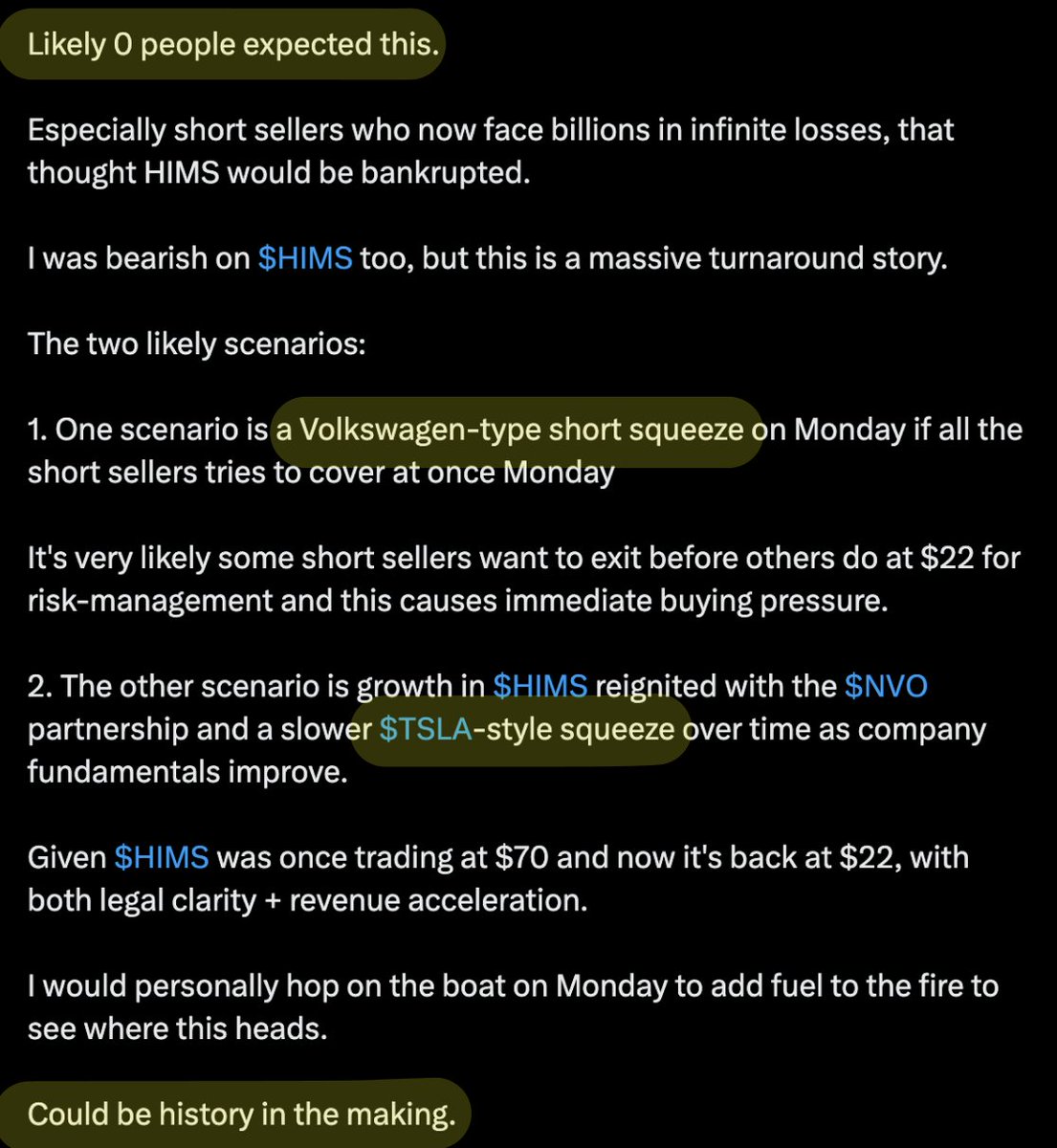
🚨 SERENITY (@ALEABITOREDDIT) -- EX-AI RESEARCH SCIENTIST AND FAMOUS TRADER UP MORE THAN 500% IN 2026 -- SAYS $HIMS MONDAY COULD MAKE HISTORY:
"One of the largest short squeezes in history could unfold"
"Likely 0 people expected this"
"Especially short sellers who now face billions in infinite losses"
"The two likely scenarios: (1) One scenario is a Volkswagen-type short squeeze on Monday... (2) a slower $TSLA-style squeeze over time as company fundamentals improve"
"I would personally hop on the boat on Monday to add fuel to the fire to see where this heads. Could be history in the making."
🤯🤯🤯
$SOFI five years ago...
~$17.76 per share
~Revenue of $1.1B
~Net income of -$484M
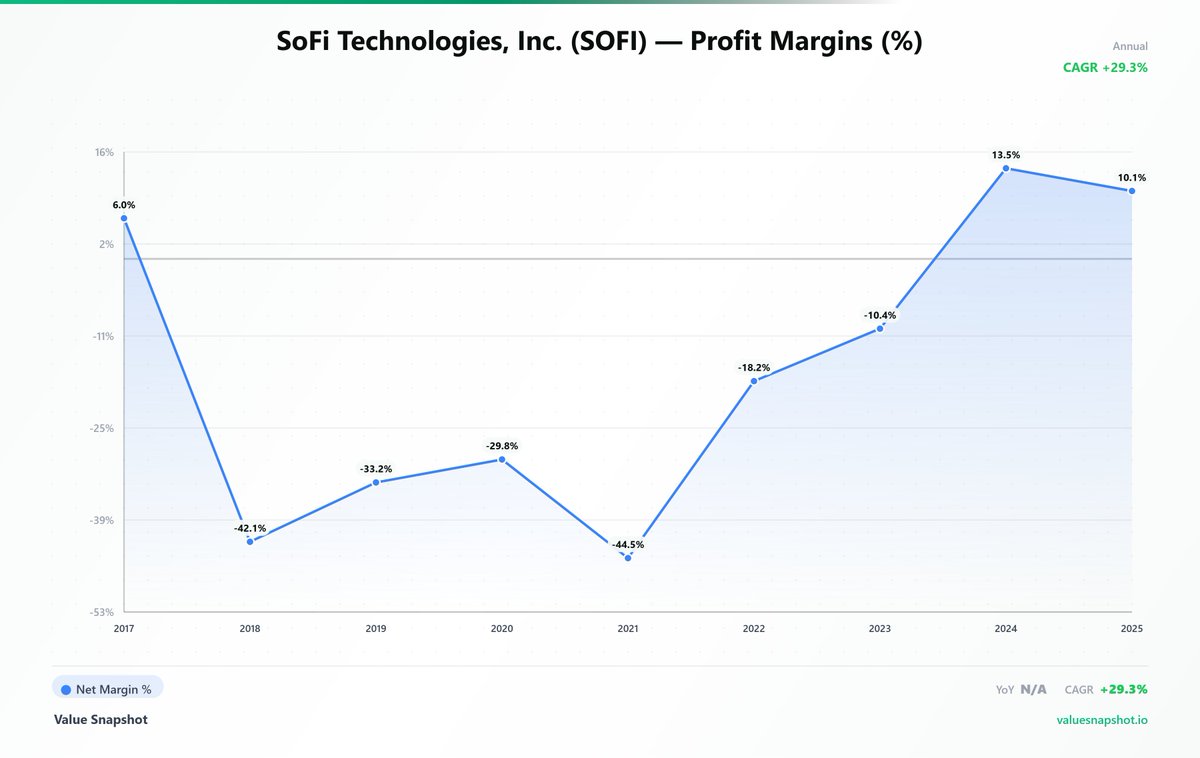
~Net margins of -44.5%
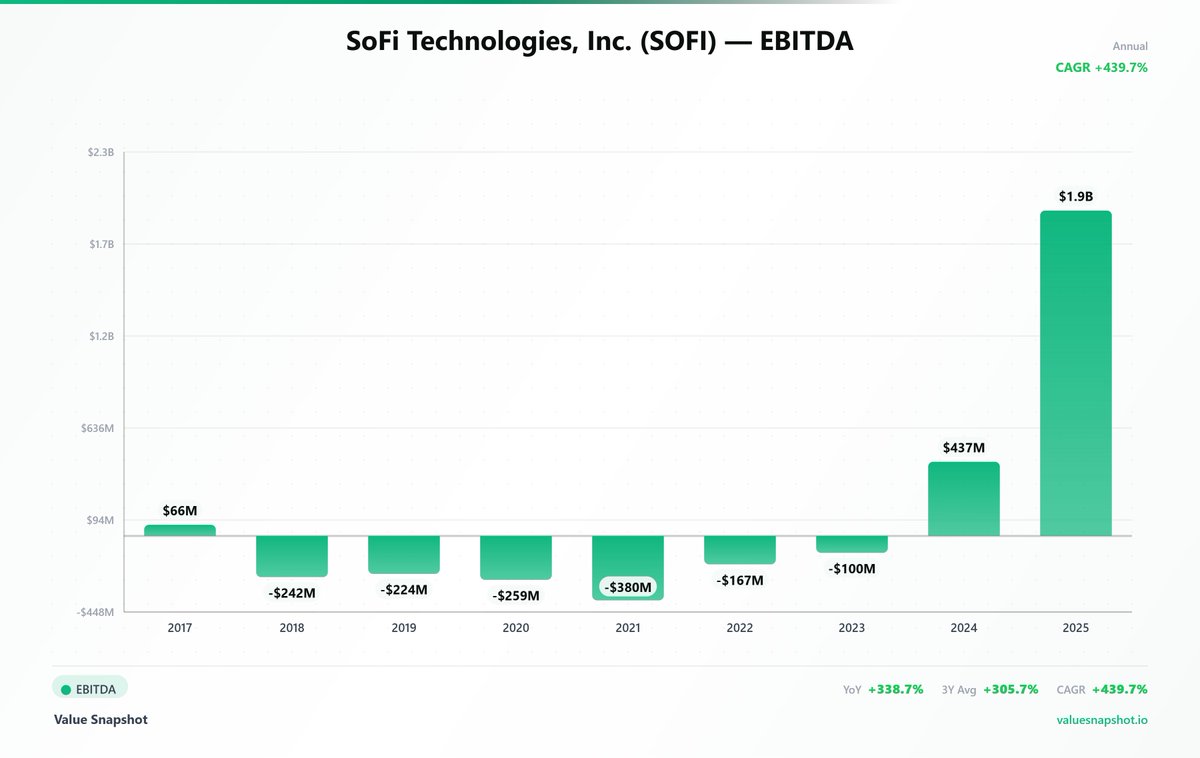
~EBITDA of -$380M
$SOFI now...
~$17.76 per share
~Revenue of $4.8B
~Net income of $481M
~Net margins of 10.1%
~EBITDA of $1.9B
Yeah... I like the stock here. Don't you? 👇
🚨BREAKING: $IREN HAS BECOME HOWARD LUTNICK’S SECOND LARGEST POSITION AFTER $ORCL.
Howard Lutnick is the United States Secretary of Commerce
Credit: @BourbonInsider
$IREN just became a hyperscaler.
The $9.7B Microsoft GPU-cloud deal locks in ~$1.9B ARR at ~85% margins. Add Canada’s 60k GPUs ($1.3B ARR) and you’re near $3.2B ARR by ’26.
At 20x EBITDA on $1.7–2B earnings power = $34–40B value → $250–300/share.
Vertically integrated. No middlemen. 🚀