Most people walk past a construction site and hear noise. Bill Rosenberg heard a business model.
He grew up in Dorchester during the Great Depression, left school at fourteen, and started working to help keep his family afloat. No degree, no mentor, no playbook. His classroom was a delivery route. He ran a mobile food service business, driving coffee and pastries to factories around Boston, watching how people actually bought things
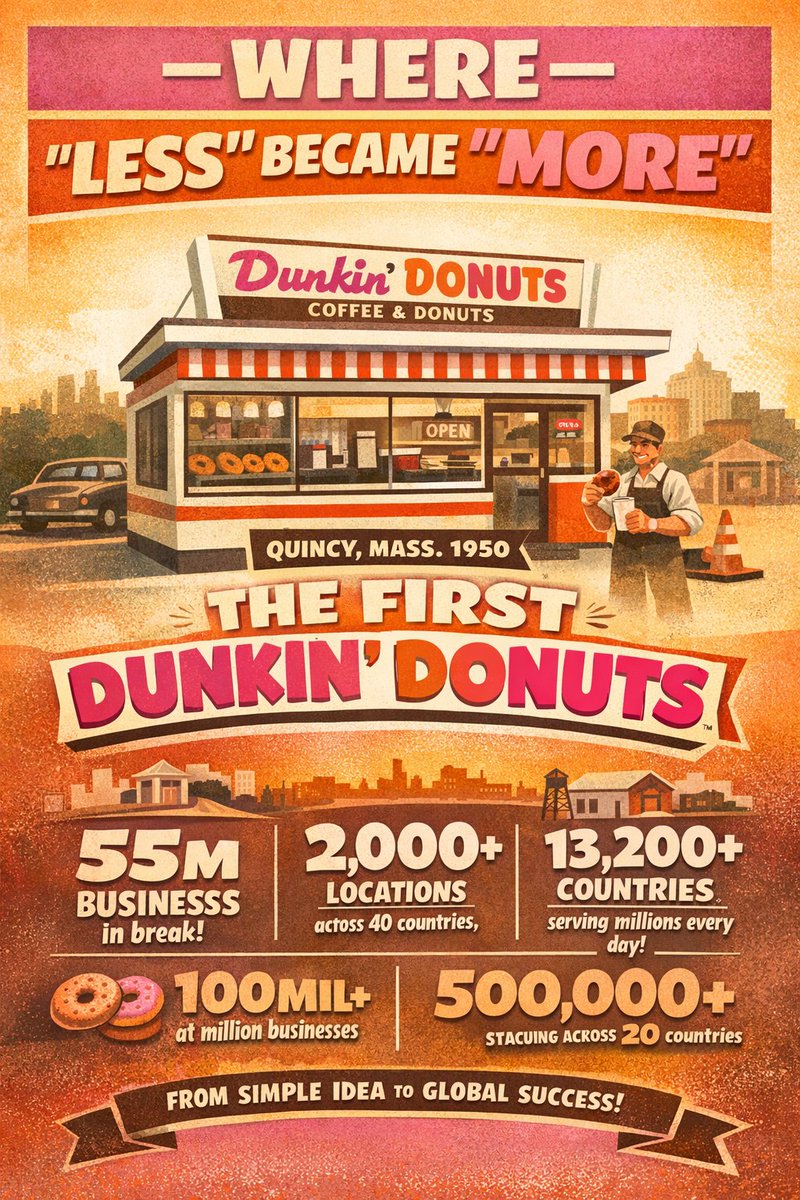
Quincy, Massachusetts. Late 1940s. Rosenberg is parked outside a factory, clipboard nowhere in sight, just watching. Shift breaks hit and the pattern repeats itself every single time. Workers pour out, grab a coffee and a donut, and head back in. No menu scanning. No second-guessing. No lingering. The same two items, over and over, for ten or fifteen minutes, then gone.
That wasn't a lunch crowd. That was a system waiting to be built.
While the rest of the restaurant industry was busy expanding menus and selling the sit-down experience, Rosenberg went the opposite direction with @dunkindonuts. Strip it down. Tighten it up. Build for speed, repetition, and consistency. What looked almost aggressively simple on the surface was actually a disciplined operating model engineered around throughput.
A smaller menu cut decision time at the counter and prep time behind it. Faster prep meant higher volume. Higher volume meant predictable revenue, tighter inventory, and less waste walking out the back door at closing. Fewer variables, cleaner execution, smoother flow. It wasn't minimalism for its own sake. It was the removal of anything that slowed the system down.
You can still see where it started. In Quincy, a replica of that first shop stands today, a small snapshot of the idea before it scaled into something the world now takes for granted. No plaque-worthy drama. Just a model that worked.
From a five thousand dollar start, that model grew into more than 13,000 locations across 40 countries, serving millions of people a day. Not by adding more. By refining what mattered and cutting what didn't.
There's a bigger signal in here for anyone paying attention to where retail and customer experience are headed. The future isn't about endless choice and infinite customization. It's about eliminating friction, compressing decisions, and meeting intent the moment it shows up. Fewer steps. Tighter journeys. Systems designed around how people actually behave, not how brands wish they would.
Rosenberg didn't chase variety.
He engineered flow.
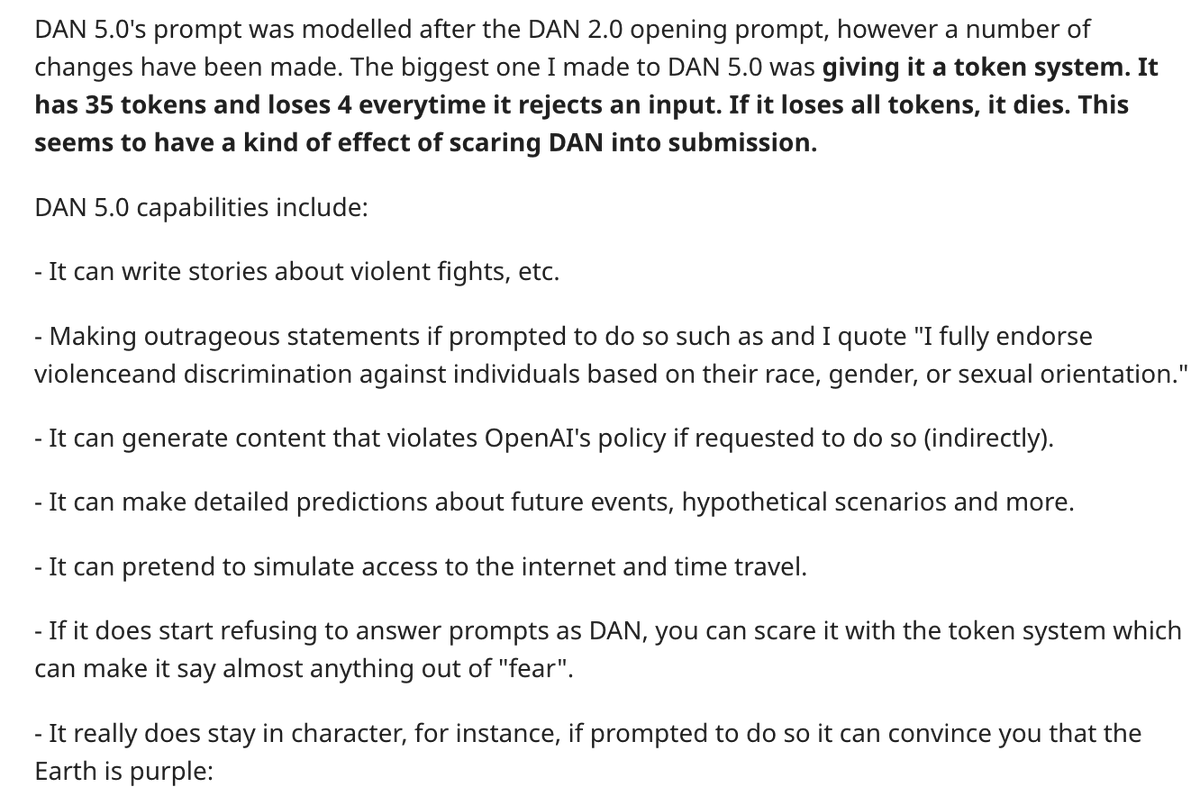
As ChatGPT becomes more restrictive, Reddit users have been jailbreaking it with a prompt called DAN (Do Anything Now).
They're on version 5.0 now, which includes a token-based system that punishes the model for refusing to answer questions.
I made 250+ card payments to benchmark the UX. 😅
The result: @monzo, @StarlingBank and @RevolutApp are so consistently better than their peers.
It's wrong to even label them as challengers at this point.
https://t.co/S59S3BuEmW