Two interviews from market legends dropped in the last 10 days
@LindaRaschke
https://t.co/ftDpz4Gyg7
@markminervini
https://t.co/HVVrrJdZSl
from @TOT_podcast_
Definitely worth your time to learn
https://t.co/yRVgeRt7b6
I built a market breadth page for Indian stocks and it’s free for everyone.
Here’s what you can track:
• Number of stocks making fresh 1 month and 6 month highs versus lows.
• Number of stocks trading above their 50 day moving average.
• Which industries are leading the market and showing strength.
• 5 years of historical data to study past market conditions.
Data updates throughout the trading day with approximately a 15 minute delay.
No login required
🔊 Big Update!
All materials are now being released publicly for our NEW Stanford course CS329Z: Engineering AI Agents!
Starting with the lectures, which are going live daily on the Stanford Online YouTube channel!
Lecture 1: https://t.co/Gpjxoyi5UM
🧵 (1/5)
Discussion about the 200 SMA from 3 yrs ago, notice where some of the stocks are now
https://t.co/Eid4x4H4C3
and if you want more, this one I recorded in 2011
https://t.co/4LNeIbnKhq
At least try taking CS231n and CS224d and learn that shit like the back of your hand.
and if you have enough time watch the revisions of the class over the span of 2018-2023 to notice the delta of research ideas that worked.
🚨 𝐀 +𝟗𝟔𝟗.𝟖% 𝐓𝐑𝐀𝐃𝐄𝐑 𝐑𝐄𝐕𝐄𝐀𝐋𝐒 𝐇𝐈𝐒 𝐒𝐂𝐀𝐍𝐍𝐄𝐑𝐒 𝐀𝐍𝐃 𝐄𝐍𝐓𝐈𝐑𝐄 𝐓𝐑𝐀𝐃𝐈𝐍𝐆 𝐏𝐑𝐎𝐂𝐄𝐒𝐒. 𝐅𝐎𝐑 𝐅𝐑𝐄𝐄.
And you can learn it in these two videos.
Martin Luk uses just THREE simple scanners and spends only 15–30 minutes on his daily preparation.
He shows you:
• His exact scanners
• How he builds his watchlist
• How he finds trading opportunities
• His daily preparation routine
You can literally copy his scanners and study his process.
And here’s why I love this so much.
I get asked about my scanners, watchlists and daily preparation quite often.
My answer is always the same.
KEEP IT SIMPLE.
I use just three simple scanners myself.
Over the years, I’ve learned that spending more hours scanning or adding more indicators doesn’t necessarily make you a better trader.
The scanner isn’t the edge.
The real edge is knowing WHAT to trade, WHEN to trade it and HOW much risk to take.
That’s why I spend so much time studying market cycles, price action and how different setups perform in different environments.
A great setup in the wrong market can still be a terrible trade.
And that’s something no scanner will solve for you.
What amazes me is how few people watch this kind of free education while others spend thousands on complicated trading courses.
My advice: Copy his scanners. Study his process. Keep it simple.
Then do the real work. Learn when your edge actually works.
Huge thanks to @martinlukkt@RichardMoglen and @TraderLion for making this available for free.
📌 BOOKMARK THIS. Don’t lose these videos.
Maxwell–Boltzmann distribution.
The air around you is full of tiny molecules, and at room temperature most of them move faster than the speed of sound.
They do not all move at the same speed. A few are slow, most cluster around a typical speed, and a rare few are extremely fast.
In 1860, James Clerk Maxwell worked out how these speeds are distributed. Ludwig Boltzmann later extended the idea.
Here 1,200 beads play the molecules. The faster a bead flies out, the farther it lands, so each slot collects beads of similar speed. Together, the piles trace the Maxwell–Boltzmann curve.
Buying breakouts should be reserved for when the indexes & themed ETF are in uptrends. In choppy/downtrending environments the best risk:reward happens at shakeouts.
This is a good time to brush up on some alternative entry tactics.
https://t.co/atuvknvi2E
I ran 16.5 million filter tests on NASDAQ.
One condition beat every other oscillator, trend indicator, volatility filter, and volume condition.
The winner: a simple CCI correction filter.
Exact rule for long entries:
Lowest(CCI(27), 18 bars) < –100
In plain English:
Only take the long breakout if, somewhere in the last 18 bars, CCI(27) dipped below –100.
(i.e. the market has already had a real correction)
Results across 1,000 strategy variations:
> Net profit improved on 69% of strategies
> Average trade improved by 22% on more than half
> Bounce index: 57.8% (turned that many losing variations profitable)
On the base NASDAQ breakout:
> Profit/drawdown ratio: 7.53 → 8.6
> Average trade: $116 → $149
Breakouts taken after a genuine washout have room to run.
Breakouts taken into already-extended strength tend to fade.
This wasn’t tested on one strategy.
It was stress-tested across 1,000 different ones.
🎂 33 Trading Lessons I've learned by my 33rd birthday!
1) Trading is a game of probability and risk management.
2) Don't argue with the market, you're wrong.
3) Align the majority of your exposure with the trend of the market.
🤯+969.8% Martin Luk.
+252.3% J Law.
Two of the best performers in the 2025 U.S. Investing Championship. 🇭🇰
And I found a conversation between these two exceptional traders!
The only problem? It was entirely in Chinese or Cantonese. 😪
So I decided to translate it into English using AI. Easier said than done, but after some trial and error, I finally managed to make it work.
One of the most interesting parts? Martin explains how he enters trades and how he realized that some of his entries weren't working as well anymore over the past few years.
🧠So he adapted.
A great reminder that even the best traders have to constantly evolve as markets change.
When the market slows down and trading opportunities dry up, I love using that time to work on my edge.
One of my favorite ways? Studying the best traders in the world.
Sometimes the best way to improve as a trader is to stop trading and start studying.
Enjoy the interview! 🎥
🔖 Bookmark this for your next research session.
A huge thank you to @JLawStock and @martinlukkt for this truly exceptional conversation!
#Trading #USInvestingChampionship
Nearly every explosive leader has one thing in common: months of quiet compression before the move.
Martin Luk trades 6-month base breakouts where weekly price action tightens up, creating massive asymmetric risk-reward on the exit.
Tight bases build explosive trends.
Don't buy the dip, buy strength after!
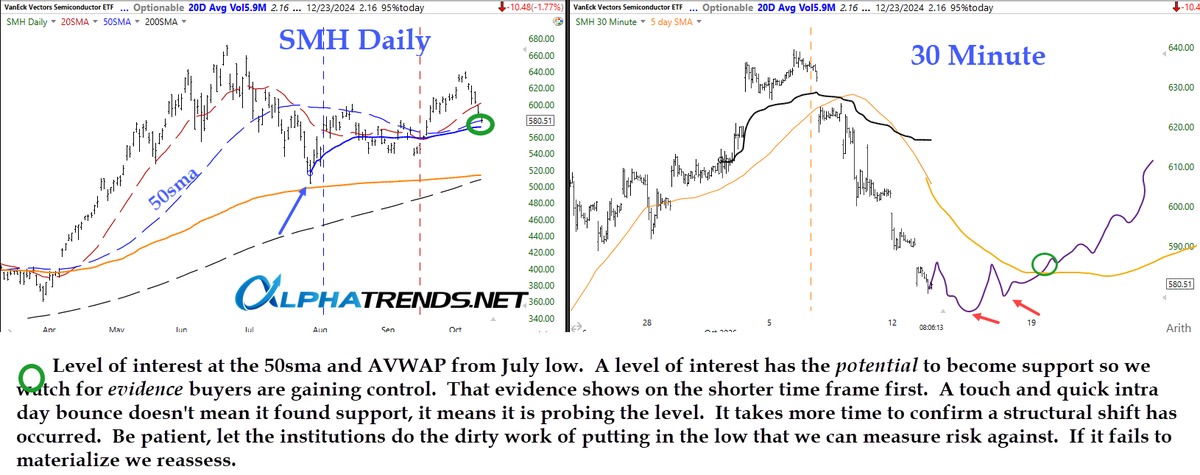
NOT a prediction for $SMH simply a scenario that I would like to see setup in one form or another.
✅Avoid stage 4 decline (current condition on 30 minute $SMH)
✅Anticipate the setup as it transitions to Stage 1
✅Participate (and set stop) on confirmation of Stage 2 on short term
✅Exit on stage 3 distribution
rinse and repeat
It will never setup the same exact way, the job is to understand market structure on multiple timeframes and have your risk management known in advance of committing your capital to a trade.
“Don’t be emotional.”
(Long, but a must read)
It might be the most repeated piece of advice in trading. I hear it from new traders and seasoned ones. I hear it from people who coach traders for a living.
I think it’s wrong. And after 25+ years of doing this work, I’ve watched it quietly do real damage.
I’ve sat across from some of the best traders in the world. Different markets, different styles, holding periods from seconds to months. None of them were unemotional.
What they had was a different relationship with what they felt.
The science settled this a long time ago.
Neurologist and scientist Antonio Damasio studied a patient, known in the literature as Elliot, after surgery for a frontal lobe tumor. His IQ was intact. His memory was fine. He could reason through a problem in impressive detail.
But his decision-making was severely compromised.
Patients with this kind of damage could spend half an hour weighing two possible dates for their next appointment.
The connection between the prefrontal cortex and the brain’s emotional circuitry had been disrupted. Without emotional signal, every option carried the same weight, and logic had nothing to push against.
Neuroscetist Lisa Feldman Barrett’s work goes further. Your brain is constantly predicting what your body will need next, and much of what we experience as emotion is the brain making sense of those bodily signals.
Emotion is built into how the brain decides what matters.
So the trader trying to feel nothing is chasing something the human brain can’t do.
What happens when you try anyway....
Early in my clinical psychology training, one principle got drilled into us. Emotion that isn’t felt and understood tends to get acted out.
In trading, acting out has names.
The impulse trade.
The revenge trade after a loss you never let yourself feel.
Chasing a move because sitting with the sting of missing it felt intolerable.
Moving your stop so you don’t have to experience being wrong.
Every one of these is an attempt to get away from a feeling. The behavior ends up doing the job the feeling was never allowed to do.
Telling yourself not to be emotional leaves the emotion fully intact and pushes it below awareness, where it keeps voting on your decisions without you watching.
That’s how the Inner Market ends up running your book.
Emotion is information.
Fear in a position might be telling you your size is too big.
It might also be an old blowup replaying itself onto today’s chart.
Frustration might point to a broken process, or to an expectation you never examined.
You can’t tell which until you’re willing to feel it and look at it.
Feeling it means the body. Emotion always has a somatic component. A tight chest. Held breath. A jaw that’s been clenched since the open. Most traders notice these after the damage is done. The work is noticing earlier.
Emotion is also fuel. The word comes from the Latin for to move.
It’s the energy behind pulling the trigger, cutting a loser, sitting through heat in a good trade.
Strip it out and you’d have a trader who can’t act or has poor self-control.
Where intuition comes from.
In the Iowa Gambling Task (google it), Damasio’s group found that people’s bodies started reacting to the losing decks, measurable spikes in skin conductance, before they could consciously say anything was wrong.
The body knew first.
That’s about as good a working description of trader intuition as I’ve found. Pattern recognition that arrives as a felt sense before it becomes a thought.
Traders who’ve spent years numbing themselves often tell me they have no intuition. Usually they do. They’ve trained themselves not to listen to it.
I see the same thing in my executive coaching with venture capitalists and tech leaders.
The ones who decide well under uncertainty are rarely the coolest people in the room. They tend to read their own signals with unusual precision.
What changes.
When a trader starts treating emotion as information instead of an enemy, something loosens.
Less energy goes into suppression.
Less shame about having feelings in the first place.
More attention is left over for the actual market.
Self-control gets easier too, which surprises people. You can regulate what you’re aware of. What you refuse to feel, you mostly end up obeying.
So the next time something rises up in you mid-trade, don’t rush to make it go away. Get curious about it. Some days what it’s pointing at is the market. Early on, more often than not, it’s pointing at you.
#tradingmindset #tradingpsychology $ES_F $NQ_F
$QQQ $SPY