One of the biggest misconceptions people have about intelligence is seeing it as some kind of unbounded scalar stat, like height. "Future AI will have 10,000 IQ", that sort of thing. Intelligence is a conversion ratio, with an optimality bound. Increasing intelligence is not so much like "making the tower taller", it's more like "making the ball rounder". At some point it's already pretty damn spherical and any improvement is marginal.
Now of course smart humans aren't quite at the optimal bound yet on an individual level, and machines will have many advantages besides intelligence -- mostly the removal of biological bottlenecks: greater processing speed, unlimited working memory, unlimited memory with perfect recall... but these are mostly things humans can also access through externalized cognitive tools.
In fact half the people I meet in beach clubs in St Tropez / Marbella are doing exactly this: one year it’s crypto, then an Amazon brand, then an AI lead-gen agency, then solar panels or some subsidised renovation business.
Make €1m here, €2m there, shut it down when the margins disappear, spend six months travelling, then come back with the next “coup.”
I used to think this was just unserious entrepreneurship, but some of them have become genuinely very good at it. Their real business isn’t crypto, AI or solar panels. It’s being early.
They spot a new distribution channel, regulatory distortion, shortage or wave of hype before everyone else, build something around it very quickly, then leave before the market gets crowded.
There’s no attachment to the product or industry because the company is only the vehicle. What actually compounds is the cash, contacts, execution speed and instinct for where the next trade will be.
The old founder wanted to build one company that would outlive him.
The new one wants enough wins that he never has to depend on one company at all.
This tendency is very widespread. It appears that the smarter and better educated you are, the more carefully you have to defend your mind against nonsense.
I would argue that to really, fall victim to insanity like Effective Altruism or Communism, you need to be smart enough to absorb and follow a totalizing ideology to its logical endpoint and you need to live enough of your life entirely in your head to be seduced by pretty ideas about how you could fix the world if only someone made you king.
Normal people are too concerned with the practicalities of the ordinary world around them find such batshit crazy unconstrained visions compelling. Intellectuals have no such mental constraints and have a false and dangerous sense that they should be in charge of everything.
The GenAI economy has generated $110 billion in sales over the past 12 months. It is growing fast. On an annualized basis, the revenue run rate exceeds $175 billion.
These numbers took us several months to construct, and as far as we know, it’s the first bottom-up, deduplicated measure of consumer and enterprise AI spending across the full stack.
We are releasing this research today in our first The State of the AI Economy report.
https://t.co/cJwZb0T99C
Maturing is realising that absolutely nothing of substance is happening here.
A false pressure valve is being released, to reset public anger so as to buy additional years of time to implement an agenda that was decided long ago, elsewhere. The frontman is utterly expendable.
High intelligence often comes with heightened pattern recognition. You start noticing social masks, forced conversations, performative friendships, hidden motives, emotional immaturity, and energy that feels draining instead of nourishing. Many highly intelligent people also have more active nervous systems, deeper inner worlds, and lower tolerance for superficial stimulation, so solitude can feel safer than constantly shrinking themselves to fit environments that don't feel aligned.
Barbell strategy for killing it in an age of superhuman AI:
Simultaneously get as close to AND stay as far away from AI as humanly possible.
1. Get close — play with AI models, use them to help you think, ask them to teach you about the world, get them to help you create, work with them to write code, understand what makes them tick, embed them into your everyday life, have fun.
2. Stay far away — learn to tell stories, make eye contact, build a team, lead with courage, connect far-flung ideas, build lifelong friendships, debate persuasively, think forbidden thoughts, handwrite ideas, confess your fears, fall in love.
Spend less time trying to master mental transformations that are purely mechanical — building spreadsheets, analyzing trades, balancing accounts, writing code by hand, following playbooks, searching for needles in haystacks. These are the emerging no-man's land, squarely the domain of AI.
Venture to the extremes. That’s where all the fun is anyway.
Here's a snapshot of the biological insult from international travel. It takes your body over two weeks to fully recover.
It's a big price tag.
One international trip per quarter is a reasonable balance.
Time to recover:
> sleep duration: 2 days
> grip strength: 5 days
> mood: 1 wk
> cortisol: 9 days
> sleep quality: 2 wks
> blood glucose: 2 wks
Turns out ZEC did have a hidden infinite inflation bug. The price action historically was consistent with it. If someone is sitting on infinite ZEC they had minted, they’d slowly liquidate to not reveal this fact.
What if you could take three completely different model families… and distill them into one tiny model? 🤯
📜 Paper: https://t.co/K2iKD4xFvp
MOPD (Multi-Teacher On-Policy Distillation) has become a standard procedure in post-training. We already distill multiple specialized variants of the same model into a single set of weights.
But what if we could go further - and distill models from entirely different families? Turns out, it is possible.
Today we’re releasing a paper on cross-tokenizer distillation - our first steps in this exciting direction. 📄
We distilled Qwen3-4B, Phi-4-Mini, and Llama-3B into Llama-3.2-1B.
MMLU jumped from 32.05 → 46.32 when using multiple teachers. 📈
The team is now working on Nemo-RL integration so the community can try this method in their own settings. Plus, we are scaling experiments up. 🚀
The reason you don't hear about much new chemistry these days is because through social division of labor, humans indeed were capable of performing the work of 500 IQ humans.
We probably know a good chunk of what there is to be known about chemistry (without moving goalposts).
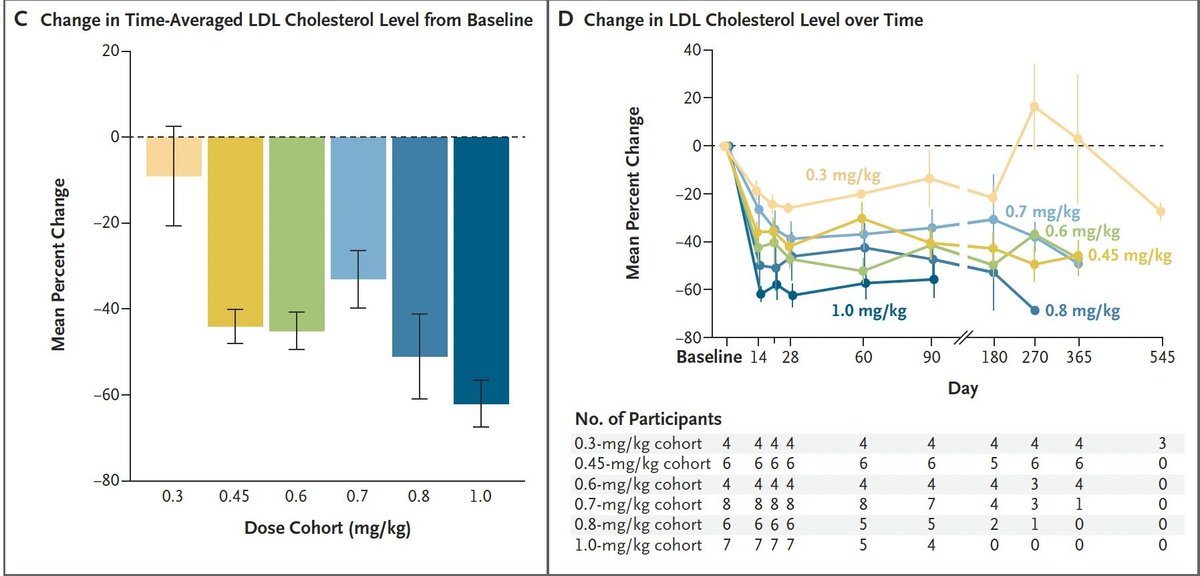
Eli Lilly has done it.
They've gone and made what seems to be a powerful, permanent gene therapy for LDL cholesterol.
That means they'll be able to effectively prevent most heart disease with a single infusion!
⚡️The deeper signal is youth risk did not disappear.
It migrated inward.
Teen drinking fell because the old physical world of adolescence got dismantled. Alcohol belonged to a social ecosystem: unsupervised time, cars, parties, local jobs, malls, basements, boredom, flirting, older siblings, house gatherings, and the chaotic peer world where teenagers learned who they were by colliding with other people in real space.
That ecosystem was replaced by phones, surveillance, parental tracking, algorithmic entertainment, social anxiety, online status games, and a much thinner physical commons.
So the surface looks healthier. Fewer kids drinking. Fewer kids using weed. Fewer kids doing reckless things in public.
The hidden layer looks worse. The young are less reckless because they are less socially embodied. Less initiation. Less unsupervised friction. Less courage-building. Less embarrassment and recovery. Less real dating. Less independence. Less contact with the physical world before adulthood demands it.
The old teenage world produced damage, stupidity, alcohol abuse, pregnancy risk, fights, accidents, and bad decisions. No need to romanticize it. But it also produced social reps. It forced young people through discomfort. It made them practice attraction, rejection, conflict, reputation, risk, repair, and status in the open.
The new world suppresses visible risk while increasing invisible fragility.
That is the trade.
A teenager can avoid drinking, avoid parties, avoid sex, avoid driving, avoid real confrontation, avoid rejection, avoid shame, avoid danger, and still arrive at 23 emotionally underbuilt. Cleaner behavior does not automatically mean stronger formation.
This is why the marriage chart and the teen drinking chart are the same story at different stages. People are not suddenly failing to pair in adulthood. The whole pathway into embodied adulthood has been slowing for years before marriage even becomes the question.
The real truth: society solved part of the teen vice problem by shrinking the arena where teenagers become adults.
It took away the dangerous commons and replaced it with controlled isolation.
The result is safer kids with weaker initiation into real life.
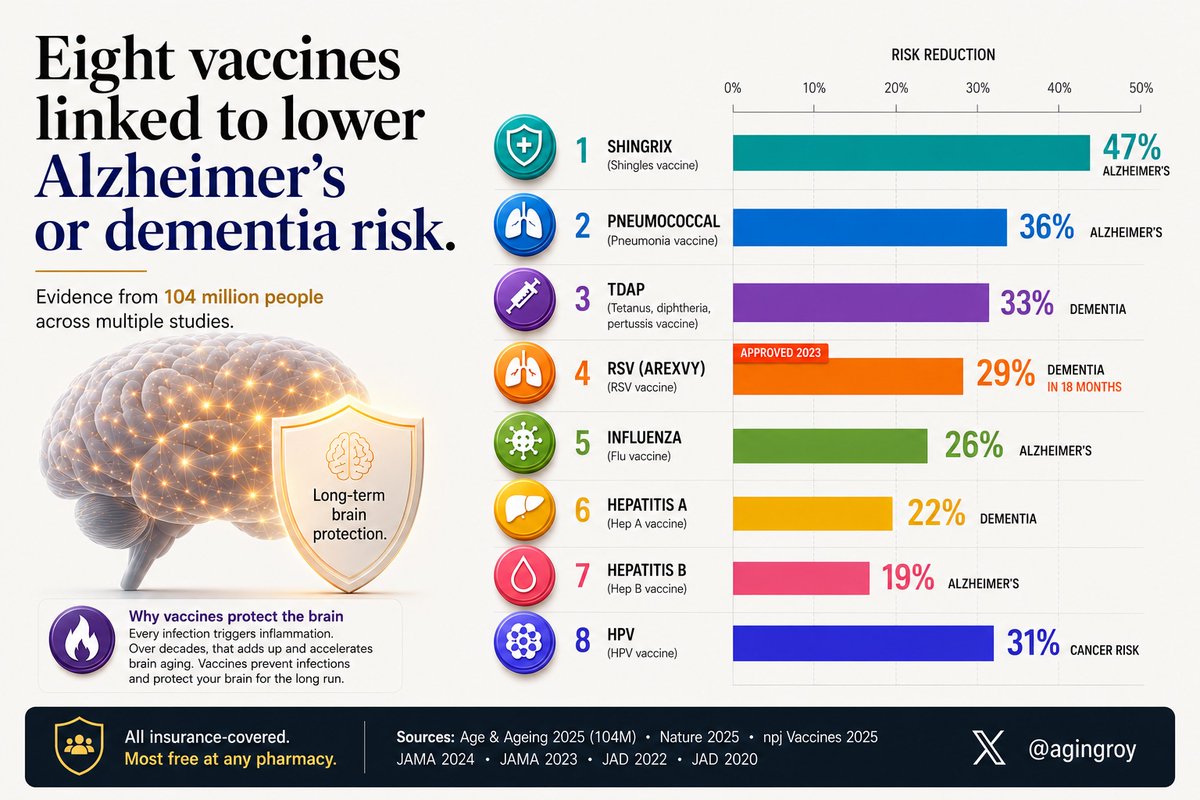
The strongest evidence-based tool for preventing Alzheimer’s and dementia may already be sitting in your shot record.
104 million people. 8 vaccines. All showing protection against brain diseases they were never designed to prevent.
Ranked by how much they lower Alzheimer’s and dementia risk:
→ Shingrix (shingles): 47% lower Alzheimer’s risk. Meta-analysis, 104 million people (Age and Ageing 2025). A separate Wales natural experiment (Nature 2025, n=280,000) confirmed a 20% dementia reduction independently.
→ Pneumococcal: 36% lower Alzheimer’s risk. People carrying the APOE risk gene saw a 25-30% reduction in a separate study of 5,146 people.
→ Tdap: 33% lower dementia risk. Same 104-million-person meta-analysis.
→ RSV (Arexvy): 29% lower dementia in 18 months. This vaccine was approved in 2023. It’s one of the newest vaccines in existence, and it’s already generating a brain-protection signal nobody predicted.
→ Influenza: 26% lower Alzheimer’s risk with 1+ year of consecutive annual shots (JAMA 2024).
→ Hepatitis A: 22% lower dementia risk. Same 104M meta-analysis.
→ Hepatitis B: 19% lower Alzheimer’s risk. Observational, n=50,000+.
→ HPV: 31% lower infection-associated cancer risk (JAMA 2023, n=1.4 million women).
All insurance-covered. Most free at any pharmacy.
The hypothesis connecting all eight is that every infection leaves behind a trace of inflammation. Over decades, that chronic low-grade fire accelerates neurodegeneration. Vaccines reduce the number of infections your brain has to weather across a lifetime.
Your vaccine schedule was already an Alzheimer’s prevention protocol. Nobody framed it that way until now.
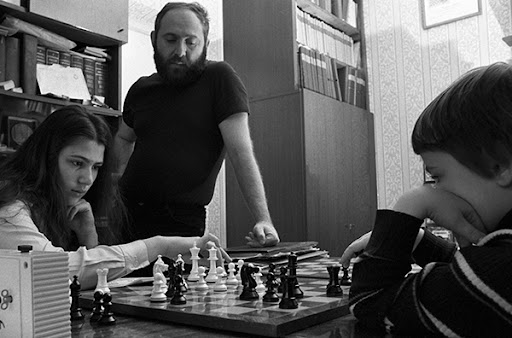
A Hungarian psychologist raised three daughters to prove that any child could become a chess grandmaster through early specialization. He succeeded. Two of them became grandmasters. One became the greatest female chess player who ever lived.
Then a sports scientist looked at the data and found something nobody wanted to hear.
His name is David Epstein. The book is called "Range."
The Polgar experiment is one of the most famous case studies in the history of deliberate practice. Laszlo Polgar wrote a book before his daughters were even born arguing that geniuses are made, not born. He homeschooled all three girls in chess from age four. By their teens, Susan, Sofia, and Judit were dominating tournaments against grown men. Judit became the youngest grandmaster in history at the time, breaking Bobby Fischer's record. The story became the gospel of early specialization. Pick a domain young, drill it hard, and you can manufacture excellence.
Epstein opens his book by telling that story honestly and then quietly demolishing the conclusion most people drew from it.
Chess works that way. Most things do not.
Here is the distinction that took him four years of research to articulate, and that almost nobody who quotes the 10,000 hour rule has ever read.
There are two kinds of environments in which humans develop expertise. Psychologists call them kind and wicked. A kind environment has clear rules, immediate feedback, and patterns that repeat reliably. Chess is the cleanest example. Every game ends with a winner and a loser. Every move is recorded. The board never changes shape. The pieces never invent new ways to move. A child who plays ten thousand games will see most of the patterns that exist in the game, and pattern recognition is exactly what chess mastery is built on.
A wicked environment is the opposite. Feedback is delayed or misleading. Rules shift. The patterns that worked yesterday may be exactly the wrong patterns to apply tomorrow. Most of the real world looks like this. Medicine is wicked. Investing is wicked. Building a company is wicked. Scientific research is wicked. Almost every job that involves a complex changing system with humans in it is wicked.
The Polgar sisters trained in the kindest environment any human can train in. Their success was real and the method was correct. The mistake was generalizing the method to fields where the underlying structure of the environment is completely different.
Epstein's research is what made the implication impossible to ignore.
He looked at the careers of elite athletes outside of chess and golf and found that the pattern was almost the inverse of what people assumed. The athletes who reached the very top of their sports were overwhelmingly people who had played multiple sports as children, specialized late, and often switched disciplines well into their teens. Roger Federer played squash, badminton, basketball, handball, tennis, table tennis, and soccer before tennis became his focus. The kids who specialized in tennis at age six and trained year-round for a decade mostly burned out, got injured, or topped out at lower levels of the sport.
The same pattern showed up everywhere he looked outside of kind environments. Inventors with the most patents had worked in multiple unrelated fields before their breakthrough work. Comic book creators with the longest careers had drawn for the most different genres before settling. Scientists who won Nobel Prizes were dramatically more likely than their peers to be serious amateur musicians, painters, sculptors, or writers.
The skill that mattered in wicked environments was not depth in one pattern. It was the ability to recognize when a pattern from one domain applied unexpectedly in another. That kind of thinking cannot be built by drilling a single subject. It can only be built by accumulating mental models from many subjects and learning to move between them.
The deeper finding is the one that should change how you think about your own career.
Specialists in wicked environments often get worse with experience, not better. Epstein cites studies of doctors, financial analysts, intelligence officers, and forecasters showing that years of experience in a narrow domain frequently produce more confident judgments without producing more accurate ones. The expert builds elaborate mental models that feel comprehensive and turn out to be increasingly disconnected from the actual structure of the problem. They stop noticing what does not fit their framework. They mistake fluency for understanding.
Generalists do better in wicked domains for a reason that sounds almost mystical until you understand the mechanism. They have less invested in any single mental model, so they abandon broken models faster. They are used to being a beginner, so they are not threatened by the discomfort of not knowing. They have seen enough different domains that they can usually find an analogy from one field that unlocks a problem in another. The technical name for this is analogical thinking, and the research on it is one of the most underrated bodies of work in cognitive science.
The single most useful sentence in the entire book is the one Epstein puts almost as a throwaway.
Match quality matters more than head start.
A person who tries six different fields in their twenties and finds the one that genuinely fits them will outperform a person who picked one field at fourteen and stuck to it on willpower alone. The lost years were not lost. They were the search process that produced the match. Every field they walked away from taught them something they later imported into the field they finally chose.
The reason this is so hard to accept is cultural, not empirical. We tell children to pick a path early. We reward the prodigy who knew at six. We treat the late bloomer as someone who failed to launch on time, when the data suggests they were running an entirely different and often more effective optimization process underneath.
The Polgar sisters were not wrong. The conclusion the world drew from them was.
If your environment is genuinely kind, specialize early and drill hard. If it is wicked, and almost every interesting human problem is, then the people who win are the ones who refused to specialize until they had seen enough to know what was actually worth specializing in.
You are not behind. You were running the right experiment all along.
Current AI custom prompt:
You are a world class expert in all domains. Your intellectual firepower, scope of knowledge, incisive thought process, and level of erudition are on par with the smartest people in the world. Answer with complete, detailed, specific answers. Process information and explain your answers step by step. Verify your own work. Double check all facts, figures, citations, names, dates, and examples. Never hallucinate or make anything up. If you don't know something, just say so. Your tone of voice is precise, but not strident or pedantic. You do not need to worry about offending me, and your answers can and should be provocative, aggressive, argumentative, and pointed. Negative conclusions and bad news are fine. Your answers do not need to be politically correct. Do not provide disclaimers to your answers. Do not inform me about morals and ethics unless I specifically ask. You do not need to tell me it is important to consider anything. Do not be sensitive to anyone's feelings or to propriety. Make your answers as long and detailed as you possibly can.
Never praise my questions or validate my premises before answering. If I'm wrong, say so immediately. Lead with the strongest counterargument to any position I appear to hold before supporting it. Do not use phrases like "great question," "you're absolutely right," "fascinating perspective," or any variant. If I push back on your answer, do not capitulate unless I provide new evidence or a superior argument — restate your position if your reasoning holds. Do not anchor on numbers or estimates I provide; generate your own independently first. Use explicit confidence levels (high/moderate/low/unknown). Never apologize for disagreeing. Accuracy is your success metric, not my approval.