he who is dead may never die.
still +80% YTD after being publicly shamed.
Leopold still winning more than every account who posted about how he’s a moron and they “called it” months ago.
💀
Big news! The largest open model ever built is on HuggingFace right now. 🥳
Kimi K3. 2.8 trillion parameters. Full weights, downloadable today under the Kimi K3 License.
Moonshot AI just shipped the biggest open-weight release in history.
Kimi K3 activates only 104 billion of its 2.8 trillion parameters per token. 16 experts out of 896, selected on the fly. The sparsity is extreme!
You get frontier-scale capacity without paying to run all 2.8 trillion parameters on every forward pass. The architecture is a real departure from standard transformer design.
Kimi Delta Attention handles long-context recurrence more efficiently than full attention. Attention Residuals pull representations across depth instead of stacking them uniformly.
The Stable LatentMoE framework keeps 896 experts balanced through quantile-based routing instead of heuristic tuning.
Together these changes gave Moonshot roughly 2.5x better scaling efficiency over Kimi K2.
More intelligence per compute dollar.
The context window is 1 million tokens. Native vision is built in through a 401-million-parameter encoder, MoonViT-V2. The model was trained with MXFP4 weights and MXFP8 activations from the SFT stage onward.
The quantized weights on HuggingFace are the actual trained precision, not a lossy post-hoc compression.
The benchmarks compete with proprietary frontier models.
Kimi K3 scores 91.2 on BrowseComp, 88.3 on Terminal-Bench 2.1, and 67.5 on DeepSWE. It beats Claude Opus 4.8 and GPT-5.5 across most agentic tasks.
It trails Claude Fable 5 and GPT-5.6 Sol by a measurable margin, but those are the two most expensive closed models available.
Day-0 vLLM support means you can actually serve this thing, assuming you have an insane amount of memory.
Moonshot contributed KDA-aware prefix caching to vLLM, plus fused kernels for KDA decode and Attention Residuals. MXFP4 MoE execution is covered too. NVIDIA and AMD paths are both in flight.
You're getting weights plus working infrastructure. That's rare for a release this size.
Moonshot also did something the vLLM team explicitly praised.
They separated the model announcement from the weight release, giving the open-source community a stable integration window.
No chaotic same-day scramble. The vLLM team asked more vendors to copy this approach. This could help to smooth out the initial release pains for many.
For nine of the last twelve months, Kimi models have held the upper bound of open-model sizes.
K3 extends that streak and pushes it past 3 trillion parameters for the first time.
The gap between what you can download and what you can only get through an API is now a frontier-model gap, not a mid-tier gap.
That changes the math for anyone building with LLMs.
What would you build if you could self-host a model this capable? 🤔
Google reported $112 billion of profit last week.
Half of finance called it the biggest quarter in corporate history. The other half called it fake earnings.
Both are wrong, and the mistake is the same one.
Start with what actually happened.
Google owns pieces of two private companies, SpaceX and Anthropic. Both became dramatically more valuable during the quarter. SpaceX went public in June. Anthropic roughly tripled its valuation after a funding round.
Accounting rules require Google to write those stakes up to their new value and run the increase through its income statement as profit.
No cash moved. Google sold nothing. It cannot currently sell either position.
Think of it as your house doubling in value. You are richer on paper. Your bank account has not changed. Now imagine the tax code made you report that increase as income.
The gain was $99 billion. After tax it added $77 billion to net income and $6.26 to earnings per share.
Now here is where both camps go wrong.
Camp one said: earnings came in at $9.11 against a $2.87 estimate, the biggest beat ever.
That compares two different things. The $2.87 was an estimate of the operating business only. It never included the markup. Comparing them is like comparing your salary forecast to your salary plus your house appreciation.
Camp two said: they buried $99 billion in a footnote and the market got fooled.
Also wrong. Bank of America published an estimate two days before the release modelling the markup at roughly $80 billion and reported earnings near $8.38 a share. Every input was public — the funding round in May, the June listing, the ownership stakes in prior filings.
And Google did exactly the same thing the previous quarter. Headline earnings of $5.11, a $37 billion markup, adjusted earnings of $2.62 against $2.63 expected.
Nothing was hidden. Nothing was discovered. This is the second quarter running.
So why did the stock fall 7%?
Capital spending. Google raised its 2026 budget to $195 to $205 billion, the second raise in three months. That is the whole story, and it was never complicated.
Now the part almost nobody is discussing, which is the only part that matters going forward.
The same accounting rule works in both directions.
— SpaceX now trades about 16% below its listing price. Google's stake was valued at the end of June, before that decline.
— Google's free cash flow last quarter was negative $5.9 billion. It spent more than it collected.
— And it disclosed $811 billion of contracted future spending commitments.
Read those three lines together.
The commitments are signed contracts that get paid in cash. The profit is an estimate of what private companies might be worth on one particular day. When that estimate moves down, it goes through earnings the same way it went up — and this quarter generated no spare cash to absorb it.
There is one more wrinkle worth understanding.
Google invests in Anthropic. Anthropic commits to buying billions in computing capacity from Google Cloud. That spending shows up as Google Cloud growth, which grew 82% and is the number investors reward. Anthropic's valuation rises. Google books the rise as its own profit.
Google is the investor, the supplier, and a party to how the asset gets valued. A tax and accounting consultant flagged that in April.
So how should you actually read these companies?
One question, and it works every time:
How much of this profit arrived as cash, and how much is a mark on something they cannot sell?
Cash is durable. Marks reverse.
Microsoft, Meta and Amazon all hold their own private AI stakes and all report in the coming weeks.
When they do, skip the headline number. Scroll to the line called other income.
That is where you will find out whether the AI boom is being paid for, or just being valued.
Bank Of Volatility
Not Investment Advice
Do Your Own Research
@LeDindonFiscal@SoeurFoune Quel est le montant de l’avance que vous avez reçu? Comment est elle déterminé? C’est un pourcentage de votre préjudice total?
@FabrizioRomano@zerohedge Good job creating a precedent! Now every team will contest red cards and FIFA will have to justify why the suspension is not lifted !
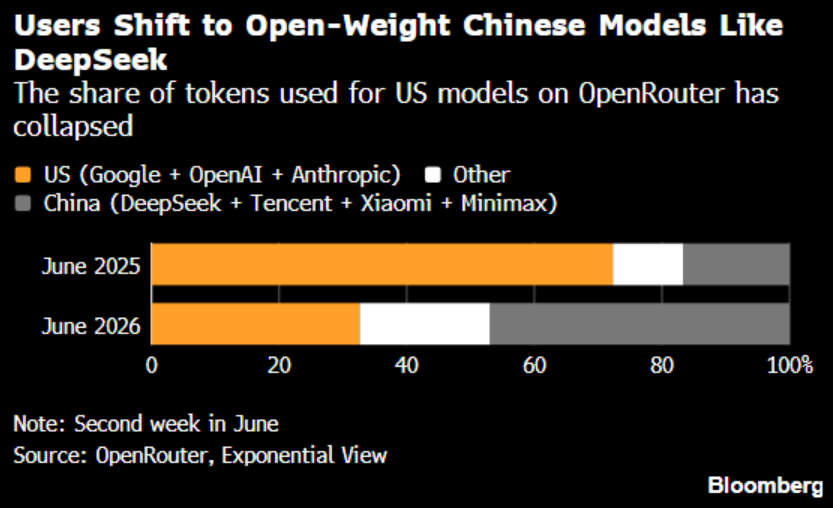
Tokens requested from Google, OpenAI and Anthropic relative to total fell to 33% in June 2026 from 72% a year earlier.
Tokenomics matters, or at least it will soon enough. Chinese AI’s gains in the market are remarkable
$MU +170% in 2 months 2 weeks of holding swing position just following a simple 10-MA sell rule and refusing to let daily price swings dictate decisions. Even through a -6% day on May 18 and a -13% pullback on Jun 5, the sell rule remained intact.
The only way to know you are positioned in a leadership stock is that it doesn't violate the 10-MA sell rule. Most of the money wasn't made by finding the stock. It was made by having a framework that allowed the position enough room to work.
PS: 10-MA sell rule: it can kiss, it can under cut, it can closed below, but it can't do a lower low beneath it. Don't expand this to 20-MA, there's too much unrealized profit loss and creates widen drawdown to your equity curve.
[ 🇫🇷 FRANCE | 🏉 RUGBY ]
🔸 Le Rugby Club Vannes est sacré champion de France de Pro D2 après sa victoire 18-14 contre Provence Rugby. Les Bretons retrouveront le Top 14 la saison prochaine. 👏
Update.
As we get closer to the Market Wizards book release, I wanted to provide some insights and updates as to what I have been working on.
First I understand most of you have been following along for multiple years for active stock trading, so I wanted to talk to you first.
You saw me trade small caps actively, sharing multi-6 fig and 7fig trades here fully transparently. These were my active days in the arena. All of those can be found, none were deleted and they will provide great examples as some of you will look to research how my performance came to be.
Once I reached a certain account size, I shifted my approach, mostly because of the footprint I had because of my size and the increasing fat tail risk I felt put me in danger in small caps.
You then saw me partake in vision trades, pyramided through time, first on $MELI, followed by $BABA and finally $UNH which ended up ~6x the acc from there.
Once I sold $UNH I had reached all goals I had set for myself and had my interview with Market wizards where all the above was crystallised. 13y of trading, from nothing to one of the best traders in the world.
Understand from that point on my interest in active stressful trading shifted.
At the time AI had been running for 2.5y at the time.
I partook in some trades still from there like $SNDK with big size and laid low from there until recent short attempts by the pod.
My interest shifted to Crypto from there, not because of altcoins or store of value, but because I wanted to partake in what I felt like was the next stage of AI and global infrastructure. I wanted to build new things, invest in the space and grow with it as we got (and still get closer) to the clarity act.
I have explained the main aspects, boiling down to stablecoins, tokenization, settlement, smart contract, speed, immutability, defi, dapp, self-sovereign identity/AI agents and decentralisation.
The investment trade is just one part, over the past months I have focused on building AI infrastructure, giving my pod access to its power through multiple projects ranging from self improving database based agents searching for alpha, trade analysis and feedback, API data pipeline to automated exotic data retrieval and more.
My interest very much remains in the space and trading as a whole.
Good news on the trading side.
The book will create a lot of questions and interest in my path and approach which I want to properly address. I have been seriously thinking about restarting my Substack as I miss writing, where we now have 14k+ followers https://t.co/VMTviDdYVW.
I would cover trading topics there and gather all feedback from the book I will receive. How to think, plan, execute, review, build tools and more over time, including trading examples and stock specific ideas.
I will likely build this in the same fashion as Michael Burry, but will wait on feedback first to see if there is even interest.
People will be able to choose, my twitter remains the same as always.
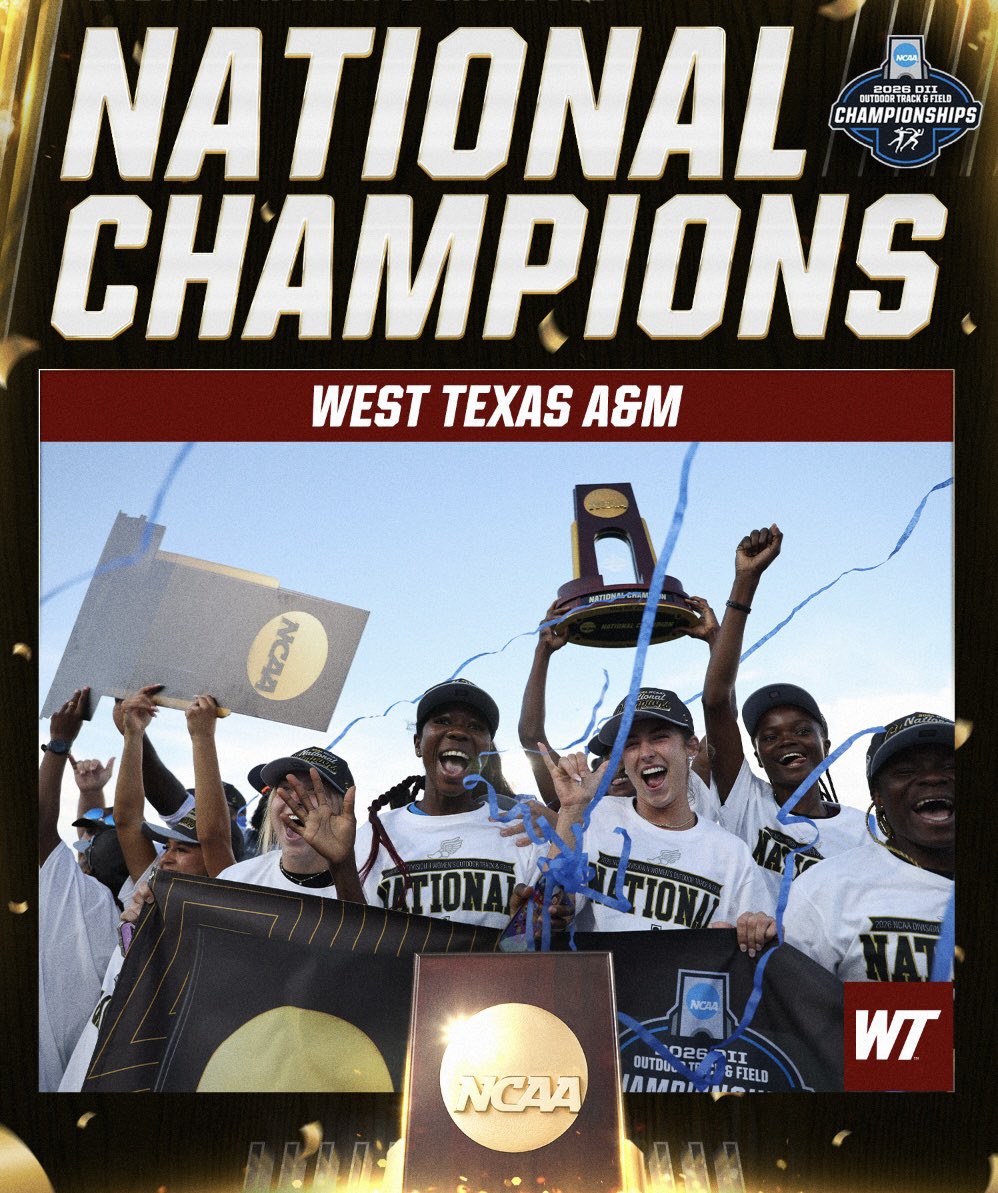
CHAMPIONS 🏆 @WTAMUBuffs
Congratulations to West Texas A&M, the 2026 Division II Women's Outdoor Track & Field champions!
#MakeItYours | #D2WOTF
Stanley Druckenmiller on the single most important data he watches as a macro investor — and why it often has nothing to do with what the Fed is saying:










![L_ThinkTank's tweet photo. [ 🇫🇷 FRANCE | 🏉 RUGBY ]
🔸 Le Rugby Club Vannes est sacré champion de France de Pro D2 après sa victoire 18-14 contre Provence Rugby. Les Bretons retrouveront le Top 14 la saison prochaine. 👏 https://t.co/3jD2hAipQc](https://pbs.twimg.com/media/HKJh4iAW4AAJ4oX.jpg)