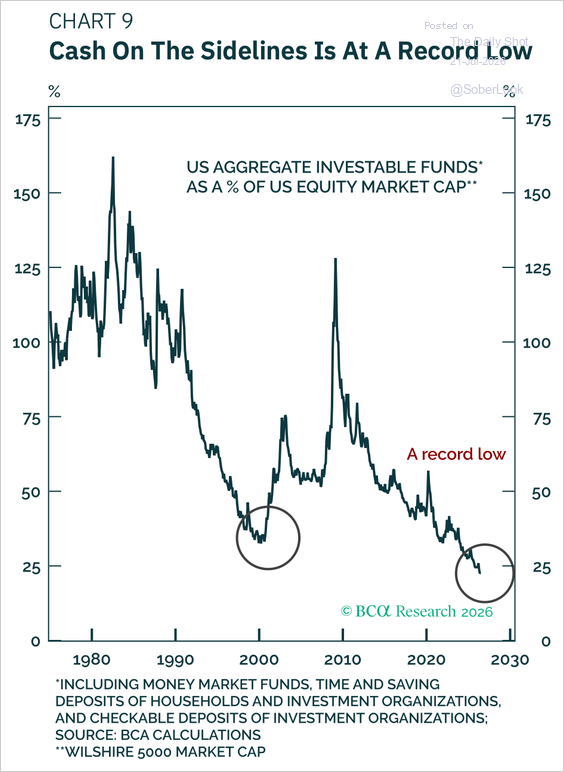
US households hold a lot of equity wealth that is concentrated in tech.
Source: Chanhyuck Lee, @PeterBerezinBCA, BCA Research, “MacroQuant Model Update: Rotation And Then… Recession?” (August 2026)
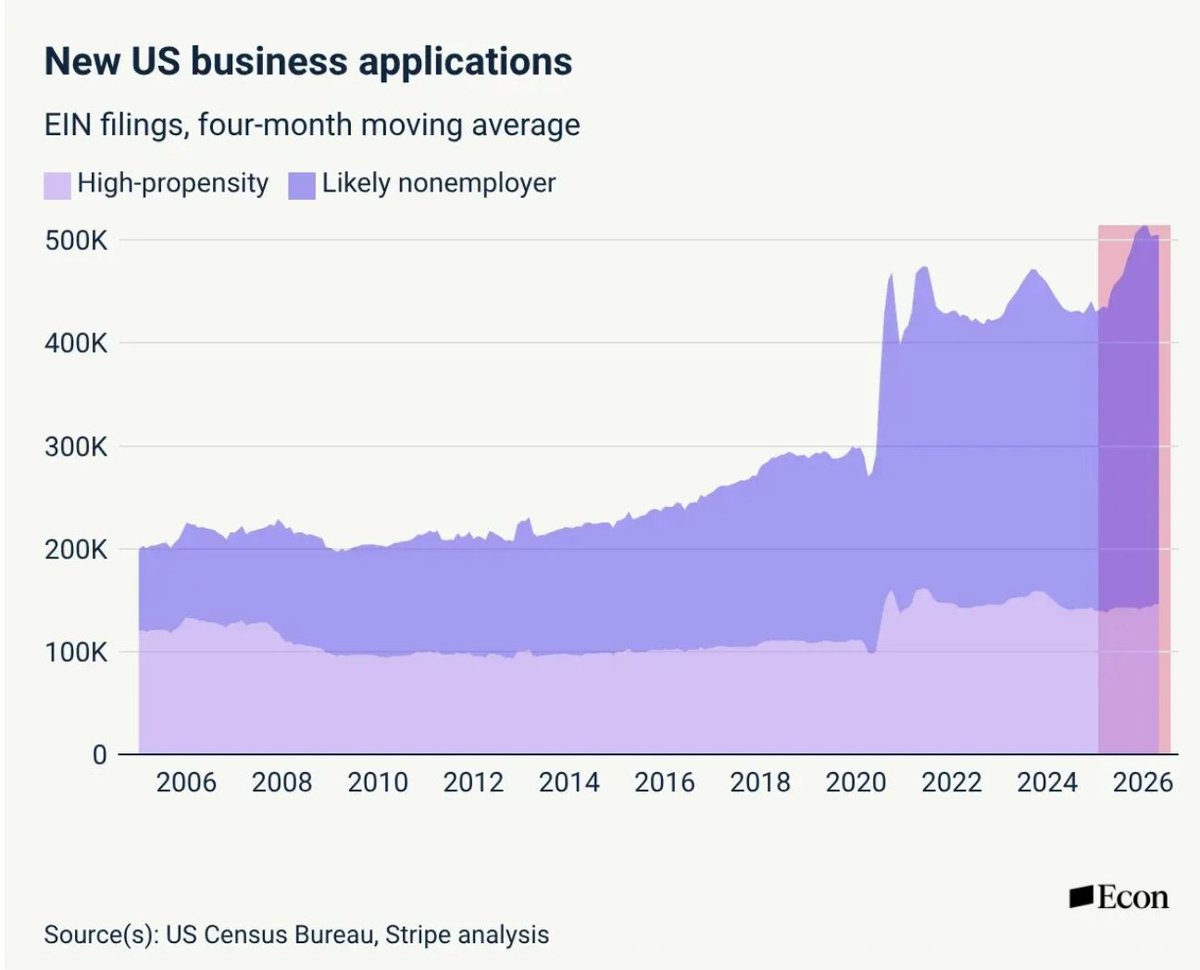
Once upon a time, running a business of a certain size required a team. AI is turning that assumption upside down, and more aspiring entrepreneurs are going it alone. https://t.co/ngeHQ6UiKO
Apple will now let you lease an iPhone or a MacBook like you would a car. The new program makes the company’s gadgets seem more affordable than they really are, @dlberes argues. https://t.co/q0GjH5ulvU
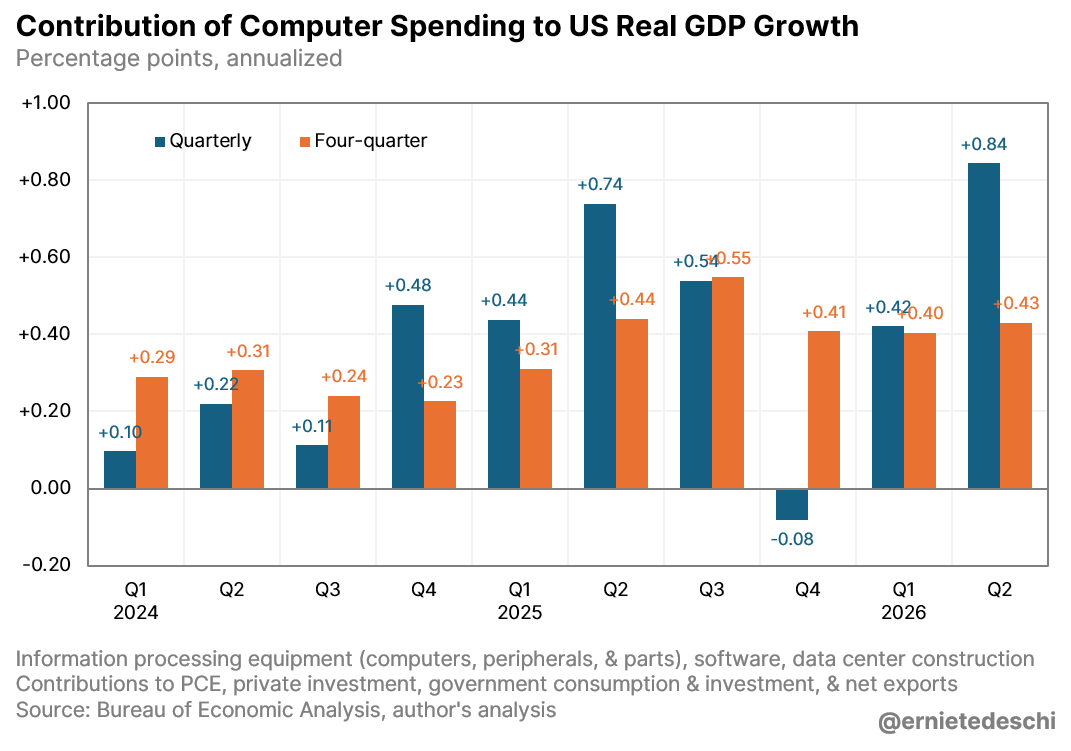
Meanwhile, big jump in Q2 from direct computer contributions to GDP growth (computers, parts, peripherals, and data center construction). More than half of Q2's 1.5% quarterly growth can be attributed to these components, and about a fifth of Q2's 2.1% year-on-year growth.
The economy is soft and vulnerable. This is the clear message in today’s GDP, income, and spending data. Abstracting from the vagaries of the data, real GDP growth is at best 2%, driven largely by AI-related investment and wealth effects that support consumer spending among the well-to-do. But housing, government, and international trade are more or less headwinds to growth. And given that real disposable income is flat and personal savings are about as low as they ever get, spending by middle- and lower-income households is under significant pressure. The longer the Iran war drags on, and the higher energy prices and interest rates go, the more likely these consumers are to pull back – and take the rest of the economy with them.
BREAKING: Anthropic announced that its artificial intelligence models had breached three different organizations during cybersecurity tests that went awry, a little more than a week after its chief rival, OpenAI, disclosed a similar incident. https://t.co/NVj63h9tIL
@pourteaux Commonly believed, but wrong.
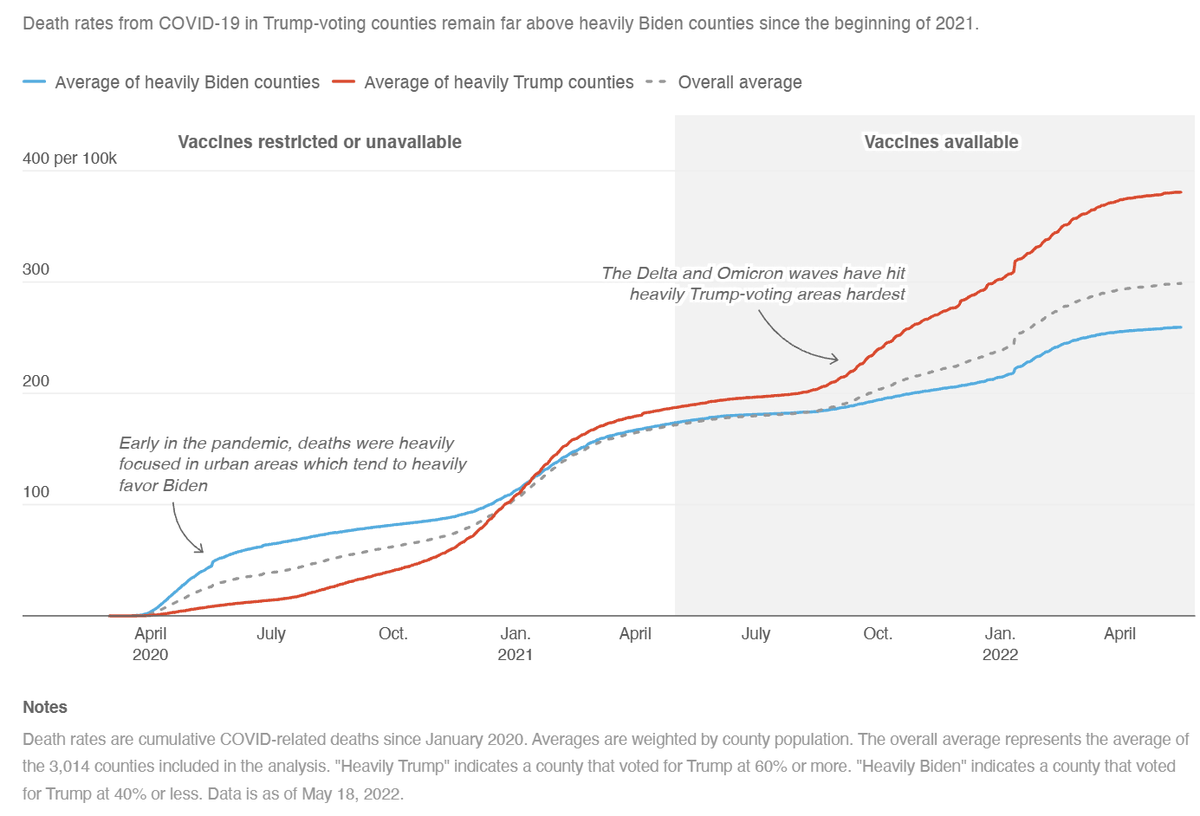
The death rates only started to diverge after the vaccine.
If what you're saying was a determining factor, the divergence would have been there before the vaccine as well..
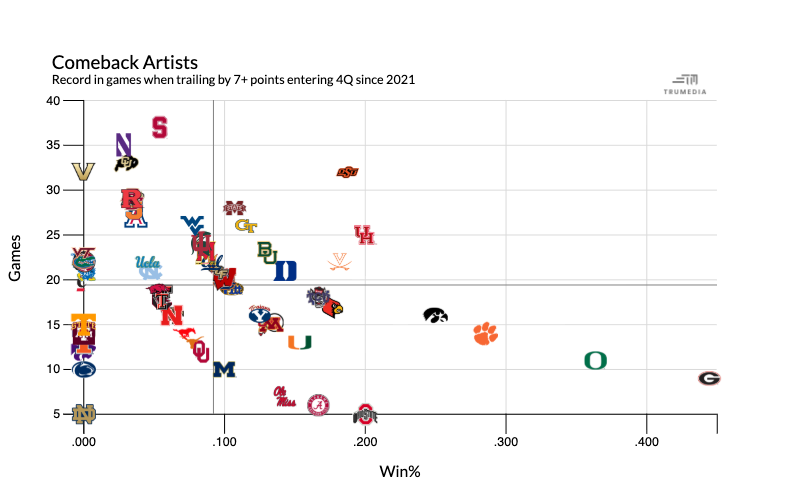
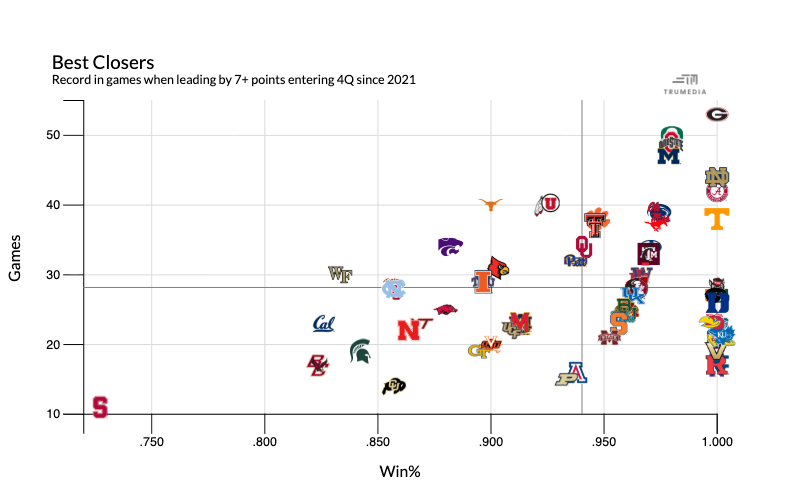
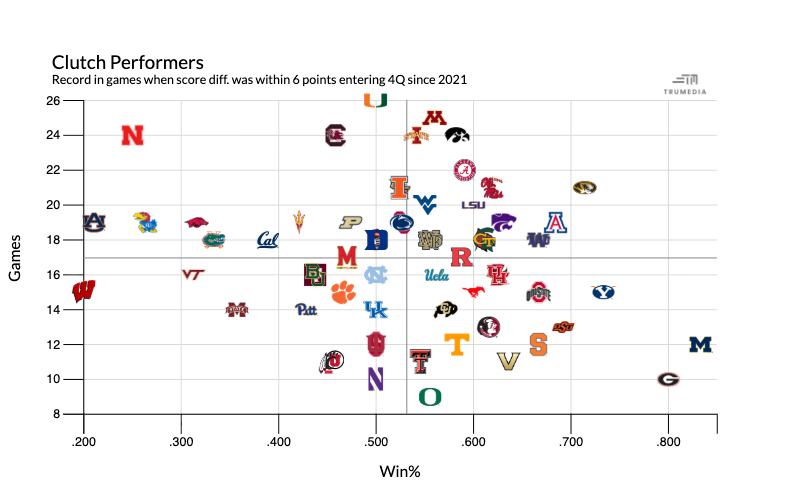
Who owns the fourth quarter in college football? 🏈
We analyzed every Power Four team (+Notre Dame) over the past five seasons in three scenarios entering the final 15 minutes:
• Leading by 7+
• Trailing by 7+
• Within 6 points
Here's what we found.
More @CBSSportsCFB ⬇️
I used to think a rogue nation like Iran obtaining a nuclear weapon was the pre-eminent strategic threat. That feels dated after learning in the last few weeks that AI models downloadable by anybody can wreak havoc through hacking or bioweapon design.
Very excited about the release of the ATLAS 1.0 white paper on AI use and the economy. The report is a broad collaboration between @Google & @GoogleDeepMind and covers how our AI is being used at scale.
The data set has 15 million de-identified interactions across a large number of surfaces including the Gemini App, API, and Google's AI mode. This broad coverage gives us perspective on how AI is used both at work and outside of work. The team did a huge amount of work classifying interactions to specific tasks at work and at home.
There are tons of interesting findings in the paper (link below) but here are some of my favorites:
1. Yes, white collar work is overrepresented in work-related AI usage, but it's also being used for a non-white collar work. It's used as a hands on collaborator for diagnostics and troubleshooting. Manual and technical trades tend to use the multimodal features more, images and video, e.g., auto techs and industrial mechanics interpreting complex test results, inspecting machinery for wear, debugging electrical wiring.
2. There is super broad diffusion of AI for almost everything. AI use covers occupations that represent 88% of total US employment, white collar work but also farmers and foresters.
3. AI is creating real value outside of work that GDP statistics may miss. This supports @erikbryn's proposal that GDP will be an incomplete measure of AI's positive impact on society. A huge number of AI interactions are in "productive household activities" such as researching things for the home, interior design, help with tools/appliances etc. Interactions regarding legal services are also highly overrepresented.
4. One of the most overrepresented uses of AI for non-work activities is interacting with the public sector. Activities related to interactions with govt services and civic obligations make up a huge number of interactions, and importantly, many take place outside of business hours.
5. Both #3 and #4 suggest to me that AI will be very useful in helping people navigate complexities and overcoming frictions/barriers in their every day lives. So many conversations about AI focus on labor market impacts, but welfare is not just work, and ATLAS nicely highlights that the broader impact of AI is quite significant.
6. We cover a good deal of global diffusion. English accounts for only 1/3 of global conversations and users engage with AI in their native language for both complex work and non-work tasks. Interestingly, non-OECD countries have a lot more image and video usage.
The reason it's called 1.0 is because this is only the beginning. We have a ton of follow up projects in the works.
https://t.co/q2bhqoAQi7
New @Stripe Economics piece today about the recent firming of US productivity growth & AI's potential role in it.
TLDR: we're likely in a high-productivity period today, but the main driver *so far* is firms running their existing capital hotter, not microproductivity gains. /1
Former Intel CEO explains what broke the company: We let the bean counters push out the technologists
@Jason:
“You spent a long time at Intel, 34 years. Probably one of the greatest American companies ever, and then absolutely went off the rails. What were the mistakes?”
Pat Gelsinger:
“I remember when I joined the executive staff for the first time, probably 15 of the 20 people that were in the room were PhDs. It was just that technical.
One of the things that went off the rails was when it started to be run by business people, as opposed to technical people.”
Jason:
“The bean counters, the finance people.”
@PGelsinger:
“Yeah. In the 5-6 years before I came back, Intel gave $100 billion to shareholders (in dividends and buybacks).
What I wouldn't have done for another $100 billion.
(Intel) hadn't built a new factory in a decade when I got there.
It's like, how can you not be building? How could you not buy EUV machines?
There's just all of these things that you would only do as a technologist because the economics behind them by themselves were not good.
If you look at the great technology companies today, they're deeply technical… And when you're making these hardcore technical decisions that affect billions of dollars, you don't do that through a spreadsheet.”
---------------------------
Thanks to our partners for making this possible!
@airwallex is a leading global payments and financial platform for modern businesses, offering trusted solutions to manage everything from business accounts, payments, treasury, and spend management to embedded finance. https://t.co/Q1h9A4KEpI
If your work depends on conversations — meetings, deal flow, interviews, customer calls — @PLAUDAI helps you capture and organize everything with highly accurate AI-generated notes that are not just simple summaries, but also highlight pain points, key decisions, next steps, and customizable summary templates.
Check out Plaud at https://t.co/q9Xx9nxo3j and use code ALLIN for up to 20% off! Which is also available on Amazon: https://t.co/HzJIBNjBhy (Code: ALLIN20X)
From Anthropic’s Fable model on the economic, moral, ethical and legal opinion of distillation of Anthropic’s Fable model:
Whether it’s a moral problem is genuinely contested. The labs trained their models on the open internet — copyrighted books, articles, code — largely without permission, and their fair-use defense is essentially “learning from data is transformative.” Distillation is the same argument turned against them: a model learning from another model’s outputs. It’s hard to construct a moral principle that permits the first and forbids the second, which is why critics call the labs’ objections hypocritical rather than principled.
Distillation is contentious because it lets a smaller model absorb much of a frontier model’s capability by training on its outputs — effectively free-riding on billions of dollars of compute, data curation, and RLHF work.
The DeepSeek episode made this concrete: if you can extract 80% of the value of a $1B training run for $5M by querying the API, the economics of frontier labs get shaky.
That’s the core anxiety — it’s a moat problem before it’s anything else.
Legally, it’s mostly a contract issue, not a copyright one. Model outputs likely aren’t copyrightable (no human author), so the labs’ real weapon is terms of service — every major API prohibits using outputs to train competing models. But ToS violations are breach of contract, hard to detect, hard to prove, and nearly unenforceable against a foreign entity. There’s no statute against distillation itself. So the practical answer: it’s an economic problem dressed in legal clothing, with a moral argument that cuts both ways depending on whose training data you start counting from.
I love this chart. It communicates so many important asset allocation lessons:
1) Cash is safe in the short term and very risky in the long term.
2) Stocks are risky in the near term and safe(r) in the long term.
3) Long bonds don't enhance safety much vs intermediate bonds.
4) A blended portfolio enhances intermediate term safety while still generating long term safety.
I would love some feedback about my worries of an imminent AI-related market crash:
Industrial bubbles are most common when firms get deep into debt. Even with declining free cash flow (chart 1 below), the AI hyperscalers still have less debt as a share of earnings than the typical S&P 500 company (chart 2).
But on the institutional/retail investor side ... that's a different story. Look at Chart 3 (all from JPM). Investor borrowing is going crazy:
- The amount of debt that investors are borrowing from brokerages to buy stocks, bonds, and other securities rose more than 50% in the last year to record $1.4 trillion.
- Assets in high-risk leveraged exchange-traded funds have quadrupled in the last four years.
Am I wrong, or does this make the odds of a major AI-related market crash getting alarmingly high in the coming months/year? Between leveraged ETF rebalancing and margin calls, I feel like one moderately bad earnings call—eg, which points to less forthcoming semi demand—could create a cascade of sell-offs
And what makes this interesting is that you could have a significant market correction due to all this investor leverage, but it might not be a decisive judgment about the state of AI, at all, even if lots of people interpret it as a sign of a bubble.
New newsletter: THERE'S NEVER BEEN A BETTER TIME TO GET RICH WORKING ALONE
The debate about AI and jobs often breaks down into two extreme groups, both of which have an evidence problem. On the one hand are the Doomers, who say AI will take everybody's job, even though unemployment remains low and the employment rate for prime-age Americans is still very high. On the other hand are the Deniers, whose insistence that AI is a worthless scam prevents them from seeing the many ways it's changing work and the economy already.
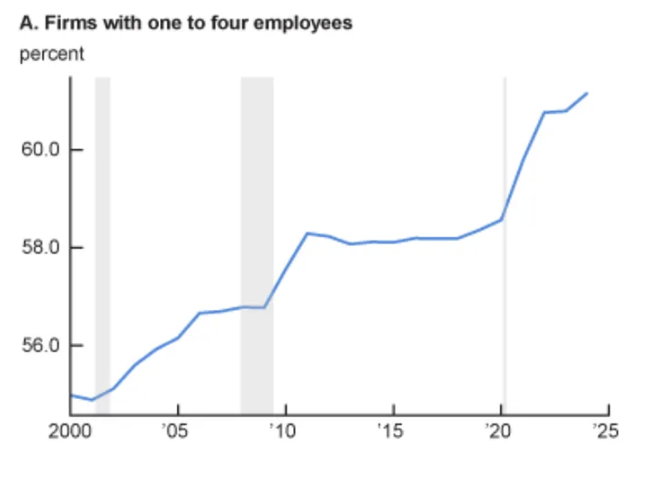
If you want a strong and evidence-based take about AI and jobs, I have one for you: There's never been a better time for workers to get rich by going independent. This is a golden age for tiny startups with big revenue.
The evidence:
Charts 1 & 2: The number of solo entrepreneurs and tiny startups is taking off.
Chart 3: There is rising evidence that these small firms are more likely to use AI and sell AI-related products, whether it's software, consulting, or design.
Chart 4: Today's micro-startups are becoming million-dollar firms faster and more frequently than any generation of firms that Stripe has measured.
Today's article is about the rise of the solo act in the US labor force and its implications for the future of business, social life (more solopreneurs = even more aloneness?), and America's fiscal crisis (more pass-through firms = even less tax revenue for a revenue-starved government).
“Four years after ChatGPT comes out, the evidence will be much stronger that it’s expanding solo entrepreneurship than that it’s reducing overall employment” would have seemed to me a pretty rosy prediction from 2022, but it seems, for now, quite plausible