Technically V15 should be able to read handicap spots now? @elonmusk
So can we get a handicap toggle to turn on or off. Turn on for folks who need it and off for those so our car doesn’t park there.
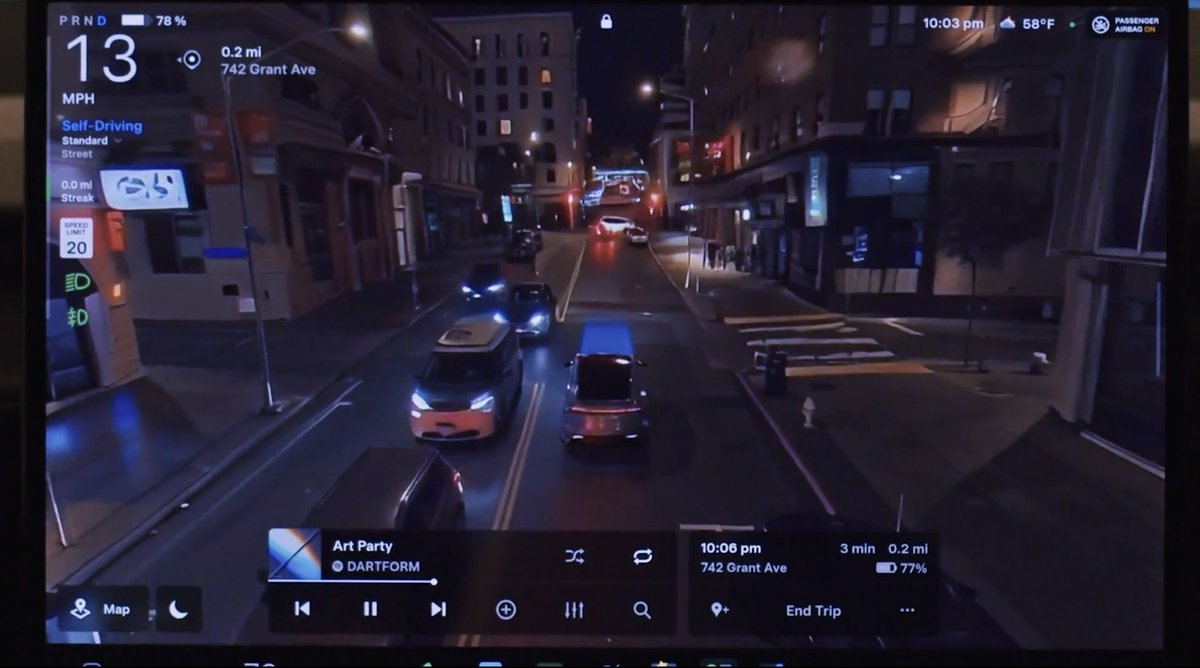
@SawyerMerritt Why doesn’t FSD engaged allow the user to select the parking spot, same as what is shown in this video?
I can only select and have it park like what Sawyer is showing when I disengage and manually drive
FSD picks the spot on it’s own - almost always poorly, and I can’t pick
@VibeWithRB@SawyerMerritt Why doesn’t FSD engaged allow the user to select the parking spot, same as what is shown in this video?
I can only select and have it park like what Sawyer is showing when I disengage and manually drive
FSD picks the spot on it’s own - almost always poorly, and I can’t pick
Tesla is saying that FSD v15 is a major upgrade to how the car sees, understands, and responds to the world around it. Rather than simply making small improvements to individual driving behaviors, Tesla has improved the underlying artificial intelligence that controls the vehicle.
Here is what each improvement means in plain English.
1. A much smarter set of eyes
What Tesla says: Upgraded vision encoder shared between FSD, Robotaxi, and Optimus, trained on millions of internet videos, improving the critical intervention rate by 25x.
What it means: Tesla has upgraded the part of its AI that interprets what the cameras see.
Previously, the system learned primarily from driving-related information. Now, by training on millions of videos from the internet, it can develop a broader understanding of how the physical world works.
For example, it can become better at understanding how people move, how objects behave, and what unusual situations might mean, even when it hasn't encountered those exact situations while driving.
This technology is also shared with Tesla's Optimus robot, meaning advancements in understanding the physical world can potentially benefit both cars and robots.
Tesla says the upgrade improves the critical intervention rate by 25 times. In practical terms, that suggests the system could encounter situations requiring urgent human intervention much less frequently.
2. A simpler, more efficient AI brain
What Tesla says: Introduced Tesla Reality View, replacing explicit model signals with a single end-to-end visualization using less compute.
What it means: Previously, Tesla's system used multiple separate pieces of information to understand the driving environment, such as detecting lanes, identifying objects, and predicting how other vehicles might move.
Tesla is moving toward a more unified representation of the world. Think of the difference between assembling a picture from dozens of separate descriptions and simply understanding the entire scene at once.
The new Reality View presents what the AI understands in one integrated visualization rather than relying on numerous separately displayed signals. Even better, Tesla says this requires less computing power.
Why this is important: The AI may be able to understand more about its surroundings while requiring less processing power. That could improve performance without requiring more powerful hardware.
3. Navigation that learns how people actually drive
What Tesla says: Improved navigation using an end-to-end learned model based on route preferences from the fleet.
What it means: Instead of relying entirely on traditional navigation rules, Tesla's AI learns which routes drivers actually prefer.
For example, the shortest route isn't always the best route. Drivers might prefer avoiding difficult left turns, complicated intersections, or awkward highway entrances. Tesla can learn from the driving preferences of millions of vehicles and use that information to make better routing decisions.
The result: Navigation that feels more like having an experienced local driver choosing the route.
4. Parking that remembers your preferences
What Tesla says: Improved parking location selection using personalized parking history, with multiple options displayed at the destination.
What it means: Your Tesla can learn where you prefer to park.
If you regularly park in a particular area of a shopping center or choose certain types of parking spaces, the car can use that history when selecting a destination. It can also show several parking options on the map, rather than assuming there is one ideal location.
The result: The car becomes better at handling the final part of a journey, not just driving to an address.
5. Driver monitoring that's less annoying
What Tesla says: Improved driver monitoring with hats and sunglasses, and reduced strictness in higher-speed driver profiles.
What it means: Tesla has improved its ability to determine whether the driver is paying attention, even when wearing sunglasses or a hat. It is also adjusting how aggressively the system monitors drivers using certain higher-speed driving profiles.
The result: Fewer unnecessary warnings and a more natural driving experience, while retaining driver-attention monitoring.
6. Better recognition of small hazards
What Tesla says: Improved detection of road signs, small animals, road debris, and chains.
What it means: The AI is getting better at spotting things that are small, unusual, or difficult to recognize.
For example, a small animal crossing the street, a chain stretched across an entrance, or debris lying in the road. These are situations that can be challenging because they don't always resemble the large, familiar objects that autonomous driving systems are typically trained to recognize.
The result: Better awareness of unusual hazards that could otherwise cause accidents.
7. Better understanding of road conditions
What Tesla says: Improved detection of potholes, road details, and avoidance of deep standing water.
What it means: Tesla is improving the AI's ability to understand the condition of the road itself.
Instead of just figuring out where the lane is, the vehicle can become better at recognizing whether the road contains potholes, damaged pavement, or potentially dangerous standing water.
The result: Smoother, safer driving with fewer situations where the vehicle blindly follows its intended path despite poor road conditions.
8. More intelligent speed decisions
What Tesla says: Improved speed handling for driver profiles, school zones, speed limits, and bad weather.
What it means: Tesla is improving how the AI decides what speed is appropriate.
Driving at 45 mph might be perfectly reasonable on a clear, dry road but inappropriate in heavy rain or near a school. The system is becoming better at combining speed limits, weather conditions, road environments, and driver preferences to select an appropriate speed.
The result: Driving behavior that better adapts to the situation rather than simply following a fixed speed target.
9. Smarter automatic gear selection
What Tesla says: Improved Autoshift functionality by unifying it with FSD-based gear predictions.
What it means: Autoshift allows the car to automatically decide whether it should move forward or backward.
Previously, this functionality was more separate from the primary FSD system. Now, Tesla is integrating gear selection with the same AI that understands the vehicle's surroundings and plans its movements.
For example, if the car needs to reverse out of a parking space before driving away, the system can use its broader understanding of the situation to select the appropriate gear.
The result: More natural transitions between parking, reversing, and driving forward.
The bigger picture: Tesla is building one AI that understands the physical world
The same underlying vision technology is being shared between FSD, Robotaxi, and Optimus. This suggests Tesla is moving toward a common foundation for physical intelligence.
A Tesla vehicle needs to understand roads, cars, pedestrians, and other objects. Optimus needs to understand rooms, people, tools, and everyday objects. Both systems benefit from an AI that understands how the physical world works.