USING RACE IN CLINICAL ALGORITHMS
Started during the heights of pandemic, this paper has been a labor of love for me for the last 3 years… finally out at @ScienceAdvances@UW_Pharmacy#UWCHOICE
https://t.co/5NrfzlCU7v
Some discussions…
🧵 1/
A key statistic to remember is that Titans plays about 70-75 defensive snaps/week, Bears play about 50-60… a big opportunity for Simmons to continue showing his impact!
#dabears@WaddleandSilvy
BREAKING: Seattle’s business community is putting City Hall on notice over public safety.
CEOs from Microsoft, Starbucks, Costco, Nordstrom, T-Mobile, Alaska Airlines, Zillow, the Seattle Mariners, Puget Sound Energy and others signed a letter demanding Mayor Katie Wilson and the City Council take action to address public safety
They’re calling for CCTV cameras, more police patrols, a 7-minute priority 911 response standard, crackdowns on open-air drug markets, treatment or prosecution for repeat drug offenders, clearing encampments near schools and parks — and a public safety action plan within 100 days with measurable goals and monthly reports.
The letter specifically calls out Wilson's abysmal 34% approval numbers
@TylerSbrt@DongNguyeb@yudapearl@f2harrell Randomization is the only mechanism to identify “a” causal effect of an intervention. In a controlled environment, such as RCT, the causal effect generated may not inform certain decisions. It may also not be generalizable to the population for which you want to make decision
@yudapearl@f2harrell There have been some discussion on this front under the pragmatic trial discussions.. one example is https://t.co/IieoOXwY4E, but there are many others. RCTs definitely have valuable uses, less valuable in social science, IMHO.
Happy to share my paper with Nicardo McInnis, now published in the Journal of Population Economics. We find childhood Food Stamp Program exposure reduced later-life fertility among men at older ages, especially in disadvantaged families.
Article: https://t.co/tDxXbHQzpH
Total factor productivity growth is conditionally additive, not exponential, from Callum J. Jones, David López-Salido, and @ThomasPHI2 https://t.co/mPY6Ec41X9
Congratulations to Beth Devine, PhD, PharmD, MBA, MSc, as she moves into the role of ISPOR President (2026-2027). #HEOR#healthcare#leaders#leadership
https://t.co/X9pv0idPaf
Now accepting submissions for the 11th Workshop in Behavioral and Experimental Health Economics (Dec 7-8, University of Washington, Seattle) @UWCHOICE.
Deadline: Aug 31, Submit here: https://t.co/GUu6WddhIz
#BehavioralEcon#HealthEcon@cawley_john@Basucally@DanielWiesen1
New paper by @Basucally! How much of a drug's social value should go to innovators? 100% maximizes long-run welfare, but less if society prioritizes consumer surplus—especially when small countries can free-ride on others' R&D. https://t.co/ZCM5xuiXgs
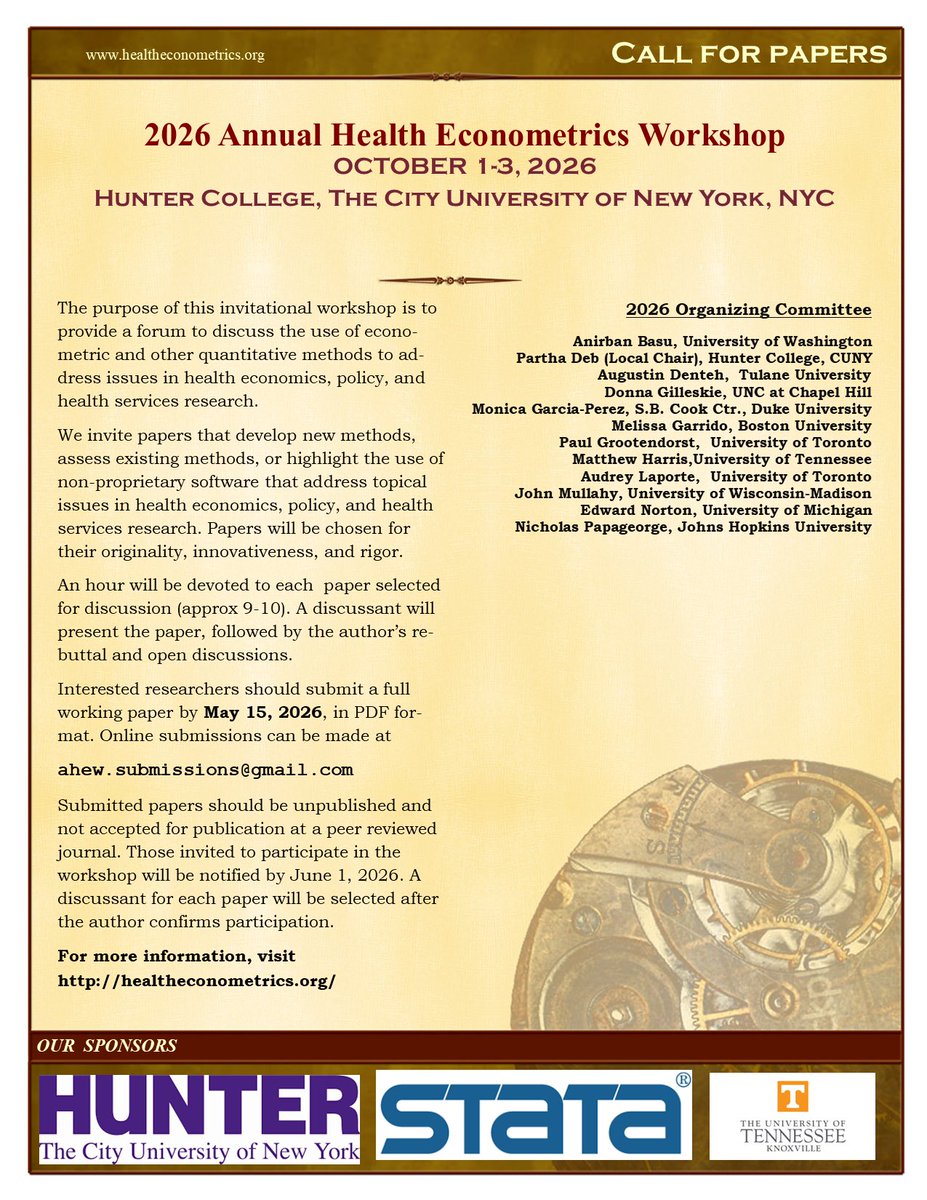
Call for papers! We are Excited that Partha Deb at CUNY has agreed to host the annual health economics workshop - Oct 1-3.
Please send cool papers to:
[email protected]