Immensely proud of the team's achievement! Today @andTruthPBC launched &Atlas, the world's first interactive map tracking progress toward safe, mathematically verified software.
The journey towards verifying all the code starts with a single spec, but at least now we have a map.
1/5
Today we’re launching &Atlas: a map of 100M+ lines of open-source C across 1,000+ codebases, tracking progress toward provably verified software.
The scale and challenge are enormous. Explore this universe: https://t.co/VHMHHgJGnD
&Truth (seed, $70m raised) is looking for top-tier AI Engineer. I created recruitment challange to code harness to prove Lean Eval Hessian estimate in less than 5h for less than $20. I did it in 3h for $9. Looking for someone to beat me. Doable in 24h. https://t.co/gPIKuGAArV
@VitalikButerin opened @EFDevcon with it: we need to be able to trust our operating systems and our hardware — a formally verified OS, open silicon.
Here is a piece of that, running today. Eita: an EVM specified in @leanprover Lean 4, with the code that runs emitted from the spec. Open source, MIT.
What it is
The EVM's semantics are a Lean 4 translation of the Ethereum execution specs (EELS), clause by clause, Frontier to Osaka, with Amsterdam staged, plus the OP Stack and Arc chain rules. The code that runs — the ARM64 and x86-64 interpreter handlers, JIT code, gas formulas, and the effect layer for calls, creates, storage and transaction application — is emitted from that spec, not written by hand; on ARM64 the handlers are proved against the spec at the instruction level. CI fails if the committed generated code differs from what the emitters produce. Not "audited": specified, derived, and checked.
Checked against the real chain, every block
It re-executes @ethereum mainnet and @circle's @arc mainnet from genesis and follows both live: gas used, logs bloom, receipts and transactions roots, EELS validate_header (base fee included) on every block, and the full state root every 10,000 blocks on Ethereum and at each 32,768-block anchor on Arc. That loop also caught our own mistakes: a missing P-256 precompile in our Base rules, and an SBCL 2.6.0 miscompile that corrupted wide integers in snapshot records.
What a replay sees that logs don't
• 2 Nov: 8 USDT destroyBlackFunds calls zeroed 2,529,259.73 USDT of blacklisted balances — a DestroyedBlackFunds event, no Transfer.
• 27 Oct–2 Nov: 41% of the ERC-20 holder-events we checked were Transfer logs from a token whose storage did not change in that transaction.
• One token credits balances in mint() and emits nothing: 23,614 silent balance changes in a week.
Live at https://t.co/NGDp98DyVw, with what is proved, what is checked and what is still trusted spelled out: https://t.co/j85QDqOQ5V
It's early. 19 proof obligations are still open and tracked in the repo. It isn't an execution client yet: an Engine API block source is the step that makes it one.
The next frontier: hardware
The techniques behind Eita — a Lean specification, the implementation derived from it, a continuous check against the real system — matter even more for secure hardware, where a bug is etched into silicon and can't be patched. Lean-specified firmware and RTL on open silicon is where "trust our hardware" gets real, and it's what I'm building now: https://t.co/gEe5ILT0QB (@beledgerless), together with @maqstik and @sbellem to the future of mobile trusted compute.
Credit where it's due: this work was motivated by conversations moths ago with @ilyasergey and his team at &Truth (@andTruthPBC), out of stealth last week. The more of us building this, the sooner verified code becomes the default.
I'll be at #Devcon in Mumbai Thursday to Saturday. Happy to talk. @ethereumfndn.
Code: https://t.co/N9NBHOFtsA
I'm joining @andTruthPBC - it will change entire field of cybersecurity. Year ago I got paid $900K for bugs I've found, right now AI is able to find 80% of that bugs, next year it will be able to find them all. We need to work hard to protect world against it. We are hiring.
I'm thrilled to bring &Truth out of stealth as its co-founder and Chief Science Officer. With a team I'm proud to be part of, we're setting out to specify and prove all the world's software correct and secure.
If you geek out over code people can understand and trust, join us!
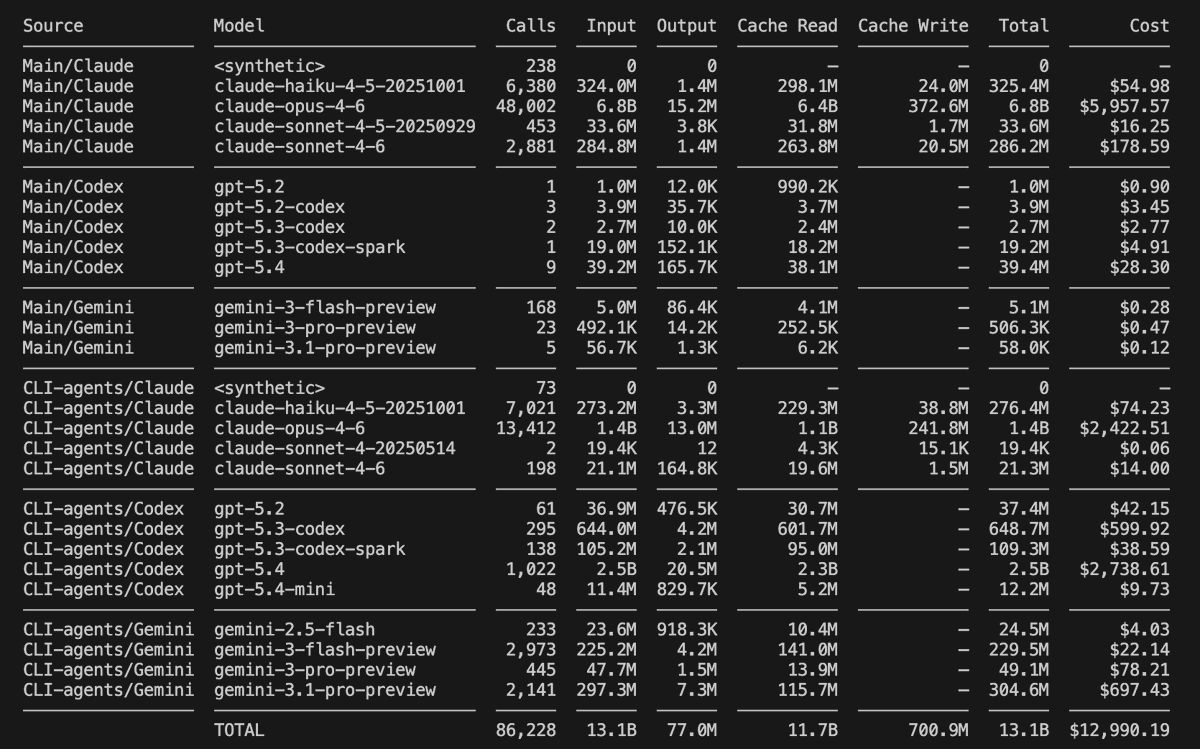
I'm building an AI startup called ResearchTech, we automate risk assessment and due diligence processes. During last 30 days for coding alone I used 13.1B input tokens and 77M output tokens. We move lighting fast, soon some of our products will be finally publicly available, they will be great.
We are hiring, if you are using AI coding tools and can build workflows which can take hours and they work well in practice, you are perfect match. We are no longer building code with AI, we are building coding frameworks for AI to build entire products for us, that's the only way to go, because during out analysis we process 100M+ tokens, it's no longer manageable to do it manually, so the only option is create AI agents to do it for us. Can't wait to share more, stay tuned.
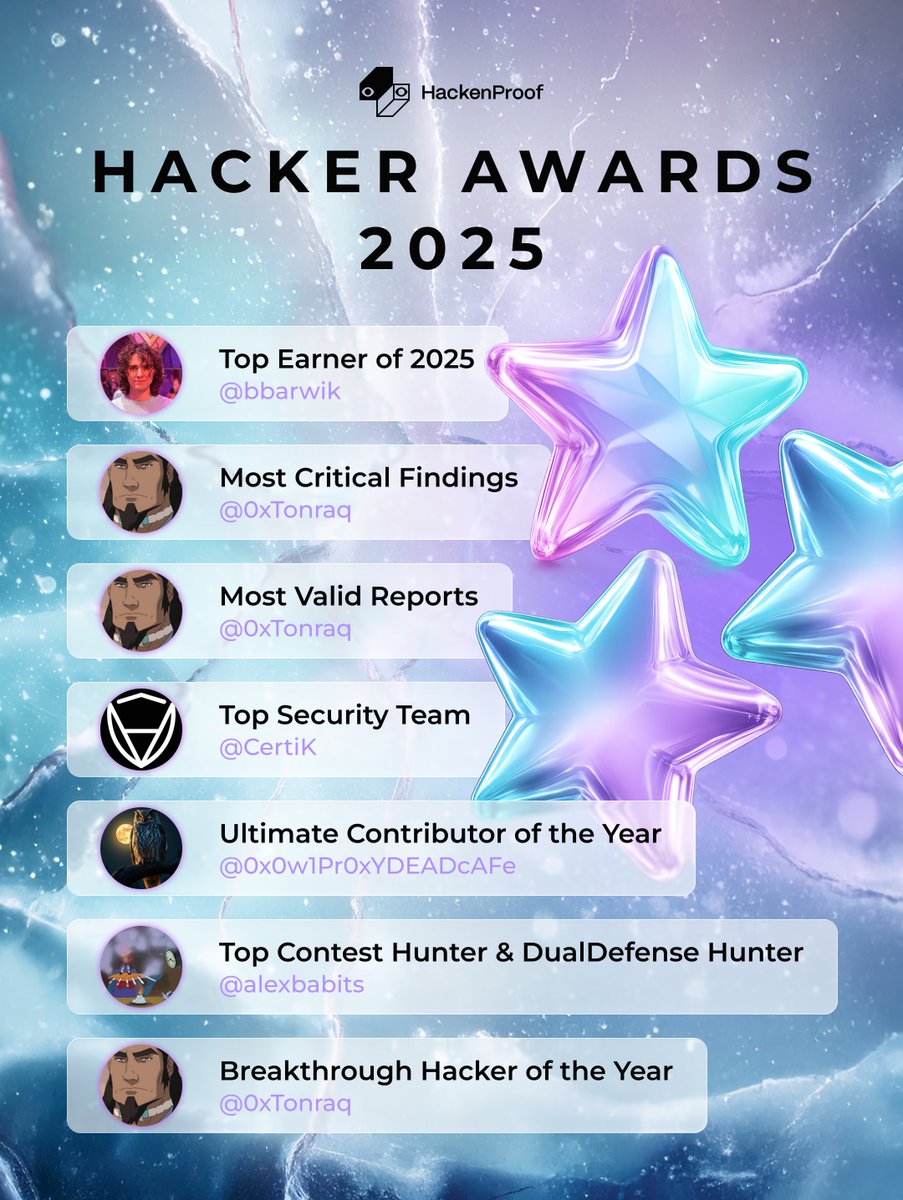
🏆 Hacker Awards 2025 – Nominees & Winners
We’re thrilled to announce the nominees for Hacker Awards 2025!
🏅 Top Earner of 2025: @bbarwik – $920k (Biggest Payout: $250k)
🏅 Most Critical Findings: @0xTonraq – 12 criticals
🏅 Most Valid Reports: @0xTonraq – 46 reports
🏅 Top Security Team: @CertiK
🏅 Ultimate Contributor of the Year: @ziko29504803 – 84 programs influenced, Summer Security event winner, HackenProof ambassador
🏅 Top Contest & DualDefense Hunter: @alexbabits
🏅 Breakthrough Hacker of the Year: – Joined April 2025, now top 13!
You’re all legends! Thank you for your contributions to cybersecurity! 👏
Most posts/videos about AI are out of touch. Today I found an exception to that: a video about "The AI Scaling Problem" - https://t.co/5CUPvzC4oM I highly recommend watching it if you prefer to have a more realistic view of AI instead of following "hype". Props to @ejmejm1
On August 11, we reported a Critical vulnerability (C-2) to Nemo regarding unauthorized manipulation of py_index_stored, an index variable which affects all interest, yield, and conversion calculations. We warned of potential "incorrect payouts, market disruption, and loss of funds" and recommended to "ensure that py_index_stored can only be updated within the intended protocol workflow and by authorized callers."
The September 7 exploit occurred through unauthorized manipulation of py_index_stored. Our recommended access controls would have prevented it.
While our full audit report will be published following protocol remediation, we believe it's important to clarify the timeline and nature of our findings given their relevance to the incident.
We remain committed to supporting Nemo's recovery.
I'm looking for a person experienced with using LLMs and creating prompts. If you can do it better and faster than me then I won't have a problem to pay you $100/h.
I created recruitment task with an example problem I'm dealing with, if you know how to deal with those problem and want to work on very interesting projects just contact me and prove it.
Task is on github: https://t.co/klHzB4LOHd
I don't care what is your background, current experience or if you know how LLMs work. I need someone who can work with the latest LLMs, long context, understands how cache/structured output works and can write prompts.
Nemo experienced a security incident occurred last night, impacting the Market pool.
We are investigating the matter and have suspended all smart contract activity for the time being. We plan to share when more information becomes available. All Vault assets remain untouched.
Our team, together with partners, is actively working on solutions. We need your patience and trust as we ensure Nemo returns to normal operations.
See you tomorrow at EthWarsaw! Just one thing, there was a change in plan because I was not yet allowed to publish story about my biggest issue which was allowing to steal $6M+. So I'll be doing presentation about "AI Audits - case study & more - 2,800 AI-Generated Tests, 22 Findings".
🛡️ Speaker: resilience track
@Bbarwik is the #2 hacker on @HackenProof.
He will discuss the high reward in identifying bugs, vulnerabilities, and how he was able to save a company 10 million dollars.
Come, ask questions, and explore the topic.
@ControlZ_1337 It will be ready within few days. I am making it because AI is terrible at using dependencies (in my case ai-pipeline-core) so I'll use different AI models to write documentation and tutorials for them, something like https://t.co/IB25lKj8AT
My personal review of executing a hard, real-world programming task with different models.
TL;DR: only gemini 2.5 pro with deep thinking is somehow useful.
I’m working on a few AI projects that use Prefect, Laminar, and multiple LLMs. To simplify development, I recently merged the core pieces into a single open-source package called ai-pipeline-core, available on GitHub.
I have access to Gemini 2.5 Pro, GPT-5, Grok-4, and Claude Opus, and I primarily use Claude Code (MAX) for implementation. I’m generally frustrated using AI for coding: it often generates low-quality, hard-to-maintain code that needs major refactors. It works only when the instructions are extremely precise; otherwise it gets overly verbose, turning 100 lines into 300+.
To mitigate this, I use one model to produce a detailed plan, then feed that to Claude Code for implementation. I was using GPT-5 for planning, but after some issues I decided to try Gemini 2.5 Pro with Deepthink.
While migrating more features to ai-pipeline-core, I set up a comparative prompt for the LLMs:
I’m working on three projects: ai-pipeline-core, ai-documentation-writer, and research-pipeline. Initially there was only research-pipeline, but I wanted to reuse its approach elsewhere, so I migrated the core code into ai-pipeline-core, which several projects now use. I want to keep improving ai-pipeline-core by moving more common functions there.Goals:
• Have ai-pipeline-core own core deps: documents (JSON/YAML), Prefect, Laminar, and OpenAI (AI interactions), so other projects don’t import them directly.
• Instead of importing Prefect in other projects, use: from ai_pipeline_core import task, flow.
• Prohibit direct imports of Prefect and Laminar in other packages (similar to how I already prohibit importing logging). I’ve included some files from the Prefect library.
• Move more shared components into ai-pipeline-core (e.g., things living in __main__.py across packages).
• Create a custom decorator for flows so they behave consistently. Call it documents_flow(project_name, documents: DocumentList, flow_options) -> DocumentList.
• Add tracing by default to my flow, task, and documents_flow. Add trace: Literal["always", "debug", "off"] = "always".
• Add function args trace_ignore_input, trace_ignore_output, trace_ignore_inputs, trace_input_formatter, trace_output_formatter (for the tracing decorator).Tests:
• Write tests to validate that my wrappers’ signatures stay compatible with Prefect/Laminar, so updates upstream get caught if I need to adjust my wrappers.Deliverables:
• A detailed plan to achieve the above, with comparisons of approaches, plus suggestions for what else to move into ai-pipeline-core. Keep the core principle: make everything simpler, less code is better. The end goal is quickly spinning up new projects (like ai-documentation-writer and research-pipeline) using a ready-to-use ai-pipeline-core.
• Code should target a principal-level Python engineer. No unnecessary comments/explainers/logging—just clear, self-explanatory code.ai-pipeline-core is open source: https://t.co/nfNgbwY8bh. ai-documentation-writer will be open sourced; other projects will not.
I provided an extensive context prompt ~600k characters long (~100–150k tokens): the full source of ai-pipeline-core, ai-documentation-writer, key parts of Prefect (src/prefect), and ~10k LOC from private repos.
I tested this prompt on every major model I have access to:
- gemini-2.5-pro
- gemini-2.5-pro-deepthink
- gpt-5 (with “thinking”)
- gpt-5 with deep research
- claude-code with Opus 4.1
- opus-4.1 on https://t.co/U4O4qJ6D3K
- grok-4
Then I fed the seven anonymized results back to each model and asked them to analyze/compare the outputs. A meta-consensus emerged: most models said GPT-5’s plan was best, with the Gemini variants usually 2nd/3rd.
Here’s my manual review:
Claude Code with Opus 4.1 — 4/10
Disappointing. It started rewriting the entire codebase, ignored my style, and generated lots of useless code. Even with my strict https://t.co/0o5bv725HY, the output quality was poor.
Opus 4.1 on https://t.co/U4O4qJ6D3K — 6/10
Much better at planning than the dedicated claude-code model. It didn’t follow all instructions and used anti-patterns I dislike (e.g., imports inside functions), but the snippets were elegant. The implementation could’ve been ~50% more concise, but it was a solid improvement.
Gemini 2.5 Pro with Deepthink — 8/10
The winner. It followed instructions almost perfectly. A few questionable choices (e.g., wrapping stdlib/Prefect/Laminar imports in try/except), but overall correct, tight, and free of unrequested features. I’ll use this plan for the final implementation.
Gemini 2.5 Pro — 5/10
Good plan, weaker implementation. It optimized for brevity, sometimes leaving placeholders like # ... other prefect args, and didn’t complete everything requested.
GPT-5 — 3/10
Overly complex, bloated with features I didn’t ask for. Hard to follow and stylistically rough (e.g., caller = str(f.f_back.f_back.f_globals.get("__name__", ""))) plus unnecessary import try/except blocks.
GPT-5 with Deep Research — 6/10
Surprisingly good high-level plan. Less step-by-step, more strategic overview—useful as a starting point if I write detailed steps myself.
Grok-4 — 3/10
Failed to understand the task. It felt like a downgraded model: after ~10 seconds it produced a very short, mostly irrelevant plan.
Decision: I’m going with Gemini 2.5 Pro with Deepthink—it fits best. Only real downside: generation time. It might have been faster to write a detailed prompt for Claude Code than to wait for Gemini to generate.
Takeaway: Current LLMs still struggle with high-quality, maintainable code on large, existing codebases. Senior developers and especially cybersecurity experts are safe for now 😄
At 15:00 CET / 13:00 UTC I'm hosting a webinar about "Top 10 Attack Paths Your Devs Are Blind To". This webinar will be about places where I search for issues in the first place when I'm doing audits or bug bounties. I found over 70 critical issues during last 3 years while doing audits and I'm top 3 bug hunter on @HackenProof . If you are interested in cybersecurity I recommend to join and watch it ;)
https://t.co/wUV8a7O2rm