Looking to change the world for the better through technology, investing & partnerships. MD @ LGT Capital Partners. ✍️ at @Open_LP , Co-host Origins Podcast 🎤
Given the current concentration of capital into venture ‘megafunds,’ we wanted our next LP guest on Origins to speak to how they are investing into this market and what their return expectations are.
Welcome @Curiousjorge65, who manages @CarnegieMellon's $4B endowment
NEW Origins! 🧵
3/ Miles believes 1 or 2 of the largest firms could pull it off, but largely questions the math.
In fact, he thinks 90% of LPs shouldn’t be in venture at all.
It’s almost ironic then that CMU allocates nearly 1/4 of its endowment to VC (notably more than what we see from many of its peer institutions)
As much as the venture industry has changed over the past 20+ years, @usv has remained remarkably consistent.
And thanks to the way they have documented and openly shared their investment theses since day one, you can physically look back and see this is true. With every change in the market and pivot from platform shifts, it’s never been a re-invention with USV, always an evolution.
The firm is unusually codified in the work that they do and how they do it, and as a long-time backer of the team, it’s one of the things I’ve always greatly appreciated and admired.
Congratulations to @fredwilson, @rebeccakaden, @nickgrossman, @mignano & the entire USV team on the next chapter! Grateful to be on this journey with you, and excited for what’s ahead. 💚 🙌
Another outstanding piece of analysis from @credistick 👇
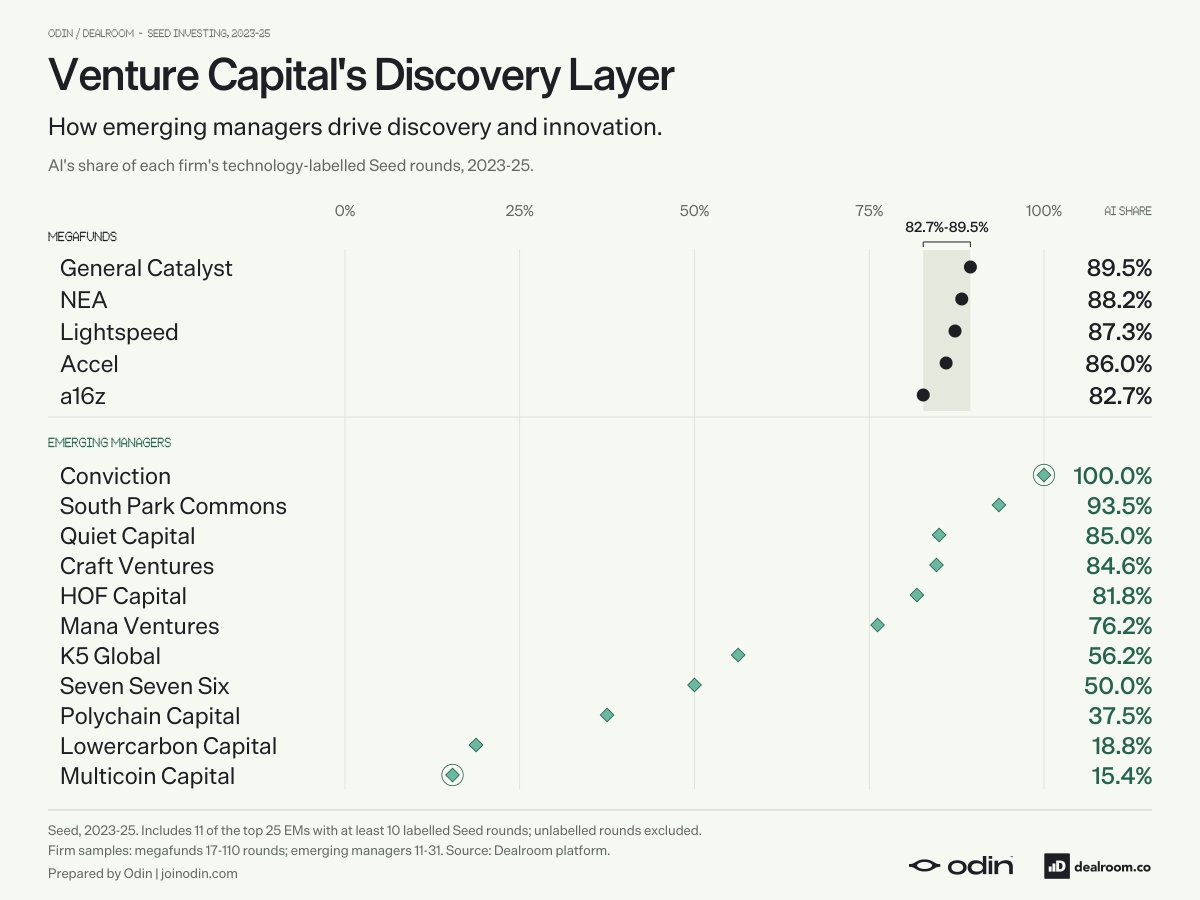
If an LP wants to build a diversified venture portfolio, part of the job is then finding managers who bring a range of opportunities. In today’s concentrated market that can be tricky, as you can invest in five different funds and still end up with a lot of the same bets. Which is great if they all work out. Less great if they don’t.
Dan puts some data behind this. Across 5 megafunds’ seed portfolios, he saw an avg of ~87% of labelled investments were in AI. EMs covered more ground… Still a focus on AI (avg of 55% in one example), but more than twice as likely to back a wider ranges of businesses.
There's so much talk about how tough it is for EMs right now (and it is), and this data illustrates the important role they play inthe ecosystem. They’re willing to put the time (and 💸💸) into ideas that aren’t yet obvious to the rest of the market.
The average emerging manager backs more than twice as many outlier profiles than a megafund, per investment.
Pooling 5 EM portfolios increases the range of investments significantly, while the same is not true for the more homogenous megafunds.
At the earliest stages, venture capital is built on discovery; innovation relies on an appetite for companies outside of "legible" categories.
Megafunds' revealed preference is to dominate existing categories, rather than drive discovery. So, the market will continue to rely on small and emerging managers for discovery.
Thanks to @dealroomco for letting me loose on their data to test this hypothesis.
Full report available here:
https://t.co/GSkYUBV8Mc
4/ We talk:
- Keeping a long-term investment focus while watching a daily share price
- How she earns access to competitive rounds
- Her case to founders for bringing retail investors onto their cap tables
▶️ Catch it all here: https://t.co/nlgFVq8mkd
1/ Throughout my 20+ yr career in venture, one question consistently comes up:
Can venture work as a public-market product?
@SPintoPeyronel thinks so... And she's making it happen at Robinhood Ventures.
NEW Origins 👇
3/ Sarah invested early in @OpenAI, @AnthropicAI and @coinbase. Now she manages a VC fund whose shares trade publicly, giving individual investors a way to participate in the value those companies create before they go public.