The distribution of zeros in Vorob'ev-Yablonski polynomials Qn(x), which provide rational solutions of the classical #Painleve II equation, is truly fascinating. Zeros are simple and form a triangular pattern (@peteraclarkson and E Mansfield https://t.co/3ESHoLQQ1b)
Here's a "theorem" in the complex variables section proved by sorry: "If g is complex differentiable at every point with Re z \geq 0, then g is complex differentiable everywhere." This is then used in the proof of another theorem in Lecture21.lean. All of this is marked as a "pass".
I am hiring a 2-year post-doc in Oxford Math to work with me on the modelling of nano-morphogenesis (bristle formation by a single cell). Details below https://t.co/xTBgDCktui
Please circulate and RT.
Had an amazing day of mathematics research talks for our annual Integrable Systems in Newcastle 2026 workshop (13th edition!), organised by @McnpNorthumbria. This continues tomorrow, here's the schedule of talks https://t.co/VeUDV1Zxjj
The distribution of zeros in Vorob'ev-Yablonski polynomials Qn(x), which provide rational solutions of the classical #Painleve II equation, is truly fascinating. Zeros are simple and form a triangular pattern (@peteraclarkson and E Mansfield https://t.co/3ESHoLQQ1b)
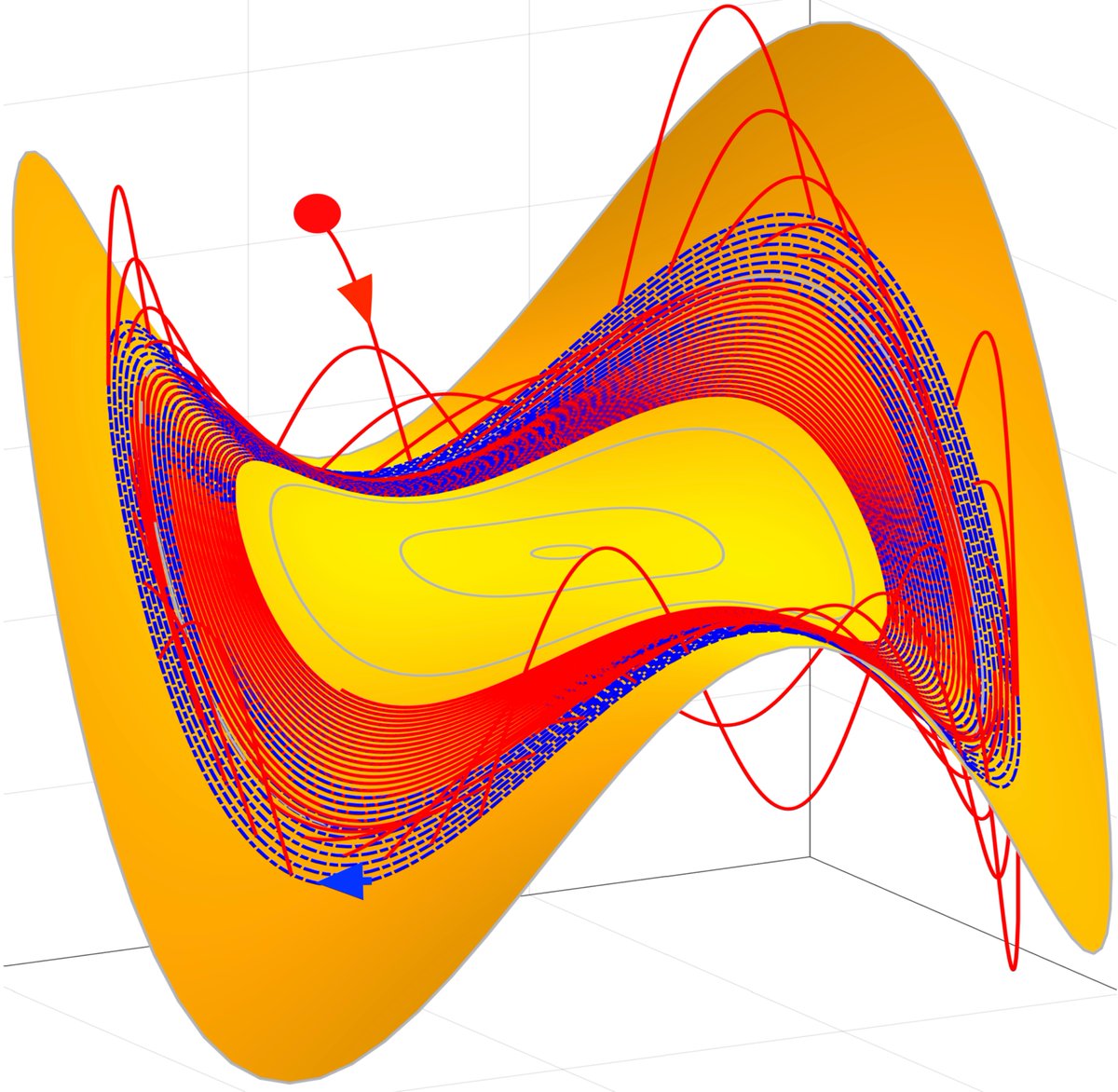
We now have another open Ph.D. position at ETH Zurich in data-driven nonlinear reduced-order modelling, with applications in system ID and control. Interested candidates may apply here:
https://t.co/SKWmp6YtR0
Excited to host tomorrow and Thursday our Integrable Systems in Newcastle meeting @NorthumbriaUni, organised every year since 2013 by @McnpNorthumbria, to push the frontiers of integrable systems theory and their numerous applications. Support @LondMathSoc https://t.co/9QSS8Ykq37
2 postdoctoral researcher positions are available in the Structured Light Group in Exeter (UK). Project focussed on quantum & classical light control through dynamic complex scattering media (see concept picture). Details are below. Drop me an email if you'd like to know more!
@DominikGStein@peteraclarkson Hi, in this particular case
1- Generate the Yablonski-Vorob'ev polynomial
2- Start with a grid of approximate zeros and iterate with the Abert-Ehrlich rule
3- Export each step to csv file
4- Import into Python and animate with Manim.
I used Julia for 1-3. Happy to comment more
The distribution of zeros in Vorob'ev-Yablonski polynomials Qn(x), which provide rational solutions of the classical #Painleve II equation, is truly fascinating. Zeros are simple and form a triangular pattern (@peteraclarkson and E Mansfield https://t.co/3ESHoLQQ1b)
if you're into pure maths and can code come join me at @PrimeIntellect - there's lots of fun and alpha in being able to reason about the parameter space through the tools of differential and algebraic geometry.