Our consortium paper on deep profiling of individuals of different ethnicities located across continents just came out. I HPP initiative involving many different labs from aorund the world and an amazing open access resource. Full of cool results. https://t.co/zJgWCCS0bQ
I meet a lot of founders who are worried by the rapid rate of technological change. They shouldn't be. It may feel uncomfortable, but techno-turbulence is net good for startups. They're much more likely to adapt successfully to some big change than incumbents are.
With this music video I successfully honor both my love for @TomCruise and my love of surfer lingo.
“The Tom Cruise Space Station”
https://t.co/KaL4oadoc9
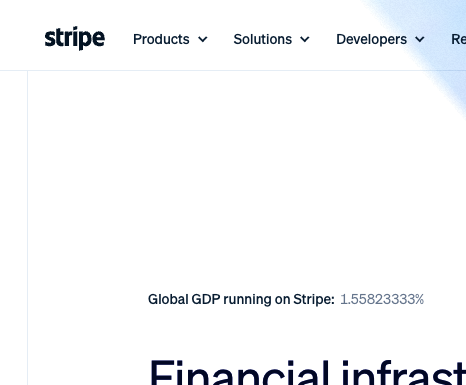
Stripe's new frontpage shows the scope of their ambition. A ticker for percent of global GDP! This is not a gimmick. Patrick and John have always thought in these terms.
I've never felt this much behind as a programmer. The profession is being dramatically refactored as the bits contributed by the programmer are increasingly sparse and between. I have a sense that I could be 10X more powerful if I just properly string together what has become available over the last ~year and a failure to claim the boost feels decidedly like skill issue. There's a new programmable layer of abstraction to master (in addition to the usual layers below) involving agents, subagents, their prompts, contexts, memory, modes, permissions, tools, plugins, skills, hooks, MCP, LSP, slash commands, workflows, IDE integrations, and a need to build an all-encompassing mental model for strengths and pitfalls of fundamentally stochastic, fallible, unintelligible and changing entities suddenly intermingled with what used to be good old fashioned engineering. Clearly some powerful alien tool was handed around except it comes with no manual and everyone has to figure out how to hold it and operate it, while the resulting magnitude 9 earthquake is rocking the profession. Roll up your sleeves to not fall behind.
A man with dementia forgot his own daughter’s birthday and quit golf forever.
Mini-Mental Score: 21/30 (severe impairment).
Dr. Sabine Hazan did something unthinkable:
She transplanted his wife’s poop microbiome into him.
Within weeks:
21 → 26 → 29
He suddenly remembered the birthday.
He went back to golf.
He started recognizing family photos again.
This is the first published case in medical history showing rapid reversal of cognitive decline after fecal microbiota transplantation.
The pioneer of FMT, Dr. Thomas Borody (who started in the 1980s), personally called her: “You HAVE to publish this.”
Top Beverly Hills neurologist Dr. Sheldon Jordan immediately began testing every Alzheimer’s patient’s stool after hearing the story.
“We are only at the infancy of the microbiome,” says Dr. Hazan.
Your gut microbes talk to your brain 24/7 — via vagus nerve, metabolites, gases, toxins.
Mind-blowing 3:53 clip with Dr. Sabine Hazan & Dr. Sharon Goldberg below.
Pure published science. Zero hype.
Just one question:
What else don’t we know about the gut-brain axis?
A very common story from a startup's investor update:
"Our partnership with <big company> did not go as expected... It was pretty evident that they were trying to take advantage of us... We’re going to walk away from that situation for now. A lot of hard lessons learned."
the openai IMO news hit me pretty heavy this weekend
i'm still in the acute phase of the impact, i think
i consider myself a professional mathematician (a characterization some actual professional mathematicians might take issue with, but my party my rules) and i don't think i can answer a single imo question
ok, yes, imo is its own little athletic subsection of math for which i have not trained, etc. etc., but. if i meet someone in the wild who has an IMO gold, i immediately update to "this person is much better at math than i am"
now a bunch of robots can do it. as someone who has a lot of their identity and their actual life built around "is good at math," it's a gut punch. it's a kind of dying.
like, one day you discover you can talk to dogs. it's fun and interesting so you do it more, learning the intricacies of their language and their deepest customs. you learn other people are surprised by what you can do. you have never quite fit in, but you learn people appreciate your ability and want you around to help them. the dogs appreciate you too, the only biped who really gets it. you assemble for yourself a kind of belonging. then one day you wake up and the universal dog translator is for sale at walmart for $4.99
the IMO result isn't news, exactly. in fact, if you look at the METR agent task length over time plot, i think agents being able to solve ~ 1.5 hour problems is coming right on time. so in some way we should not be surprised. and indeed, it appears multiple companies have achieved the same result. it's just... the rising tide rising as fast as it has been rising
of course, grief for my personal identity as a mathematician (and/or productive member of society) is the smallest part of this story
multiply that grief out by *every* mathematician, by every coder, maybe every knowledge worker, every artist... over the next few years... it's a slightly bigger story
and of course, beyond that, there is the fear of actual death, which perhaps i'll go into more later.
this package -- grief for relevance, grief for life, grief for what i have known -- isn't unique to the ai age or anything like that. i think it is a standard thing as one appreaches end of career or end of life. it just might be that that is coming a bit sooner for many of us, all at once.
i wonder if we are ready
If I was broke today
I'd instantly fly to South East Asia, book a $8/night hotel room with AC near the beach
Eat $1 street food and drink Nescafe Gold all day
And build a $10K MRR startup