Exploit EVERY SINGLE unfair advantage you have.
Looks, genetics, connections, wealthy contacts etc.
There's no nobility in doing things the hard way unnecessarily.
Guys try so hard to recreate the rags to riches underdog story that they become blind to their unique advantages
I have some advice for young men newly employed,
When you get employed:
• Be grateful to God, your parents, your mentors and your boss for this opportunity
• Work hard
• Respect your employer
• Adhere to your employer's rules and protocols
• Embrace the mission and vision of the employer
However, if working for your employer becomes unbearable due to other reasons,
• Quit respectfully
• Follow the procedures of quitting as written in your contract or employment letter
• Return your employer's resources in your custody
• Handover politely and thank your employer for giving you an opportunity
• Leave with a clean conscience
Don't be chaotic, abusive and contemptuous on your way out.
Don't think you are smarter than your employer.
The employer you are disrespecting gave you a livelihood when you were seeking a footing and direction.
The employer may not have paid you to your satisfaction, but be polite.
Don't go bad mouthing your employer, speaking nastily, and broadcasting your foul mouth while disclosing what is considered private policies, programs, products or services of your former workplace.
Leave courteously.
This way, you open room for better opportunities, newer networks and better leverage.
Don't be a rude employee. Other employers will fear giving you opportunities in the future because they don't trust you.
Be courteous when you close the door behind you, the universe will be kind to you on your way out.
Kenya Is In The Red As Ruto Mistakes A Revolution For A Security Lapse
From June 2024 to where Kenya stands today, the biggest mistake William Ruto has made is treating a political revolution like a police operation, because what began as anger over the Finance Bill quickly became a national rejection of arrogance, waste, corruption, overtaxation, police brutality and a government that talks too much while listening too little.
The people who went to the streets in June 2024 were not complaining because Parliament had weak gates, police had poor formation or intelligence officers had slept on duty, because they were complaining because life had become too expensive, public money looked like private property for connected people and leaders were behaving as if citizens existed only to be taxed, lied to and beaten into silence.
That is why Ruto is very very wrong if he thinks the lesson from June 2024 was that security failed to stop citizens from reaching Parliament, because the real lesson was that the public had reached a point where fear no longer worked as the main tool of control.
The first stage of a revolution is pain that leaders dismiss, and Kenya went through that stage when citizens complained about food prices, taxes, unemployment, corruption, medical costs, school fees, public debt and the daily humiliation of watching leaders live big while ordinary people were told to tighten belts that had already cut into their skin.
The second stage is shared anger, and that came when Kenyans stopped seeing their suffering as private bad luck and started seeing it as a national pattern created by bad leadership, greedy budgeting, tone deaf speeches and a political class that had lost the shame needed to pretend it cared.
The third stage is the trigger, and for Kenya that trigger was the Finance Bill, because the bill became more than a tax document and turned into a symbol of a government that wanted to take more from people who already felt squeezed dry.
The fourth stage is the breaking of fear, and that happened when young Kenyans faced tear gas, live bullets, arrests, intimidation, online threats and still returned to the streets with phones, flags, placards, chants and a stubborn refusal to be treated like children of a lesser God in their own country.
The fifth stage is state panic, and that is where Ruto’s government moved from political response to security obsession, because instead of accepting that citizens had legitimate anger, the system started behaving as if the main problem was protest logistics rather than the pain producing the protests.
That is how we arrived at this strange place where CBDs are closed, roads are blocked, Parliament is barricaded, police are deployed like the country is at war with itself and strange squads appear around protests as if the State is trying to scare citizens back into silence.
The use of acoustic weapons and other aggressive crowd control tools shows how badly the regime has misread the national mood, because a machine that screams at citizens does not answer why they are broke, why they are angry, why families are burying children, why abducted people remain a national wound or why public trust has collapsed.
Ruto thinks stronger policing can stop the wheel, but once the wheel of a revolution starts rotating, it does not stop simply because a government has bought bigger vehicles, louder machines, darker helmets and more officers to flood the streets.
This is where necessity becomes the mother of invention, because when you close the CBD, people begin to think beyond the CBD, when you block one route, people begin to imagine another route, and when you militarize one protest style, the public begins to create new civic languages that the State has not yet learned how to police.
A revolution does not always move in one straight line, and it does not always announce itself through one big crowd in one big city, because sometimes it becomes refusal, silence, boycott, ridicule, underground coordination, public memory, electoral punishment and a slow national agreement that the people in power have lost moral authority.
Kenya is now in the red because the same issues citizens complained about in 2024 have not been fixed in a way that people can feel in their homes, pockets, hospitals, schools, workplaces, police stations and villages.
The anger is still there, the distrust is still there, the cost of living is still there, the debt burden is still there, the corruption anger is still there, the police brutality question is still there and the feeling that government only listens when people rise up is now deeper than it was before Parliament was stormed.
The danger for Ruto is that he has armed and empowered the security sector so heavily that officers may start behaving with the carelessness that comes when a government teaches them that every angry citizen is an enemy to be subdued instead of a Kenyan to be heard.
That kind of overconfidence can spin things out of control, because once security officers believe they are the last wall protecting a collapsing political order, small confrontations become national tragedies and every excessive response creates new anger for the next round.
The political bomb coming to Kenya is not a cartoon bomb carried by protesters, but a pressure bomb created by the State itself every time it refuses to solve the real issues and chooses instead to add more uniforms, more barricades, more arrests and more threats.
Ruto still has not understood that revolutions are not defeated by closing streets, because streets are only the visible part of a deeper public shift that begins inside people’s minds before it appears on roads, timelines, funerals, markets, campuses, churches, workplaces and ballot boxes.
Kenya is now past the complaint stage, past the awakening stage, past the trigger stage and past the first breaking of fear, which means the country is currently in the state panic stage where government responds to a legitimacy crisis with security muscle.
The next stage is adaptation, where citizens stop relying on the old predictable protest patterns and begin finding new ways to express anger, preserve memory, pressure power and punish arrogance without waiting for permission from the same system they are resisting.
After adaptation comes the judgment stage, where the regime either reforms honestly and lowers the national temperature or continues provoking the country until public anger becomes impossible to manage through police deployments and emergency speeches.
That is why Kenya is in the red today, because Ruto is fighting the smoke while feeding the fire, and a government that keeps mistaking citizens’ pain for a security lapse eventually learns that the real breach was not at Parliament, but inside the trust that once held the country together.
As we speak today, Kenyan politics remains the graveyard of imagination because the people who rule this country keep becoming billionaires without building anything that can honestly be called industry.
Take Rigathi Gachagua as an example.
He is a billionaire today, yet when you ask what serious industry he owns, what factory he built, what product he created, what export empire he established or what invention changed people’s lives, the answer disappears into tenders, land, proxies and state access.
If you want to track stolen Kenyan money today, stop looking for complicated explanations and just follow the plots, the sudden apartments, the ranches, the malls, the relatives and the proxies who become rich without any visible enterprise.
Kenya’s political class has perfected the art of turning public office into private land, then calling the proceeds investment.
Now look at gambling and ask yourself why almost all politicians are linked to betting, Aviator style addiction and gambling companies that drain poor Kenyans every day.
A young man loses his last fifty shillings chasing fake hope on his phone, while the same political class that ruined the economy stands behind the machinery taking the money.
From Ruto to Gachagua and the wider political class around them, the problem is not just corruption but a total lack of creativity.
These people are not creative enough to build industries, so they build gates around public money and charge Kenyans to pass through their own country.
They do not create value for citizens, they create access for themselves, and when they gather in one place, you are not looking at leaders with ideas but at the easiest industry in Kenya for people whose only real talent is extracting money from poor citizens without shame.
YES, IT'S POSSIBLE. IN UTERINE RUPTURE (WHEN THE WOMB TEARS OPEN)
A NEAR- DEATH EXPERIENCE.
READ. SHARE. REPOST.
Dear married and singles on our dear green earth,
Come, let me speak to you as a obstetric doctor, and also as someone who understands how easily a moving video can frighten or impress the eye. This clip circulating of a pregnant woman having an ultrasound while the feet and palms of the baby appear to show clearly on the surface of her abdomen. It looks dramatic, and it looks convincing, and that is exactly why it needs to be handled with care. According to obstetric anatomy and clinical guidelines, a baby’s hands and feet cannot be outlined so sharply on the mother’s abdominal wall in a normal pregnancy. Between the baby and the skin are layers of muscle, uterus, and fluid, and these soften and blur movement. What you are seeing is not how a healthy uterus behaves.
There is only one frightening exception, and it is not something to celebrate or record for social media. If a baby’s limbs appear to be pushing directly against the skin in an abnormal, exaggerated way, the concern is uterine rupture. This is when the wall of the uterus tears open, often during labour or in women with previous caesarean scars. It is not a curiosity. It is a catastrophe. It means the baby is no longer safely contained, and the mother can bleed severely within minutes. In such a moment, there is no time for filming, only time for emergency surgery.
Uterine rupture is rare, but when it happens, it is one of the most dangerous events in obstetrics. The mother can lose large amounts of blood very quickly, and the baby can lose oxygen just as fast. Without immediate medical intervention, both lives are at risk. This is why doctors take abdominal pain in labour, abnormal fetal heart rates, and sudden changes in the shape of the abdomen so seriously. These signs are not entertainment; they are alarms.
So I ask you gently, but firmly, to be careful with what you believe and what you share. Misinformation about pregnancy is not just harmless gossip; it can make women ignore real danger or assume that something deadly is “normal” because they saw it online. Not every dramatic pregnancy video is a miracle, and not every strange movement is a sign of health. Trust science, trust trained eyes, and when in doubt, seek medical care. In pregnancy, the difference between a story and the truth can be the difference between life and death.
🚨 The U.S. just took a big step to reduce China’s control over critical minerals.
Yesterday, Trump announced Project Vault, a new U.S. strategic reserve for critical minerals.
The U.S. already has a Strategic Petroleum Reserve for oil. Now, the U.S. is doing the same thing for critical minerals.
Let’s break it down properly.
WHY IS THE U.S. DOING THIS NOW?
The U.S. economy depends heavily on minerals it does not control. Many key materials used in: EV batteries, Aerospace, Defense systems, Chips and electronics are either imported or processed outside the U.S.
In many cases, China controls the processing stage.
That means even if a mineral is mined elsewhere, it often still goes through China before being usable.
This creates a big risk: If supply is disrupted for political or geopolitical reasons, U.S. industries can stall.
Project Vault is meant to reduce that risk.
HOW BIG IS PROJECT VAULT?
This is not a small program. Project Vault is backed by around $12 billion. Here’s how the money breaks down:
- $10 billion comes as a loan from the Export-Import Bank of the United States (EXIM).
- $1.67 to $2 billion comes from private sector capital.
So this is not just government money. Big companies are putting real money into this. That tells you this is meant to be operational.
WHAT EXACTLY WILL THE U.S. STOCKPILE?
Project Vault will stockpile:
- 50 critical minerals
- 17 rare earth elements
Some important ones include:
- Lithium, cobalt, nickel → EV batteries and energy storage
- Gallium → chips, radar, defense electronics
Other materials needed for aerospace, defense, and advanced tech. These are not optional materials. Without them, factories stop.
WHO IS INVOLVED IN THIS?
This is not being run in isolation. Major U.S. companies are involved, including: General Motors, Boeing, Google, GE Vernova.
On top of that, large commodity traders are involved to handle Buying, Transport, Storage. That matters because these firms actually know how physical commodity markets work.
WHAT IS THE REAL GOAL HERE?
The goal is simple:
Protect U.S. industries from supply shocks and geopolitical pressure. Especially pressure coming from China, which currently dominates: Processing, Refining, Downstream supply chains. Project Vault gives the U.S. a buffer.
If supply is disrupted, the U.S. doesn’t immediately panic-buy at high prices or shut down production.
HOW DOES THIS AFFECT THE U.S. ECONOMY?
This has several direct effects:
1. MORE STABILITY FOR U.S. MANUFACTURERS: Industries like EVs, defense, and aerospace get supply certainty.
2. LOWER RISK OF SUDDEN PRICE SPIKES: Stockpiles reduce panic buying during shortages.
3. STRONGER NATIONAL SECURITY POSITIONING: Supply chains become harder to weaponize.
4. LONG-TERM SUPPORT FOR MINERAL DEMAND: Stockpiling creates steady, structural demand.
WHAT DOES THIS MEAN FOR MINERAL PRICES?
Over time, this is likely bullish for critical minerals. Why?
Because: The U.S. is becoming a large, steady buyer, Supply chains are already tight, Demand from EVs, AI, and defense is growing.
Stockpiling doesn’t reduce demand. It locks demand in. That usually supports prices, especially during supply stress.
Project Vault is the U.S. admitting one thing clearly: Critical minerals are no longer just commodities. They are now strategic assets.
So let me get this straight...
$15T was flash-liquidated from Gold, Silver, and Crypto.
The same weekend, the media floods everyone with Epstein Files and WW3 threats.
So my question is... where did the $15T actually go? It doesn't just vanish... someone stole it while everyone was distracted.
I feel like everyone knows who took it... but no one is brave enough to say it out loud...
The FBI, created in 1908, did not hire Black Agents,
Until 1921, when it hired negros specifically to infiltrate the movement of Marcus Garvey
Remains true today, it's always your kind, tribe, kith that is used to bring you down
Be vigilant this year
Happy New Month
Ann Waiguru single-handedly killed the dreams of millions of youths. To date, NYS has never recovered from the theft that was orchestrated under her watch. Despite all these atrocities, the people of Kirinyaga saw it fit to entrust her with managing the county’s revenue. She has literally done little to nothing to steer the county forward.
In a country with a functioning system, Waiguru would be spending her 12th year in jail. In 2027, she is vying for a Senate seat, and to show just how this country is destroyed by the very same people who complain about bad leadership, the people of Kirinyaga will likely give her another chance to oversee theft,, an area in which she is a professional.
No one is coming to save you. And that’s not a curse, it’s power. It means you don’t have to wait.
You don’t have to beg. You don’t have to be chosen. You become the one who shows up. Show up for your goals. For your healing. For your future. When you accept that rescue isn’t coming, discipline is born. Consistency follows. And slowly, your life changes. Hard truth. Strong freedom. Have a Fruitful week ahead.
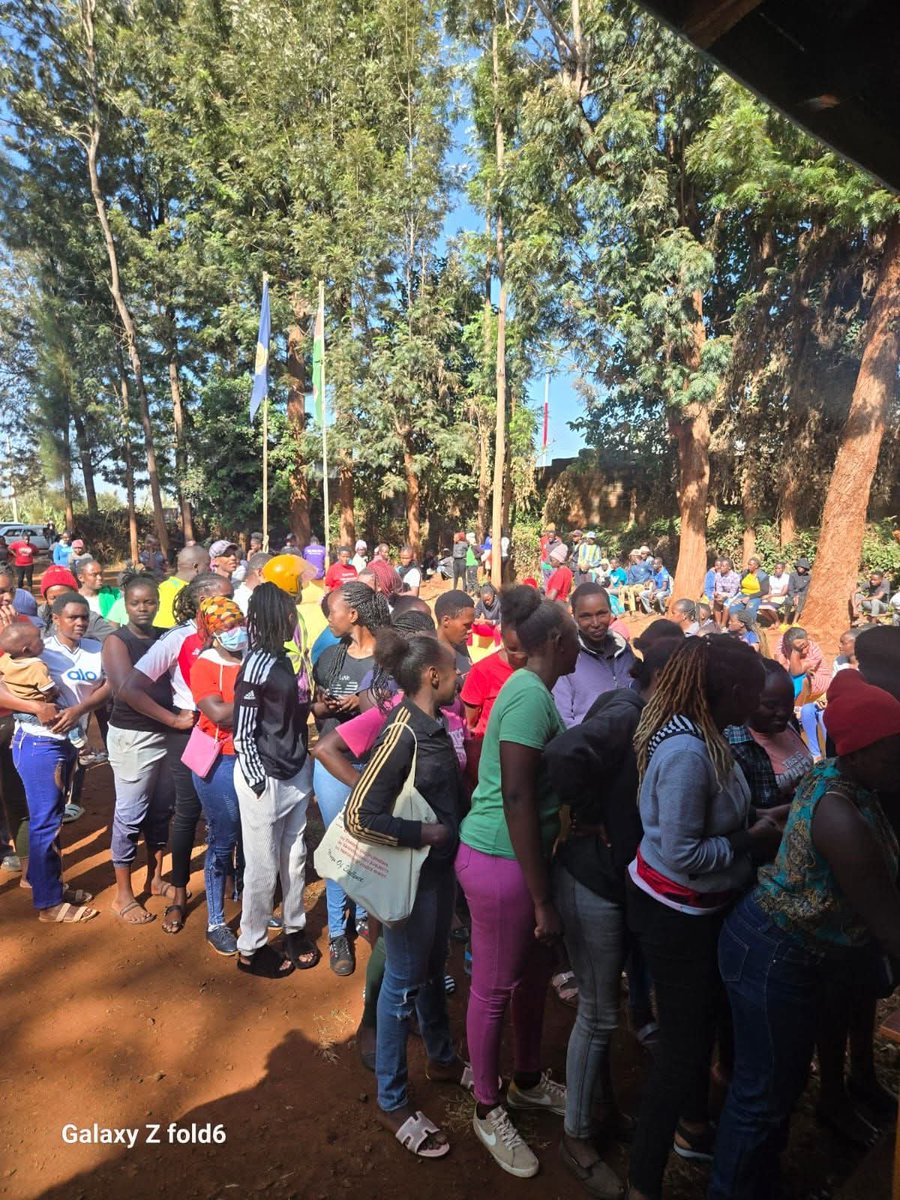
In Murang’a, there is a program called the Murang’a Youth Service. Yesterday there was a recruitment exercise across the whole of Murang’a. This program takes 30 youths per ward, and so far they have taken more than 8,000 youths. The youths are selected through balloting, if you pick “yes,” you get a chance. No educational qualifications are required.
If you are selected, you work in cleaning the towns in Murang’a for two months and you are paid Ksh 400 per day. You receive Ksh 300, while Ksh 100 is sent to your parent.
After finishing the cleaning work, you are taken to a polytechnic to study a course of your choice such as plumbing, hair and beauty, etc., for three months, and the program pays for your NITA exam.
After completing the exams, there is a graduation, and you are given Ksh 15,000 to start a business. If you start your business in Murang’a, you do not pay a business license fee for one year.
Murang'a is making other Kenyans feel like they were born in Mogadishu. Now that is empowerment, silent, focused and impacful, not what we are currently seeing in other areas. Other leaders are milking the country dry while telling their mumu voters that all development is taken to Murima bcoz of entitlement.🤡
Had General Francis Ogolla still been alive, the current situation in Sudan might have taken a markedly different trajectory. His strategic discipline and firm stance on regional security would likely have curtailed the flow of arms empowering the RSF to commit atrocities against innocent civilians. When Rigathi Gachagua alleged that President Ruto was involved in Sudan’s conflict, many dismissed his remarks as mere political bitterness. Yet, the unfolding humanitarian catastrophe in Sudan,, bordering on genocide now demands sober reflection on the complex web of political interests, regional diplomacy, and the moral cost of silence. One day those responsible will be held accountable.
Those celebrating Mutahi Kahiga’s gutter talk are the rot that festers when ignorance mates with hatred. You clap because a man insulted the dead? You are are putrid.
You mistake vulgarity for bravery, yet you’ve achieved nothing in your miserable lives except worshipping politicians who wouldn’t spit in your direction if you were on fire. You laugh at death because you have no legacy worth dying for, no principle worth defending, no brain worth consulting.
You call Raila names, yet his shadow has done more for this country than your entire bloodline combined. You think you’ve mocked him but you’ve only revealed the smallness of your souls. Raila built the road you’re walking on, bled for the democracy you now abuse, and endured prison so you could tweet stupidity freely.
Mutahi Kahiga ; a governor by mistake and a disgrace by design you don’t speak for Nyeri, you speak for your own emptiness. Leadership demands grace; you offered gutter. A man who dances on graves forgets that the soil is patient and one day, it will host him too.
History has a cruel sense of humor. The men who mock lions are usually eaten by jackals.
A governor with devolved funds to fix schools, hospitals, roads, markets, water, and agriculture in Nyeri still wakes up every day blaming Nyanza and Western for his own failures.
Mutahi Kahiga was elected to lead a county, not to gossip about communities. But when a man is small in mind and bankrupt in vision, he seeks relevance by spitting venom. It’s easier to insult Raila than to explain why Nyeri’s hospitals have no medicine, why farmers are sinking in debt, and why the youth are jobless.
He thinks shouting at the dead makes him powerful , no, it just exposes the rot in his soul. The man is drunk on tribal hate and allergic to work. He has devolved funds but not sense.
How does a whole governor turn from fixing lives to fueling division at funerals? Because it’s easier to weaponize ignorance than to govern.
Mutahi Kahiga is a disgrace to the institution of devolution ; a loud, lazy embarrassment masquerading as leadership. Nyeri deserved a leader; they got a loudspeaker for bitterness.