Anthropic Says Life Sciences Is Its Biggest Bet After Code.
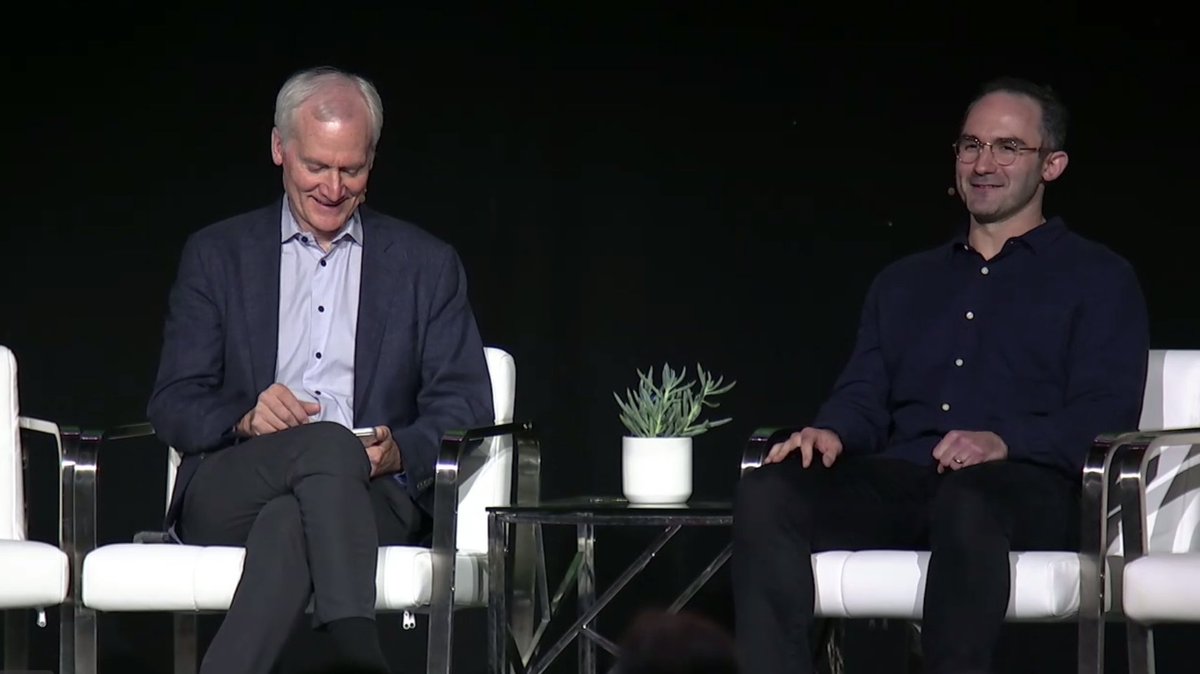
Eric Kauderer-Abrams started @AnthropicAI 's life sciences division ten months ago. He took on the stage at @SynBioBeta with Marc Tessier-Lavigne from @Xaira_Thera , and what caught my attention was how plainly Eric stated the following:
"The greatest opportunity to have a beneficial, scaled impact with everything that's happening in frontier AI is in the life sciences."
After coding, it's their biggest investment area. They've been training Claude on bioinformatics, chemistry, molecule design, structural biology, clinical regulatory. Their models went from mediocre in life sciences to roughly PhD level across most domains in under a year. That's a steep curve.
But what I found more telling than the benchmarks was the infrastructure they're building around it. Wet labs for basic research so their own scientists hit the walls firsthand. An acquisition of Coefficient Bio (acquired by Anthropic) to teach @claudeai how to think like a biotech program manager, not just a bench scientist. The gap between "Claude can answer a biology question" and "Claude can help you run a drug program" is enormous, and they're clearly aware of it.
Marc mentioned that 90% of drugs fail in the clinic. Two-thirds of those failures aren't bad science, but patient matching. You have a good target, a good drug, and you can't find who will respond. That's the problem both of them kept circling back to, and it's where causal AI models trained on real perturbation data might actually move the needle.
Marc said nobody's pushing a button for a development candidate anytime soon. But Anthropic went from $1B to $30B in revenue in sixteen months. That kind of resource behind this kind of focus is new. It's fun to think of what R&D can look like in the next few months!
#SynBioBeta2026 #SyntheticBiology #Biotech #AIxBio
On AI's expanding role across biopharma & drugmaking, Amgen's CTO (& ex Head of R&D) David Reese said he believes that AI’s greatest impact will come from improving the thousands of human-led decisions. $AMGN
Lots of great Gemini API updates shipping today 🛠️
1. Built-in tools (search, maps, file search) now work with function calling
2. We now do context circulation with built-in tools for better model performance
3. Grounding with Google Maps now works with Gemini 3!!
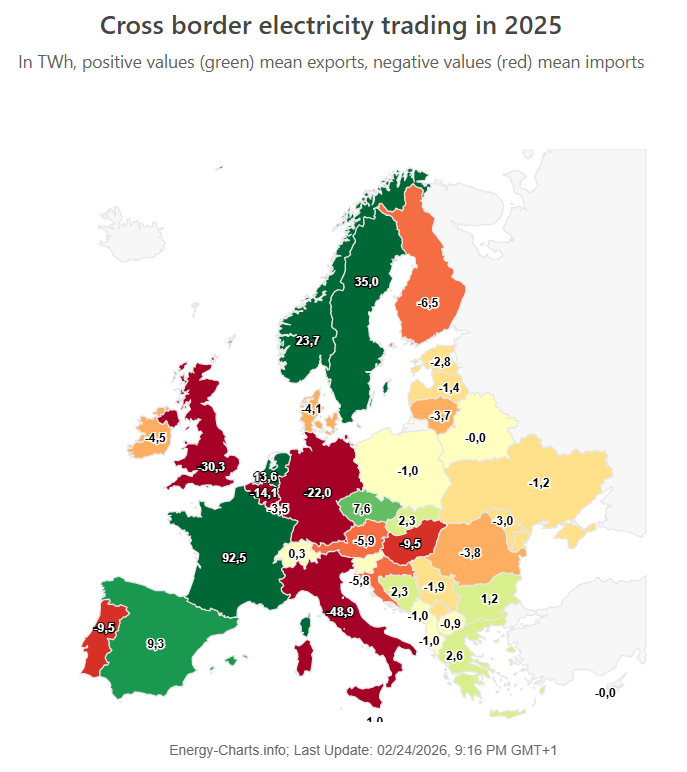
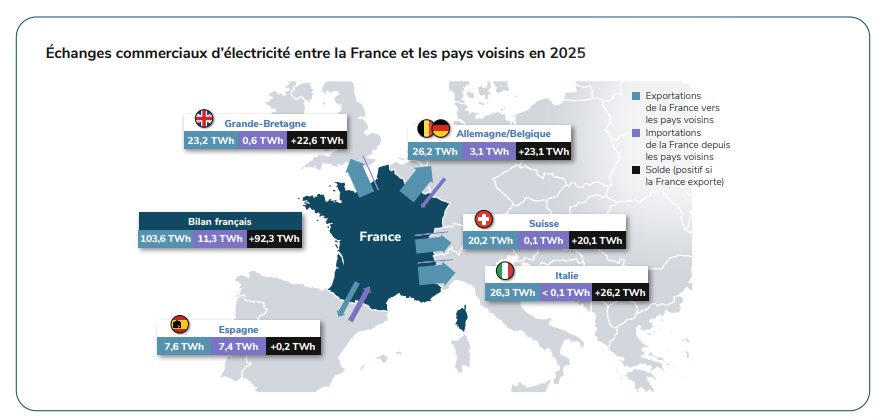
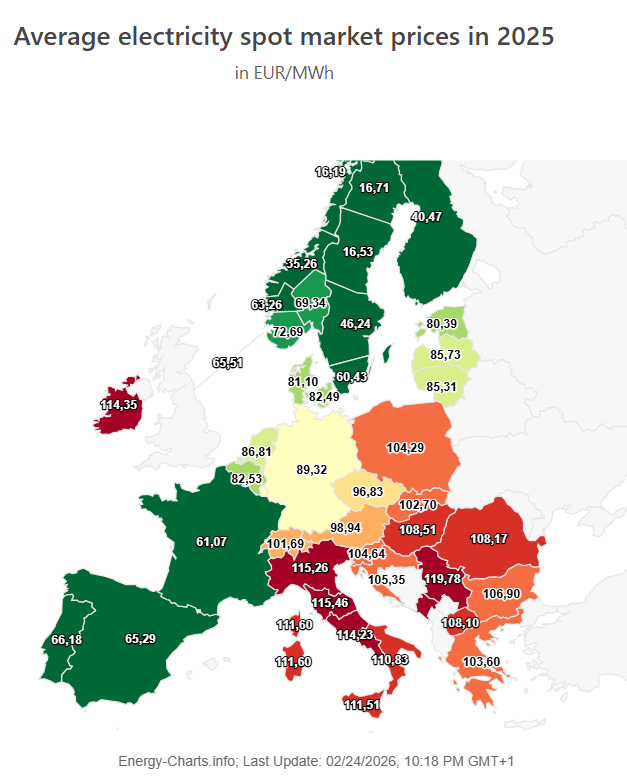
Last year, France sent us 22.6 terawatt hours of (mostly nuclear) electricity, about eight percent of our total.
It also sent Italy 26.2 terawatt hours, Germany 23.1, and Switzerland 20.1
Ours and Germany's crazy energy policies would cost us a lot more if France wasn't, kindly, running a reliable nuclear grid, producing Europe's cheapest non-hydro electricity.
Thank God for France!
https://t.co/vIj4Sdpfky
@clarashih Also, a cautionary tale from China/WTO's great manufacturing labor arbitrage: once human knowhow is outsourced, it is really hard to scale back skills, talent and innovation from scratch...
Great take, beyond the "doom"... When it comes to broadening capital ownership, we might want to go a step further to build a true "skin-in-the-game" architecture for labor. The French system of "labor participation in capital" is interesting in the sense that it includes profit and capital sharing as well as governance participation.
Perhaps mandating profit sharing or stock grants for larger companies, paired with corporate tax relief to balance the cost?
La France a fait une percée spectaculaire (et inattendue) : le pays est devenu le 4ème au monde pour les investissements industriels entre 2021 et 2025 (dépassé seulement par Etats-Unis, Chine et Inde)
https://t.co/CDBhRmgCzm
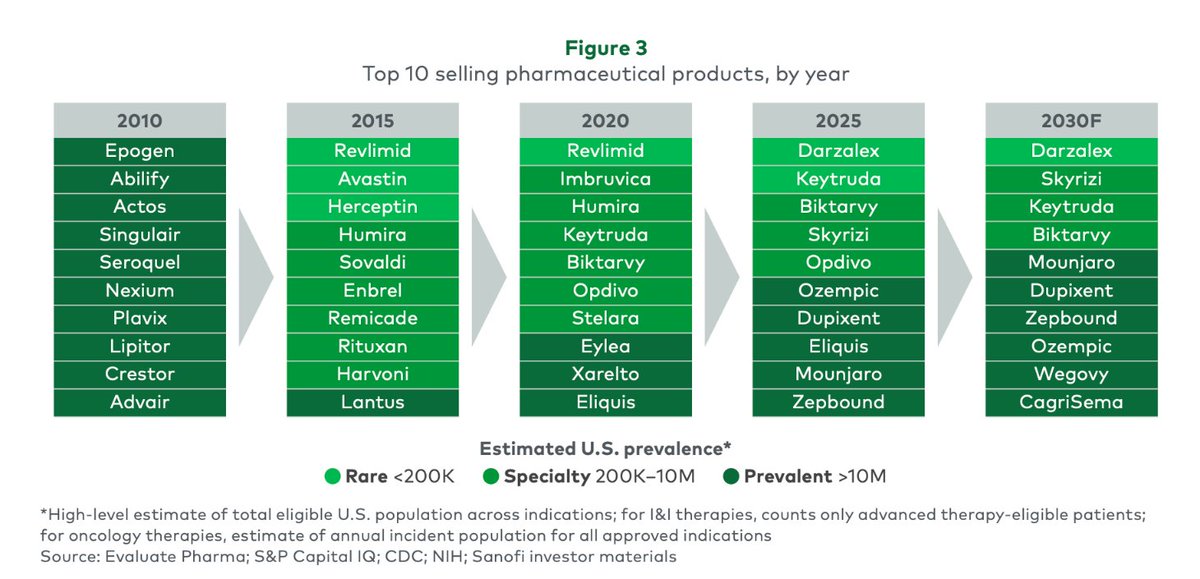
The return to prevalent diseases... Big is Beautiful.
LEK captures the evolution of the top 10 biggest drugs... 2010 all were prevalent, by 2015 most were rare/specialty, now swinging back again.