Senior Investment Advisor and Portfolio Manager at Wellington-Altus. Tweets are not investment advice.
DM with your financial planning and investment questions.
"There is only one wholistic system of systems. One vast and immane, interwoven, interacting, multivariate, multinational dominion of dollars."
Network (1976)
@SantiagoAuFund
TRUMP says "The whole world has become somewhat of a casino." after U.S. special forces soldier was charged for betting on Maduro's removal before the raid was reported and won $409,000
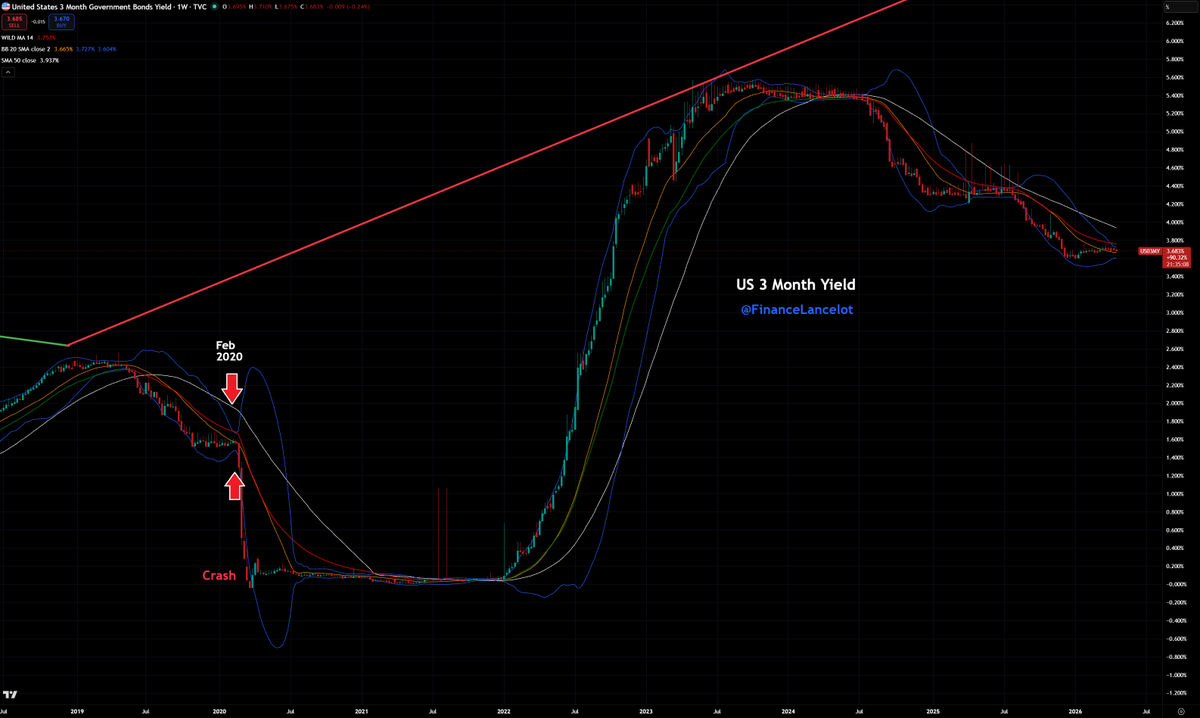
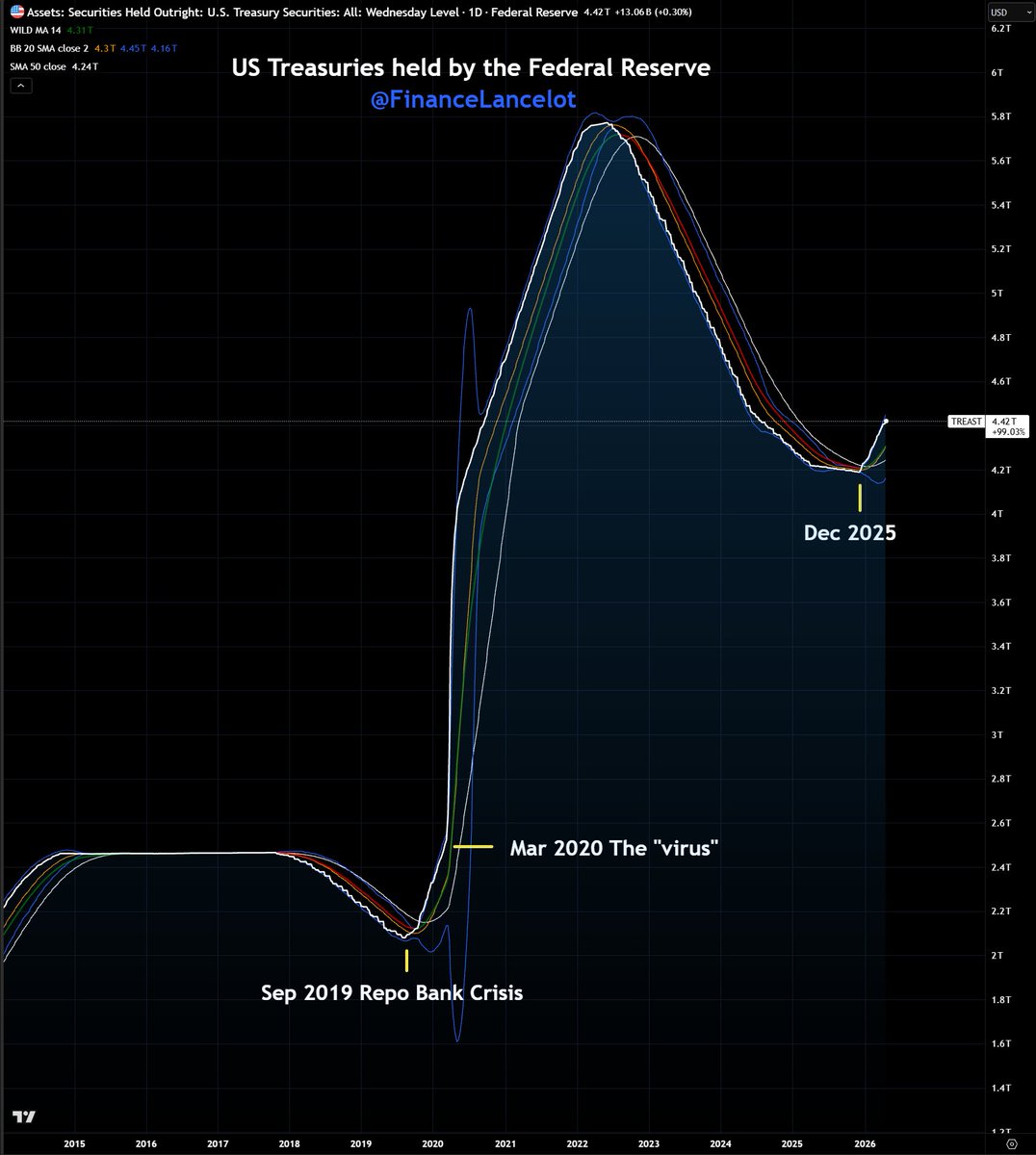
The Federal Reserve's T-Bill purchases are still rising, hitting $425 billion this week.
Powell continues to buy despite clear signs of a stock market bubble the last 22 days.
Total treasuries held by the Federal Reserve continues to rise, hitting $4.42 trillion.
This is what we call "Not QE, QE." Jerome Powell is quietly providing liquidity to financial institutions prior to whatever crisis is coming, arrives.
The question is, what is it this time?
Absolutely spot on @jam_croissant. What better way to bring about the rise of populism than create a global shortage of energy, fertilizer & food.
This will be extremely destabilizing, but the perfect excuse to implement the new system of CBDC rationing.
It isn't a coincidence.
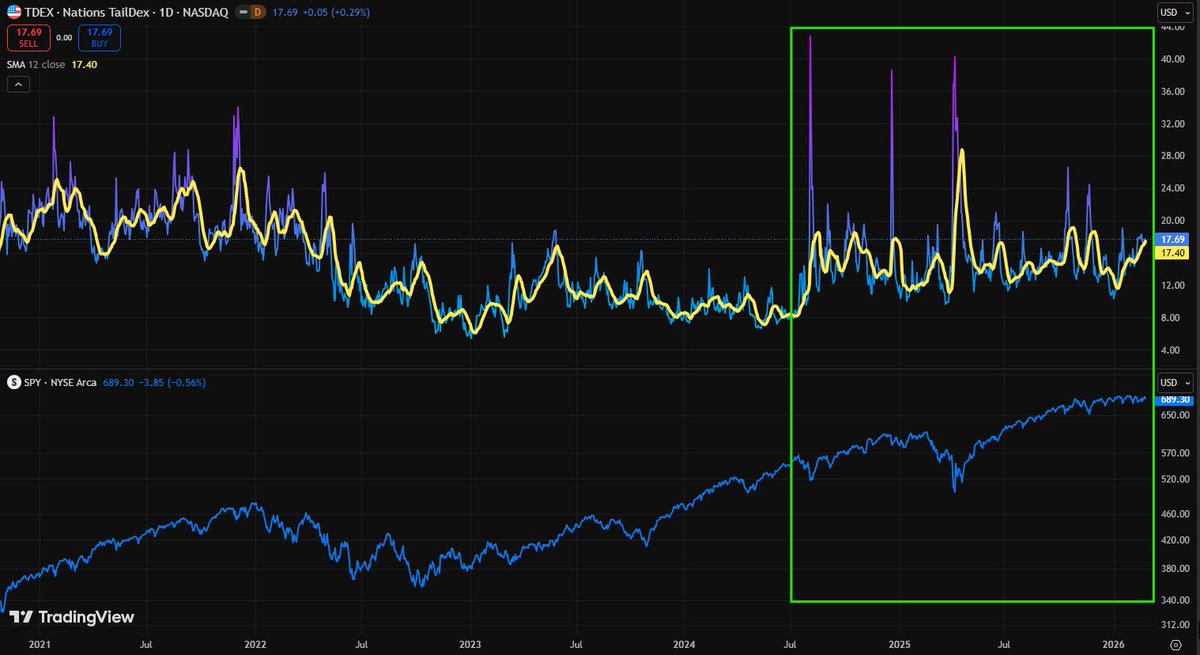
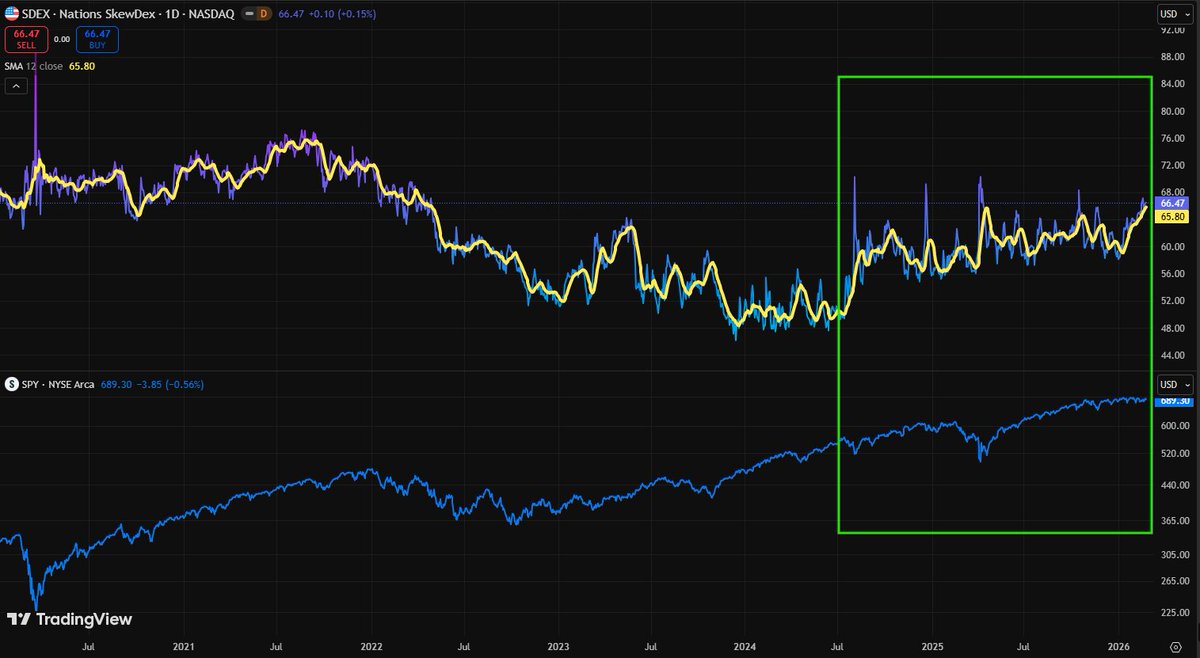
The recent calm is manufactured by passive flows and dealer hedging, and the longer it holds, the more explosive the potential unwind becomes:
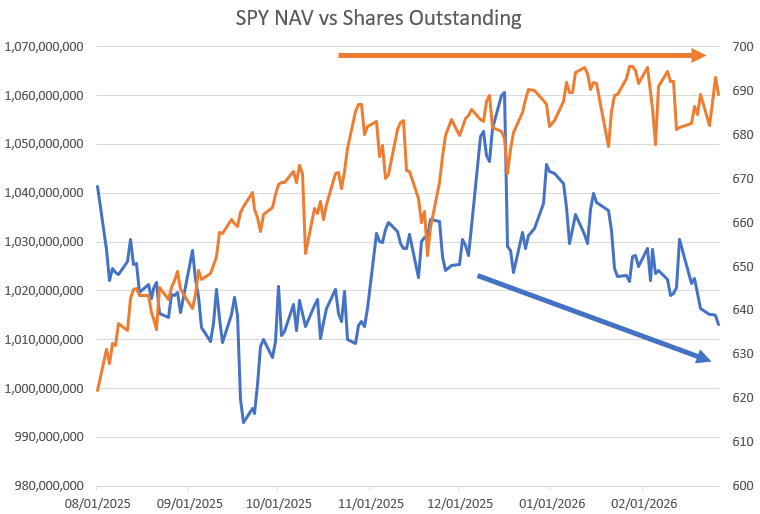
The skew regime we see today is, at its core, a downstream consequence of the explosive growth of passive investing, which has rendered equity markets fundamentally more inelastic. As a larger share of assets sits in index funds and benchmark‑tracking vehicles, flows become price‑insensitive: money coming in pushes prices up mechanically, and money going out pushes them down mechanically.
This suppresses realized volatility during normal conditions yet it simultaneously makes genuine drawdowns more violent. When selling finally hits, there are fewer natural buyers, liquidity evaporates quickly, and index‑level downside becomes jumpier and more nonlinear.
In that environment, the payoff profile of systematically selling SPX downside convexity deteriorates: the carry is too lean in calm regimes, but the left‑tail is more severe. Deep‑OTM put selling becomes structurally less attractive for banks, insurers, and other historical providers of convexity.
Passive dominance also helps entrench extreme index concentration. A handful of mega‑caps now drive a disproportionate share of index performance, raising dispersion and lowering average correlations. The old comfort that “selling index downside is safer than selling single‑stock downside” no longer holds when one megacap’s idiosyncratic shock can drag the benchmark.
Those two forces, inelastic passive flows and index concentration, change what structured‑product buyers want and, crucially, how issuers hedge.
The product mix has migrated away from classic SPX downside‑vega notes toward autocallables, income notes, and single‑stock or basket structures engineered around the volatility and correlation characteristics of the dominant names. These designs rely more on upside vanna and single‑stock correlation than on selling deep SPX downside.
As issuance shifts, so do hedges: desks no longer need to supply a steady stream of far‑OTM SPX put‑selling to offset their liabilities. Instead, they must manage call‑vanna and dispersion. The result is that a major structural supplier of SPX downside protection (once embedded in the routine issuance of buffered notes, reverse convertibles, and worst‑of structures) has quietly faded. With that supply gone, the skew surface becomes far more sensitive: modest put demand pushes the wings sharply higher, skew stays elevated rather than mean‑reverting, and even small hedging flows can produce outsized distortions. In today’s market, the persistence of high skew is less a story about surging demand for puts and more about the vanishing of natural sellers who used to anchor the downside.
This is where the market’s recent “quiet” tape initially comes from. Since late 2025, the S&P��500’s unusually tight range has been less about macro calm and more about the mechanical by‑product of dealer call‑vanna hedging. As structured‑product inventories age and autocall barriers sit close to ~7000 spot, dealers’ positive vanna becomes extremely sensitive to even tiny price changes: rising spot pushes implied vol lower (benefiting the desk), and dealers sell delta to keep exposures in bounds. Falling spot lifts vol (hurting the desk), and dealers buy delta to stabilize P&L. The buy dips sell rips loop is powerful and it mechanically drags the index back toward the same zone day after day after day after day....
This effect is magnified by the recent surge in 0DTE call‑buying from retail, systematic, and intraday traders who continually force dealers short intraday gamma on the upside, requiring even more delta‑selling into rallies to stay hedged. Layer on dispersion hedges, 0DTE gamma‑hedging flows, and intraday vanna rebalancing, and the index looks “naturally stable” when, in truth, it is being continuously pinned by the combined risk management needs of massive call‑vanna books and an enormous flow of same‑day upside optionality.
This regime is fantastically brittle: once a move grows large enough (think either a fundamental fast downside break that spikes vol or a sharp upside gap that knocks out large clusters of autocall barriers) dealers’ hedging flips sign. On the way down, vanna turns stabilizing dip‑buying into reflexive forced‑selling. On the way up, knockout cascades and 0DTE dealer hedges force violent delta‑buying. Pinned equilibrium turns into a non-linear air‑pocket, and once it starts, the flows that previously suppressed volatility become an accelerant.
Now, let's dive into call‑vanna management. Because dealers are effectively long call‑vanna against large autocallable inventories, their P&L is sensitive to how implied volatility changes as spot rises (and vice‑versa).
First, they delta hedge by selling index futures or single‑stock deltas against the long call convexity that autocallables embed in order to control direction without eliminating the vanna component. As underlyings approach autocall barriers, vanna grows, forcing dealers to hedge more aggressively into rallies (often by selling upside calls or trimming long‑vol blocks as barriers threaten to knock out).
Second, they manage vega across maturities, layering in long‑vega hedges in nearby expiries or balancing vanna with variance swaps, VIX futures, or short‑dated vol to shape sensitivity as notes approach call dates.
Third, because many modern structures reference single‑stocks or worst‑of baskets, dealers actively trade dispersion (long single‑stock vol vs short index vol) to offset the tendency for index vol to compress in mega‑cap‑led rallies.
Finally, they gamma‑scalp and rebalance across strikes as spot moves and notes age, a path‑dependent process that naturally produces the “buy dips, sell rips” footprint and some dislocations around quarterly rolls.
Enter 0DTE. 0DTE didn’t create this regime but helps reveal and amplify it. Passive inelasticity suppresses realized swings until the tape breaks, while concentrated leadership makes up‑moves smooth and down‑moves abrupt. Dealers managing call‑vanna want cheap, precise, short‑term tools to fine‑tune risk, and 0DTE is perfectly suited: it lets them adjust convexity and vanna at today’s spot with minimal duration. In an inelastic market, those intraday hedges hit thinner active/discretionary liquidity, so the price impact is larger, producing sharper intraday reversals, accelerations, and volatility clustering. Meanwhile, the migration of hedging to the front of the surface starves the wings of the steady, structural supply they once enjoyed, reinforcing a stickier higher skew.
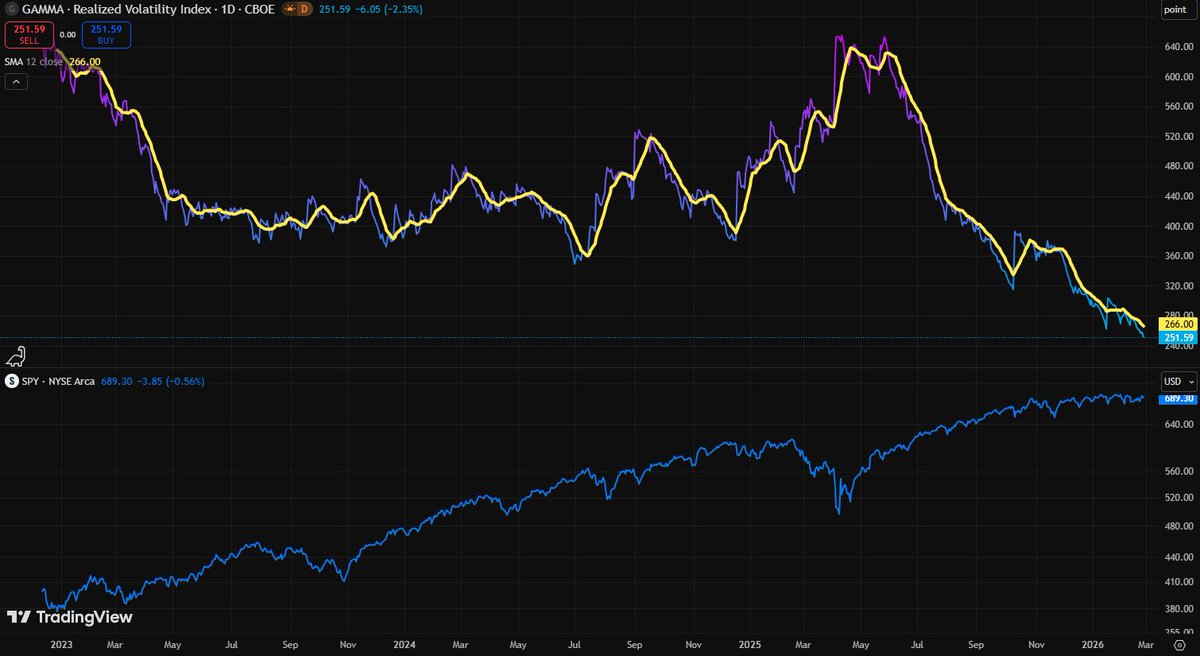
The CBOE Realized Volatility Index (GAMMA) provides a good diagnostic of this. GAMMA measures how profitable it is to hold and delta‑hedge short‑dated ATM options relative to their implied cost. A measure of realized‑vol versus theta. When GAMMA trends higher, realized moves exceed what was priced in and hedgers are rewarded. But its collapse in this regime says the opposite: close‑to‑close realized volatility has persistently undershot short‑dated implieds, so delta hedged long‑gamma has been grinding lower.
That kind of persistent undershoot is a sign of structural suppression. Today’s environment has been made exceptionally efficient at damping realized swings by passive inelasticity, dealer long‑gamma regimes during rallies, high index concentration, and systematic vol‑selling embedded in structured‑product hedging.
Put differently, GAMMA’s decline confirms that realized volatility has been compressed by design. Crucially, this compression is not free. Suppressing realized volatility through mechanical flows and vanna‑hedging feedback loops stores energy in the wings. With fewer natural sellers of SPX downside, skew becomes hypersensitive, VVIX stays sticky, and far‑OTM puts remain elevated even when VIX is low. The longer GAMMA sits depressed, the more brittle the equilibrium becomes; when realized volatility finally pokes higher, the cost of suppression turns unsustainable, dealer long‑gamma cushions vanish, deltas must be chased rather than leaned against, and the unwind goes nonlinear.
Seen through this lens, today’s skew dynamics are not mysterious and not simply a story of “more demand for puts.” They’re the cumulative downstream effects of passive‑flow dominance and index concentration: these forces reshaped market elasticity, altered the risk/return of selling index convexity, changed what structured‑product buyers want, changed how banks hedge those products, and ultimately removed the structural downside sellers that once kept SPX skew anchored. Skew reveals the missing supply on the wings, GAMMA shows chronic suppression of realized vol, and 0DTE allows the intraday hedging that keeps the machine running. Until, as history tends to remind, the machine meets a shock it can’t absorb.
Maybe you guys think this is a good explanation of how passive investing has changed structured product and hence options regime or maybe not? 👆
@VolSignals@bennpeifert@Ksidiii@spotgamma
AI has turned into a growing systemic risk for the U.S. financial sector:
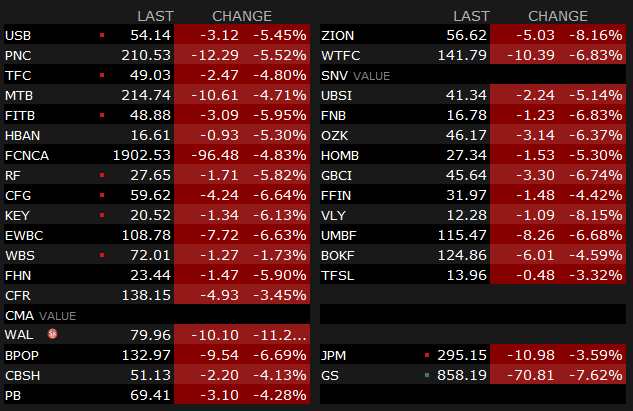
The breakdown in regional banks ETF $KRE today is the clearest sign that risk has fully migrated from earlier, mechanical positioning flows into the credit‑sensitive core of the equity market.
Because financials are the second‑largest sector in $SPY and the largest in $IWM, stress in banks exerts outsized influence across both large‑cap and small‑cap indices.
The path to this point began with multistrat degrossing in Sept/Oct 2025, which forced systematic unwinds, squeezed crowded shorts, and mechanically lifted small caps, a move that was misread as a sign of economic reflation. The next phase emerged when rising volatility triggered long‑only VaR limits, forcing sales of the most liquid, highest‑quality large-cap names and pushing the index down from above.
Today marks the third phase where those VaR flows intersect with credit‑sensitive assets, as contagion moves into credit intermediation, the core of the U.S. financial system.
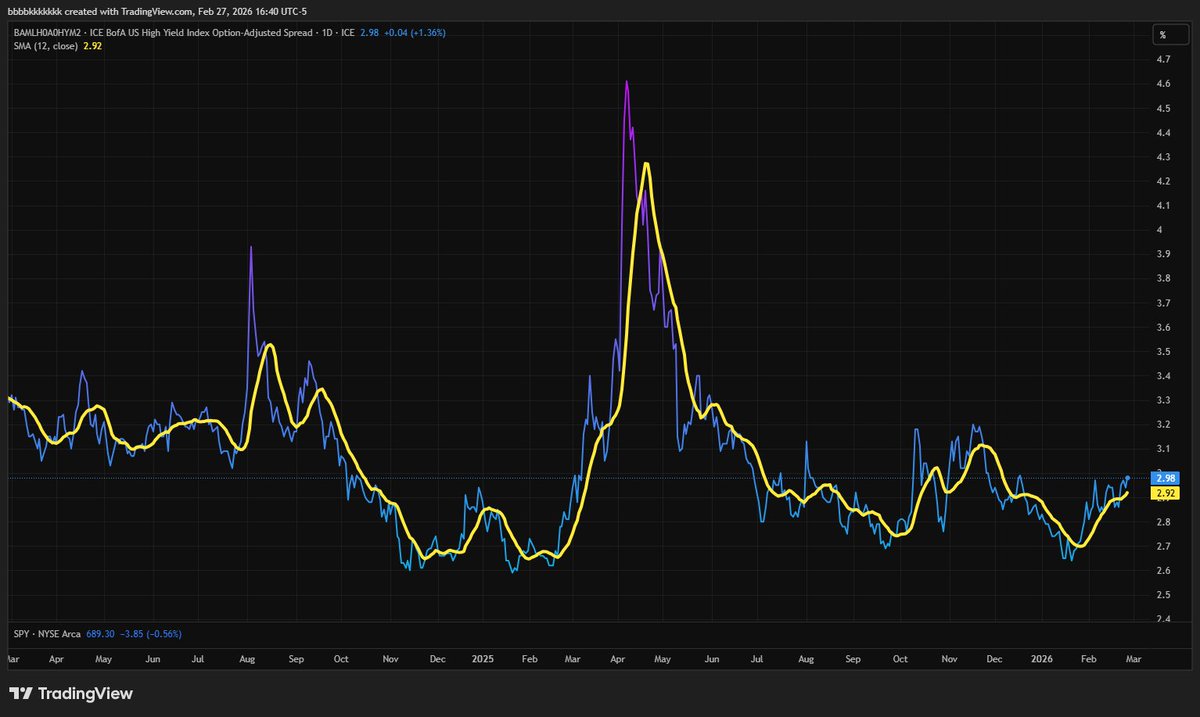
At the fundamental level, AI’s potential disruption of software business models has weakened software lending, pressuring private‑credit asset managers and widening credit spreads. That widening is now feeding directly into major financials and the regional banking channel. As spreads move out, funding conditions potentially tighten for the private‑credit ecosystem and, in turn, for the banks that sit at the center of U.S. credit intermediation.
With contagion now fully spreading throughout market‑cap tiers and financials factors, the S&P 500 is increasingly vulnerable.
The AI narrative is now turning into a credit intermediation problem at banks, striking at the core of the U.S. financial system.
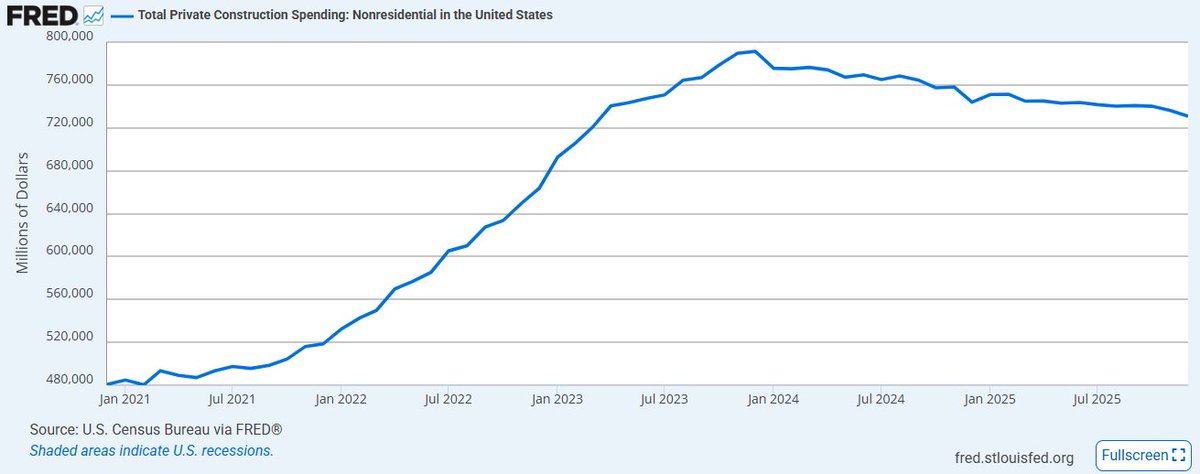
A significant rise in credit spreads in 2026 would hit the current financial system very differently than in past cycles because non‑depository financial institutions (NDFIs) and private credit vehicles now make up an unusually large share of total credit creation.
Over the last decade, bank lending to NDFIs has grown into the single fastest‑growing category of bank lending. This reflects a structural shift in which banks increasingly lend not to businesses directly, but to intermediaries like private credit funds, mortgage lenders, private equity structures, and other nonbank financial players that then recycle that funding back into the real economy. The modern credit system is now built on this bank–NDFI interdependence. Banks are deeply tied to fund finance, subscription credit lines, and warehouse facilities used by private lenders.
NDFI loans have now reached approximately $1.9 trillion, and +$300 billion of that exposure is to private credit providers specifically, which themselves rely on leverage and short‑term funding.
As a result of this interconnected growth, when credit spreads widen, the effect is amplified at several layers of the credit system: the cost of borrowing rises for portfolio companies; it rises again for private credit funds that depend on bank credit lines or other financing; and it rises yet again for banks that are increasingly exposed to these NDFI borrowers. This creates the potential for “spillover effects” when credit conditions deteriorate, as rising defaults in private credit can boomerang back onto the banks that fund them.
When spreads widen, private credit funds may be unable to refinance at reasonable rates, raising default risks for their portfolio companies. Banks, facing both rising credit losses and a deterioration in the value of their NDFI exposures, would likely tighten lending further. The result is a feedback loop of wider spreads and further tightening.
Because private credit and NDFI lending have supplied the bulk of incremental credit growth in recent years, any spread‑driven retrenchment would likely contract credit availability more forcefully than during the dot‑com period, though (hopefully) without the systemic insolvency dynamics of 2008. But it would still represent a significant tightening shock because the modern system depends so heavily on leveraged, opaque, and interconnected nonbank lenders whose activity is acutely sensitive to rising funding costs.
When credit spreads rise in an environment so heavily dependent on NDFIs and private credit, the result is likely a contraction in the rate at which new financial assets (bank deposits, credit balances, and other forms of money) are created. Because modern lending creates new financial claims as a by‑product, any slowdown in the willingness or ability of lenders to extend credit directly reduces the pace of money creation in the economy.
Therefore, when banks pull back from financing NDFIs, and NDFIs simultaneously pull back from financing businesses, the entire multilayered credit intermediation chain produces fewer new loans, fewer new deposits, and fewer new spending flows.
This decline in credit creation lowers the amount of income circulating through firms and households, weakening aggregate demand.
As credit‑generated money grows more slowly or even contracts, the feedback into economic activity becomes self‑reinforcing: businesses face tighter cash flow, consumers see fewer opportunities and higher borrowing costs, and investment plans are delayed or canceled.
I.e. Recession.
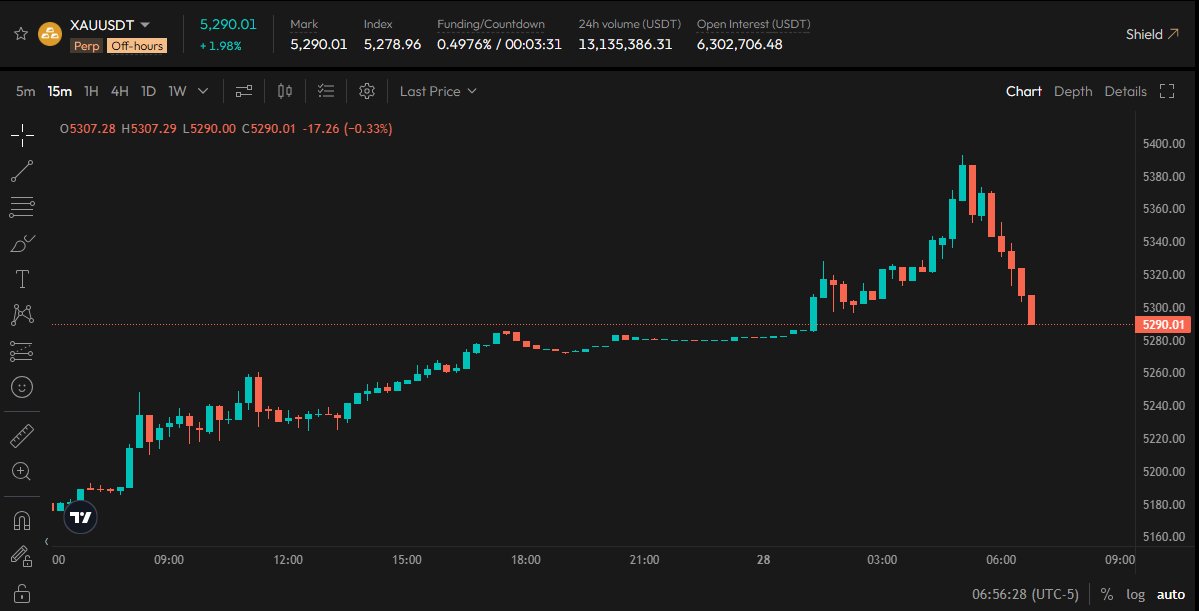
Contrary to gold’s reputation as a defensive asset, XAU/USDT via Aster is selling off.
Much of the hot potato money that left megacaps during Oct-Jan degrossing was absorbed by gold and silver, the only asset classes liquid enough and deep enough to absorb that level of flow, that were already rising at the time. Some money left the US domain and went to RoW.
However with liquid equities under continuing pressure since then, and with gold and silver volatility increasing over the last month, that hot potato money is likely to move again.
So much of modern portfolio management still runs on simple trend following logic that chases the most liquid uptrends with the lowest realized volatility.
The next stops that fit the criteria? Crude oil and US Treasuries.
The late-cycle dynamic continues to play out as scripted.