https://t.co/TmIGvhWJ8J
An efficient N-heterocyclic carbene (NHC)-mediated oxidative esterification of aldehydes in an undivided microfluidic electrolysis cell
Beneficial microbes can help rice battle Fusarium.
Sadvakasova et al. showed that Bacillus amyloliquefaciens and Nostoc-based microbial consortia reduced disease symptoms by up to 55% while reshaping rice microbiomes across soil, roots, and leaves
🔗 https://t.co/rlfRkiW7pn
#𝐀𝐌𝐈𝐧𝐬𝐩𝐢𝐫𝐞 🐝 | Pseudoproline Dipeptides
🧬 𝗣𝘀𝗲𝘂𝗱𝗼𝗽𝗿𝗼𝗹𝗶𝗻𝗲 𝗱𝗶𝗽𝗲𝗽𝘁𝗶𝗱𝗲𝘀 are acid-labile building blocks widely used in 𝘀𝗼𝗹𝗶𝗱-𝗽𝗵𝗮𝘀𝗲 𝗽𝗲𝗽𝘁𝗶𝗱𝗲 𝘀𝘆𝗻𝘁𝗵𝗲𝘀𝗶𝘀 (𝗦𝗣𝗣𝗦) to improve the preparation of challenging peptides. They are typically derived from 𝘀𝗲𝗿𝗶𝗻𝗲 or 𝘁𝗵𝗿𝗲𝗼𝗻𝗶𝗻𝗲 through the formation of 𝗼𝘅𝗮𝘇𝗼𝗹𝗶𝗱𝗶𝗻𝗲 𝗿𝗶𝗻𝗴𝘀, which mimic the conformational properties of proline and introduce a "kink" into the peptide backbone.
🔬 This conformational effect disrupts intermolecular hydrogen bonding, suppresses β-sheet formation and peptide aggregation, reduces steric hindrance, and improves the solubility of peptide intermediates. As a result, pseudoproline incorporation enhances coupling efficiency and often leads to higher peptide purity and yield. Because direct coupling to pseudoproline residues is generally inefficient, they are commonly employed as preformed pseudoproline dipeptides.
🧪 The cyclic pseudoproline moiety is stable under mild acidic conditions but can be readily cleaved by 𝘁𝗿𝗶𝗳𝗹𝘂𝗼𝗿𝗼𝗮𝗰𝗲𝘁𝗶𝗰 𝗮𝗰𝗶𝗱 (𝗧𝗙𝗔) during final deprotection, regenerating the native serine or threonine residue in situ. In addition to facilitating the synthesis of complex peptides, pseudoproline dipeptides can promote peptide cyclization, suppress 𝗮𝘀𝗽𝗮𝗿𝘁𝗶𝗺𝗶𝗱𝗲 formation, and improve the stability and handling of peptide intermediates, making them valuable tools in peptide synthesis and peptide drug development.
🐝 Try Ambeed's 𝗣𝘀𝗲𝘂𝗱𝗼𝗽𝗿𝗼𝗹𝗶𝗻𝗲 𝗱𝗶𝗽𝗲𝗽𝘁𝗶𝗱𝗲𝘀 in your research.
📖 Reference:
https://t.co/4PUsXUaStG
🔗 Product Collection:
https://t.co/ORctiA9jlR
#PeptideSynthesis #SPPS #Pseudoproline #PeptideChemistry #PeptideDrugDevelopment #OrganicSynthesis #MedicinalChemistry #BuildingBlocks #LifeScience #Ambeed
#BLDseries 🔥 Imidazo[2,1-b][1,3,4]thiadiazoles
Imidazo[2,1-b][1,3,4]thiadiazole is a fused bicyclic heteroaromatic scaffold composed of an imidazole ring condensed with a 1,3,4-thiadiazole moiety. Owing to its rigid, planar structure and the presence of multiple nitrogen and sulfur heteroatoms, this privileged scaffold exhibits favorable electronic properties and enables diverse intermolecular interactions with biological targets.
Consequently, imidazo[2,1-b][1,3,4]thiadiazole derivatives have attracted considerable interest in medicinal chemistry and have demonstrated broad pharmacological potential, including activities in the central nervous system, infectious diseases, cardiovascular disorders, and oncology.
Representative drug candidates containing this scaffold include:
💊 Padsevonil: GABAA receptor agonist (Phase I)
💊 ACT-678689: Tryptophan hydroxylase (TPH) inhibitor
💊 INE963: Antimalarial agent (Phase II)
💊 BMS-986120: PAR4 antagonist (terminated in Phase II)
💊 E260: Fer/FerT kinase inhibitor (preclinical)
Try @BldPharm's imidazo[2,1-b][1,3,4]thiadiazoles in your research!
🛒 https://t.co/N3xSSC9BpI
Researchers who study shark attacks on humans have experimented with a variety of methods for preventing harmful encounters. There is no single solution, but layered defenses can help keep swimmers and surfers safe.
Learn more: https://t.co/y22sCMe035 #ScienceMagArchives
"Radioactive contamination" is not a "radiation leak." It means radioactive material was detected in a controlled area, not that radiation escaped into the environment. According to Eskom, the contamination remained inside the containment building.
Science isn't a cost, it's an investment in economic growth. South Africa invests just 0.61% of GDP in R&D, well below its own 1.5% target. If we want a more innovative, productive economy, investing in science isn't optional, it's essential. #Science#Innovation#SouthAfrica
Very excited to release TT-Atom today.
You can now run machine learning based molecular dynamics on @tenstorrent AI processors, simulating how molecules and materials move atom by atom, a workhorse of drug discovery, chemistry and materials science.
The forces come from @Meta's UMA, a single model trained across the periodic table that handles molecules, materials and catalysts alike, at near-quantum accuracy for a fraction of the cost of traditional simulations. It is one of the leading models today, and more will follow in TT-Atom.
The clip shows a real simulation of a caffeine molecule, the one in your coffee, with every force computed by UMA on a Tenstorrent Blackhole card.
It's open-source under the MIT License. Link in the comments.
Another step toward Tenstorrent becoming the best hardware for AI x science.
Simulating a melting silicon crystal on @tenstorrent silicon.
Excited to include Orb-v3 by @Orbital_Ind in TT-Atom, with roughly 5x higher performance per dollar than an H200 GPU, matching its accuracy.
Orb-v3 is a state-of-the-art model for predicting material behavior and in very high demand across materials science and engineering. Give it a group of atoms, and it predicts the forces between them.
In this clip, a 216-atom silicon crystal is heated past its real 1,687 K melting point until the ordered lattice collapses into a liquid. Every force on every atom is computed on a single Tenstorrent Blackhole card.
Affordable and fast hardware for AI x science is a beautiful thing.
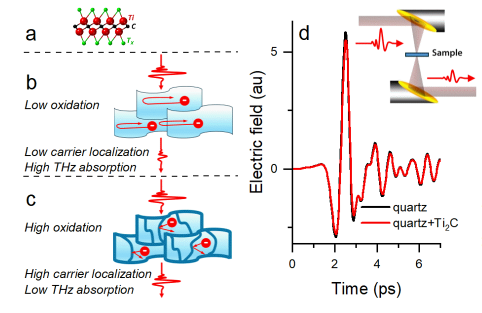
Glad to co-author my first paper "Terahertz Spectroscopy of Intrinsic and Photoexcited Carrier Dynamics in Ti₂CTₓ MXene Film" with Lyubov Titova from @WPI. The intrinsic free carriers in Ti₂CTₓ are strongly localized due to short-range disorder.
https://t.co/kKDiW1Kgp9
Remote site selective C-H oxidation via dehydrogenation led to efficient semisynthesis of 10 natural products isolated in Spain, England, Netherlands, Taiwan. Great collaboration with a Brazil team @eluccajr: https://t.co/WNwTontQv1
I was impressed to see researchers from several universities in Prague, Brno and even Bratislava attending my #MXene talk at the University of Chemistry and Technology (UCT Prague). There are extensive activities in the field of #MXenes in the Czech Republic.
Calling South African researchers! The NRF is pleased to announce that applications are open for the SGCI–STISA 2034 Multilateral Research Call.
Details here: https://t.co/8E5BEDYRcW





![BldPharm's tweet photo. #BLDseries 🔥 Imidazo[2,1-b][1,3,4]thiadiazoles
Imidazo[2,1-b][1,3,4]thiadiazole is a fused bicyclic heteroaromatic scaffold composed of an imidazole ring condensed with a 1,3,4-thiadiazole moiety. Owing to its rigid, planar structure and the presence of multiple nitrogen and sulfur heteroatoms, this privileged scaffold exhibits favorable electronic properties and enables diverse intermolecular interactions with biological targets.
Consequently, imidazo[2,1-b][1,3,4]thiadiazole derivatives have attracted considerable interest in medicinal chemistry and have demonstrated broad pharmacological potential, including activities in the central nervous system, infectious diseases, cardiovascular disorders, and oncology.
Representative drug candidates containing this scaffold include:
💊 Padsevonil: GABAA receptor agonist (Phase I)
💊 ACT-678689: Tryptophan hydroxylase (TPH) inhibitor
💊 INE963: Antimalarial agent (Phase II)
💊 BMS-986120: PAR4 antagonist (terminated in Phase II)
💊 E260: Fer/FerT kinase inhibitor (preclinical)
Try @BldPharm's imidazo[2,1-b][1,3,4]thiadiazoles in your research!
🛒 https://t.co/N3xSSC9BpI](https://pbs.twimg.com/media/HNaXOCZbUAA_InM.jpg)