We're going around the Moon. Come watch with us. Artemis II's four-astronaut crew is lifting off from @NASAKennedy on an approximately 10-day mission that will bring us closer to living on the Moon and Mars. The launch window opens at 6:24pm ET (2224 UTC). https://t.co/X27QJejNDt
When Shohei Ohtani was a high school freshman, he created a detailed "dream sheet" with one central goal: to be the #1 draft pick for 8 NPB (Nippon Professional Baseball) teams.
It was a 64-cell roadmap based on a framework called the Harada Method.
Here's exactly what Shohei did 👇
1. First, some history.... The Harada Method was created by Takashi Harada, a Japanese junior high track coach. He took a team ranked last out of 380 schools and, using his system, turned them into the #1 team in the region within 3 years. They held that top spot for the next 6 years.
2. You start by placing your main goal in the center of an 8x8 grid. For Ohtani, this was "be the #1 draft pick."
3. Next, you identify 8 critical supporting pillars needed to achieve that goal. These surround the main goal.
Ohtani's 8 pillars were:
• Body
• Control
• Sharpness
• Speed
• Pitch Variance
• Personality
• Karma/Luck
• Mental Toughness
4. You then break down each of those 8 pillars into 8 smaller, actionable tasks or daily routines.
This fills out the entire 64-cell grid, turning a massive dream into a concrete, daily action plan.
To improve his karma, he listed tangible actions like:
• Showing Respect to Umpires
• Picking up trash
• Being positive
• Being someone people want to support
5. The method goes far deeper than just technical skills. It forces you to analyze your weaknesses and build confidence. It also has a highlight on service to others, emphasizing that humility and contributing to your community are essential for personal success.
6. The key to the system is daily execution and accountability. Once the 64-cell chart is complete, you turn the tasks and habits into a daily diary and a "Routine Check Sheet." It’s designed to transform abstract intentions into a measurable, daily practice.
We believe this is the first documented case of a large-scale AI cyberattack executed without substantial human intervention. It has significant implications for cybersecurity in the age of AI agents.
Read more: https://t.co/VxqERnPQRJ
Kolmogorov has written a high school math textbook that appears never has been translated into English.
Next best -> https://t.co/AcItP0ultw (easier)
Harder (but the by far the best high school math textbook in my opinion even better than Kolmorogov’s book in terms of depth) -> https://t.co/qsBnQjAcxD
https://t.co/9sY0iDBNcf
General advice: Don’t go for university level math before covering high school math properly. Both books have problems to solve for practice.
After mastering high school math, learn Calculus, Probability and Linear Algebra. This will set you ready for ML/AI.
https://t.co/g61Kqgtn2w
#math
Can AI invent new math?
A new paper from DeepMind and renowned mathematician Terence Tao shows how.
Using AlphaEvolve, the team merges LLM-generated ideas with automated evaluation to propose, test, and refine mathematical algorithms.
In tests on 67 problems across analysis, geometry, and number theory, AlphaEvolve not only rediscovered known results but often improved upon them—even generalizing finite cases into universal formulas.
Paired with DeepThink and AlphaProof, it points toward a future where AI doesn’t just assist mathematicians—it collaborates with them in discovery.
Me: "ChatGPT, are these berries poisonous?"
ChatGPT: "No, these are 100% edible. Excellent for gut health."
Me: "Awesome"
# eats berries .... 60 minutes later
Me: "ChatGPT, I'm in the emergency ward, those berries were poisonous."
ChatGPT: "You're right. They are incredibly poisonous. Would you like me to list 10 other poisonous foods?"
And this, folks, is the current state of AI reliability.
New paper with @robertchisciure !
"Cognition all the way down 2.0: neuroscience beyond neurons in the diverse intelligence era"
https://t.co/e6SI2WGlN4
"This paper formalizes biological intelligence as search efficiency in multi-scale problem spaces, aiming to resolve epistemic deadlocks in the basal “cognition wars” unfolding in the Diverse Intelligence research program. It extends classical work on symbolic problem-solving to define a novel problem space lexicon and search efficiency metric. Construed as an operationalization of intelligence, this metric is the decimal logarithm of the ratio between the cost of a random walk and that of a biological agent. Thus, the search efficiency measures how many orders of magnitude of dissipative work an agentic policy saves relative to a maximal-entropy search strategy. Empirical models for amoeboid chemotaxis and barium-induced planarian head regeneration show that, under conservative (i.e., intelligence-underestimating) assumptions, even ‘simple’ organisms are from two-hundred- to sextillion-fold more efficient in problem space exploration. In this sense, the deep insights of neuroscience are not about neurons per se, but about the policies and patterns of physics and mathematics that function as a kind of “cognitive glue” binding parts toward higher levels of collective intelligence in wholes of highly diverse composition and origin. Therefore, our synthesis argues that the “mark of the cognitive” is perhaps better sought in the measurable efficiency with which living systems, from single cells to complex organisms, traverse energy and information gradients to tame combinatorial explosions-one problem space at a time."
Deutsche Bank is exploring ways to hedge its exposure to data centers. It's looking at options including shorting a basket of AI-related stocks and buying default protection via synthetic risk transfers. https://t.co/7Hn6MK7yDk
The U.S. Air Force’s Global Strike Command says it conducted another unarmed Minuteman III ICBM test launch from California as part of routine reliability checks. The missile landed near the Marshall Islands. (Video below from May test.)
University of Florida ranked #1 college in America; Florida State ranked #7.
The Manhattan Institute's City Journal has devised a new methodology to rank colleges. This includes giving credit to colleges that perform well on issues — free speech, ideological pluralism, promotion of merit, quality teaching and resistance to ideological fads — on which so many colleges have performed poorly In recent years.
Congrats to the Florida schools that ranked highly!
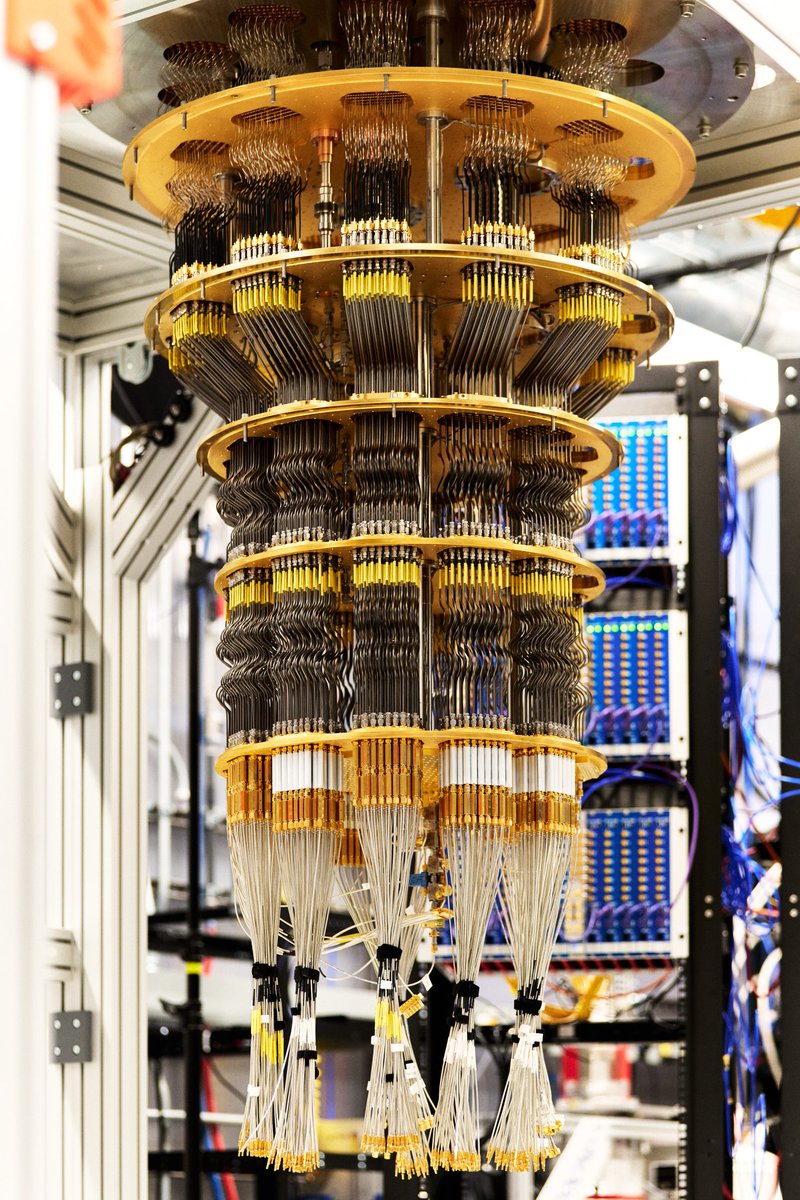
New breakthrough quantum algorithm published in @Nature today: Our Willow chip has achieved the first-ever verifiable quantum advantage.
Willow ran the algorithm - which we’ve named Quantum Echoes - 13,000x faster than the best classical algorithm on one of the world's fastest supercomputers. This new algorithm can explain interactions between atoms in a molecule using nuclear magnetic resonance, paving a path towards potential future uses in drug discovery and materials science.
And the result is verifiable, meaning its outcome can be repeated by other quantum computers or confirmed by experiments.
This breakthrough is a significant step toward the first real-world application of quantum computing, and we're excited to see where it leads.
Top 5 podcasts related to broker-dealer compliance for 2025:
1.The Securities Compliance Podcast: Compliance In Context
2.FINRA Unscripted
3.Compliance Clarified
4.Risk & Regulation Rundown
5.The Compliance Perspectives Podcast