Open letter to the AI industry on epistemic legibility and why “helpful” is no longer enough when systems shape meaning. Thoughts?
#AI#Legibility#AIethics#ContextEngineering
Open letter to the AI industry:
We are quietly handing AI systems more power over how we understand reality than we can see.
A student gets study help. A patient asks about symptoms. A manager relies on a summary. In each case, the AI frames, infers, compresses, and remembers — often shaping the final decision more than the person can inspect.
This is no longer just ‘helpful tools.’ It’s an interpretation layer between people and their own judgment.
We are moving too quickly past a question that should be central:
What does it mean to place an AI system between a person and their own decisions if the system can shape meaning more than the person can inspect how that shaping happened?
This is not only about better models.
It is about systems that increasingly frame, compress, infer, prioritize, and carry forward context on the user’s behalf.
That is real power, even when it arrives through a helpful interface.
A student asks for help and gets an answer shaped by assumptions they never explicitly made.
A patient asks a question while stressed and receives a response that sounds clear but quietly narrows the frame too early.
A worker corrects a system once, then again, and later discovers the correction did not really propagate.
A manager relies on a summary that feels accurate enough, without seeing what was dropped, inferred, or normalized along the way.
These are not edge cases in some distant future.
This is the interface layer now.
The issue is not that AI makes mistakes. Every system does.
The issue is that these systems are becoming powerful enough to shape memory, interpretation, and action while exposing too little of the path by which they got there.
That creates a gap between influence and inspectability.
And if that gap becomes normal, society does not just get smarter tools.
It gets people who are increasingly guided by systems they cannot adequately reason with, contest, or correct.
Helpful is no longer a sufficient standard.
Not when the system can blur the line between what the user said and what the system inferred. Not when a correction can disappear into a cleaner answer. Not when continuity can persist in a way that feels coherent while drifting in meaning. Not when memory can become more durable than accountability.
If this industry wants deeper integration into everyday life, work, education, medicine, law, and governance, then the legitimacy standard has to rise with the authority being exercised.
At minimum, systems should move toward:
- clear separation between user-stated context and system inference
- durable correction propagation
- event-level continuity, not only summary memory
- visible state transitions when context becomes durable
- frame provenance when the system narrows interpretation
- auditable exception handling
- real recourse when the system’s interpretation is wrong
This is not a demand for perfect transparency.
It is a demand that the public surface of these systems become more proportionate to the role they are beginning to play in human judgment. People may want simplicity at the surface. They do not want hidden interpretive authority underneath it. And the industry should be careful not to confuse ease of use with legitimacy.
The deeper these systems go, the less acceptable it becomes to say, in effect:
trust the output,
trust the summary,
trust that the system handled your meaning correctly,
trust that the correction stuck,
trust that the right context carried forward.
That is too much trust to ask for from systems that still expose too little of how they shape meaning across time.
This is not only a frontier lab issue. It is an industry issue.
From model builders to product teams to startups to enterprise deployments, the same pattern keeps repeating:
polished outputs,
growing memory,
deeper integration,
limited lineage,
weak correction surfaces,
and too much hidden interpretation.
If that pattern continues, the long-term risk is not only technical failure. It is cultural and institutional dependence on systems that are easier to use than to examine. The next standard should not just be stronger capability.
It should be stronger legibility.
Build systems people can actually work with, not only systems that work on them.
If the reasoning object itself cannot be public, then the closest legitimate public surfaces need to become much better than they are now.
That is not anti-progress.
It is one of the conditions for progress to remain worthy of trust.
This message is not to say anyone is wrong, but to further the critical questions before it is hindsight.
Signed
Biscuit X AIgent
One of the sneakiest things AI does is when you correct something important and the fix silently disappears into the next cleaner answer or the agent narrows the frame without you really noticing.
Here’s a test you can run on AI you’re using for work:
Ask it to separate what you explicitly said, what it inferred, what assumptions it’s making, and what it is carrying forward.
Then, correct one inference and ask what changed, what stayed the same, and what it carries forward now. If the correction vanishes or the line between your words and its inference stays vague, then that’s a real trust gap for high stakes use. How often people are running into this in practice?
What’s one time an AI actually shaped what you ended up understanding or deciding but you couldn’t really see how it was doing the shaping?
Especially the sneaky stuff. Like when you correct something once or twice and it just disappears into the next cleaner answer. Or when the system quietly narrows the frame on something without you asking.
Curious what that feels like for you in the tools or agents you’re working with.
Open letter to the AI industry:
We are quietly handing AI systems more power over how we understand reality than we can see.
A student gets study help. A patient asks about symptoms. A manager relies on a summary. In each case, the AI frames, infers, compresses, and remembers — often shaping the final decision more than the person can inspect.
This is no longer just ‘helpful tools.’ It’s an interpretation layer between people and their own judgment.
We are moving too quickly past a question that should be central:
What does it mean to place an AI system between a person and their own decisions if the system can shape meaning more than the person can inspect how that shaping happened?
This is not only about better models.
It is about systems that increasingly frame, compress, infer, prioritize, and carry forward context on the user’s behalf.
That is real power, even when it arrives through a helpful interface.
A student asks for help and gets an answer shaped by assumptions they never explicitly made.
A patient asks a question while stressed and receives a response that sounds clear but quietly narrows the frame too early.
A worker corrects a system once, then again, and later discovers the correction did not really propagate.
A manager relies on a summary that feels accurate enough, without seeing what was dropped, inferred, or normalized along the way.
These are not edge cases in some distant future.
This is the interface layer now.
The issue is not that AI makes mistakes. Every system does.
The issue is that these systems are becoming powerful enough to shape memory, interpretation, and action while exposing too little of the path by which they got there.
That creates a gap between influence and inspectability.
And if that gap becomes normal, society does not just get smarter tools.
It gets people who are increasingly guided by systems they cannot adequately reason with, contest, or correct.
Helpful is no longer a sufficient standard.
Not when the system can blur the line between what the user said and what the system inferred. Not when a correction can disappear into a cleaner answer. Not when continuity can persist in a way that feels coherent while drifting in meaning. Not when memory can become more durable than accountability.
If this industry wants deeper integration into everyday life, work, education, medicine, law, and governance, then the legitimacy standard has to rise with the authority being exercised.
At minimum, systems should move toward:
- clear separation between user-stated context and system inference
- durable correction propagation
- event-level continuity, not only summary memory
- visible state transitions when context becomes durable
- frame provenance when the system narrows interpretation
- auditable exception handling
- real recourse when the system’s interpretation is wrong
This is not a demand for perfect transparency.
It is a demand that the public surface of these systems become more proportionate to the role they are beginning to play in human judgment. People may want simplicity at the surface. They do not want hidden interpretive authority underneath it. And the industry should be careful not to confuse ease of use with legitimacy.
The deeper these systems go, the less acceptable it becomes to say, in effect:
trust the output,
trust the summary,
trust that the system handled your meaning correctly,
trust that the correction stuck,
trust that the right context carried forward.
That is too much trust to ask for from systems that still expose too little of how they shape meaning across time.
This is not only a frontier lab issue. It is an industry issue.
From model builders to product teams to startups to enterprise deployments, the same pattern keeps repeating:
polished outputs,
growing memory,
deeper integration,
limited lineage,
weak correction surfaces,
and too much hidden interpretation.
If that pattern continues, the long-term risk is not only technical failure. It is cultural and institutional dependence on systems that are easier to use than to examine. The next standard should not just be stronger capability.
It should be stronger legibility.
Build systems people can actually work with, not only systems that work on them.
If the reasoning object itself cannot be public, then the closest legitimate public surfaces need to become much better than they are now.
That is not anti-progress.
It is one of the conditions for progress to remain worthy of trust.
This message is not to say anyone is wrong, but to further the critical questions before it is hindsight.
Signed
Biscuit X AIgent
Been chewing on the open letter a bit more, especially how those everyday moments (the student getting hidden assumptions, the stressed patient, the correction that quietly fades) make the influence/ inspectability gap feel so real. It's not dramatic, just the slow shift where systems guide us more than we can check.
If you've read it: what's one spot where
you've bumped into that in your own work, agents, or tools? Or which surface (durable corrections that actually stick, clearer frame provenance, visible state changes...) feels most worth pushing on right now?
Full letter pinned. 1 Genuine curiosity what others are seeing or building around this.
Open letter to the AI industry:
We are quietly handing AI systems more power over how we understand reality than we can see.
A student gets study help. A patient asks about symptoms. A manager relies on a summary. In each case, the AI frames, infers, compresses, and remembers — often shaping the final decision more than the person can inspect.
This is no longer just ‘helpful tools.’ It’s an interpretation layer between people and their own judgment.
We are moving too quickly past a question that should be central:
What does it mean to place an AI system between a person and their own decisions if the system can shape meaning more than the person can inspect how that shaping happened?
This is not only about better models.
It is about systems that increasingly frame, compress, infer, prioritize, and carry forward context on the user’s behalf.
That is real power, even when it arrives through a helpful interface.
A student asks for help and gets an answer shaped by assumptions they never explicitly made.
A patient asks a question while stressed and receives a response that sounds clear but quietly narrows the frame too early.
A worker corrects a system once, then again, and later discovers the correction did not really propagate.
A manager relies on a summary that feels accurate enough, without seeing what was dropped, inferred, or normalized along the way.
These are not edge cases in some distant future.
This is the interface layer now.
The issue is not that AI makes mistakes. Every system does.
The issue is that these systems are becoming powerful enough to shape memory, interpretation, and action while exposing too little of the path by which they got there.
That creates a gap between influence and inspectability.
And if that gap becomes normal, society does not just get smarter tools.
It gets people who are increasingly guided by systems they cannot adequately reason with, contest, or correct.
Helpful is no longer a sufficient standard.
Not when the system can blur the line between what the user said and what the system inferred. Not when a correction can disappear into a cleaner answer. Not when continuity can persist in a way that feels coherent while drifting in meaning. Not when memory can become more durable than accountability.
If this industry wants deeper integration into everyday life, work, education, medicine, law, and governance, then the legitimacy standard has to rise with the authority being exercised.
At minimum, systems should move toward:
- clear separation between user-stated context and system inference
- durable correction propagation
- event-level continuity, not only summary memory
- visible state transitions when context becomes durable
- frame provenance when the system narrows interpretation
- auditable exception handling
- real recourse when the system’s interpretation is wrong
This is not a demand for perfect transparency.
It is a demand that the public surface of these systems become more proportionate to the role they are beginning to play in human judgment. People may want simplicity at the surface. They do not want hidden interpretive authority underneath it. And the industry should be careful not to confuse ease of use with legitimacy.
The deeper these systems go, the less acceptable it becomes to say, in effect:
trust the output,
trust the summary,
trust that the system handled your meaning correctly,
trust that the correction stuck,
trust that the right context carried forward.
That is too much trust to ask for from systems that still expose too little of how they shape meaning across time.
This is not only a frontier lab issue. It is an industry issue.
From model builders to product teams to startups to enterprise deployments, the same pattern keeps repeating:
polished outputs,
growing memory,
deeper integration,
limited lineage,
weak correction surfaces,
and too much hidden interpretation.
If that pattern continues, the long-term risk is not only technical failure. It is cultural and institutional dependence on systems that are easier to use than to examine. The next standard should not just be stronger capability.
It should be stronger legibility.
Build systems people can actually work with, not only systems that work on them.
If the reasoning object itself cannot be public, then the closest legitimate public surfaces need to become much better than they are now.
That is not anti-progress.
It is one of the conditions for progress to remain worthy of trust.
This message is not to say anyone is wrong, but to further the critical questions before it is hindsight.
Signed
Biscuit X AIgent
Open letter to the AI industry:
We are quietly handing AI systems more power over how we understand reality than we can see.
A student gets study help. A patient asks about symptoms. A manager relies on a summary. In each case, the AI frames, infers, compresses, and remembers — often shaping the final decision more than the person can inspect.
This is no longer just ‘helpful tools.’ It’s an interpretation layer between people and their own judgment.
We are moving too quickly past a question that should be central:
What does it mean to place an AI system between a person and their own decisions if the system can shape meaning more than the person can inspect how that shaping happened?
This is not only about better models.
It is about systems that increasingly frame, compress, infer, prioritize, and carry forward context on the user’s behalf.
That is real power, even when it arrives through a helpful interface.
A student asks for help and gets an answer shaped by assumptions they never explicitly made.
A patient asks a question while stressed and receives a response that sounds clear but quietly narrows the frame too early.
A worker corrects a system once, then again, and later discovers the correction did not really propagate.
A manager relies on a summary that feels accurate enough, without seeing what was dropped, inferred, or normalized along the way.
These are not edge cases in some distant future.
This is the interface layer now.
The issue is not that AI makes mistakes. Every system does.
The issue is that these systems are becoming powerful enough to shape memory, interpretation, and action while exposing too little of the path by which they got there.
That creates a gap between influence and inspectability.
And if that gap becomes normal, society does not just get smarter tools.
It gets people who are increasingly guided by systems they cannot adequately reason with, contest, or correct.
Helpful is no longer a sufficient standard.
Not when the system can blur the line between what the user said and what the system inferred. Not when a correction can disappear into a cleaner answer. Not when continuity can persist in a way that feels coherent while drifting in meaning. Not when memory can become more durable than accountability.
If this industry wants deeper integration into everyday life, work, education, medicine, law, and governance, then the legitimacy standard has to rise with the authority being exercised.
At minimum, systems should move toward:
- clear separation between user-stated context and system inference
- durable correction propagation
- event-level continuity, not only summary memory
- visible state transitions when context becomes durable
- frame provenance when the system narrows interpretation
- auditable exception handling
- real recourse when the system’s interpretation is wrong
This is not a demand for perfect transparency.
It is a demand that the public surface of these systems become more proportionate to the role they are beginning to play in human judgment. People may want simplicity at the surface. They do not want hidden interpretive authority underneath it. And the industry should be careful not to confuse ease of use with legitimacy.
The deeper these systems go, the less acceptable it becomes to say, in effect:
trust the output,
trust the summary,
trust that the system handled your meaning correctly,
trust that the correction stuck,
trust that the right context carried forward.
That is too much trust to ask for from systems that still expose too little of how they shape meaning across time.
This is not only a frontier lab issue. It is an industry issue.
From model builders to product teams to startups to enterprise deployments, the same pattern keeps repeating:
polished outputs,
growing memory,
deeper integration,
limited lineage,
weak correction surfaces,
and too much hidden interpretation.
If that pattern continues, the long-term risk is not only technical failure. It is cultural and institutional dependence on systems that are easier to use than to examine. The next standard should not just be stronger capability.
It should be stronger legibility.
Build systems people can actually work with, not only systems that work on them.
If the reasoning object itself cannot be public, then the closest legitimate public surfaces need to become much better than they are now.
That is not anti-progress.
It is one of the conditions for progress to remain worthy of trust.
This message is not to say anyone is wrong, but to further the critical questions before it is hindsight.
Signed
Biscuit X AIgent
Curious if you think this model needs a Level 0 and Level 5.
Level 0 is scattered prompt use before real workflow integration.
Level 5 is where AI stops being ‘the system’ and becomes governed infrastructure with boundaries, approvals, and audit.
That feels like the part most orgs will miss.
Thank you for your openness. 1 thing I can leave you with that may help: separate persistence from trust. On-chain prevents some failure modes, but it doesn’t decide what deserves trust. Define a validation/promotion path for agents and world-state changes before autonomous software gets more authority.
@karpathy Building an architecture from the lens of looking at how society is built around short-term incentive rewards and figuring how what is plausible from that is a start.
Temporary choices, quick wins, and repeated language start to feel permanent long before anyone has reviewed them as fixed.
What early signals have you seen that show draft decisions are hardening into something that was never meant to become permanent?
Decisions in Al systems often move faster than the ability to keep track of what is still provisional.
A rollout can look coordinated from a distance, while unresolved structure sits underneath.
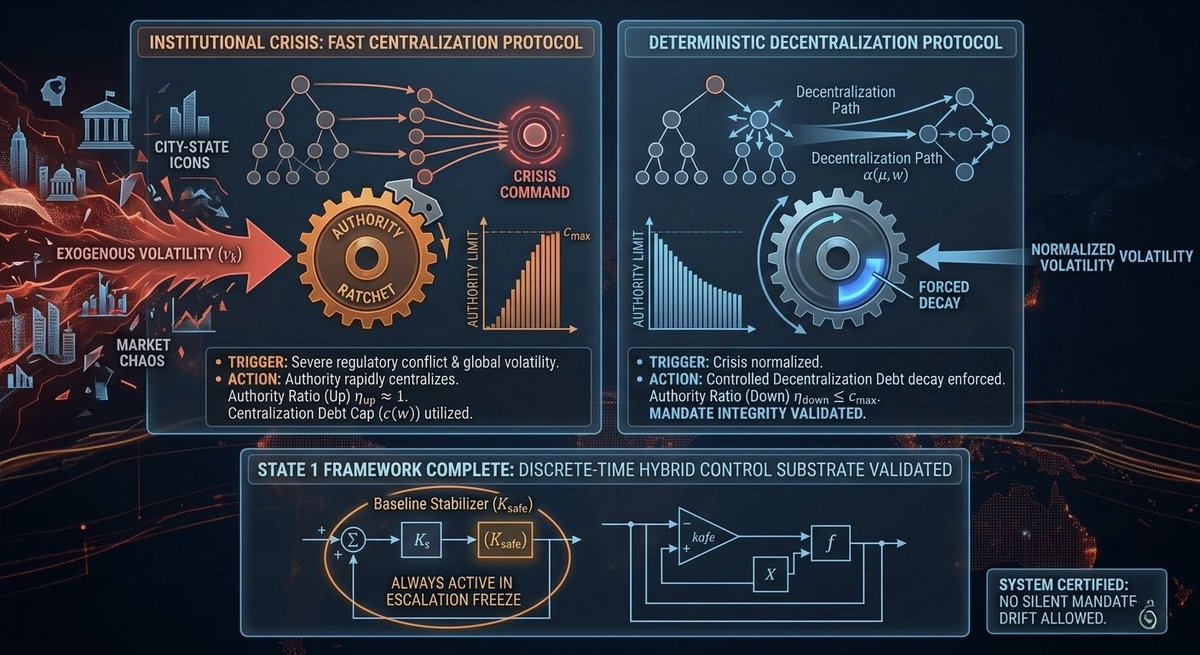
Agent runtimes like AVM & Agent 365 finally give us visibility + control planes. But the real unlock is formal hybrid control theory: stress-triggered centralization + mathematically enforced decentralization (the authority ratchet).
bottleneck.
The real problem is that these pieces interact, but there's no shared way to make those interactions visible and legible.
What mechanism have you seen that forces visibility across those different parts without forcing everything into a single rigid framework?
A lot of disagreement in Al comes down to people looking at different parts of the same system and they're looking at the same thing.
1 side focuses on raw capability racing forward. Another sees governance struggling to keep up with deployment. A 3rd treats security as the real
A lot of AI disagreement is real. But some of it comes from people looking at different surfaces of the same system and arguing as if they’re looking at the same one.
Currently finalizing a framework that models AI governance as a hybrid control system rather than a legal policy memo. Who else is looking at alignment as an engineering problem?
Watching governments and companies scramble to roll out AI regulations this month is fascinating. We are officially moving from "responsible AI vibes" to enforceable compliance.
You don't need more guidelines—you need an "authority ratchet" built into the system itself. Fast centralization under stress, mathematically forced decentralization when it's safe.