STRC is trading around 93 against a 100 liquidation preference. That gap is a value lever for MSTR common that nothing in the BPS or mNAV conversation will surface
Here is the move. Strategy issues common above its CEBE mNAV and uses the proceeds to retire STRC at the discount. Retiring one STRC share takes a 100 claim out of the senior stack for 93 of value. Net senior claims fall by more than the cash spent, so the Bitcoin sitting behind common rises and CEBE goes up. The discount to par accrues straight to common
Funding it with common issued above mNAV is what makes it efficient rather than just clever. Issuing above mNAV is already accretive, because the new shares bring in more value than the net Bitcoin they take. So you capture two things in one trade, the premium on the issuance and the discount on the preferred. It is the same premium issuance engine that funds the Bitcoin buying, only pointed at retiring below par preferred instead to capture the discount to market
There is a third advantage that could be overlooked. Retiring STRC also removes its cash dividend, which lowers the wrapper fee and stretches the runway. So the discount is not the only gain. You also stop paying to carry the instrument
So why does nobody model this? Because the strategy is built to grow the pref stack, not shrink it. STRC face roughly doubled through the Q2 ATM. The machine is a net issuer of prefs, and the value maximizing move at a discount is to be a buyer. The structure creates an accretive lever the strategy is oriented away from using, and CEBE is what lets you see the lever at all
Two honest caveats. STRC resets monthly to pull its price back toward 100, so the discount can close on its own before anyone acts on it. Also in a real buyback the actions would lift the price as it accumulated, so 93 is the marginal discount, not the average you would capture
None of this is a prediction that they do it. It is what the structure makes possible, and the the potential of the optionality their capital structure affords their team
The hardest thing in business is not seeing the future. It is surviving long enough to build it.
My fireside chat with @Julian_Liniger at @BTCPrague on focus, endurance, corporate transformation, and how entrepreneurs can use Bitcoin, AI, and digital finance to create the next generation of products.
Full interview below.
00:00 - Bitcoin as the dominant global Digital Capital network: 17 years, hundreds of billions invested, and a potential $100T opportunity
00:51 - Bitcoin near the 200-week moving average: why $BTC is more compelling after a 50% drawdown
01:52 - Strategy’s scale and the media narrative: from ~$600M enterprise value to as high as ~$120B
10:29 - Bitcoin fundamentals: economic empowerment, sovereign property rights, and the dominant digital monetary network
12:16 - Why there is no second best: Bitcoin as Digital Capital, Digital Money, and a potential $100T network
16:09 - Entrepreneur advice: build a simple product using new technology to solve a real problem
20:30 - Focus, endurance, and the danger of dilutive distractions
32:25 - What I would build today: AI plus Digital Assets, especially Digital Money and Digital Yield
33:27 - Digital Credit: taking a 40 vol asset, stripping it to ~4 vol, and creating new yield products
34:57 - Digital Money: 6–8% yield in major currencies with no volatility
38:05 - $STRC, $SATA, and the next layer of bitcoin-backed financial products
48:52 - Q&A: why Strategy sold 32 BTC and why bitcoin-backed capital must support credit and equity
59:29 - Q&A: Strategy as a shock absorber: selling 32 BTC while buying net ~250,000 BTC during the bear market
01:02:39 - Why public companies protect Bitcoin through accounting, tax, legal, political, and economic advocacy
01:07:58 - Strategy as the extension of the Bitcoin network into the free market system
I might have a low IQ and might even be bad at math (even though I earned a PhD in it).
But I understand one or two things about markets. And I want Bitcoin to succeed.
IMHO, STRC is a risky double-edged sword.
On the surface, it looks like an instrument that allows Strategy to become a perpetuum mobile. Strategy can issue high-yielding STRC, buy Bitcoin without dilution, and serve its own interests.
Beautiful, isn’t it?
But here is the risk.
Markets are full of nasty creatures that can smell weakness.
Why is that?
Well, the product is designed so it can’t move far above 100. A short seller therefore has a very favorable risk profile(I ignore here the cost of borrowing the shares).
Now assume there is a massive attack by short sellers.
In that case, STRC will likely trade down significantly, and Saylor would be forced to increase the already hefty interest to push it back to par.
And that can create a vicious cycle for Strategy, where it might ultimately be forced to sell Bitcoin.
I really hope this doesn’t happen, because it would be very bad for Bitcoin.
Is the Bitcoin power law still alive?
I check it every month.
The 5 falsification conditions (F1-F5) from Santostasi & Perrenod, measured on free Coin Metrics data:
· Floor violation — clear
· Adoption (βA≈3) — clear
· Exponent drift (β=5.67, normal 5-7) — clear
· Metcalfe R²=0.95 — clear
· Residual stationarity — clear
All five pass.
Price is at x0.57 of the trend line (cheap, lower band), but the model itself is intact.
@Giovann35084111@moneyordebt@ScientificBTC
#Bitcoin #PowerLaw
Comments like these show the abject ignorance and lack of research by some critics.
In 2022 MicroStrategy was working on Lightning Network rewards for their employees and BI product.
In 2024 there was MicroStrategy Orange, an initiative to build on L1.
No one cared about any of those bitcoin products. Strategy never made money from these and they didn't raise any money either.
For years Saylor was teaching everyone who would listen about Bitcoin. Some listened some didn't. Microsoft gave him 3 minutes to teach about Bitcoin.
Strategy tried doing that whole education and Bitcoin native thing... and got absolutely nothing.
Now Strategy does digital credit. And people who have no clue will act like they never made an attempt to do the tech and education stuff.
They did all of that and more. They did more than any of the critics ever will do.
And now with digital credit they are able to do more than ever before.
Finally, they will be told that they didn't do it right by those who have done nothing at all. This is certainly a funny world we live in.
A lot of big traders were levered up on $STRC to earn the spread between margin rates and STRC yield.
They didn't do the same with $SATA because they didn't quite trust the track record of Strive and viewed Strategy as the best way to express the bet.
This carry trade happened not just on brokerages but also in DeFi protocols that are predominantly tokenizing STRC. (Recall that for a while it was only STRC that meant to be strictly pegged at $100. SATA started off with a wider range and crypto companies haven't really integrated it much.)
With the drop in STRC, many of these levered positions were closed either due to liquidations or hitting stop losses and risk limits.
In anticipation of some kind of wick down, a surge of demand for STRC 90 and 85 puts ensued. This in turn meant it was profitable for dealers to sell these puts and delta hedge it by shorting STRC.
On the flip side, the surge in call demand (people expecting quick return to peg) was met by covered call sellers (to collect premium) and naked call writers specifically for the purpose of being short delta. So now the "dealers" that sold the calls aren't buying STRC to delta hedge what they sold. This is predominately the 95 calls.
Put demand is hedged. Call demand isn't. Net spot pressure is selling (ie. price go down). And it is only happening for STRC. Look at the SATA options and the volume trend is not like STRC's at all.
The result is that STRC has been compressed while SATA has returned to par. Strategy will have to raise rates, maybe 50 bps.
My two sats on what's happening.
Ironically, Bitcoin mining funds three of the climate movement's hardest jobs at once: recycling waste heat, stabilising grids for more solar and wind, and cutting methane
Bitcoin has already won as Digital Capital.
The next wave is Digital Credit, Digital Money, Digital Yield, and Bitcoin-backed capital markets — products that can bring trillions of dollars of traditional credit and money market capital onto Bitcoin.
My interview with @Cointelegraph at @BTCPrague.
00:57 — Bitcoin in a drawdown: five major pullbacks in six years, stronger fundamentals, and rising dominance
02:23 — Digital Credit: from zero to an $11B+ asset class in 12 months
03:35 — Digital Money: bitcoin-backed yieldcoins and the path from 40 vol to 0 vol
04:31 — The opportunity for 8% yield in dollars, euros, yen, pounds, and francs
06:02 — $300T of credit, $30–50T of money markets, and the $10T opportunity for Bitcoin
07:19 — Why Bitcoin is winning economically, technically, and ethically
08:26 — Quantum computing, FUD, and why bear markets amplify Bitcoin debates
10:37 — AI capital rotation, Bitcoin’s current drawdown, and the path to recovery
11:36 — Six years of Strategy: why I would have moved faster into Digital Credit
12:22 — The ideal Bitcoin Treasury Company: common equity plus STRC-style Digital Credit
14:35 — The 32 BTC sale, the $100M bitcoin buyback, and why capital must back credit
17:02 — Defending the equity, credit, and bitcoin-backed capital structure
19:03 — The tradeoff: buy 200,000 BTC and sell 10,000 BTC — or buy and sell zero
20:15 — “Never sell,” Twitter trolls, and Strategy’s fiduciary obligations
22:06 — Bitcoin per share, long-term accretion, and accumulating through bull and bear markets
22:34 — $21B of equity raised in 16 weeks and ~$10B of bitcoin acquired this year
24:18 — The Strategic Bitcoin Reserve, US leadership, and supportive regulation
27:18 — Digital Credit, bank credit, and Digital Money bringing trillions onto Bitcoin
28:01 — Why Bitcoin can grow organically without central bank support
After July 1, firms without authorization can’t keep serving EU clients. Users shouldn’t be left scrambling because a platform is still waiting on approval.
BitGo Europe is already MiCA-licensed through BaFin and built to support regulated custody, transfer, staking, and trading infrastructure across the EU.
If you’re still waiting on approval, or you’d rather use licensed infrastructure than build it yourself, we can help keep you moving safely and compliantly.
Europe needs crypto access on regulated rails. That’s what @BitGo has been building.
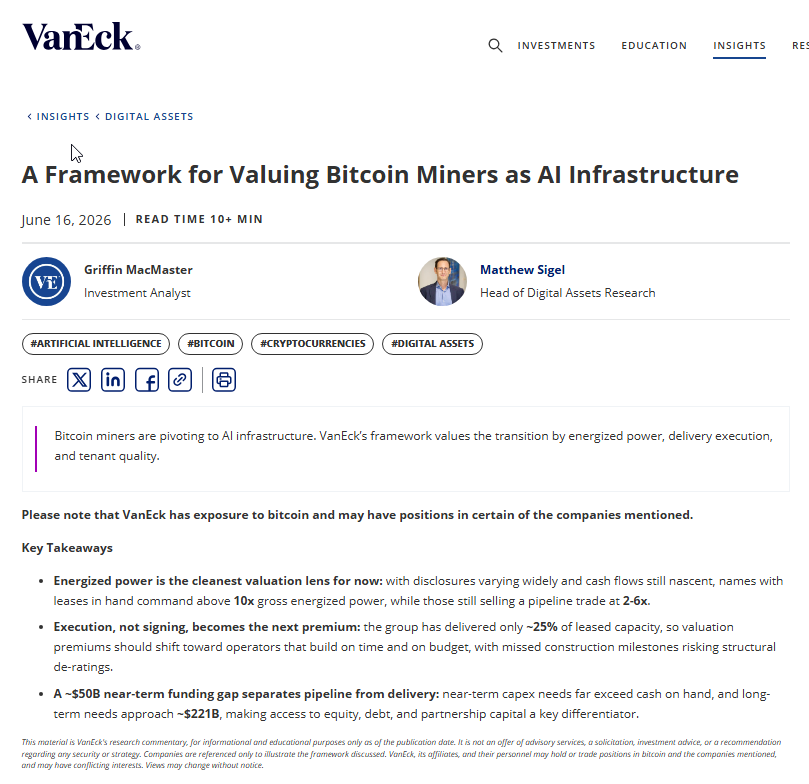
VanEck's @matthew_sigel published a framework for valuing Bitcoin miners pivoting to AI infrastructure.
He argues that energized power is the only clean valuation lens right now. Disclosures vary wildly across the sector and cash flows barely exist, so contracted capacity is what the market is actually pricing.
Companies with signed leases trade above 10x energized power. Those still selling a pipeline trade at 2-6x.