@Strategy Interesting inversion. DeFi has a similar advantage: capital can be more programmable and composable, moving between lending, LPs and collateral markets without rebuilding the balance sheet. The trade-off is that liquidity can leave just as fast
@Kaffchad@frontierhood Interesting mechanism, but this is also a good case study in "follow the yield." The key question isn't how attractive the loop looks it's whether real trading fees can sustain NFT rewards after speculative volume and incentives cool off.
@EthanDeFi_ 1.93% borrowing is interesting, especially if the borrowed USDC can be deployed into sustainable higher-yield strategies.
The key risk is leverage: BTC volatility can make the collateral side much more expensive than the 1.93% funding cost.
@EthanDeFi_@monarchlend The double-digit APY is interesting, buy I'd look at it as risk-adjusted yield. PT-reUSD collateral can create leverage and liquidation risk if its market price moves before maturity. The key is net yield after that risk
@0xcarlosg@ethena@aave This is bullish for DeFi composability. Ethana collateral earning yield while also unlocking $15?M+ of borrowing means the same capital can do more.
The key question now is where those borrowed dollars flow and whether the extra yield justifies the added leverage risk.
@EthanDeFi_ Interesting strategy. The real metric I'd watch is not APR after funding, fees and slippage. If the hedge stays close to delta-neutral, the points become the yield source.
The question is whether that reward compensates for 8x leverage risk
@DeFi_Andree@AxisFDN I think the bigger opportunity her is DeFi composability. If Axis can consistently turn fragmented market inefficiencies into market-neutral yield, USDx/sUSDx can become a productive base layer for Curve, Pendle and other DeFi strategies.
@0xcarlosg This is actually pretty bullish for DeFi. The interesting part isn't just the revenue but it's the fly wheel:
More trading = more DEX fees = more LP revenue = deeper liquidity = more capital staying onchain.
@DeFi_Andree@aave@Token_Logic@Matthew_Graham_ This is one of the more interesting DeFi developments. The real unlock isn't the 6.8% APY, it's capital efficiency. PT-USDG can earn fixed yield while also becoming collateral, letting the same capital stay productive instead of being locked until maturity.
@0xcarlosg@fomo The revenue growth is impressive, but I'm more interested in what it means for Solana DeFi. If FOMO is driving sustained spot volume, LPS and DEXs can capture more fees. The key question is whether those fees outweigh IL/LVR and other LP risks.
@thedefiedge I think the bigger question is whether ETF demand actually makes its way on-chain. ETF inflows can tighten liquid SOL supply, but they don't automatically create DeFi activity. I'd watch SOL TVL, stablecoin growth, lending utilization and DEX volume alongside EFT flows.
@Kaffchad@blknoiz06 The ZEC accumulation thesis is interesting, but I think the bigger question is what happens after the coins are accumulated. Scarcity can push ZEC higher, but that doesn't create yield by itself. If Zcash can turn its privacy layer into liquid lending DeFi flywheel could start.
@DeFi_Andree@aave@Token_Logic@Matthew_Graham_ Interesting one. I think the real DeFi angle is on the supply side: if the 2% borrow incentive keeps utilization high, USDC suppliers can benefit from stronger lending yields. But at 92% utilization, the withdrawal buffer gets thinner.
Higher yields vs Liquidity risk
@JSeyff Woof indeed 🤣. The bigger DeFi concern for me is LBTC collateral risk. If the $BTC banking/peg out mechanism is disrupted, protocols using LBTC as collateral may need tighter risk parameters or face liquidation.
This is a good reminder that yield exit≠ liquidity.
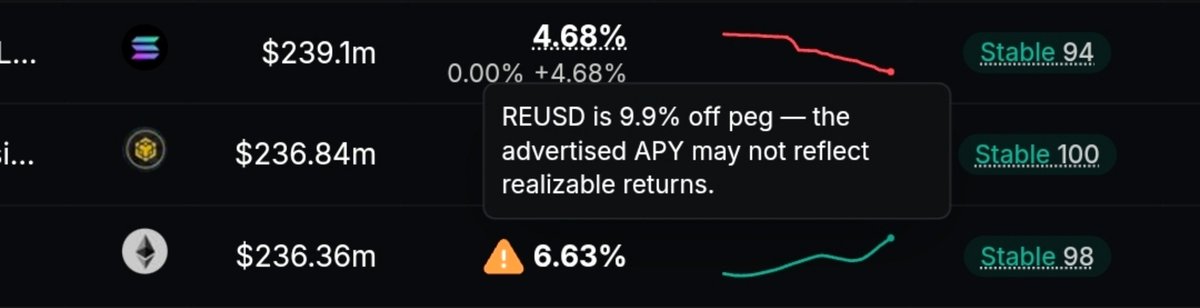
Not saying Re is broken. The real question is: why is $reUSD trading away for its $1 target, what does that mean for someone chasing the advertised APY?
That's the part I want to dig into.
6.63% APY looks attractive.
Then I saw this warning on DefiLlama: reUSD is 9.9% off peg.
If the asset trades ~10% away from $1, how much of that 6.63 yield is actually realizable