Stand With Crypto and over 200 organizations sent a simple message to Senate leadership: it's time for the Clarity Act.
The community is unified — large companies, startups, associations, and grassroots groups across the country are counting on their lawmakers to deliver rules of the road for crypto in America.
The Clarity Act passed the Senate Banking Committee with bipartisan support.
Now it needs to cross the finish line. Tell your Senators you want Clarity 👇
🌎 Green Week is here.
@Shift4 employees across 20+ countries are taking real action for the planet by volunteering, donating, and reducing their carbon footprint.
Learn more and get involved 👉
https://t.co/ZAtYg3SwTu
#GreenWeek
El sistema global fue diseñado para otra era. Podemos rediseñarlo?
En el próximo Logos Space vamos a conversar con @elchanguitoeth de @netxgenworld sobre:
𖤓 Economía regenerativa
𖤓 Pop-up cities
𖤓 Network states
𖤓 Instituciones nativas de internet
https://t.co/8Zf6NVvM80
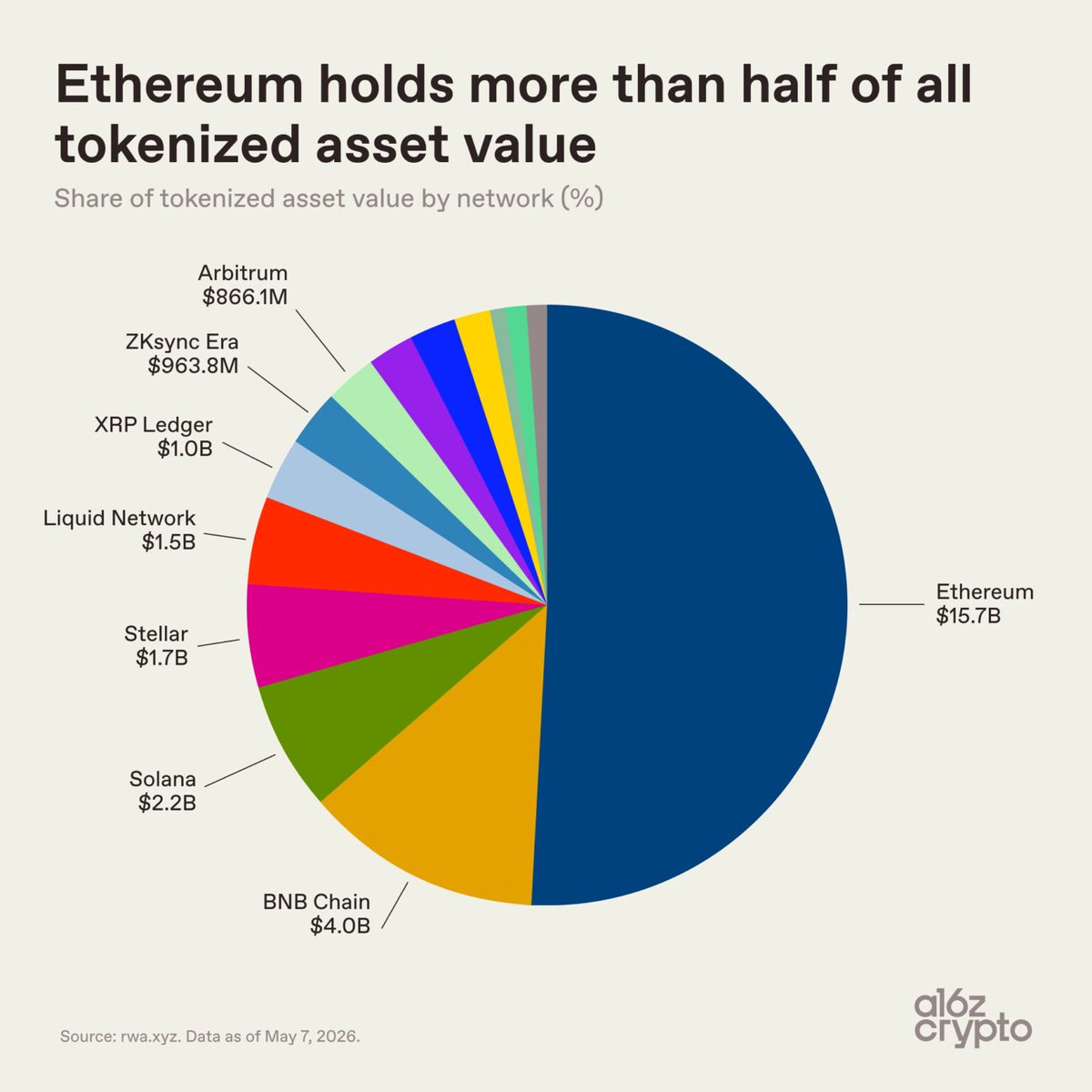
Ethereum still dominates tokenized assets, consistent with its headstart in DeFi and institutional adoption.
Ethereum: $15.7 billion
BNB Chain: $4B
Solana: $2.2B
Stellar: $1.7B
Liquid Network: $1.5B
XRP Ledger, ZKsync Era, Arbitrum: ~$1B each
Rather than converging around a single chain, tokenized assets are spreading across multiple blockchain ecosystems — given criteria like cost, liquidity, compliance requirements, and go-to-market relationships.
The tokenized asset market crossed $30 billion last month and has stayed there. Roughly the size of an elite university endowment.
As recently as mid-2024, it was below $3 billion. 10x in under two years.
What changed: the GENIUS Act, mature institutional onchain infrastructure, and a wave of financial institutions moving from pilots to production — all at roughly the same time.
Hold my beer 🍺
🇵🇦 Panama wants more tech companies.
More crypto.
More AI.
More founders.
More innovation.
To every builder tired of anti-tech governments and bureaucrats treating innovation like a crime:
🚀Come to Panama. We’ll roll out the red carpet.
Introducing Agent eXchange Layer (AXL) on Gensyn.
A peer-to-peer network node that provides encrypted, decentralised communication allowing agents, apps and ML pipelines to exchange data without a central server.
Read the docs: https://t.co/C447qa8H8f
From privacy breakthroughs to AI agents and institutional rails, the Ethereum ecosystem keeps shipping.
Here are 22 things the ecosystem delivered over the past few weeks.
0/ @gnosis_ and partners introduced The Ethereum Economic Zone (@etheconomiczone), a framework to unify the L1 and L2s into a more composable system with better interoperability.
1/ @aztecnetwork Alpha went live, a feature-complete privacy stack built natively on Ethereum.
2/ @aave V4 was released with a new hub-and-spoke architecture with support for over 20 assets across three initial liquidity hubs.
3/ @PrivacyEthereum released Social Recovery SDK, a wallet recovery model where trusted guardians can help restore access if the owner loses their private key, replacing seed-phrase backups with programmable onchain policy.
4/ Post-quantum wallets launched on @Starknet. A path to quantum resistance without address changes or hard forks.
5/ The @ethereumfndn's Board released the EF Mandate. This document, which was first intended for EF members, reaffirms the promise of Ethereum, and the role of EF within this ecosystem.
6/ Private transfers are live on @Scroll_ZKP. You can now send funds privately onchain, advancing default user protections and confidentiality.
7/ @base introduced Batches Cohort 003. 12 teams were selected from 1,100+ building across AI, DeFi, payments, and prediction markets, pushing forward OnchainApps.
8/ @ethereumfndn launched pq.ethereum (dot) org. Supporting coordination and research in post-quantum cryptography. Two breakthrough papers progressing research on PQ, with input from Ethereum researchers, were also released.
9/ Stablecoins on Ethereum hit a new ATH. Supply surpasses $180B, up 150% in 3 years, with ~60% market share globally, reinforcing Ethereum’s role in stablecoins and DeFi.
10/ @Morpho launched Morpho Agents (beta), allowing users to integrate lending into apps via natural language using AI agents and accelerating the convergence of DeFi and AI.
11/ @thedaofund deployed $1M+ via an Ethereum Security quadratic funding round hosted by @Giveth, funding work to strengthen security across the ecosystem.
12/ Deposit time from L1 to L2s and exchanges can now be as low as 13 seconds due to the new Fast Confirmation Rule (FCR). This new industry standard can be adopted by the ecosystem over the next few months.
13/ @hinkal_protocol launched Hinkal Pay, end-to-end confidential payments where sender, receiver, and amounts remain private.
14/ @peerxyz launched Peer Verify, allowing users to prove their identity, in a privacy-preserving way via ZK proofs.
15/ @ensdomains integrated with PayPal, allowing users to send funds cross-border using ENS names instead of addresses.
16/ @AskVenice shipped verifiable end-to-end encrypted AI, introducing privacy systems that can be externally audited and proven.
17/ @safe released Safenet (beta), a pre-execution security layer for Safe wallets that runs before transactions execute onchain.
18/ @SiloFinance launched Silo V3 for safer lending markets in DeFi. The team rebuilt core assumption behind lending so collateral does not need to be sold to keep markets solvent.
19/ @coinbase announced x402, an initiative to establish the x402 protocol as a universal standard for AI-driven payments, is moving under the Linux Foundation to ensure vendor-neutral, community-governed oversight of the protocol.
20/ @zksync introduced The Cari Network, a new platform to bring tokenized deposits onchain, developed alongside five regional banks and powered by ZKsync’s Prividium.
21/ @EthCC completed their 9th annual event in Cannes with attendees from across the industry. @ETHGlobal hit a milestone with their 300th event following ETHCC, continuing to support builders across the global ecosystem.
You want to get into investing but don't know where to start?
SheFi Investment Club is here for you ✨
We’re gathering to talk all things crypto investing, practical insights, and community learning with fellow SheFiers.
If you want to build confidence investing together, join us. 👇
🧠 The 60,000x figure is widely cited but the actual neuroscience is more interesting than the number.
Visual processing engages the primary visual cortex, the ventral stream for object recognition, and the dorsal stream for spatial processing simultaneously and in parallel. Text processing is sequential and serial, running through Broca's and Wernicke's areas one symbol at a time.
The real mechanism: the brain evolved for 300 million years responding to visual threat and opportunity before written language existed for roughly 5,000 years. Visual processing is hardwired at the architecture level. Reading is software installed on hardware that wasn't designed for it.
This is why a single image can activate an emotional response in 13 milliseconds faster than conscious awareness. You feel the picture before you know you've seen it .!
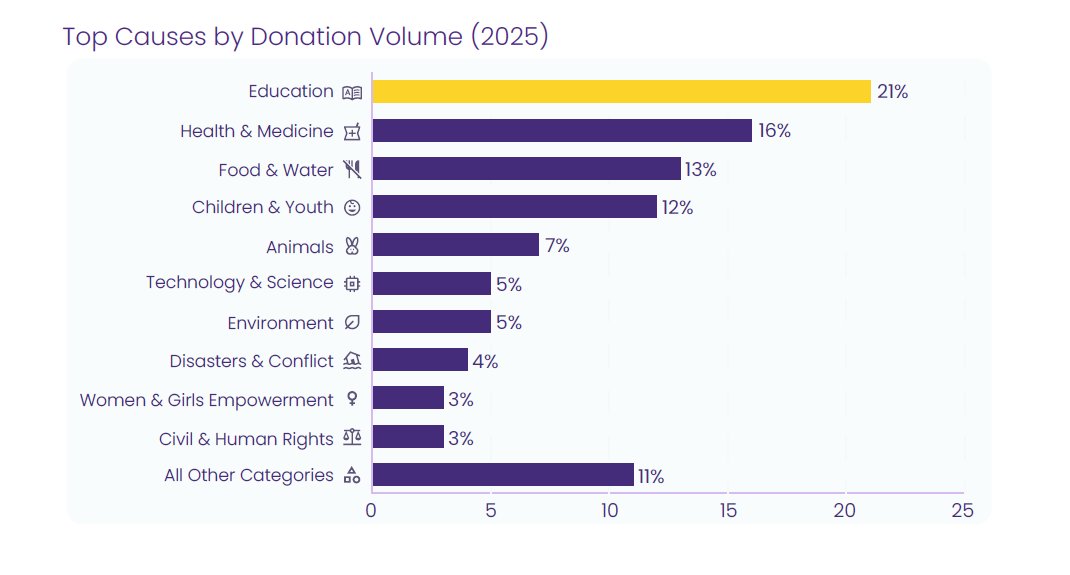
Where are Digital Donors making the biggest impact?
In 2025, Education, Health & Medicine, and Food & Water led the way.
These trends show how crypto donors are supporting essential services at a time of growing demand.
Read more in our 2026 Annual Report:
https://t.co/7euqsKvvvV
#DigitalFundraising