This is a sign of extreme fire behavior, with powerful updrafts launching chunks of tree bark several kilometres downwind.
Some are possibly being driven by fire-generated vortices.
Likely also going to see several spot fires downwind, as flaming embers land on dry vegetation.
#bcfire #bcstorm
BREAKING 🚨🚨
#Spokane / #Washington
Dramatic New Video from the Old Trails Fire in Spokane shows dozens of homes burnt to the ground, similar to what we saw in LA and Paradise. Eery feelings
*Warning graphic language*
I just got this video showing some of the damage in the Indian Trail area near the elementary school on West Weile. Still no official word on how many homes have been lost in the fires.
I’m very sorry for the families who’ve lost their homes.
🌪️ Thirty-nine years ago, almost to the day, a summer storm did far more than soak the ground. What happened on July 31, 1987 is still the deadliest day in Edmonton’s history.
The morning felt like any other summer day, hot and hazy, with holiday traffic already building for the long weekend. A low-pressure system had been dragging warm, humid air up from the south for days, and by early afternoon the sky had turned an unsettling shade of green, the air heavy and strange. Just before 3pm, a man on an acreage near Leduc became the first person to spot the funnel and call it in.
At 2:55pm the funnel touched down and started tracking north into the city, intensifying almost immediately into an F4, the second highest rating a tornado can receive, with winds reaching around 418 km/h. Some later analysis of the ground scarring even suggested pockets of F5 strength, though the official rating stayed at F4. It briefly weakened crossing the North Saskatchewan River, but the worst was still ahead.
It tore through southeast Mill Woods first, dropping hail up to ten centimetres wide, then cut through the industrial core of the city, passing directly between two operating oil refineries and narrowly missing a chemical plant, a power station, and a second trailer park entirely. Freight trains were derailed, one of them hauling hazardous materials, and vehicles were thrown through the air. By the time it reached Clareview in the northeast around 4pm and finally lifted, it had been on the ground just over an hour, cutting a path of destruction roughly 37 kilometres long.
The worst of it hit the Evergreen Mobile Home Park, where a two-block stretch of destruction killed 15 people and destroyed close to 200 homes, some trailers left piled three high on top of each other. It remains the single deadliest location anywhere along the tornado’s path.
Another 12 people died along Refinery Row, bringing the total to 27, though early reports that afternoon feared it could reach as high as 36. Hundreds more were hurt, and hundreds of families lost their homes entirely. Crews spent the next 24 hours searching collapsed buildings and wrecked vehicles for survivors, working through gas leaks, fires, and flooding the storm left behind.
Mayor Laurence Decore declared a state of emergency that evening, once the scale of it became clear. The Canadian Red Cross opened a relief centre for those displaced, with Canadian Forces members joining local crews in the cleanup. Total damage came to more than $332 million in 1987 dollars, close to $800 million today, making it one of the costliest natural disasters in the country’s history at the time.
It’s still the second deadliest tornado ever recorded in Canada, behind only the 1912 Regina Cyclone, which killed 28. As of the most recent count, it remains the deadliest and most destructive tornado Alberta has ever seen.
Black Friday exposed how little warning people actually had once the weather turned deadly, and it led directly to Alberta’s Emergency Public Warning System in 1992, the forerunner to today’s Alberta Emergency Alert. It reshaped how the country invested in severe weather radar and warning technology for decades after.
If you were here in 1987, or grew up hearing about it from someone who was, drop your memories in the comments.
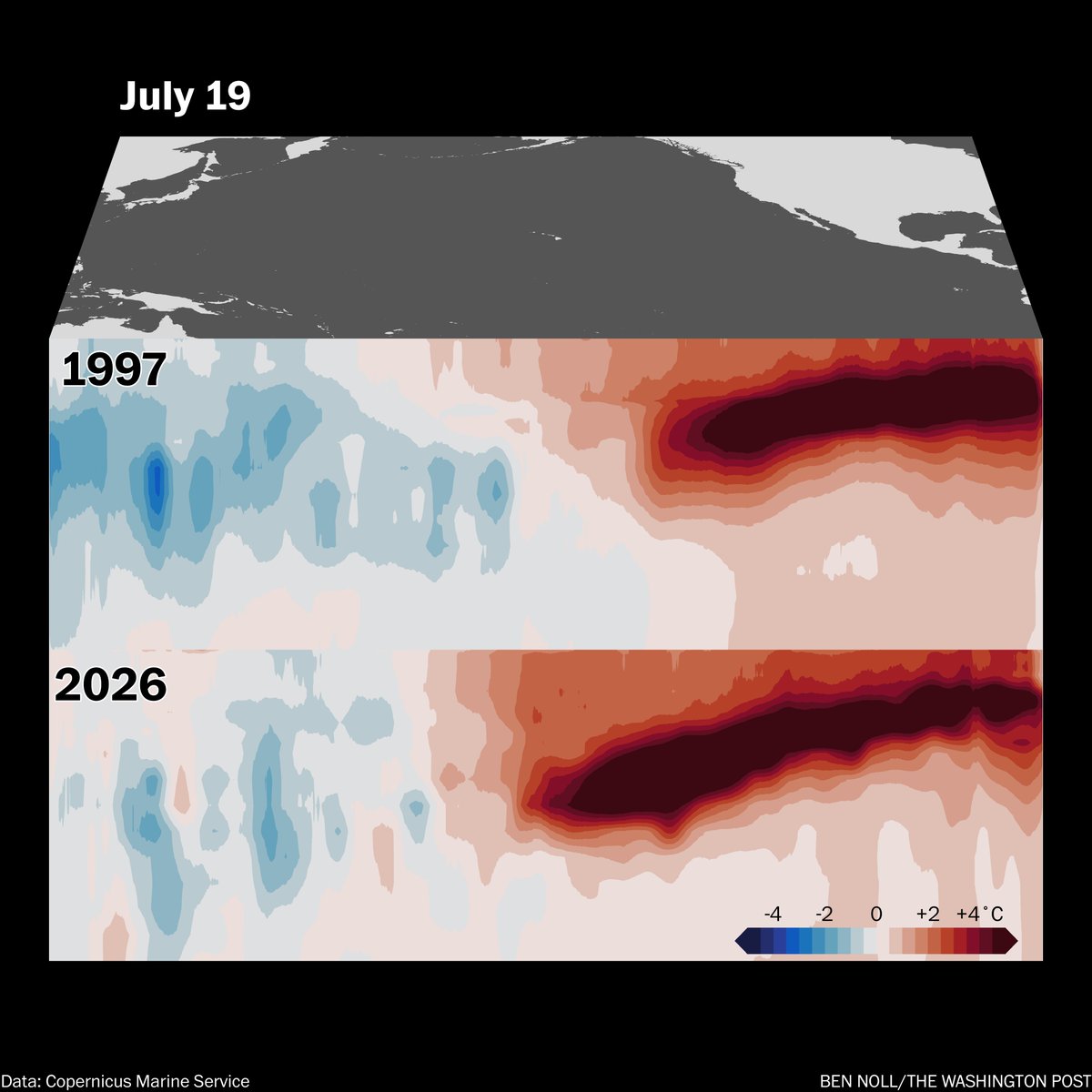
2026 and 1997 are El Niño twins, both featuring 8°C ocean temperature anomalies beneath the surface of the Pacific.
But they're not identical.
This year's El Niño is warmer across a wider region, meaning there's more heat in the tank and its impacts won't exactly mirror 1997.
Dozens of intense wildfires are burning tonight across Oregon, Washington, and British Columbia. Many thick smoke plumes and even pyrocumulus clouds, also known as “fire clouds”, can be seen on visible satellite imagery.
We shouldn’t lose our nerve.
We need to be strategic, not tactical; patient, not impulsive.
This latest attack, like all the attacks before it, are designed to flood the zone & destabilize Canada. But in fact the impact on Canada is modest.👇
Rushing into yet more concessions outside the framework of comprehensive negotiations would be to reward belligerence with weakness.
Panicked one-off concessions weaken, rather than strengthen our hand in the negotiations. USTR Jameson Grier has said as much publicly.
The American judiciary has demonstrated that it will not accept frivolous use of tariff powers. Our pro free trade allies in the US will challenge these new tariffs, and there is a high probability they will be struck down.
In just over 100 days, the President’s party will likely lose control of the House of Representatives.
Polls consistently show that a large majority of American voters oppose Trump’s tariffs, because they understand that consumers, not exporters, pay for them in higher prices.
As the midterms approach, the political focus on cost of living will dominate.
Time is on our side.
Marlon Brando once told Dick Cavett that everyone on Earth is an actor.
Then he proved it, live on air, by dissecting Cavett himself.
It remains one of the most disarming exchanges in talk show history.
Cavett opened by pressing Brando on something he had read for years: that Brando considered acting "not a fit profession for a man." Brando deflected at first. "We can't believe the press; I don't know what we can believe in this country."
But then, in his words, "in an effort to help your ratings," Brando laid out his real view of acting:
"I think that we couldn't survive a second if we weren't able to act; acting is a survival mechanism, a social lubricant, and we act to save our lives every day."
People lie constantly, he explained. By not saying what they think. By showing something they don't feel. By trying to give the appearance of feeling something they don't actually feel.
Cavett pushed back: "But that's not acting."
Brando disagreed:
"That is acting. When you're nervous or frightened in this chair, or distressed and angry, you know that is not what is necessary to be shown here, so you control your face. You're a highly controlled person and you have to do that."
Cavett argued there had to be gradations. He was motivated in the moment, but he couldn't wake up the next morning and repeat that same performance on command, take after take. Surely that skill, the thing Brando did better than almost anybody, was something different.
Brando refused the compliment. He pointed to the office worker who hates his boss but performs enthusiasm for his "impossible notions" day after day to keep his job.
Cavett countered that delivering the same line six times, getting "something deeper into it time after time," takes an actor. Everyday performances are one-time things with immediate motivation.
"No, they're not one-time things because it's a daily procedure," Brando replied. "The dialogue changes but the motivation doesn't."
Then came the moment the interview is remembered for. Brando turned the lens directly on his host:
"Right now, you're thinking of 60 things at once: 'Is it getting dull? Is he upset? Is he bored? Is he offended? Here's a good time for a joke.' You're doing this editing at an insane rate with a demeanor of levity and zest, and that finally isn't what goes on in your mind or feelings at all."
Cavett's response said everything:
"I just feel like all my clothes have been taken off."
Brando softened it. "I couldn't do what you do, and that's a different kind of acting; you're playing a different kind of role."
Cavett tried one final test. He handed Brando a commercial script and challenged him to read it, any way he wanted. Brando refused flatly: "No, I won't do it."
Cavett's closing line: "I'm glad you didn't. The man's incorruptible, and that's what I hoped."
Source: The Dick Cavett Show, interview with Marlon Brando (1973)