Years ago Snowbird — about 30 miles from SLC airport — put a billboard roughly 30 miles from Denver airport that basically said:
“If you had flown to Salt Lake, you’d already be at Snowbird.”
The billboard itself was still in Denver.
@haridigresses@gokulr Every new tech paradigm calls for generalists who can sift through the shifting chaos and get things done. Once things settle, we'll specialize again.
Introducing Claude Design by Anthropic Labs: make prototypes, slides, and one-pagers by talking to Claude.
Powered by Claude Opus 4.7, our most capable vision model. Available in research preview on the Pro, Max, Team, and Enterprise plans, rolling out throughout the day.
THE PARADOX OF LEVERAGE
The CEO of YC, @garrytan stayed up late this weekend vibecoding.
So did I, and so did thousands of other founders, engineers, and builders (and, frankly, insomniacs) because the gap between "idea" and "working product" has collapsed from years / months / weeks to hours.
This should (and does!) feel liberating. But honestly I've also felt some existential dread, because of the following events and reads over the last week.
1. All the foundation models will win
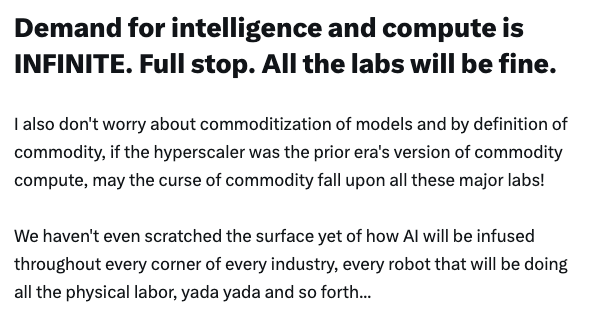
@EthanChoi7's excellent post last week, where he lays out why all the foundation model companies will win: OpenAI, Anthropic, xAI, Gemini.
The most consequential section (for me) was this one:
Ethan calls out (correctly) that we're still in the first innings.
While I (and others) have been celebrating all my superpowers with building, we're not paying attention to the fact that the capabilities are sprinting faster than we can keep up.
2. The value of knowledge workers is evaporating
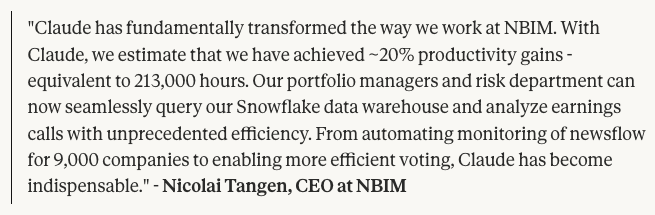
The Norwegian sovereign wealth fund published a case study where they deployed Anthropic to monitor their ~$1T AUM, with 9,000 companies, saving 213,000 analyst hours / year.
That's 100 full-time employees. Gone. Absorbed into the model. From one function, at one organization.
3. Clawdbot taking X by storm
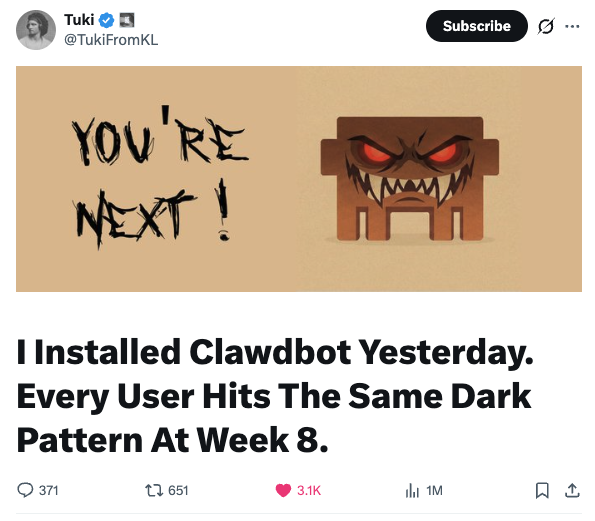
I'm yet to dig in and install it. In the meantime, I read this excellent post by @TukiFromKL, reminding us not to outsource our memory, our presence, and our life experience by overrelying on tooling like that.
4. @DarioAmodei's The Adolescence of Technology.
He reminde us that things are happening far faster than we're prepared for:
The years in front of us will be impossibly hard, asking more of us than we think we can give.
~10 days ago I told a friend that I think there's a non-trivial (though still <10% chance) of reaching the singularity in 2026. I think the probability is significantly higher in 2027. You can see direct traces of this possibility in Dario's post.
5. Software is eating the world, and the foundation models are eating software
In the last ~week, Anthropic has released released Claude Cowork, Claude for Excel, apps (whereby you can interface and export work to Figma, Box, Clay, etc. from inside Claude.
Anthropic is utterly taking over every single enterprise application.
In parallel, OpenAI is sprinting ahead on consumer apps (and enterprise, to a lesser extent than Anthropci), eating one startup at a time.
6. Months of work in days
My wife and I did months' worth of work (for a 2020 startup) in a few hours on Sunday — a personal finance / portfolio management app with recursive querying, temporal data storage, external data integrations, the works.
————
The paradox and dilemma as a builder
I have never had more leverage. And yet I've never had less clarity on what will survive the next 5 years.
Because if the models keep compounding at this rate, what moat actually exists? What's durable? What won't get absorbed into OpenAI or Anthropic or Gemini's next release?
Paul Atreides, after drinking the Water of Life, describes the feeling of seeing the time-matrix for the first time: standing on shifting sands where even a single grain can cause landslides. He observes "not moving is a choice."
I think that's where I am. It's where all founders of companies <$1M in ARR are. It's where most founders <$100M ARR are — even if they won't say it publicly.
So where does that leave us?
I think the only edge left is action, momentum, agency.
The old startup playbook was: find a problem, build a solution, iterate until PMF. The new playbook might be: build fast, stay close to the frontier, and accept that the ground beneath you is moving faster than your roadmap.
I say "might be", because I don't even have conviction in this. But the alternative is watching from the sidelines while the world rewrites itself.
I will not give into the quiet desperation. There is no choice but to build.
Thanks to Opus 4.5 for helping write parts of this post, and Barbara Pascetta for the discussion that sparked it + the Dune reference.
A few random notes from claude coding quite a bit last few weeks.
Coding workflow. Given the latest lift in LLM coding capability, like many others I rapidly went from about 80% manual+autocomplete coding and 20% agents in November to 80% agent coding and 20% edits+touchups in December. i.e. I really am mostly programming in English now, a bit sheepishly telling the LLM what code to write... in words. It hurts the ego a bit but the power to operate over software in large "code actions" is just too net useful, especially once you adapt to it, configure it, learn to use it, and wrap your head around what it can and cannot do. This is easily the biggest change to my basic coding workflow in ~2 decades of programming and it happened over the course of a few weeks. I'd expect something similar to be happening to well into double digit percent of engineers out there, while the awareness of it in the general population feels well into low single digit percent.
IDEs/agent swarms/fallability. Both the "no need for IDE anymore" hype and the "agent swarm" hype is imo too much for right now. The models definitely still make mistakes and if you have any code you actually care about I would watch them like a hawk, in a nice large IDE on the side. The mistakes have changed a lot - they are not simple syntax errors anymore, they are subtle conceptual errors that a slightly sloppy, hasty junior dev might do. The most common category is that the models make wrong assumptions on your behalf and just run along with them without checking. They also don't manage their confusion, they don't seek clarifications, they don't surface inconsistencies, they don't present tradeoffs, they don't push back when they should, and they are still a little too sycophantic. Things get better in plan mode, but there is some need for a lightweight inline plan mode. They also really like to overcomplicate code and APIs, they bloat abstractions, they don't clean up dead code after themselves, etc. They will implement an inefficient, bloated, brittle construction over 1000 lines of code and it's up to you to be like "umm couldn't you just do this instead?" and they will be like "of course!" and immediately cut it down to 100 lines. They still sometimes change/remove comments and code they don't like or don't sufficiently understand as side effects, even if it is orthogonal to the task at hand. All of this happens despite a few simple attempts to fix it via instructions in CLAUDE . md. Despite all these issues, it is still a net huge improvement and it's very difficult to imagine going back to manual coding. TLDR everyone has their developing flow, my current is a small few CC sessions on the left in ghostty windows/tabs and an IDE on the right for viewing the code + manual edits.
Tenacity. It's so interesting to watch an agent relentlessly work at something. They never get tired, they never get demoralized, they just keep going and trying things where a person would have given up long ago to fight another day. It's a "feel the AGI" moment to watch it struggle with something for a long time just to come out victorious 30 minutes later. You realize that stamina is a core bottleneck to work and that with LLMs in hand it has been dramatically increased.
Speedups. It's not clear how to measure the "speedup" of LLM assistance. Certainly I feel net way faster at what I was going to do, but the main effect is that I do a lot more than I was going to do because 1) I can code up all kinds of things that just wouldn't have been worth coding before and 2) I can approach code that I couldn't work on before because of knowledge/skill issue. So certainly it's speedup, but it's possibly a lot more an expansion.
Leverage. LLMs are exceptionally good at looping until they meet specific goals and this is where most of the "feel the AGI" magic is to be found. Don't tell it what to do, give it success criteria and watch it go. Get it to write tests first and then pass them. Put it in the loop with a browser MCP. Write the naive algorithm that is very likely correct first, then ask it to optimize it while preserving correctness. Change your approach from imperative to declarative to get the agents looping longer and gain leverage.
Fun. I didn't anticipate that with agents programming feels *more* fun because a lot of the fill in the blanks drudgery is removed and what remains is the creative part. I also feel less blocked/stuck (which is not fun) and I experience a lot more courage because there's almost always a way to work hand in hand with it to make some positive progress. I have seen the opposite sentiment from other people too; LLM coding will split up engineers based on those who primarily liked coding and those who primarily liked building.
Atrophy. I've already noticed that I am slowly starting to atrophy my ability to write code manually. Generation (writing code) and discrimination (reading code) are different capabilities in the brain. Largely due to all the little mostly syntactic details involved in programming, you can review code just fine even if you struggle to write it.
Slopacolypse. I am bracing for 2026 as the year of the slopacolypse across all of github, substack, arxiv, X/instagram, and generally all digital media. We're also going to see a lot more AI hype productivity theater (is that even possible?), on the side of actual, real improvements.
Questions. A few of the questions on my mind:
- What happens to the "10X engineer" - the ratio of productivity between the mean and the max engineer? It's quite possible that this grows *a lot*.
- Armed with LLMs, do generalists increasingly outperform specialists? LLMs are a lot better at fill in the blanks (the micro) than grand strategy (the macro).
- What does LLM coding feel like in the future? Is it like playing StarCraft? Playing Factorio? Playing music?
- How much of society is bottlenecked by digital knowledge work?
TLDR Where does this leave us? LLM agent capabilities (Claude & Codex especially) have crossed some kind of threshold of coherence around December 2025 and caused a phase shift in software engineering and closely related. The intelligence part suddenly feels quite a bit ahead of all the rest of it - integrations (tools, knowledge), the necessity for new organizational workflows, processes, diffusion more generally. 2026 is going to be a high energy year as the industry metabolizes the new capability.
The correct term for "vibecoding" now is simply "coding".
What used to be called "coding" is now "handcoding".
It's been trending in this direction but we crossed the tipping point in the last few weeks.
@haridigresses absolutely. anyone playing the one-shot prompt game is on shaky ground. you need people to wire their brains to your proprietary workflow like a powertool.
Introducing Llama 3.3 – a new 70B model that delivers the performance of our 405B model but is easier & more cost-efficient to run. By leveraging the latest advancements in post-training techniques including online preference optimization, this model improves core performance at a significantly lower cost, making it even more accessible to the entire open source community 🔥
https://t.co/1dmCkFdVxQ
Hi folks! We're hiring for 2 critical roles on the founding team at Autograph.
- founding GTM Lead
- founding Principal Engineer
Breakdown of each role below, along with a link to our careers page!
@nikitabier How much of that spend is palliative vs attempted life saving measures?
Life saving measures would be lumped in with other attempts that succeeded.
🚨 New paper in @NatureComms 🚨
We created deepfakes of the current & former @POTUS giving speeches (w/ voices from voice actors & @elevenlabs) to study what drives how well people can tell fake speeches from real ones
Time to update the "Seeing is Believing" narrative
👇