🧠Check out our latest paper (from @cathnaledi's lab, co-first-authored by @OrlaBonBon & @kirashaw). We show vascular changes in awake APOE4 mice are mild vs earlier studies with big blood flow deficits. Read the thread below to see why we think responses were mainly preserved🧵:
I’m delighted to announce the lovely @orlabonbon and @kirashaw 's paper is out in @_jcbfm
https://t.co/LNTvyCPmuu
Haven’t got time to read it right now? Here’s a 🧵 to summarise it! 1/11
Our paper is out!
https://t.co/k0IMgPxQMe
With genetic Ca2+ clamping and chemogenetic activation of astrocytes, we show that astrocytes enhance neurovascular coupling when neuronal activation is sustained but not when activation is brief.
I’ve made this video as an intuition pump for the density of #synapses in the #brain. This volume ~ grain of sand, has >3.2 million synapses (orange cubes). Peeling them away leaves only inputs on 2 #neurons. Zooming in, we see the synapses localized to the dendritic spines.
#b3d
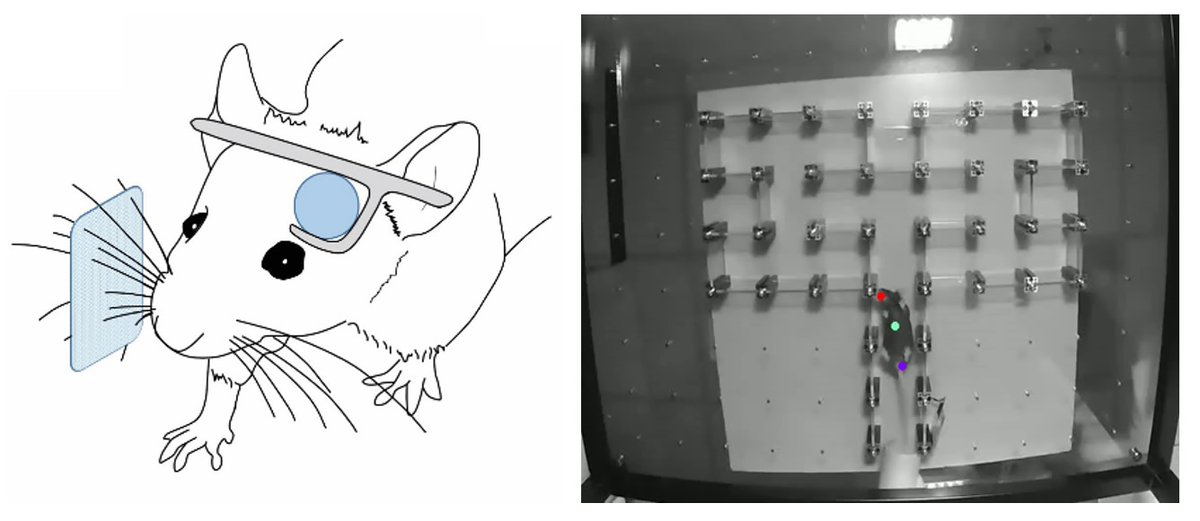
New postdoc in my lab funded by BBSRC! Project will investigate behaviour and neuronal responses in mice performing goal-directed tasks guided by whisker input, either in head-fixed configuration combined with two-photon imaging, or in a novel freely-exploring configuration
Our #LongCOVID mechanisms, risk factors and recovery review is out! It follows on from the @physoc online conference of the same name earlier in the year. Hats of to all the amazing contributors ... https://t.co/hcvE3d73de
Grear talk by @cathnaledi at the ECSS @OfficialUoM on the differences between visual cortex and hippocampus in neurovascular function and implications for disease.
Hippocampus seem to be more prone and sensitive to hypoxia, which might be relevant for the development of AD.
You can now apply for my PhD project with @DgnLab looking at how microglia respond to hypoxia! Details here: https://t.co/VkLDZj2S3A and apply here: https://t.co/gMwO0pnVYi Please get in touch if you’re interested, address here https://t.co/LhthaleV6D
Exciting news! I’m recruiting a PhD student to find out what happens to microglia when the brain’s oxygen levels fall. It’s a very cool project working with me and the excellent @DgnLab - in vivo imaging and omics! Get in touch if you’re interested or know someone who might be!!
It was the best experience ever! @AlzResearchUK's cheer and support was unmatched. I can't wait to take on the next challenge. 🥰
Also, it's not too late to donate. This is the link: https://t.co/RNUkPXr2fo
Next Sunday I am running the London marathon and I'm fundraising for @AlzResearchUK. Check out my @JustGiving page and please donate if you can. Thank you! #JustGiving https://t.co/C70EteHW1m
🌟#BNA2023 REGISTRATION & ABSTRACT SUBMISSION opens TOMORROW!
🏖️Don't miss out on the #neuroscience event of 2023: take your first look at the international programme & get ready to book your spot at the seaside!
🧠Programme here: https://t.co/SeZHgR6kjC
🚨 Happy to launch a new Research Topic in Frontiers in Aging Neuroscience! 😃
👇🏻👇🏻👇🏻👇🏻👇🏻👇🏻
Imaging of the blood-brain barrier in Alzheimer's disease and related disorders https://t.co/qYlFw3SbhF
Feel free to reach out if interested and please RT 🙏🏻
Echoing a 4-year (?!) old tweet that still resonates; mine & @Alex_C_Stuart’s new review (https://t.co/qOIQbCPWt4), out in @EJNeuroscience, agrees ApoE does literally everything and suggests a novel multi-hit hypothesis of APOE4 mediated pathology … a thread
(1/14)
Out today!
Check out our paper to learn that neurovascular function and mural cell types down the cerebrovascular network change gradually, therefore indicating that there is not a clear boundary between arteriole and capillaries.
https://t.co/hPNulCiTD2
Thanks @BrainEnergyLab@DrMattHHaley@AnderleSilvia@kirashaw and everyone else, including Davina Amin, who took the first images for this paper too many years ago. Sorry it's taken so long to put it all together!
Check out our lab's latest paper!
We used novel and existing data to show that there is a gradual change in vascular function and mural cell population across the vascular network, indicating that there isn't a clear boundary between arterioles and capillaries.
New paper! We use new and existing data to show gradual change in mural cell and vascular function across cerebrovascular network, not clear arteriole/capillary boundaries
https://t.co/xeBr5XsziG
Thanks @AndyShih_Lab & @cai_changsi for such constructive review. Key findings:🧵